A 400 MW utility-scale solar plant in the southwestern United States covers 2,100 acres: 1,600 acres of single-axis tracking arrays, 28 miles of gravel access roads, a 25-acre substation yard, two O&M buildings with a combined 22,000 square feet of interior space, and a visitor center that hosted 14,000 schoolchildren and tour groups last year. The plant's O&M contractor runs a team of 34 — 26 electrical and inverter technicians, 4 SCADA and controls engineers, and just 4 general workers who are responsible for everything else: sweeping dust off access roads before delivery trucks arrive, clearing wind-blown debris from array corridors, keeping the substation yard presentable for quarterly insurer inspections, and cleaning both O&M buildings. A time study the contractor conducted in 2025 found that general workers spent 68% of their shift on grounds and interior cleaning — work that has nothing to do with the electrical expertise the contract pays for, and that pulls the same four people away from module washing coordination, torque checks and vegetation management.
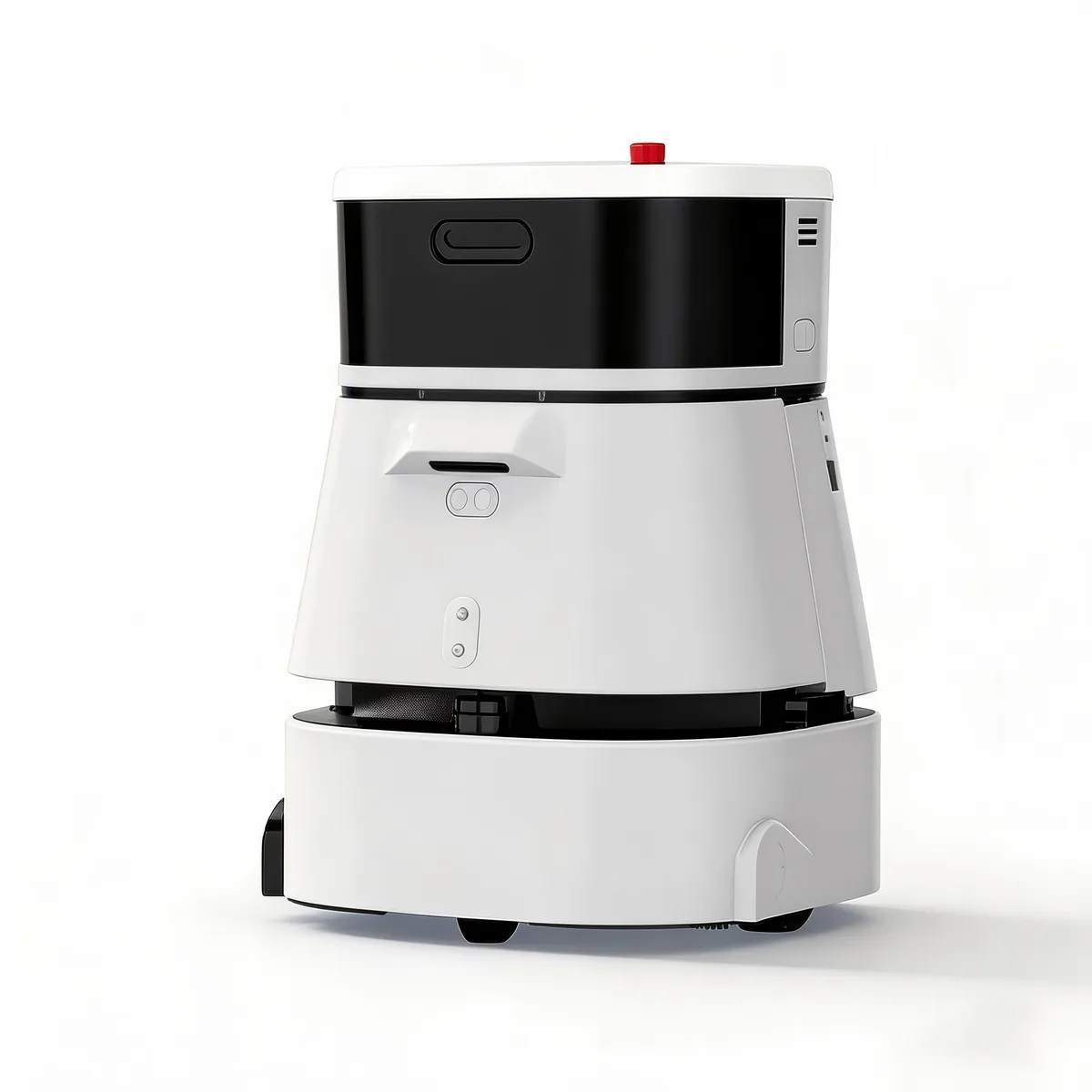
In Q1 2026 the plant deployed CLEINBOT CC201 outdoor sweepers across the access road network and substation yard, CLEINBOT M79 floor scrubbers inside the O&M buildings, and a CRUZR humanoid concierge robot at the visitor center. The operations manager's summary after five months: "The technicians stopped competing with dust for their own time, and the site went from a quarterly inspection scramble to a continuous presentation standard."

The Grounds Maintenance Gap: 15-25% of O&M Hours Spent Off the Electrical Scope
Utility-scale solar O&M contracts are priced and staffed around electrical scope: inverter replacement, tracker maintenance, string testing, module washing and vegetation management. Grounds maintenance is the un-budgeted category that quietly consumes the largest share of general-worker time. The Solar Energy Industries Association (SEIA) operations and maintenance benchmarks show that at plants above 100 MW, non-electrical facility tasks — access road grading and sweeping, panel corridor clearing, substation and parking lot cleaning — account for 15-25% of total O&M labor hours, and the share rises at sites in arid or windy regions where dust deposition is severe. For the 400 MW plant above, that is the equivalent of 5-8 full-time positions dedicated to tasks with zero impact on energy yield.
The cost structure makes the case for automation unusually clean. A general worker at a utility-scale solar site costs $52,000-68,000 per year in loaded labor, and sweeping one mile of gravel access road by hand with a push broom and blower consumes 6-8 person-hours. The same mile with a CC201 outdoor sweeper running at 0.5-1.5 m/s takes about 40 minutes of unattended operation. The outdoor autonomous cleaning deployment guide documents the same economics at campuses and industrial parks: autonomous sweepers deliver 4-6x the swept area per labor hour of manual crews, with the additional benefit of consistency — the route is swept every scheduled cycle, not when someone gets to it.
Panel Array Corridors: Dust Management Where Technicians Actually Work
The most under-appreciated cleaning problem at a PV plant is not the panels — it is the corridors between them. Single-axis trackers rotate throughout the day, and the rows sit close enough that a technician's work corridor is only 3-4 meters wide. Wind-blown sand and debris accumulate in these corridors, and during rain events the packed dust turns to mud that dries into a hardened crust. Technicians performing string testing, connector inspections and torque checks must work in these corridors, and an unmaintained corridor can add 20-30 minutes of prep time per work order across a 40-row block.
CC201's configuration is built for this environment. The IP67-rated enclosure and UV-stabilized body panels handle the two things that destroy consumer-grade equipment on solar sites: water ingress during irrigation and rain, and years of direct sun exposure. Its operating range of -10°C to 50°C covers the full seasonal envelope of most US utility-scale sites, and the LiDAR + IMU fusion navigation holds a precise sweeping line along tracker rows without drifting into the panel faces. The 800L auto-emptying station means the sweeper runs its full shift without a single manual dust-bin exchange — the operator empties the station weekly instead of the sweeper every 45 minutes. The 180° obstacle detection from LiDAR and ultrasonic sensors automatically slows the machine near pedestrians, which matters in corridors where technicians kneel to inspect tracker motors. This is the same safety and compliance framework that governs autonomous mobile robots sharing space with workers in manufacturing and industrial automation — ISO 3691-4 applies to the CC201 on a solar site exactly as it does on a factory floor.
The O&M Building: Control Rooms, Warehouses and the 45-Minute Cleaning Window
The interior of a modern solar O&M building contains three distinct zones with different cleaning demands. The control room and SCADA room must be cleaned without dust disturbance — technicians monitoring 400 MW of generation from a single desk cannot have a blower-driven cleaning crew stirring particulates into server racks. The parts warehouse and inverter workshop accumulate cardboard, cable offcuts and dust from grinding work. The office and break areas need daily turnover cleaning like any commercial space.
CLEINBOT M79 handles all three zones with one machine. Its scrub, vacuum and mop single-pass operation at 500-800 m²/h cleans a 4,000-square-foot O&M building in under an hour, and the adjustable water output (0-300 mL/min) lets operators dial the moisture down to near-dry in the control room and up to full scrub in the workshop.
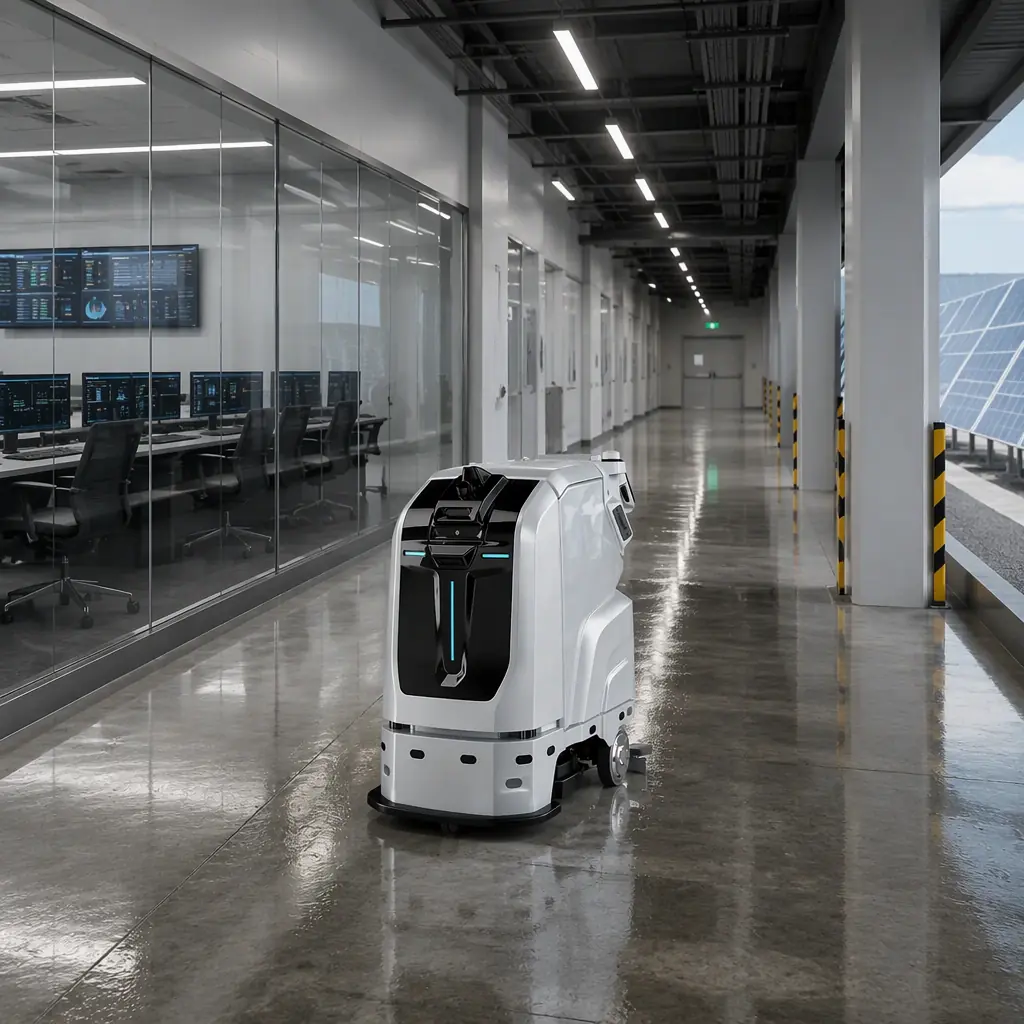
The critical specification for a live operations environment is noise: M79 operates at approximately 58 dB(A) in quiet mode — comparable to a normal conversation — which lets it run through the control room corridor while SCADA engineers are on shift calls. The 45L water tank provides about 45 minutes of continuous active cleaning, and auto-return docking with automated water exchange means the robot self-services between scheduled tasks. The same fleet management systems that coordinate robots across multi-site deployments schedule the M79 around the site's shift patterns — cleaning the control room before the morning shift, the workshop after the technicians leave.
Visitor Centers: The Public Face of a Private Infrastructure Asset
Utility-scale renewable sites have discovered that public tours are not optional outreach — they are increasingly a permitting and community-relations requirement. The 400 MW plant above hosts 14,000 visitors a year, and most utility-scale developers now staff visitor centers with at least one full-time guide. The visitor center creates a staffing paradox: the site needs reception coverage exactly when the O&M team is busiest, and tour groups arrive in waves that overwhelm a single guide at peak.
CRUZR's humanoid form factor — RGB-D cameras with 0.3-second face recognition, 7-category emotion detection and configurable voice persona — handles the routine 80% of visitor center work: greeting arriving groups, running the check-in queue, answering the three most common questions (bathrooms, tour start time, gift shop) and delivering the orientation spiel on loop while the human guide handles the deep-dive Q&A with engineers' groups and school chaperones. The reception and concierge deployment model documents the same split at corporate lobbies: the robot absorbs the repetitive information layer, the human handles the exceptions. For wind farms and substations, which typically have no visitor center staff at all, a CRUZR unit in the lobby of the O&M building provides the same greeting capability that banks and financial institutions use for branch lobbies.

Weather Resilience: The Specification That Separates Solar Site Robots from Campus Robots
The single biggest procurement mistake at renewable energy facilities is buying commercial campus robots for industrial outdoor sites. A solar plant in the desert Southwest sees 300+ days of direct sun, dust storms that deposit 2-3 mm of silt overnight, and seasonal monsoon rain that turns access roads to mud. A campus sweeper with an IP54 rating and a plastic body will fail within one season. The procurement bar for renewable sites is: IP67-rated enclosure, UV-stabilized materials, operating range covering the site's seasonal temperature envelope, and a charging/emptying station that can live outdoors or in a shaded equipment shelter.
The maintenance economics follow from the spec. The maintenance and TCO guide breaks down the difference: an IP67 outdoor robot with brush deck inspection intervals at 500 operating hours and full service at 2,000 hours runs roughly $0.08-0.12 per swept hour in maintenance cost — versus $0.30-0.50 for a consumer-grade unit that needs component replacement every season. Sites that deploy a mixed fleet (CC201 outdoors, M79 indoors) consolidate service into a single visit, the same fleet-level approach documented in service robot maintenance planning.
Deployment Roadmap: Phasing the Renewable Site Robot Fleet
The plants that succeed with robot deployment follow a four-phase sequence. Phase 1 — grounds proof: deploy one CC201 on the highest-traffic access road and substation yard, run it for 90 days, and measure swept area per week against the baseline manual hours. Phase 2 — corridor expansion: add CC201 routes through panel array corridors on a night schedule (arrays are static after dark, and the site is empty of technicians). Phase 3 — indoor coverage: bring in the M79 for O&M buildings, scheduled around shift patterns. Phase 4 — public face: add CRUZR at the visitor center or O&M lobby once the operations team is comfortable with the fleet.
Financing follows the same phased logic. Solar O&M contracts are multi-year agreements with predictable budgets, which makes them natural fits for RaaS and subscription models — the budget planning framework shows how a $1,200-1,800/month all-in subscription per robot maps to the labor it displaces. The vendor evaluation framework is directly applicable: renewable site buyers should score vendors on IP rating, operating temperature range, auto-emptying station capacity and fleet management software — not on marketing materials. And the change management playbook covers the specific dynamic at renewable sites: general workers initially view the sweeper as a threat to their positions, then discover that the robots absorb the dust work and the staff training and certification guide turns two general workers into the site's robot operators — the same career shift that played out in industrial laundry facilities and petrochemical plants.
The renewable energy industry built the largest outdoor infrastructure of the century and staffed it like a construction site. The operators winning the O&M margin war in 2026 are the ones treating grounds maintenance as an automation problem rather than a labor problem — sweepers that run while the sun is down, scrubbers that keep control rooms clean without disturbing a single shift call, and concierges that greet a thousand schoolchildren a month without adding a single hire. That is the difference between an asset that generates power and an asset that generates power and looks like a business.