A Tier-1 aerostructures plant in the Dallas–Fort Worth metro runs three assembly halls covering 210,000 sq ft, with 62 mechanics, machinists and assembly technicians supporting two narrowbody aircraft programs. A time study the plant ran in late 2025 found its skilled crew walked an average of 2.8 km per shift — not between aircraft, but to the tool crib and back: consumables, torque tools, sealants, fasteners and rework kits. At a loaded rate of $38–52/hour for certified aerospace labor, those walks consumed an estimated 11,400 hours a year across the floor. The plant's FOD program, meanwhile, required two full-time floor walkers and a documented daily inspection, and its ITAR compliance officer logged 400+ visitor escorts in the previous twelve months — each one pulling a trained employee away from production for an average of 47 minutes.
The plant is not unusual. Aerospace and defense manufacturing is the rare industry where the cost of walking a skilled worker, the cost of a single piece of debris, and the cost of an unescorted visitor are all quantified in the same document: the AS9100 quality manual. That is why service robots have moved from the factory floor experiment to the deployment plan in this sector — not as machine tools, but as the logistics, floor-care and access-control layer underneath the skilled workforce. The manufacturing service robot guide covers the general factory pattern; this guide covers the aerospace-specific version, where compliance documentation is as important as the movement itself.
The Tool Crib Tax: Where Delivery Robots Pay First in Aerospace
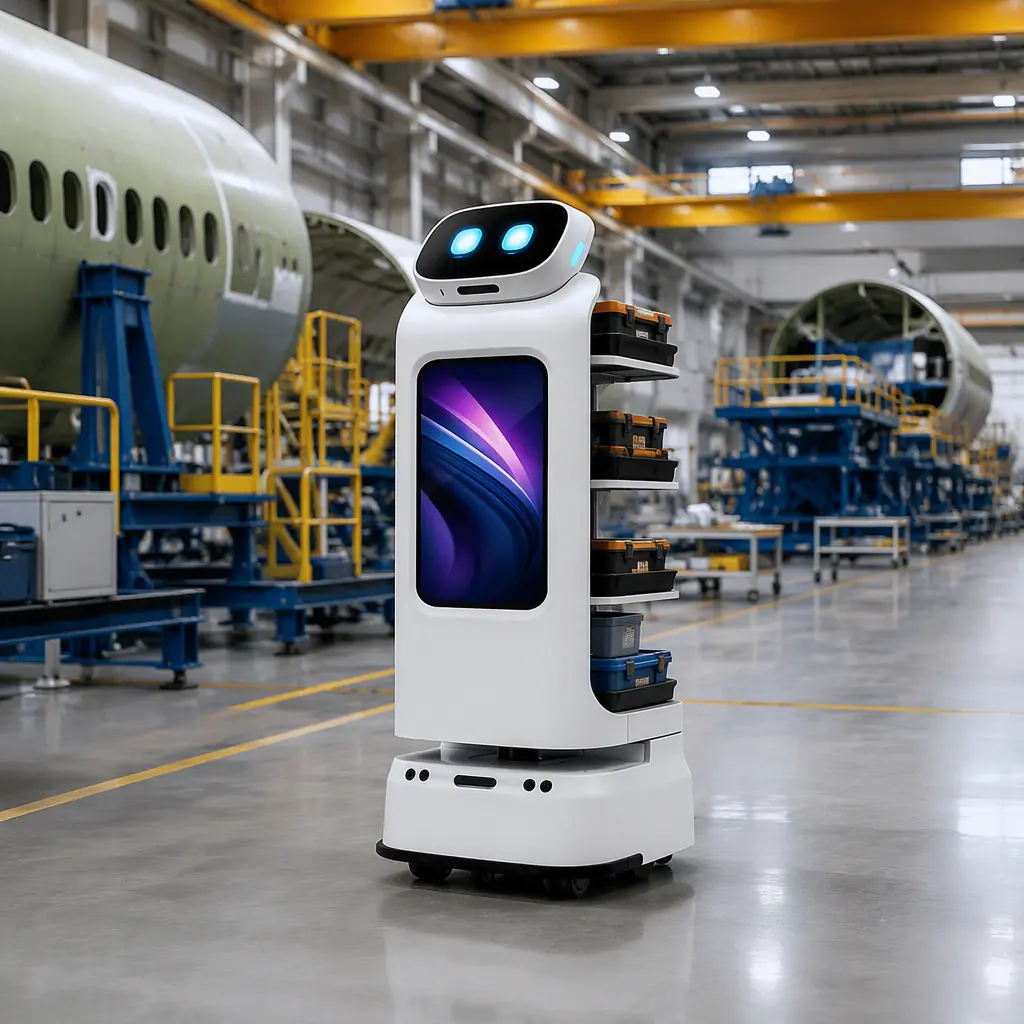
The tool crib is the highest-traffic point in any aerospace plant, and every trip between a workstation and the crib is a licensed skill walking. The Dallas plant's 2.8 km/shift figure breaks down to roughly 23 crib trips per day per crew member, and the trips are not uniform: torque tools move in calibrated cases, sealants move in cold packs, and rework kits move on demand with a 20-minute service-level expectation.
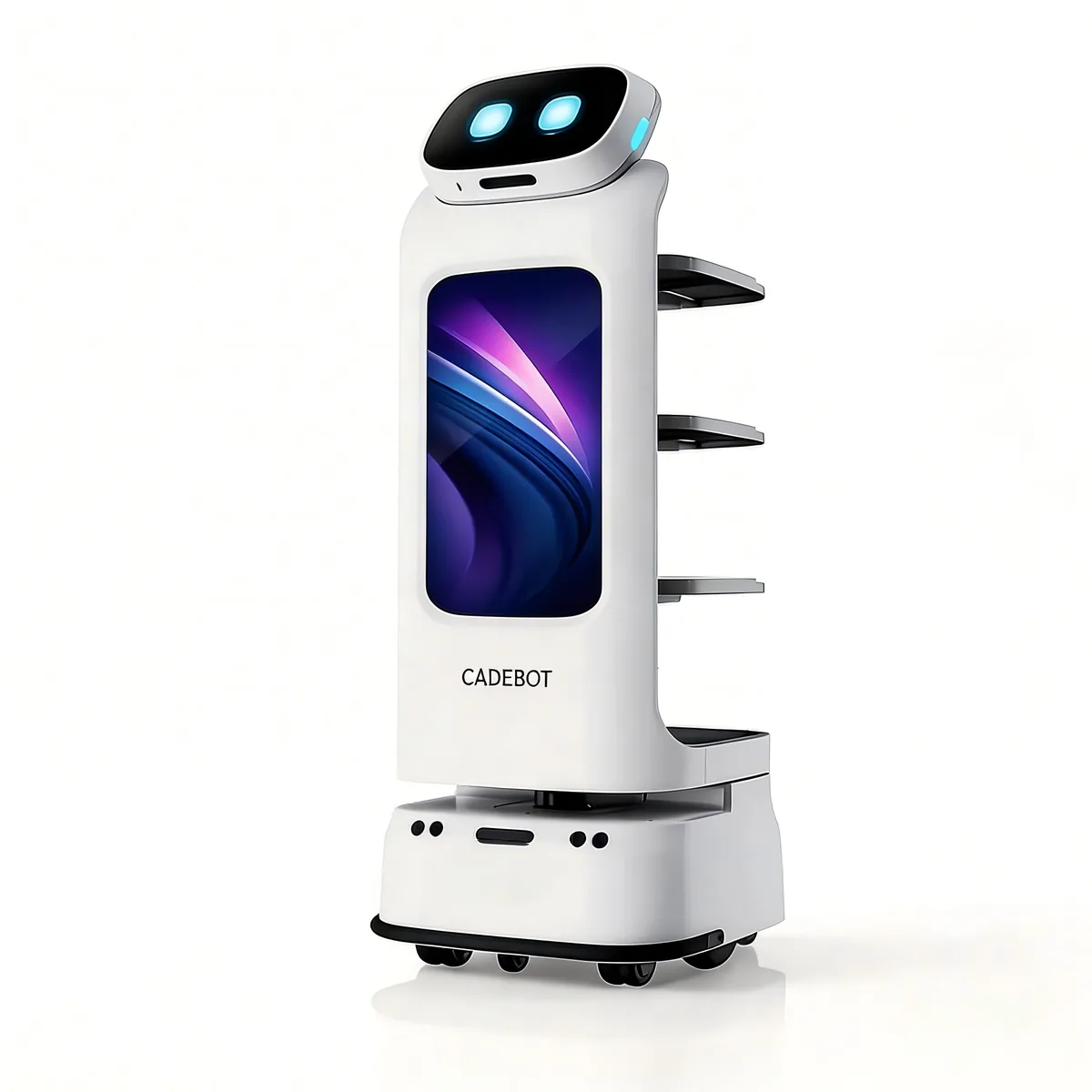
Autonomous delivery robots absorb this movement without changing the crib's control discipline. The CADEBOT L100 with four open tray shelves carries kitted tooling sets and consumables between the crib and assembly stations, while the AOMAN DOUBLE 70L handles the heavier flow — bulk fasteners, sealant cartridges, and the 15 kg in-cabin load that covers most aerospace line-side kits. The robots follow the same route logic documented in the delivery robot selection guide, with one aerospace-specific addition: every delivery is logged, which converts the robot from a labor-saving device into an evidence source. The AMR vs AGV guide covers why self-navigating robots matter here — an AGV's fixed tape path becomes a compliance problem the day the line layout changes, while an AMR re-maps a reorganized assembly hall in under an hour.
The economics follow the pattern quantified in the pharmacy guide: one delivery robot at $1,300–1,900 per month under a RaaS subscription replaces roughly 90 minutes of walking per shift per station cluster — about 380 hours a year per cluster at $40+/hour, which is $15,000+ of skilled labor returned per cluster. A four-robot deployment across three halls pays for itself before the first AS9100 surveillance audit.
FOD Prevention Is a Floor-Care Problem
Foreign object debris — a dropped washer, a broken drill bit, a scrap of aluminum swarf — is the aerospace industry's most expensive failure mode, and it is a floor problem before it is an airworthiness problem. FOD programs in production plants run daily documented floor sweeps, and the classic failure is not the sweep itself but the gap between sweeps: a 1,000 m² assembly bay that gets inspected at 06:00 can collect debris from 14 hours of machining and assembly before the next documented pass.
The floor-scrubbing robot converts FOD control from a discrete event into a continuous program. The CLEINBOT M79 scrubber runs single-pass scrub, vacuum and mop at up to 2,000 m²/h — a 1,000 m² bay in about 30 minutes — with adjustable water output for the transition from epoxy-sealed assembly floors to machine-shop areas, and a 45L tank with auto-return docking that lets it run between shifts without a dedicated operator. The commercial cleaning robot buyers guide covers the specification comparison; the aerospace-specific point is documentation. Every cleaning pass is timestamped and stored, which means the FOD program's "floor status at 14:00" question has a machine-generated answer instead of a clipboard estimate — the same evidence logic the safety standards guide documents for compliance-driven industries.

Controlled-Area Visitor Escort: CRUZR at the Security Boundary
ITAR- and EAR-controlled facilities carry an escort obligation that most manufacturing automation never touches: every visitor, every contractor, every auditor must be registered, badged, escorted and logged, and the escort must be a cleared employee whose time is now unavailable to production. The Dallas plant's 47-minute average escort cost, at cleared-employee rates, is roughly $36 per visit — and the visits number in the hundreds per year.
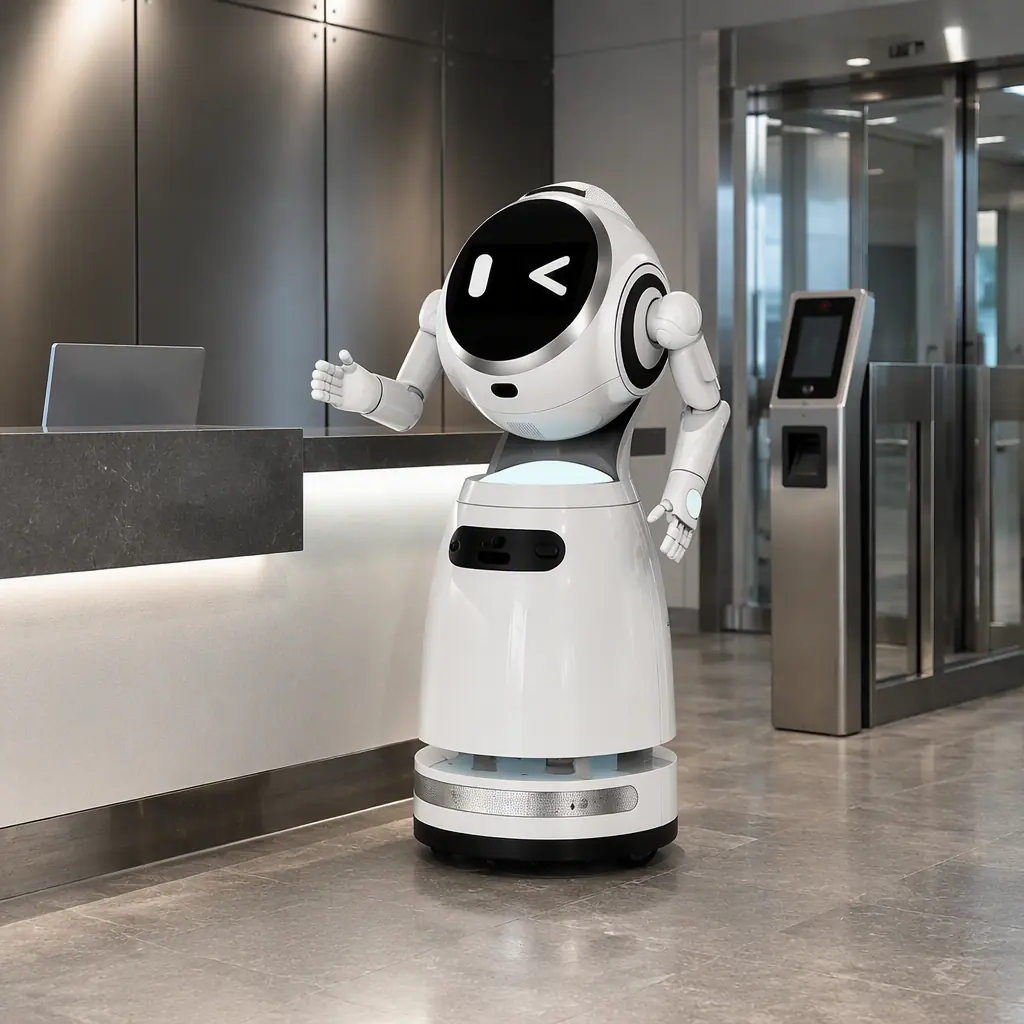
The humanoid reception robot CRUZR takes the registration and wayfinding layer of that process: it greets the visitor at the controlled entrance, walks them through the sign-in script, confirms their host and badge status, and notifies the escorting employee — while logging the interaction timestamp that the compliance file requires. The pattern is the same one the reception and concierge guide documents for corporate lobbies and the security and surveillance guide covers for controlled commercial facilities: the robot handles the repetitive, scriptable part of the security interaction, and the cleared human covers the judgment part — which, in a defense facility, is the escort itself. The robot never releases a visitor into the plant; it only makes the registration-to-escort handoff faster and fully logged.
AS9100 Evidence: The Robot as an Audit Trail
Aerospace quality systems run on evidence, and the three robot roles above all produce machine-generated evidence: delivery logs show which tooling kit reached which station at which time; cleaning logs show floor-care coverage against the FOD schedule; access logs show visitor registration, host notification and escort start times. For plants under AS9100 or NADCAP surveillance, that evidence converts automation from a cost center into a quality-system contribution — the same argument the vendor evaluation framework makes for checking a robot vendor's data architecture before piloting.
Deployment Math for an Aerospace Plant
| Robot role | Product | Typical fleet | Monthly cost (RaaS) | Returns |
|---|---|---|---|---|
| Line-side tooling delivery | CADEBOT L100 / AOMAN DOUBLE | 2–4 | $1,300–1,900 each | 380+ skilled hours/cluster/year |
| FOD floor care | CLEINBOT M79 | 1–2 | $1,000–1,600 each | Documented continuous FOD coverage |
| Visitor registration & escort handoff | CRUZR | 1 | $1,200–1,800 | 40+ escorts/month without production staff |
The budget planning framework walks through the full comparison, and the multi-site deployment guide covers the pattern for prime contractors rolling robots across a supplier network — one plant proves the route data and the compliance documentation format, and the next plant deploys in days rather than months.
Aerospace manufacturing pays a premium for every minute of skilled labor and every gram of debris, and it pays a documented price for every unescorted visitor. The service robot deployment addresses all three at once: the delivery robot keeps the licensed skill at the aircraft, the scrubber keeps FOD on a machine-verified schedule, and the humanoid keeps the security boundary scripted and logged. That is the automation pattern that survives an AS9100 audit, and — as the change management playbook documents — the one the floor crew defends first, because it gives the mechanic back their time at the airplane.