A 92,000-square-foot climate-controlled self-storage facility in suburban Dallas operates 812 units across three buildings, a 140-space paved lot, and a 2,800-square-foot leasing office. The property is managed by a single full-time manager and one part-time assistant — a staffing model that the 2025 Self Storage Association (SSA) Facility Operations report identifies as the industry norm: 61% of US facilities operate with two or fewer employees, and 18% operate with zero dedicated on-site staff, relying on a regional manager covering multiple properties. The Dallas facility's manager spends an average of 3.8 hours per day on non-selling tasks: sweeping the lot and driveways, cleaning the corridors and the 14 shared restrooms, and resetting the leasing office — time that the facility's occupancy report shows is worth $1.8 million in annual rent at 93% occupancy.
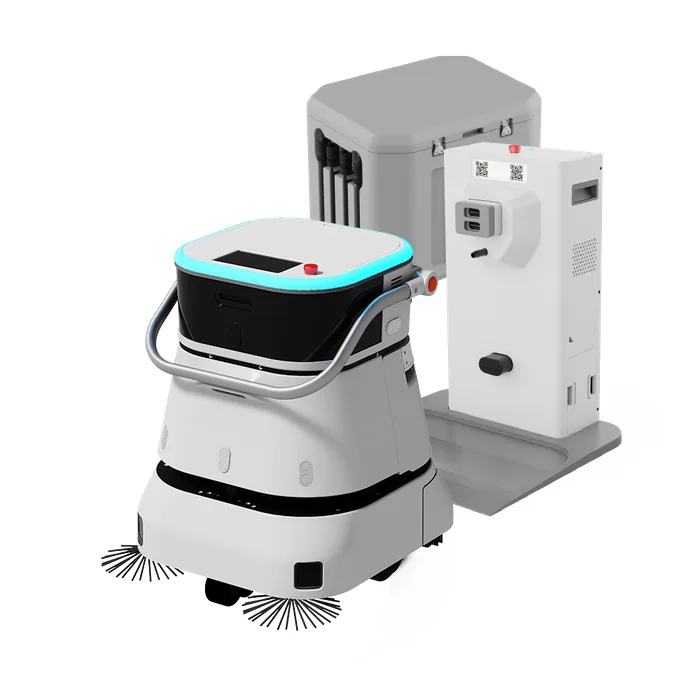
In Q1 2026, the facility deployed CLEINBOT C2 Pro floor scrubbers for the corridors, offices, and restroom approaches; CLEINBOT CC201 outdoor sweepers for the lot, driveways, and the 18-foot-wide entry apron; and CRUZR humanoid reception robots for after-hours leasing, move-in orientation, and the 9 PM-6 AM window when the facility has no staff on site at all. The operating thesis was simple: in an industry where the renter's decision happens at the gate, the property that looks maintained and feels staffed wins the lease.
Curb Appeal Is the Pricing Engine: The 75% First-Impression Rule
The self-storage rental decision is made in minutes, and it is made on appearance. The 2025 SSA renter survey found that 75% of new renters visited only one facility before signing — meaning the first visit is the only visit — and that "cleanliness and maintenance" ranked as the top facility attribute influencing the decision, ahead of price (71%), security (68%), and proximity (62%). The corollary is pricing power: facilities in the top quartile of third-party mystery-shopper cleanliness scores command 8-14% higher effective rent per square foot than bottom-quartile facilities in the same submarket, a spread that on a 92,000-square-foot property equals $145,000-255,000 in annual revenue.
The problem is that the highest-leverage presentation surface — the lot, driveways, and entry apron — is also the highest-maintenance surface. A paved storage lot accumulates leaf litter, gravel tracked out of units, and the tire-worn sand that collects at every curb; the entry apron collects the coffee cups and cigarette butts of every visitor. CC201's 3,000 m²/hour cleaning efficiency clears the facility's entire 140-space lot and driveway system in under 40 minutes on a programmed night schedule, its 130L auto-emptying dust bin (with HEPA PM2.5 filtration) handles the full load without a mid-shift dump, and its IP67 enclosure and -10°C to 50°C operating range keep the schedule running through the rain events that leave other properties looking neglected. The same dynamic drives outdoor sweeping adoption in petrol stations and highway service areas and shopping mall complexes, where lot presentation is directly tied to traffic conversion.
The Fractional Staffing Model: What the 18% of Unstaffed Facilities Are Missing
The industry's staffing reality — 61% of facilities with two or fewer employees, 18% with none — creates a service gap that operators paper over with phone-answering services and a "call for appointment" sign on the gate. The gap has three measurable costs. First, after-hours leasing: the 2025 SSA report found that 34% of rental inquiries arrive outside 9 AM-6 PM business hours — the evening and weekend window when the facility's would-be renter drives by, sees an empty lot and a locked office, and leases from the competitor down the road. Second, move-in experience: the highest-churn moment in storage is the first 90 days, and a move-in conducted with no on-site staff — the renter fumbling with the gate code, unable to find their unit, unclear on the lease terms they signed online — produces early-exit churn that operators measure at 12-18% of first-quarter tenants. Third, presentation decay: an unstaffed facility's lot and corridors degrade visibly within two weeks, and the mystery-shopper scores that drive pricing power collapse with them.
CRUZR addresses the after-hours gap directly. Stationed in the leasing office (or a climate-controlled alcove by the gate), the robot takes over the 9 PM-6 AM and weekend windows: it greets walk-up prospects through the intercom-linked screen, answers the 15 most common pre-lease questions (unit sizes and availability, pricing tiers, insurance requirements, gate hours, moving-truck access), collects contact details for the morning follow-up, and — for the facility with remote gate integration — walks a new renter through the move-in sequence: gate code, unit location, lock procedures, and the facility rules the lease references. The 1,450 mm humanoid form with its 14-inch facial LED array carries the facility's brand through a face-to-face interaction that a call box cannot, and the 50+ language support covers the renter base that many metropolitan facilities now serve. This is the same after-hours service model that drives residential apartment complex automation, where package rooms and leasing offices run unstaffed after hours with robot assistance.
Corridor Hygiene at Climate-Controlled Standards
Climate-controlled facilities market their interior environment as the product: "your belongings stay at 60-80°F, dust-free, year-round." The interior corridors and unit doors are the physical proof of that promise, and they accumulate the two contaminants that climate-controlled storage specifically promises to prevent: the dust that settles on unit doors and corridor floors from the loading dock, and the tracked-in grime from move-in traffic. A 2025 facilities benchmark of 1,400 climate-controlled properties found that corridor cleanliness is the second-strongest predictor of renewals (after rate competitiveness) — renters who perceive the interior as dirty are 2.3x more likely to shop competitors at renewal.
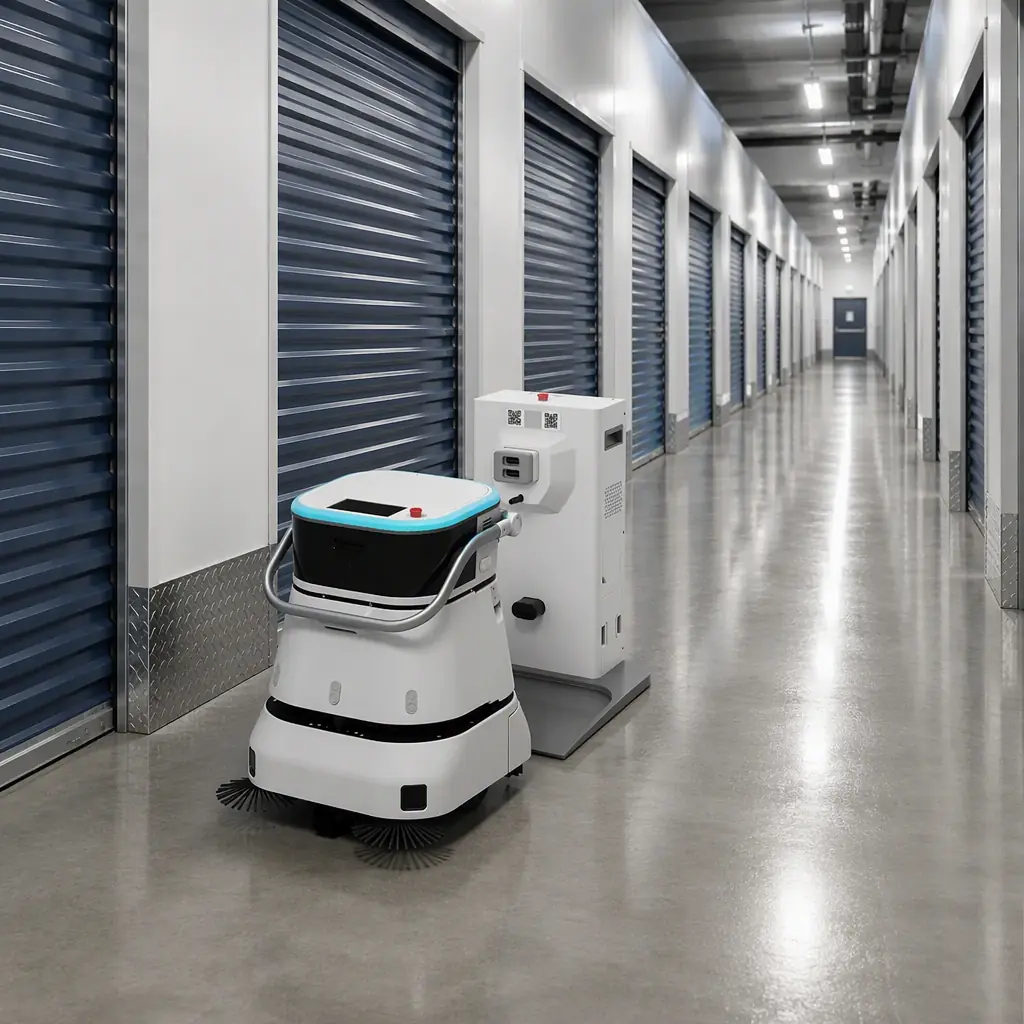
CLEINBOT C2 Pro maintains the interior standard continuously. At 500-800 m²/hour with a 440 mm cleaning width, the robot cycles the facility's corridors on a programmed schedule — typically 2 AM-5 AM for the main corridors and daytime passes for the office and restroom approaches — with a ≤65 dB noise profile that stays below the threshold that would disturb the units' tenants during evening access hours. The 10L clean / 10L dirty split tanks handle the move-in grime load without the operator needing to babysit water changes mid-shift, and the logged cleaning events produce the maintenance record that regional managers reviewing multiple properties actually use to verify that the unstaffed Tuesday shift didn't skip the corridor pass. The audit-trail logic is the same one that drives data center environmental monitoring and pharmaceutical cleanroom operations: when the property runs with fractional staff, the robot's log is the proof that the standard was met.
Security Perception: The Gate, the Cameras, and the Robot That Complements Both
Self-storage security is 50% technology and 50% perception. The 2025 SSA renter survey found that 68% of renters cite security as a top-3 decision factor, and that the perception of security — visible cameras, well-lit lots, an attended gate — matters as much as the actual breach statistics. The industry's security stack is already standardized: gated access, camera coverage, and increasingly smart locks. The gap is the human presence that makes a property feel watched — the same gap that commercial security patrol deployments address in warehouses and corporate campuses.
The robot layer complements rather than replaces the security stack in three specific ways. First, the moving presence: a CC201 sweeping the lot at 2 AM is a visible, unpredictable presence that the facility's existing cameras record and that would-be trespassers cannot schedule around — operators report that after-hours lot activity drops measurably in the first 30 days of night-sweeping schedules. Second, the access-control handshake: CRUZR at the gate or leasing office intercom verifies the after-hours renter against the access-control system's check-in records before the gate opens, adding a human-verification step to the gate-code-only model. Third, the documented patrol: the robot fleet's GPS-tracked routes and cleaning logs create a time-stamped activity record that facility owners can produce for insurance and liability discussions — the same documentation value covered in the insurance and liability guide.
The Multi-Site Operator: Robots as the Standardized Service Layer
The consolidation wave in self-storage — REITs and regional operators now control 31% of US facility square footage — has created a new problem: how to deliver a consistent service standard across hundreds of properties staffed by regional managers who cover 8-15 sites each. The multi-site deployment strategy guide and the fleet management platform describe the operating model: the regional manager's dashboard shows lot-sweeping completion, corridor-cleaning cycles, and after-hours leasing interactions across every property, flagging the site whose CC201 ran 22% fewer cycles than its sister property — evidence of a scheduling problem, a gate obstruction, or a maintenance issue — before it becomes a mystery-shopper score collapse. The RaaS and financing models let operators roll robot costs into per-property operating expense rather than capital budgets, which matters for REITs managing same-store NOI targets, and the ROI framework provides the unit-level math: the Dallas facility's 3.8 hours per day of manager time redirected from sweeping to selling, plus the after-hours lease capture, plus the renewal-rate lift from corridor cleanliness, produced a modeled payback of 11 months on the three-robot deployment.
The vendor evaluation framework and the safety standards compliance guide close out the procurement checklist — including the two questions storage operators must ask that other industries don't: Does the robot's charging station fit within the facility's power budget at the gatehouse panel? And does the sweep schedule handle the gate-code traffic pattern, so the robot isn't blocking the entry lane during 8 AM move-in windows? The change management playbook covers the staff dynamic: the on-site manager whose sweeping duties are absorbed by the robot becomes the facility's robot operator, a promotion in responsibility that operators report cuts the 34% annual manager turnover that plagues the industry.
The self-storage facility is the purest test of the fractional-staffing thesis in commercial real estate: a multi-million-dollar asset whose revenue depends on presentation and service, staffed by one person or none. The operators winning the occupancy war are the ones using robots as the service layer that makes an 18%-unstaffed property feel like a fully attended one — sweeping while the renters sleep, scrubbing what the cameras can't, and greeting the after-hours prospect who would otherwise lease from the competitor down the road.