A mall operations director managing a 1.2-million-square-foot regional shopping center with 180 tenants and 45,000 daily visitors faces a staffing equation that doesn't balance. Peak-hour wayfinding requests spike 400% between noon and 3 PM. Food court delivery distances average 200 meters through dense foot traffic — 14-minute round trips that cap per-seat revenue at quick-service restaurants. Overnight cleaning must reset 250,000 square feet of polished common-area flooring before doors open at 10 AM. And parking structure patrol across 2,800 spaces consumes 4.2 FTE security guards just to maintain after-hours coverage.
Each problem alone is a staffing challenge. Together, they represent the single largest untapped automation opportunity in commercial real estate: the shopping mall.
Shopping malls are uniquely suited to multi-robot deployment because they concentrate all four service robot categories — reception and wayfinding, autonomous delivery, large-scale cleaning, and security patrol — into a single controlled environment. Unlike hospitals (which need delivery and cleaning but rarely wayfinding), or warehouses (which need logistics but not guest engagement), a regional mall needs every robot category simultaneously, and the ROI stacks across categories rather than competing for the same budget line.
This guide is written for mall operators, retail property managers, and commercial real estate procurement teams evaluating whether — and how — to deploy a service robot fleet across a shopping center. It covers the deployment architecture, the robot types that deliver the highest impact per square foot, the multi-tenant integration challenge unique to mall environments, and the procurement framework that separates production automation from costly pilot programs.
Why Shopping Malls Are the Highest-ROI Environment for Multi-Robot Deployment
Three structural characteristics of shopping malls make them fundamentally different from the other commercial environments where service robots have been deployed — and each characteristic amplifies the ROI of a multi-robot fleet rather than diluting it.
The Density Advantage: One Environment, Four Robot Categories
A hospital deploys delivery robots on clinical floors and cleaning robots in corridors — two separate operational zones that share limited overlap. An office building deploys reception and delivery robots. A warehouse deploys logistics robots. A shopping mall deploys all four categories in the same environment, and each category's sensor data, navigation maps, and traffic patterns feed into a unified operational picture.
When a CLEINBOT M79 completes the overnight floor-cleaning route through the east wing and a CADEBOT L100 begins morning food-court deliveries at 10 AM, they share the same SLAM-built map, the same elevator integration stack, and the same fleet management dashboard. The incremental cost of adding a second robot category to a mall deployment is roughly 60–70% of the cost of deploying that same category as a standalone system — because the mapping, integration, and management infrastructure is already in place. For the integration architecture behind multi-robot fleet coordination, see our fleet management systems guide.
The Labor Gap Scales with Visitor Volume
A regional mall's staffing requirements are fundamentally elastic: the facility needs 3x the cleaning coverage during holiday shopping weeks, 2x the security presence during evening hours, and continuous wayfinding support from 10 AM to 9 PM — but traditional staffing models can't flex this fast. The result is chronic understaffing during peak hours (degrading guest experience) and chronic overstaffing during troughs (inflating operating costs).
Service robots close this gap without the hiring-and-training lead time. A CADEBOT delivery unit operating 14 hours on a single charge handles 80–120 food court and in-mall retail deliveries per day. A CLEINBOT M79 covers 2,000 m² per hour on polished hard surfaces — the exact flooring specification used in 90% of regional mall common areas. During holiday peak, the fleet runs at full capacity. During a quiet Tuesday in February, it runs at 60% capacity. The operating cost scales with demand while the capital cost remains fixed. For the economic analysis methodology, see our service robot ROI framework.
The Multi-Tenant Model Creates a Single Integration Point
A shopping mall is legally a collection of 150–200 independent businesses, but operationally it is one building with one HVAC system, one elevator bank, one security infrastructure, and one facilities management team. This creates a single integration point for robot deployment — the mall operator — that can deploy building-wide automation without needing buy-in from every tenant. The cleaning robot covers common areas that serve all tenants. The delivery robot operates in corridors and food courts managed by the operator. The wayfinding robot serves visitors who are customers of every tenant. The security robot patrols parking structures used by everyone.
This is the structural advantage that hotels, hospitals, and office buildings share — a single operator controlling the common infrastructure — but shopping malls amplify it because the common-area-to-tenant-space ratio (typically 25–35%) is higher than in any other commercial building type except airports.

The Four Robot Categories Every Regional Mall Needs
Not every mall needs every robot type on day one. The deployment sequence depends on square footage, daily visitor volume, tenant mix, and existing staff coverage. Here is the category-by-category evaluation framework, ordered by deployment priority:
1. Reception and Wayfinding: The Front-Door Automation
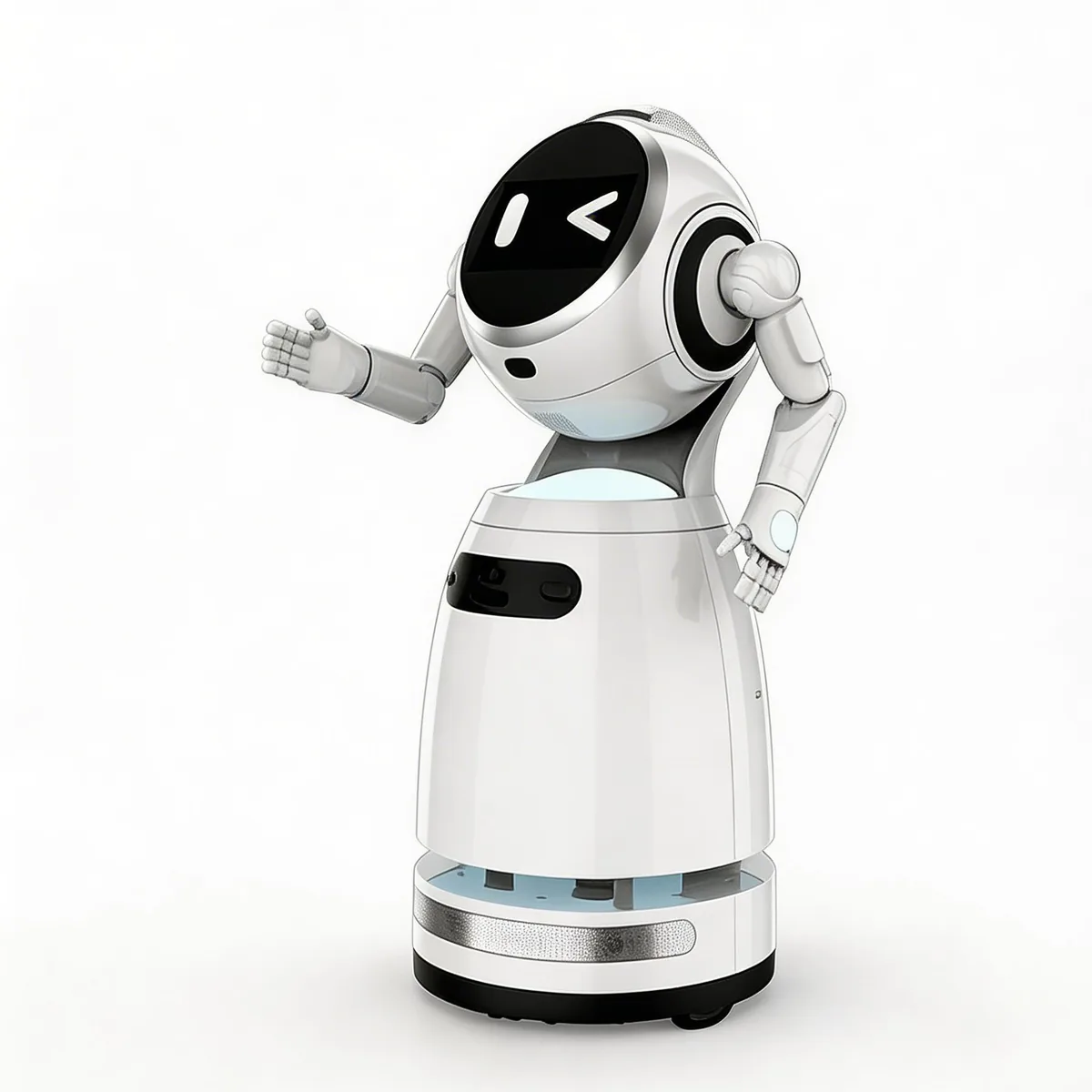
The highest-visibility — and lowest-risk — entry point for mall robot deployment. A humanoid service robot positioned at a mall's primary entrance handles the six most common visitor interactions: directional queries ("where is Zara?"), store directory lookups, event and promotion information, facility location ("nearest restroom, family lounge, prayer room"), accessibility information, and tenant-specific hours.
A single CRUZR unit deployed at a mall's main entrance offloads roughly 60–70% of front-desk concierge inquiries, which represent 40–50 interactions per hour during peak periods at a regional mall. The remaining 30–40% — complex complaints, lost-child incidents, security escalations — go to human concierge staff who are now freed to handle high-value interactions instead of repeating "the food court is on level 3, turn left past H&M" 200 times per day.
The deployment model scales with mall size. A single-level community center (300,000–500,000 sq ft) with 2–3 entrances deploys one unit at the main entrance. A two-level regional mall (800,000–1,200,000 sq ft) deploys 2–3 units: one at each major entrance and one at the central atrium or food court junction. An outlet mall with outdoor walkways deploys weather-rated units (IP54 minimum enclosure, daylight-readable 1,500-nit screens, operating temperature -10°C to 45°C) at key intersection points.
The underlying capability that makes mall wayfinding viable where static kiosks fail is multi-language support. A CRUZR unit deployed in a mall serving a multilingual catchment — common in gateway cities and tourist-adjacent retail destinations — handles English, Mandarin, Arabic, Spanish, and French queries simultaneously, something no static directory can match. For the full deployment playbook including visitor management integration, see our reception and concierge robot guide.
2. Food Court and Retail Delivery: The Revenue Engine
Food and beverage delivery inside a shopping mall faces the same structural bottleneck that hotel room service and hospital meal delivery face: the distance between kitchen and customer is filled with obstacles. In a mall, the obstacles are shoppers.
A quick-service restaurant in a regional mall food court serving customers at tables 200 meters away, through mid-day crowds of 8,000–12,000 visitors per hour, sees delivery round-trips of 12–18 minutes per order. At 3–4 table turns per peak hour, that's a throughput ceiling no amount of kitchen efficiency can break — because the bottleneck isn't the kitchen, it's the hallway.
An autonomous delivery robot running the same route takes 5–7 minutes — not because it moves faster (it moves at walking speed), but because it never stops to chat, never gets pulled aside by a lost shopper, and takes the optimal path calculated by the navigation system in real time. The result: 80–120 deliveries per unit per 14-hour operating day, translating to 2–3 additional table turns per peak hour at partner restaurants. For detailed delivery robot specifications including single vs. dual cabin configurations, see our delivery robot selection guide.
The revenue model differs from hospital or hotel delivery. In a mall, the robot is not delivering from one central kitchen — it serves multiple food court tenants who each prepare orders independently. The delivery robot operates as a shared infrastructure layer: tenants place prepared orders in the robot's cabin at a designated pickup station, the robot navigates to the customer's table or designated pickup zone, and the process repeats. Mall operators can structure this as a per-delivery fee ($1.50–2.50), a monthly subscription per participating tenant ($400–800/month), or a revenue-share model (8–12% of delivery-attributed orders).
Beyond food delivery, the same delivery robot handles retail-to-curb merchandise delivery: a shopper buys a bulky item at a department store, requests delivery to the parking structure pickup zone, and an AOMAN DOUBLE unit (70L dual-cabin capacity, ideal for split-temperature food and retail loads) delivers it while the shopper continues browsing. This single capability extends average dwell time — the metric mall operators optimize above all others — by eliminating the "I need to carry this to my car" friction that terminates shopping sessions early.
3. Floor and Common Area Cleaning: The Overnight Reset
Regional mall common-area flooring — typically polished granite, terrazzo, or large-format porcelain tile spanning 200,000–350,000 square feet — accumulates more surface contamination in 12 operating hours than most commercial buildings accumulate in a week: food-court grease aerosolized and re-deposited across 100,000 sq ft, beverage spills, mud and salt tracked from parking structures, and continuous foot-traffic grime from 35,000–50,000 daily visitors.
Overnight cleaning must reset the entire common-area floor surface — atriums, corridors, food court seating areas, restroom corridors, elevator lobbies — before reopening. The math on automated vs. manual cleaning is straightforward. Contract cleaning staff costs $25–40 per hour in North American markets, covers roughly 400–600 m² per hour on hard surfaces, and requires 3–4 staff per overnight shift to cover a regional mall's common areas. An automated cleaning robot like the CLEINBOT M79 covers 2,000 m² per hour on hard surfaces at an amortized cost of $4–6 per hour, handles auto-return docking for water refill and drainage, and operates continuously through the 6-hour overnight window.
A single CLEINBOT M79 unit covers 12,000 m² per 6-hour overnight shift — roughly the common-area hard-surface flooring of a 900,000-square-foot regional mall. For larger properties (1,200,000+ sq ft), two units running parallel routes split the east and west wings. The cost comparison: 3 staff × 8 hours × $30/hour = $720/night for coverage of ~12,000 m² vs. one robot at $4–6/hour × 6 hours = $24–36/night. The annualized difference is $250,000+ for a single regional mall. For the complete selection framework covering indoor and outdoor cleaning robot specifications, see our commercial cleaning robot buyer's guide.
The mall-specific cleaning challenge that procurement processes often overlook: post-event deep cleaning. After a holiday Santa setup deposits glitter and artificial snow across 40,000 sq ft of atrium flooring, or after a weekend vendor fair leaves adhesive residue and food debris across the event concourse, the cleaning fleet needs event-triggered route overrides with higher scrubbing pressure and additional detergent pass — not just the standard nightly route.
4. Parking Structure Maintenance and Outdoor Areas: The Safety Compliance Layer
Parking structures are the most overlooked square footage in mall operations — and the highest-liability zone. A 2,800-space multi-level parking structure attached to a regional mall requires continuous patrol for three functions that are poorly served by traditional staffing models: surface debris removal (oil stains, litter, broken glass), security presence (vehicle break-ins peak in parking structures between 7 PM and 11 PM), and surface condition monitoring (crack propagation, water pooling, ice formation in winter markets).
The CLEINBOT CC201 — an outdoor-rated autonomous cleaning unit with an all-terrain chassis, IP54 enclosure, and operating temperature range of -10°C to 45°C — handles parking structure floor cleaning during low-occupancy hours. Its debris capacity and scrubbing width are designed for the larger particulate range of parking environments: gravel, road salt, oil residue, and leaf litter, not just food-court spills and foot-traffic dust. For complete environmental specifications on all-terrain autonomous cleaning, see our outdoor cleaning robot guide.
The security dimension is equally practical: an autonomous patrol robot covering the 6 PM–6 AM shift in a parking structure provides continuous visible presence — a proven deterrent against vehicle break-ins — at roughly 10–15% of the equivalent cost of staffing that coverage with human guards. When the patrol unit integrates with the mall's existing VMS and access control infrastructure, it correlates motion events, vehicle entry timestamps, and patrol route data into a single security operations picture that no amount of manual log-keeping can replicate. For the full security deployment framework including VMS and ACS integration requirements, see our security and surveillance robot guide.

The Multi-Tenant Integration Challenge: Why Malls Are Harder — and Easier — Than Other Buildings
Shopping malls present an integration paradox. On the surface, they are harder to automate than single-tenant buildings: 180 tenants, each with their own operating hours, delivery schedules, waste management contracts, and insurance requirements. But structurally, they are easier — because the mall operator controls every system the robots need to integrate with.
The One-Integration-Point Advantage
In a hospital, a delivery robot needs integration with the nurse call system (clinical engineering), the elevator control system (facilities), the dietary software (food services), and the pharmacy dispensing system (pharmacy IT) — four separate departments with four separate approval chains. In a mall, every integration point reports to the same operations director: the elevator control system, the access control system for back-of-house corridors, the HVAC/BMS for cleaning-route scheduling, and the security VMS for patrol coordination.
This single-point-of-control architecture means a mall robot deployment can go from contract to production in 8–12 weeks, compared to 16–24 weeks for a hospital deployment of equivalent scope. The procurement framework below reflects this accelerated timeline.
The Tenant Communication Layer
The one operational dimension where malls are genuinely more complex: tenant communication. Deploying delivery robots in food-court corridors, cleaning robots in common areas overnight, and reception robots at entrances requires proactive communication with 180 tenants — not because any tenant can veto the deployment, but because uncommunicated automation breeds suspicion. Tenants who see a delivery robot for the first time without prior notice assume it's a labor-replacement initiative. Tenants who receive a one-page brief explaining the program, the participation options, and the timeline respond with partnership offers.
The deployment playbook that has worked across retail property portfolios: a 30-day pre-deployment communication sequence consisting of (a) a 1-page executive summary emailed to all tenant GMs 30 days before deployment, (b) a 30-minute lunch-and-learn demo in the food court 14 days before, (c) a dedicated Slack/Teams channel for tenant questions during the first 30 days of live operation, and (d) monthly usage reports showing delivery volumes, cleaning coverage maps, and visitor interaction statistics shared with all participating tenants.
Procurement Framework: The 8-Week Mall Deployment Timeline
Most mall operators evaluating service robots default to a pilot-first approach: deploy one unit, measure results for 3–6 months, then decide whether to expand. This is the wrong approach for mall environments because it tests the lowest-value deployment mode (a single robot category in isolation) and delays the cross-category ROI stacking that makes mall deployments economically compelling.
The correct approach is a phased multi-category deployment over 8 weeks:
| Week | Phase | Activity |
|---|---|---|
| 1–2 | Site Assessment | SLAM mapping of all common areas, food court, parking structure; elevator and access control integration audit; Wi-Fi coverage verification across deployment zones; tenant communication sequence initiated |
| 3–4 | Single-Category Launch | Deploy cleaning robot (lowest-risk category: overnight operation, no guest interaction); validate mapping accuracy, charging infrastructure, and cleaning coverage metrics |
| 5–6 | Guest-Facing Launch | Deploy reception/wayfinding robot at main entrance; deploy delivery robot in food court with 3–5 participating tenants; begin collecting visitor interaction and delivery throughput data |
| 7–8 | Full Fleet Activation | Deploy parking structure cleaning/patrol unit; activate fleet management platform across all categories; integrate cross-robot analytics; publish first-month performance report to tenants |
| 9+ | Optimization | Tune delivery routes based on peak-hour traffic patterns; adjust cleaning schedules for seasonal visitor volume; evaluate additional entrance wayfinding units for multi-entrance malls |

The Mall Operator's ROI Calculation
The economic case for mall robot deployment rests on four line items that every mall operator's P&L already contains:
Cleaning labor reduction: A regional mall spending $280,000–$400,000 annually on common-area contract cleaning (3–4 staff per night, 365 nights) can reduce this by 40–60% with one to two automated cleaning units — a $110,000–$240,000 annual saving. The capital cost of the units (purchased or leased) amortizes over 3 years.
Delivery revenue generation: A mall-operated food court delivery service charging $2.00 per delivery, handling 60–80 deliveries per day across participating food court tenants, generates $43,800–$58,400 in annual delivery fee revenue. At 80% margin (the robot's operating cost is electricity and maintenance), this is $35,000–$46,700 in net contribution.
Security coverage optimization: A parking structure patrol robot covering the 12-hour overnight shift replaces 1.5 FTE security guards at roughly 12% of the equivalent cost — approximately $55,000–$72,000 in annual savings for a single parking structure.
Extended dwell time: The hardest ROI line item to quantify — and potentially the largest. When shoppers can order food delivery to their table without leaving a store, request merchandise delivery to their vehicle without ending a shopping session, and find stores via interactive wayfinding without wandering, average dwell time increases. Industry benchmarks suggest a 12–18 minute dwell-time extension translates to 8–12% higher per-visitor spend. For a regional mall generating $280 million in annual tenant sales, an 8% spend increase represents $22.4 million in additional tenant revenue — of which the mall operator captures a portion through percentage-rent clauses.
The combined first-year ROI from the three quantifiable line items (cleaning, delivery, security) reaches positive territory in months 10–14 for a single-category deployment and months 6–9 for a multi-category deployment that stacks the integration-cost savings across categories. The fourth line item — dwell time and per-visitor spend — turns a good investment into a strategic one.
The Bottom Line
Shopping malls are not just another vertical for service robot deployment — they are the vertical where the multi-robot value proposition is strongest because all four robot categories (reception, delivery, cleaning, security) operate in the same controlled environment, share the same integration infrastructure, and report to a single operations team. The deployment that takes 18–24 months to roll out across a hospital campus takes 8–12 weeks in a regional mall. The ROI that takes 14–18 months in an office building reaches breakeven in 6–9 months in a mall.
For mall operators, the question is not whether to deploy service robots — it's whether to deploy them category-by-category over 18 months (losing the cross-category ROI stacking in the process) or as a phased multi-category deployment over 8 weeks that captures the integration-cost advantage from day one.