The general manager of a 350-unit luxury apartment tower in a Tier 1 city manages a $14.2 million annual operating budget. Three line items consistently overrun their allocations: package management labor ($48,000 budgeted, $71,000 actual — the result of package volume increasing 22% year-over-year while staffing remained flat), common-area cleaning ($132,000 for daily maintenance of 52,000 sq ft across 28 floors of hallways, two lobbies, a gym, a resident lounge, and a rooftop terrace), and overnight lobby staffing ($72,000 for a concierge/security presence between 11 PM and 7 AM, a role with 40% annual turnover because "sitting in an empty lobby at 3 AM" is not a career-advancing position).
These three line items share a structural problem: they are variable labor costs applied to problems that are continuous and predictable. Packages arrive every day, corridors need cleaning every day, and the lobby needs staffing every night. The volume scales with occupancy — a 350-unit building generates 2.4x the package volume of a 150-unit building — but labor costs scale in step-function increments (you hire one full-time person or you don't). The gap between these two scaling curves is where service robots create operating leverage.

The Package Problem: 630 Packages Per Week and the Mailroom That Cannot Scale
In 2026, the average apartment unit receives 1.8 packages per week — a figure that has doubled since 2019 and shows no sign of plateauing, per data from the National Multifamily Housing Council's annual operations benchmark. A 350-unit building processes approximately 630 packages weekly, or 90 packages per day. Package management workflow in a typical building:
- Carrier delivers packages to mailroom or package locker (FedEx, UPS, Amazon, DHL — often at different times across a 10-hour window)
- Staff sorts packages by recipient, logs them into the building's package-tracking system, and notifies residents
- Residents retrieve packages during office hours (9 AM-6 PM) — approximately 60% of packages are retrieved within 24 hours
- Remaining 40% require staff follow-up (reminder emails, phone calls) and consume mailroom storage space
- Oversized packages that don't fit in lockers require manual handling and dedicated storage
The labor cost for a 350-unit building: 15-18 staff hours per week, or approximately $23,000-28,000 annually at $28/hour loaded labor cost. The capital cost of package locker systems sufficient for the volume: $45,000-80,000 for installation — and lockers don't solve the oversized-package problem or the resident-retrieval friction.
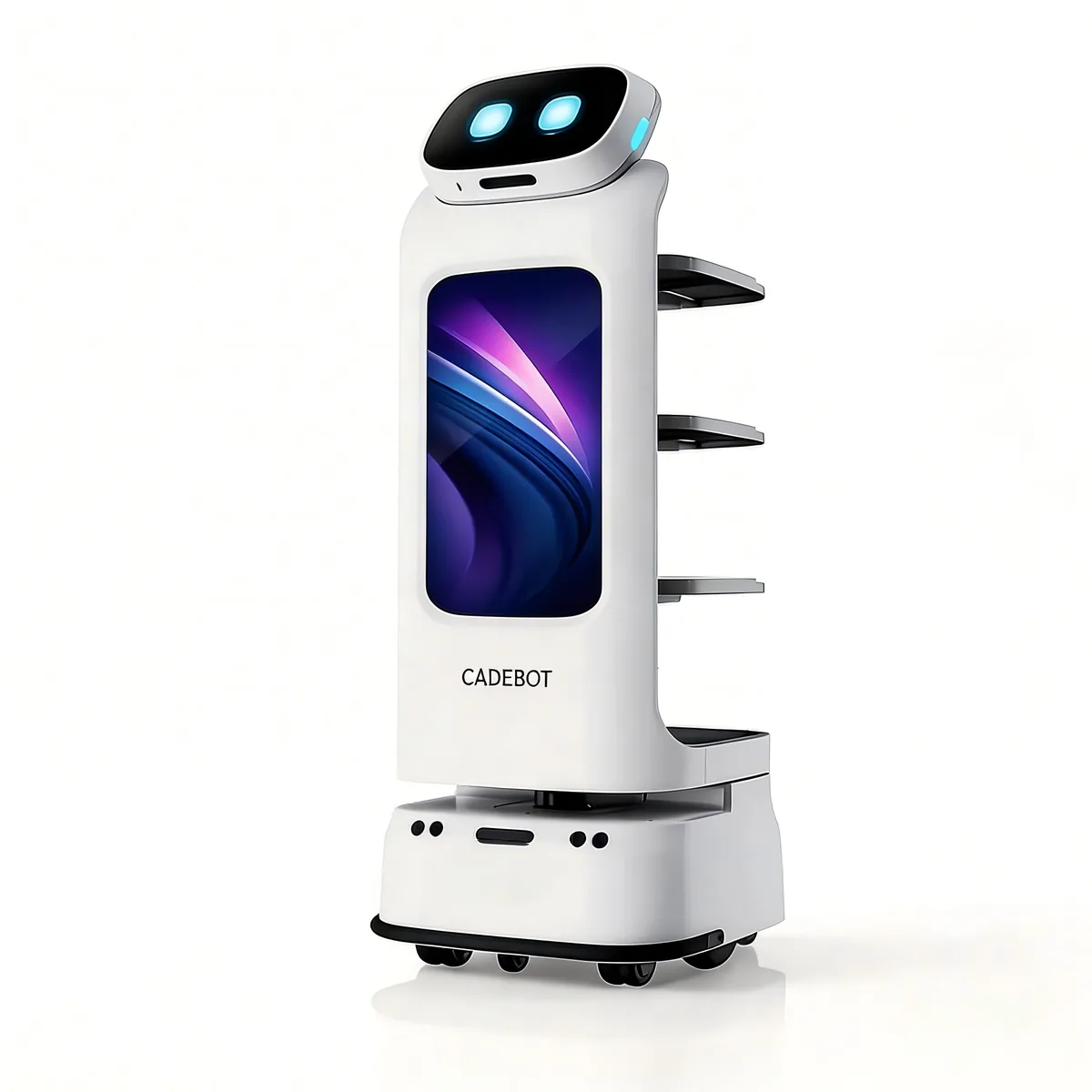
CADEBOT L100 delivery robots, deployed in a mailroom-to-door delivery model, change the workflow: packages are loaded onto the robot in the mailroom (sorted by floor/delivery route), the robot autonomously navigates to each recipient's unit door, the resident is notified via building app that the robot is en route, and the robot waits at the door for 3 minutes before returning undelivered packages to the mailroom. A single robot can deliver 15-20 packages per hour — meaning 2 robots can clear a day's package backlog in approximately 2.5 hours of coordinated operation.
This is not a labor-elimination play. It is a service-quality play. The resident who arrives home at 8 PM and finds their Amazon package at the door — rather than waiting until tomorrow's 9 AM office opening — reports higher satisfaction, renews at higher rates, and generates fewer front-desk complaints. The delivery robot selection guide provides the technical evaluation framework; the operational decision for property managers is whether package-delivery friction is costing them renewals.
Common-Area Cleaning: 52,000 Sq Ft That Never Stays Clean
Residential common areas present a cleaning challenge distinct from commercial office or hotel environments: the traffic is continuous and unpredictable. A hotel corridor has predictable peaks (check-in, check-out, post-event return). An office corridor is quiet after 6 PM. A residential corridor has traffic at all hours — the night-shift nurse leaving at 5 AM, the early-morning runner returning at 7 AM, the dog owner taking the elevator to the pet-relief area at 2 AM, the teenager returning from a late-night study session at midnight.
This continuous traffic pattern means that once-daily cleaning — the model for hotel and office corridors — is insufficient for residential. A hallway cleaned at 10 AM looks visibly trafficked by 6 PM when residents return from work. The operational response in most buildings is to clean common areas twice daily (morning deep clean, evening touch-up), which doubles the labor cost without fully solving the perception problem.
CLEINBOT M79 indoor cleaning robots, deployed on a 3-hour continuous cycle during waking hours (7 AM-10 PM), maintain common-area surfaces at a consistent cleanliness level throughout the day. A single unit covers approximately 25,000 sq ft per cycle, meaning two units can maintain 50,000 sq ft — the typical common-area footprint of a 350-unit mid-rise — at continuous cleanliness. The cleaning staff is not eliminated; their role shifts from routine corridor maintenance to specialized tasks (gym equipment deep-cleaning, upholstery extraction, window washing) that the robots don't perform. This is the same role-redefinition model proven in hotel housekeeping deployments and office building maintenance, where robots absorb high-volume, low-complexity surface cleaning and human staff focus on high-value deep-cleaning tasks.
The financial model for a 350-unit building: pre-robot cleaning labor for common areas runs $132,000 annually (3 FTE at $44,000 loaded cost). Post-robot, cleaning staff is reduced to 1.5 FTE ($66,000) plus annual robot cost of approximately $38,000 (2 units under RaaS), saving $28,000 annually while improving cleanliness consistency. The cleanliness improvement is harder to quantify financially but not less real — it manifests in resident satisfaction surveys, online reviews, and the subtle but measurable effect of "the building always looks clean" on lease-renewal decisions.
After-Hours Lobby Coverage: The $72,000 Midnight-to-Dawn Staffing Problem
Every Class A residential building provides 24/7 lobby staffing — a concierge, security guard, or combined role — because residents expect someone to be present for package acceptance, visitor screening, and emergency response regardless of the hour. The overnight shift (11 PM-7 AM) is universally the hardest to staff: turnover averages 40% annually, shift differentials add 15-25% to base pay, and the role's primary function — being present — does not attract career-minded candidates.
CRUZR humanoid reception robots, deployed in the lobby during overnight hours, provide three functions: (1) visitor screening via intercom — the arriving guest states their destination unit, the robot connects to the resident's phone via the building's visitor-management system, and the resident grants or denies access remotely, (2) package acceptance and secure storage — deliveries arriving after hours are logged by the robot and placed in a secure holding area, with automatic resident notification, and (3) emergency protocol initiation — fire alarm activation, water leak detection, or medical emergency triggers immediate notification to the building's on-call manager and emergency services via pre-configured protocols.
The robot does not replace the overnight concierge entirely — it absorbs the 80% of overnight interactions that are routine (visitor screening, package logging, resident questions about amenity hours) and escalates the 20% that require human judgment (medical emergencies, security breaches, building-system failures) to the on-call manager. The overnight staffing model shifts from "one full-time concierge on-site" to "remote on-call manager supported by lobby robot," reducing the annual cost from $72,000 to approximately $32,000 (on-call retainer + robot RaaS cost). This model mirrors the corporate lobby reception deployment, where human receptionists handle exceptions while robots manage routine visitor traffic.
Security and Incident Documentation
Residential buildings are liability magnets: slip-and-fall claims in common areas, package theft allegations, noise complaints, unauthorized access incidents. Each incident requires documentation — timestamped video footage, access-control logs, witness statements — and the quality of that documentation determines the outcome of insurance claims and legal disputes.
Service robots, continuously traversing common areas on cleaning or delivery routes, generate timestamped location data and camera footage that serves as passive incident documentation. When a resident claims they slipped on a wet lobby floor at 11:15 PM, the cleaning robot's log shows that the lobby was cleaned at 10:48 PM and the floor was dry when the robot passed through again at 11:22 PM. When a resident alleges a package was stolen from outside their door, the delivery robot's timestamped delivery confirmation and photo documentation provides evidence of successful delivery. This passive documentation function mirrors the security surveillance model, where operational robots double as environmental sensors.
Resident Acceptance: The Social Dynamics of Robots in Living Spaces
A 2025 resident survey across 12 robot-equipped apartment buildings in the U.S. found that initial resident skepticism ("I don't want robots in my hallway") converted to 78% approval after 90 days of exposure, with the strongest approval among residents under 40 (87%) and the weakest among residents over 65 (61%). The conversion pattern — from skepticism to neutrality to approval — follows a consistent timeline across deployments and mirrors the change management dynamics observed in workplace robot introductions.
The key variable in resident acceptance is not the robot's appearance or function — it is the building management's communication strategy. Buildings that announced robots as "a new amenity to improve your living experience" with a 2-week advance notice, lobby demonstration, and named robots ("This is CADE, your new package delivery assistant") achieved 85% approval at 90 days. Buildings that deployed robots without resident communication achieved 52% approval. The lesson: the robot is not the variable. The introduction is.
ROI for a 350-Unit Building: The Three-Robot Model
A three-robot deployment (2 CADEBOT L100 for package delivery, 1 CLEINBOT M79 for common-area cleaning, 1 CRUZR for overnight lobby coverage) in a 350-unit building:
| Line Item | Pre-Robot Annual Cost | Post-Robot Annual Cost | Annual Impact |
|---|---|---|---|
| Package management labor | $71,000 | $36,000 (0.5 FTE oversight) | -$35,000 |
| Common-area cleaning | $132,000 | $104,000 (1.5 FTE + 2 robots) | -$28,000 |
| Overnight lobby staffing | $72,000 | $32,000 (on-call + 1 robot) | -$40,000 |
| Total | $275,000 | $172,000 | -$103,000 |
Total annual robot cost (RaaS, 48-month term): approximately $68,000. Net annual savings: $35,000. 12-month payback period. The ROI methodology and budget planning framework provide the full cost-modeling detail.
Property managers evaluating robotic deployment should apply the vendor evaluation framework to assess vendor stability, run a pilot program for 60-90 days before full deployment, and structure the contract as a RaaS financing model to align cost with occupancy rather than front-loading capital expenditure.