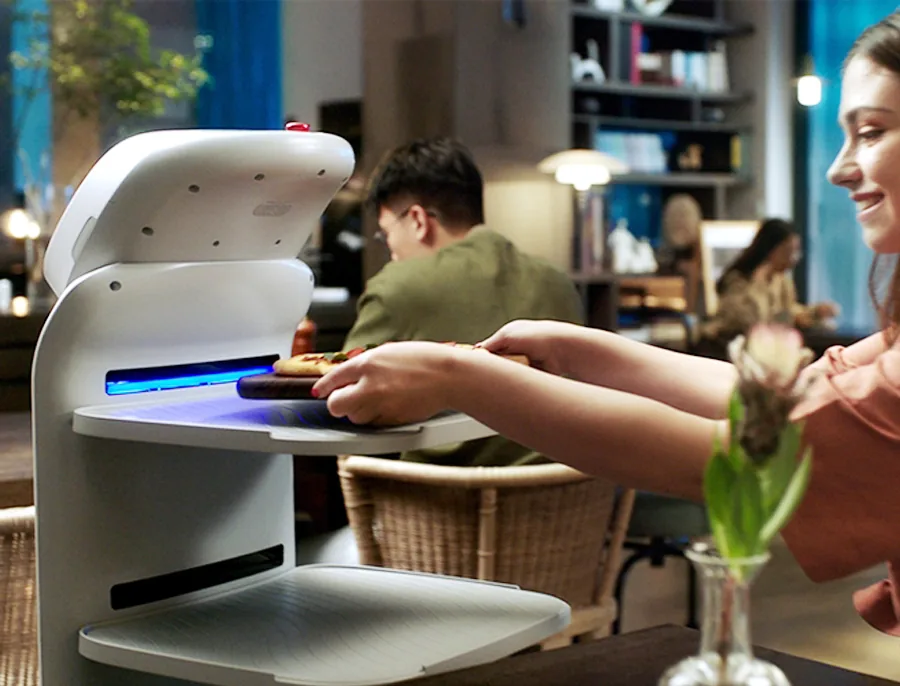
Service Robots for Cleanrooms & Laboratories, GMP-Compliant Automation for Pharma, Biotech & Semiconductor Facilities
At a glance: ISO 14644-1 caps an ISO 7 cleanroom at 352,000 particles ≥0.5 µm/m³. A limit a standard service robot can breach within minutes. This guide maps the classes, the failure modes, and how D1 transport and C1 surface care fit Grade C/D spaces.
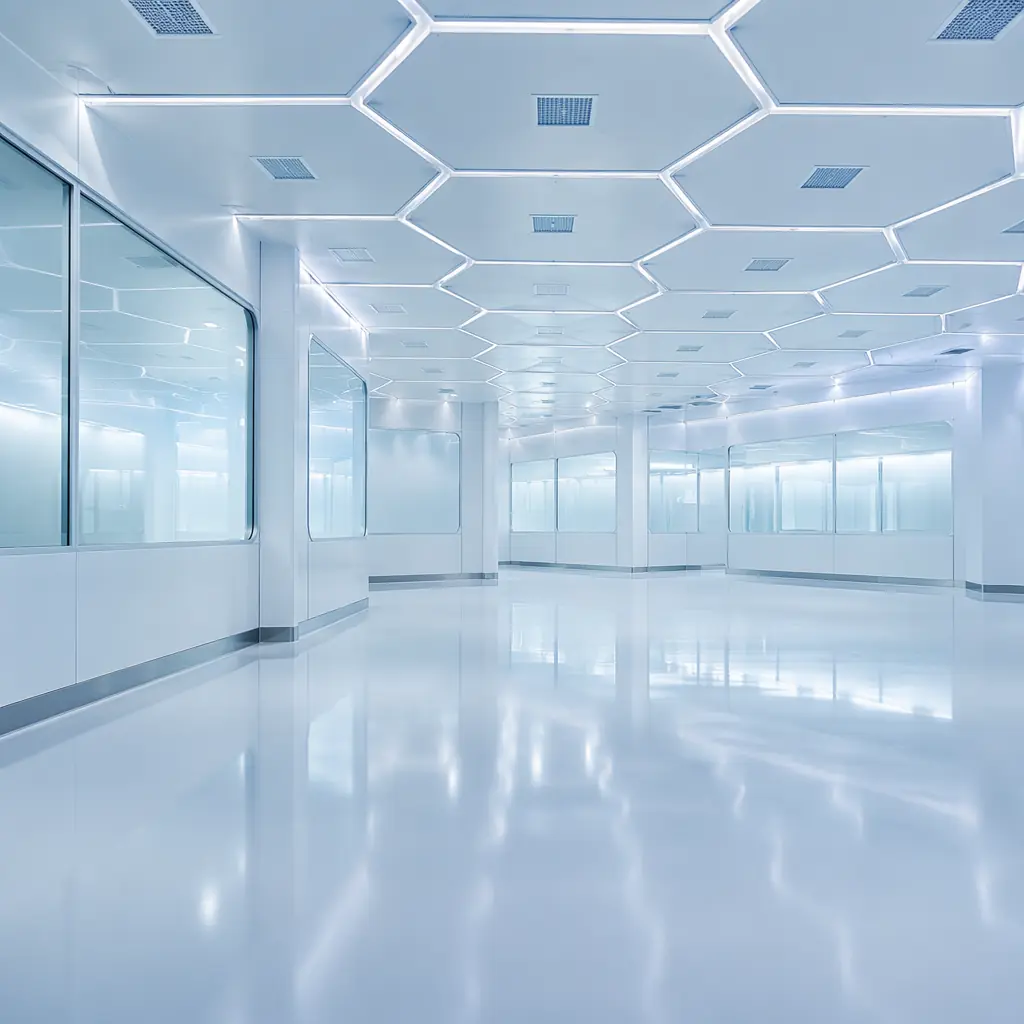
Laboratory automation has focused on what happens inside the workcell: liquid handlers, robotic arms, fixed conveyors. The workflows between workstations, sample transport, surface decontamination, supply replenishment, remain overwhelmingly manual. That is the gap service robots are designed to close, and it is also where the compliance risk sits.
This guide covers what lab directors, facility managers, and QA leads need to know in 2026: cleanroom classification, the three ways a standard robot fails a cleanroom, the workflows worth automating, and the compliance framework that governs deployment.
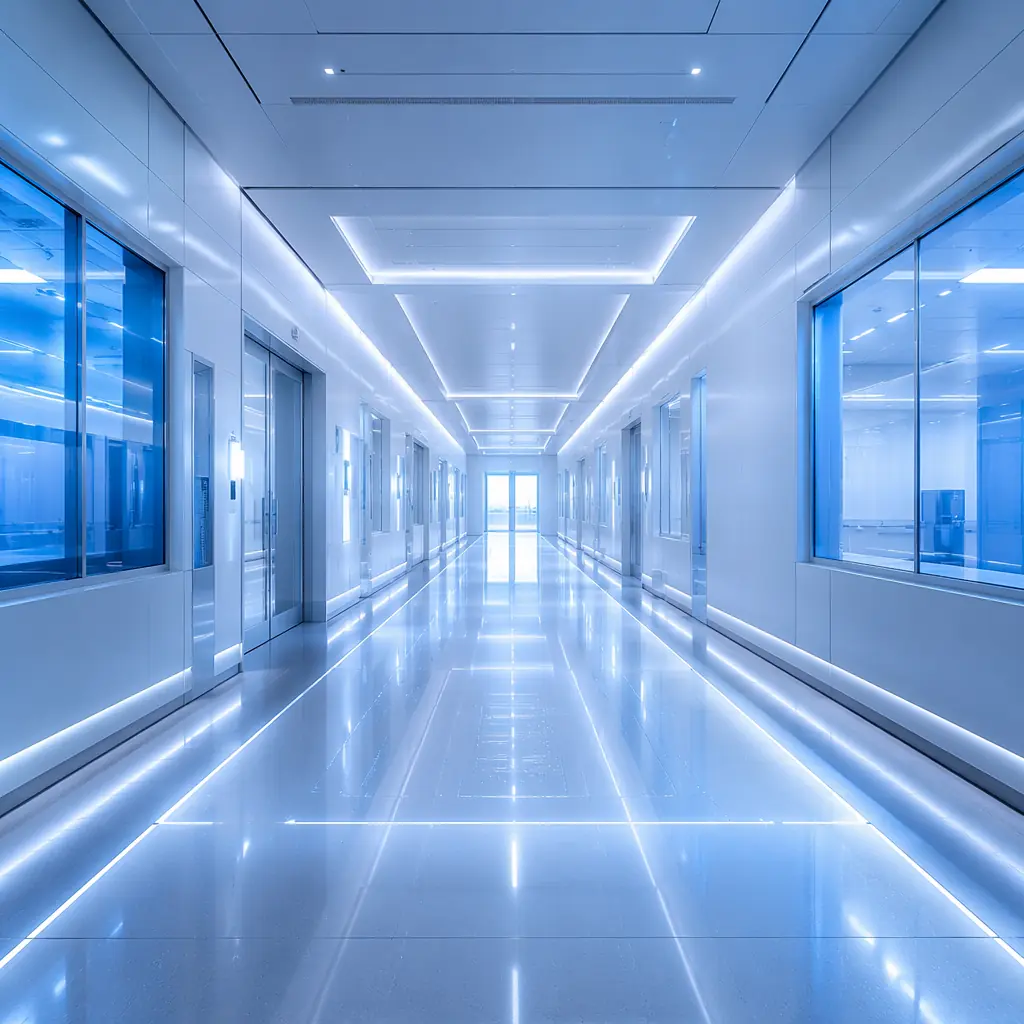
Why Laboratories Need a Different Class of Service Robot
A robot that works flawlessly in a hotel corridor can be a contamination event in a classified space. The requirements are set by classification standards, not by operational convenience.
Cleanroom classification: what the robot is walking into
| ISO Class | Max Particles ≥0.5 µm/m³ | Typical Environment | Robot Feasibility |
|---|---|---|---|
| ISO 5 | 3,520 | Aseptic filling, open vial handling | Fixed automation only, mobile robots not suitable |
| ISO 6 | 35,200 | Semiconductor photolithography | Purpose-built configurations only |
| ISO 7 | 352,000 | Grade C background, biotech processing | Viable with particulate-rated configurations |
| ISO 8 | 3,520,000 | Grade D, lab corridors, media preparation | Standard service robots with cleanroom options |
For most lab workflows the sweet spot is ISO 7–8, sample transport corridors, media preparation areas, equipment washrooms, and R&D lab space. The classification cannot be ignored, and these are exactly the areas where automation returns the highest labor value per unit of compliance effort.
Three ways standard robots fail in cleanrooms
- Particulate emission: wheels, motors, and joints all generate particles. Cleanroom-oriented configurations use sealed motors and bearings plus filtered exhaust, so the unit’s own emission profile stays inside the zone limit.
- Electrostatic discharge: synthetic wheels and housings can accumulate charge and discharge into sensitive electronics or solvent vapors. For semiconductor and solvent-handling zones, conductive wheels and ESD-checked housing are required, ANSI/ESD S20.20 describes the test regime.
- Outgassing: standard plastics, adhesives, and lubricants release volatile organics over time. In a sealed room running 20–60 air changes per hour, those compounds circulate. Low-outgassing materials and seals belong on the materials-of-construction checklist.

Three High-Impact Lab Automation Workflows
1. Specimen and sample transport
A mid-size clinical lab moves hundreds of sample tubes, culture plates, and reagent vials per day between collection, processing, analysis, and storage. Each movement is a potential contamination point and a chain-of-custody event. Manual transport means technicians walk kilometers per shift, time spent away from analysis.
The AOMAN D1 carries up to 40 kg across four trays on routes that fit 70 cm corridors, and each pickup and delivery is logged to the lab’s barcode system with a timestamp and robot ID. The route runs on SLAM mapping, no floor tape, no ceiling markers, no infrastructure changes; see how SLAM-based navigation works.
2. Cleanroom surface maintenance
ISO 7–8 areas require surface cleaning at prescribed intervals, and manual cleaning introduces variability: a missed corner, a contaminated mop, a surface that looks clean and is not. The AOMAN C1 scrubs up to 2,040 m²/h with a 790 mm squeegee and 70 L / 50 L dual tanks that keep recovered liquid separate from fresh water. It executes the same coverage pattern every pass, and logs every pass.
For tight lab aisles and instrumentation rooms, the AOMAN C2 Pro works at bench scale, its compact profile clears a 70 cm underside clearance and 85 cm aisles, which matches most workstation layouts. In a publicly documented deployment at a Tokyo nursing care facility, a compact cleaning unit runs scheduled passes through care corridors; the same compact platform scales down to lab support areas.

3. Lab logistics and supply replenishment
Research labs stock thousands of unique consumables across satellite storage points, and restocking them is a standing job: usually someone’s standing job. The D1 runs a continuous replenishment loop: clean consumables outbound on upper trays, empties and waste inbound on lower trays, on the same route. No empty return trips, and no one walks the length of the corridor for a box of tips. For the healthcare and life-sciences industry page, the same fleet logic maps to hospitals and clinics.
Regulatory Compliance: What Lab Robots Need to Prove
ISO 14644 particulate compliance
Deploying mobile equipment in a cleanroom means demonstrating that its operational particulate emission remains within the zone’s classification limits. Preferably with continuous particle-count data the QA team can review, rather than a quarterly report after the fact.
GMP Annex 1 and 21 CFR Part 211
These rule sets require that equipment in classified areas be appropriate for its intended use and not present a hazard to product quality. For a mobile robot the demonstration package is: documented materials of construction, cleaning validation for the robot’s exterior surfaces, and standard operating procedures for deployment, maintenance, and emergency recovery.
21 CFR Part 11, electronic records
If the robot logs sample chain of custody, that electronic record system must comply with Part 11: audit trails, authority checks, and electronic signatures where applicable. The practical answer is integration. Log the robot’s data into an already-validated LIMS rather than creating a standalone record that needs independent validation.
IEC 61010-1 and machinery safety
Robots in laboratories should meet the same electrical safety and EMC expectations as other lab equipment: liquid ingress protection appropriate to the zone, no interference with sensitive analyzers, and fail-safe braking on power loss. Where the relevant CE machinery directives apply, request the applicable documentation from the vendor.

Integration with Laboratory Information Systems
A robot that transports samples without logging the transport creates a data gap, and data gaps in regulated labs become audit findings. REST API integration to the LIMS follows a standard pattern:
- Pickup: the robot scans the sample barcode at origin; the LIMS receives timestamp, robot ID, and facility location.
- In-transit monitoring: for cold-chain samples, temperature is logged at configurable intervals, with alerts on deviation.
- Delivery: the destination scan closes the transport event with a delivery timestamp and recipient confirmation.
- Audit trail: each event lands as an immutable entry in the LIMS audit log.
The integration effort is a small number of API endpoints; the compliance value is the removal of paper logbooks and manual data entry, the most common source of documentation observations in lab operations.
Selecting the Right Robot for Your Classification
| Environment | ISO Class | Recommended Robot | Key Configuration |
|---|---|---|---|
| Lab corridor, media prep, equipment wash | ISO 8 / Grade D | AOMAN D1 | Sealed bearings, filtered exhaust |
| Biotech processing, cell culture support | ISO 7 / Grade C | D1 + C2 Pro | Cleanroom options plus compact cleaning |
| Aseptic fill background, litho corridor | ISO 6 | Purpose-built configurations | ESD-checked, low-emission |
| Aseptic fill zone, open vial handling | ISO 5 / Grade A | Not suitable | Fixed automation only |
The decision rule is simple: at ISO 8, standard platforms with cleanroom options work. At ISO 7, particulate-rated configurations are required. At ISO 6 and cleaner, mobile robots are generally out of scope.
The ROI Case for Lab Automation
Lab directors weigh two numbers: technician hours and contamination exposure. Illustrative example. A lab where a team collectively spends 60 hours a week on transport and surface cleaning can recover a large share of that with one D1 plus one cleaning unit, shifting the time from walking to analysis and effectively adding bench capacity without hiring. On the risk side, one failed batch, with materials, labor, investigation, and rework overhead, is typically worth more than several months of a robot lease at most sites. Build the model on your own batch value and shift structure; the pattern holds.

Getting Started: The 90-Day Lab Pilot
Days 1–14, mapping and measurement: deploy one unit on mapping-only missions; measure particulate emission against the classified area limits and adjust the configuration before proceeding.
Days 15–45, single-workflow pilot: choose sample transport OR surface cleaning, run it in parallel to the manual process, and collect a baseline on completion time, error rates, and staff feedback.
Days 46–75, integration and optimization: connect the fleet to the LIMS, adjust routes from the pilot data, train the second shift, then add the second workflow once the first is stable.
Days 76–90, validation and SOPs: document standard operating procedures, run the QA validation protocol, and go live on the qualified route.
Skipping the single-workflow pilot is the most common failure mode. The 90-day structure is risk management, not bureaucracy.
Bringing It to Your Facility
Service robots in cleanrooms and laboratories are operational today in pharma, biotech, and hospital pathology settings. The technology works, the integration route is documented, and the regulatory path is defined. The difference between a deployment that ships and one that stalls is whether the robot is treated as validated equipment, or as a project to keep studying. The zone-by-zone routing and cycle-time side of the same decision is worked through in the cleaning labour cost model.
Tell us your cleanroom classification and layout . We will map the zones, recommend the configuration, and quote the fleet within 24 hours.