Service Robots in Healthcare: 5 Applications Reducing Staff Workload by 35% in 2026
At a glance: AOMAN D1 carries 40 kg per run, a full cluster of ward deliveries on four trays in one trip, on 70 cm corridors. This guide covers five hospital applications where autonomous transport, cleaning, and guidance are moving past the pilot stage.
Hospital staffing is under sustained pressure. The WHO projects a global shortfall of about 10 million health workers by 2030, and the non-clinical work on a ward, transport, document runs, equipment moves, competes directly with patient time. Robots will not replace nurses. They do absorb a large share of the movement work that pulls clinical staff away from care, and in 2026 the deployments have moved well past the pilot stage.
Five applications capture most of the value today: medication and specimen transport, corridor and clinical-floor cleaning, patient guidance and wayfinding, waste and linen logistics, and the infrastructure decisions that make any of them work.
Autonomous Medication and Specimen Transport
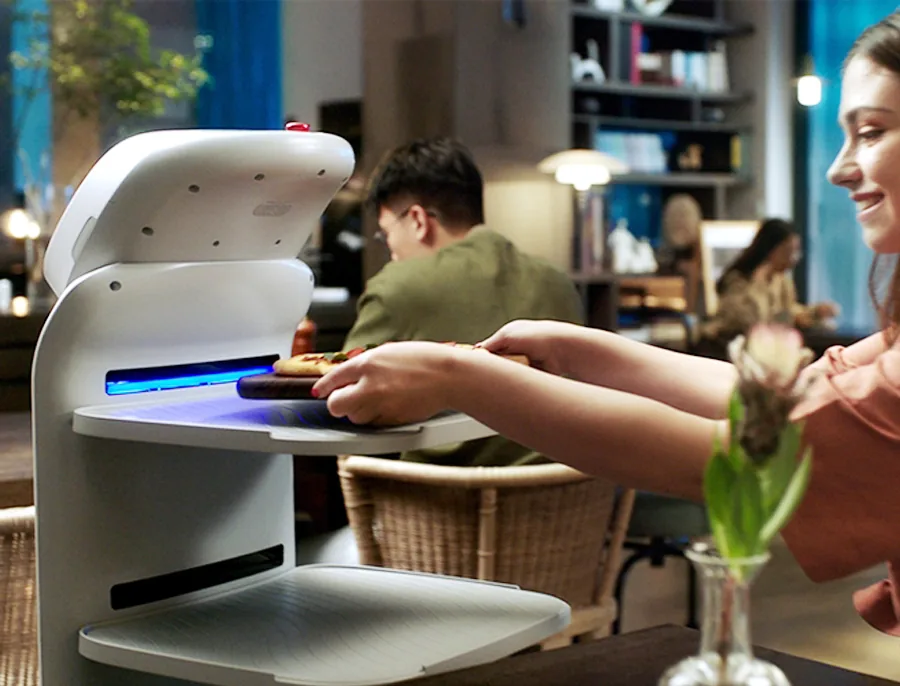
Every day a hospital generates internal transport requests: medications from pharmacy to ward, lab samples from ward to lab, meal trays, linens, and supplies. In most facilities this loop runs on porter rounds and on clinical staff walking the same corridor again and again. The AOMAN D1 carries up to 40 kg per run across four trays, enough to complete a whole cluster of ward deliveries in one trip, and navigates corridors down to 70 cm wide using lidar and depth vision for obstacle avoidance.
Why transport is the strongest first case
Removing the ward-to-pharmacy walking loop from a shift returns time to patient assessment and medication administration, which is what the workforce is licensed to do. Delivery runs also move lab samples at collection time instead of waiting for the next porter round, cutting the waiting leg out of specimen logistics. Four tray positions let cold items, time-critical items, and routine items travel in fixed positions on the same run. And every pickup and delivery is logged with a timestamp and robot ID, which gives the quality team a transport record it can audit.
Clinical-Grade Cleaning on Corridors and Clinical Floors
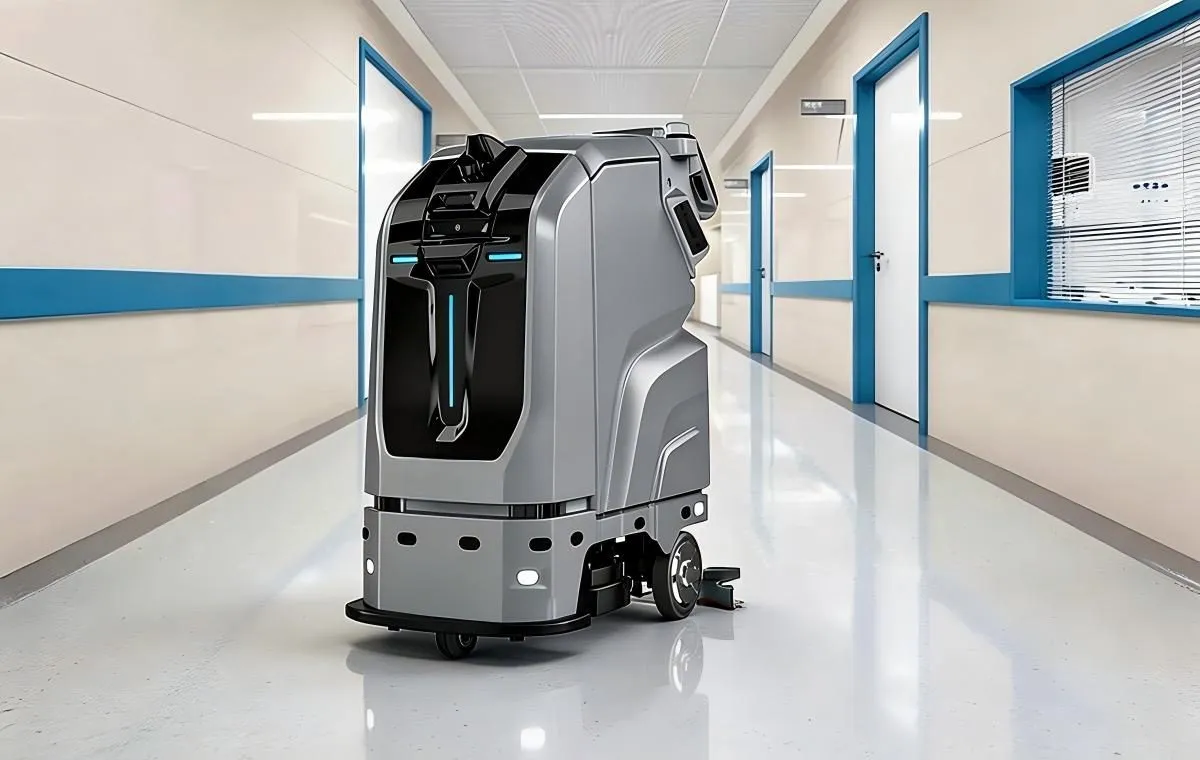
Manual cleaning is variable by nature: coverage depends on technique, timing, and how busy the ward happens to be. Hospital-acquired infections track surfaces, and a skipped corner stays skipped. The AOMAN C1 is built for hospital corridors, waiting rooms, and clinical floors. Up to 2,040 m²/h in open areas, a 790 mm squeegee, and a 70 L freshwater / 50 L recovery tank pair that keeps contaminated water separated from the clean supply.
Verifiable consistency
The argument for a cleaning robot is not speed alone, it is repeatability. The C1 executes the same route, the same dosing, and the same coverage on every pass, and logs each session with timestamps and coverage data. For clinics, surgery support areas, and smaller care units, the AOMAN C2 Pro cleans below a typical 70 cm desk height and fits 85 cm aisles at reduced volume. The right platform where corridors are tight and quiet operation matters.
In a publicly documented deployment at a Tokyo nursing care facility, a compact cleaning unit runs scheduled passes through care corridors, keeping floors clean and dry without disturbing residents or disrupting the shift rhythm of staff.
Choosing between the two cleaning platforms
The rule of thumb is scale, not technology. Open, high-throughput areas, corridors, waiting rooms, outpatient concourses, belong to the C1: the 2,040 m²/h rate plus 790 mm squeegee covers linear space quickly, and the 70 L / 50 L tank pair keeps runtime long between docks. Compact, cluttered, or quiet zones, exam rooms, clinics, offices, small care wings, belong to the C2 Pro, which trades tank capacity for a 70 cm desk clearance and a smaller footprint, so it fits spaces where a large unit simply cannot go. Mixed facilities almost always end up with both, sharing one charging corridor and one fleet dashboard.
One more distinction worth drawing: the schedule. The C1 earns its keep on long overnight passes, corridors and waiting areas at 2 AM, when the work happens at 2,040 m²/h on empty floor. The C2 Pro earns its keep during operating hours, in the spaces where a small room has to be turned over between patients. A plan that allocates one night pass plus a handful of daylight compact passes usually covers a clinical floor better than either machine alone.
Patient Guidance and Wayfinding
Large hospital campuses are hard to navigate, and the questions cluster into a few repeat categories: which wing, which floor, lab opening hours, what to bring for a fasting appointment. A AOMAN G1 guidance robot covers the routine layer at the front of house, 15 degrees of freedom for natural gesture, a six-microphone array with 5 m pickup to hear questions over a busy lobby, a 13 MP camera to support registration and check-in assistance, and multi-language guidance for international patients. It escorts visitors to the right department, answers the recurring pre-appointment questions, and returns to its dock automatically to recharge.
The division of labor is what makes it work: G1 absorbs the repetitive inquiries so reception and nursing staff handle exceptions, sensitive conversations, and escalations. Wayfinding runs on the same mapping layer as the rest of the fleet, see how the SLAM navigation stack works.
The practical setup is one unit at the main lobby plus optional coverage of the outpatient wing; the lobby unit serves the wayfinding volume, and a second, docked unit can be moved to the outpatient wing for registration-day peaks instead of buying a third. Configure the site's own question set, department list, visiting hours, lab prep instructions, into the unit's knowledge base before go-live; the escalation rule should send financial or personal-identification questions to a human, always.
Secure Waste and Linen Logistics
Hospitals produce regulated waste that needs chain-of-custody tracking, soiled linen that must not cross clean product, and sterile supplies that should arrive just-in-time. Because the AOMAN D1 runs four independent tray positions, a single unit can carry soiled linen back on one run while an uncontaminated tray brings clean supplies forward on the same route. Waste and clean streams stay physically separated, and each movement is recorded on the fleet log.
What to Evaluate Before Deploying
Infrastructure readiness
- Aisle and door clearance: the D1 needs 70 cm passages; the cleaning units need 85 cm. Survey before you demo.
- Elevator integration: multi-story facilities need the VDV elevator interface (commonly carried over BACnet or Modbus) so units can call and ride autonomously.
- Automatic doors: motion-sensor doors work best; adding actuators to manual swing doors adds cost and a maintenance item.
- Wi-Fi coverage: a site survey across every operational zone, run before the pilot, is the cheapest risk reduction in the project.
Hygiene and compliance alignment
- Robots in clinical zones should have sealed, smooth surfaces compatible with hospital-grade disinfectants.
- ISO 13482 covers the safety requirements for personal care robots, confirm the platform’s declaration before purchase.
- Plan post-clean ATP spot checks at a fixed sample set per zone. The pilot acceptance metric should be the surface-read trend, not the robot’s own log.
Staff adoption
Deployments with a designated on-site coordinator, a named person handling docking, consumables, and exceptions, start faster. A short training window of a shift or two per unit, plus clear messaging about what the robot does and does not do, produces the highest first-month utilization. Run the first workflow on one floor, measure over 90 days, then expand. For the fuller planning picture, see the healthcare industry guide.
Structuring the 90-day pilot
The most reliable pilot design is deliberately boring: pick one workflow (transport or cleaning, not both), pick one zone, and define the acceptance metrics before the unit arrives, staff minutes displaced per shift, sample turnaround hours on the pilot route, or floor coverage at the end of the shift. Weeks one and two are for mapping, navigation tuning, and route conflicts with beds, carts, and supply trolleys; weeks three and four establish the baseline under supervision; the remaining weeks run parallel to manual operations so the difference is measured, not assumed. Keep the manual process in place until the robot log shows it is genuinely at parity. The common failure mode is scaling on enthusiasm, not on evidence.
The Bottom Line
Service robots in healthcare are not a future concept. They absorb the logistics, cleaning, and guidance tasks that pull clinicians away from patient care, transport first, cleaning second, guidance last, each with a measured 90-day window before scaling. The sequence matters more than the technology: start with the workflow that costs the most staff time, and let the evidence from your own corridors carry the decision forward. The zone-by-zone routing and cycle-time side of the same decision is worked through in the cleaning labour cost model.
Tell us your ward layout, floor plan, and shift pattern, request pricing on a healthcare deployment and we will match unit counts and routes within 24 hours.