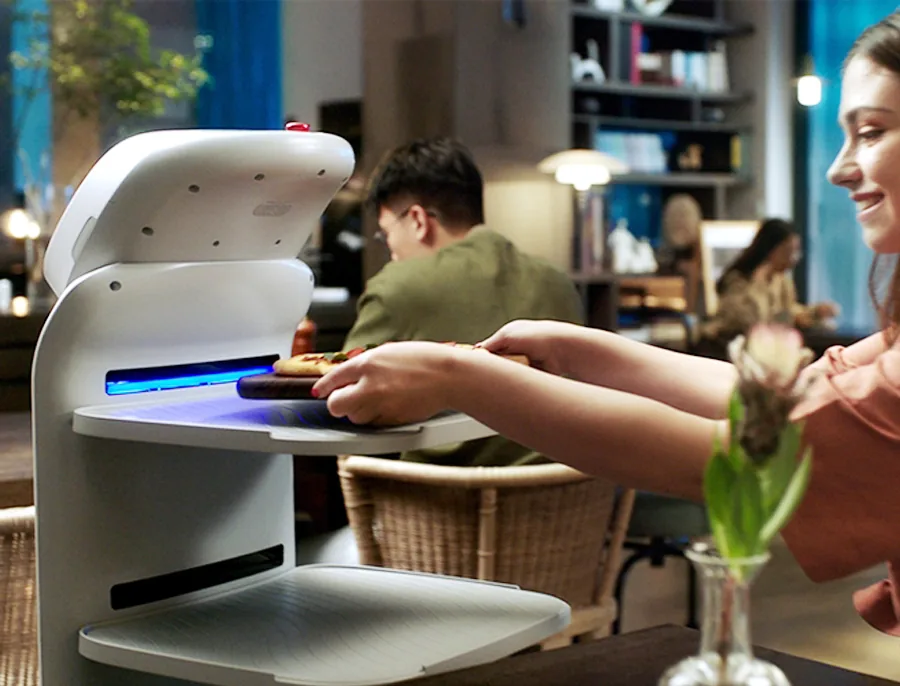
Service Robot Security & Data Privacy. What Facility Managers Must Know Before Deployment in 2026
At a glance: A service robot carries cameras, a live map of your building, occupancy data and a network connection. This guide covers the data service robots collect, GDPR/CIPA/CCPA obligations, network segmentation and encryption, physical tamper resistance, and the exact vendor-security questions to add to your RFP.
Because service robots are mobile, connected and camera-equipped, they sit at a rare intersection: operational equipment, IT hardware and a personal-data sensor. That combination triggers questions most facilities buy robots without asking. A robot that scrubs a floor also maps your building, records what its camera sees, and stores it on a vendor platform. Which means your procurement decision is also a security and privacy decision.
What Service Robots Collect
A modern service robot is a data-gathering platform. The list matters because the GDPR/CCPA and CCTV-consent obligations attach to it:
| Data Type | Why It Is Collected | Privacy Trigger |
|---|---|---|
| Video / camera feeds | Navigation, obstacle avoidance, monitoring | Personal data, biometric in some cases |
| Occupancy & movement | Map building, route optimisation | Location data, movement patterns |
| Wi-Fi / BLE signals | Indoor positioning | Personal data if tied to individuals |
| Fleet telemetry | Runtime, battery, coverage | Operational, resolves to the site |
For a broader view of what the platform does with this data, see the fleet-management technology and the fleet management guide.
The Regulations That Apply
Wherever your facility operates, data-protection and CCTV rules attach to a robot's camera. Two points matter most on the ground:
- GDPR / CCPA-CPRA: if the robot records identifiable people, you need a lawful basis, a privacy notice and, in some cases, a camera-sighting or opt-out. A robot that films a public lobby is CCTV under most frameworks.
- CIPA (US states like California) and PIPL (China): state-level and cross-border rules that separately govern camera placement and the export of data across borders. If your vendor processes video on a server overseas, that is a data-transfer decision with its own obligations.
Security and liability sit together. The insurance and liability guide covers how a data or safety incident is addressed contractually; the safety and compliance guide covers the wider regulatory picture.
Network and Platform Security
The practical security layer for a connected robot fleet is the same as for any IoT deployment, but with the addition that the device moves through your most sensitive spaces. Treat a robot as an untrusted endpoint on a segmented network, not as trusted hardware.
- Network segmentation: put robots and their management platform on a dedicated VLAN, not the general office or OT network. A camera-equipped device that can reach your ERP is a liability, not a feature.
- Encryption: require TLS for all device-to-cloud traffic and at-rest encryption for stored video and maps.
- Identity and access: role-based accounts, MFA on the fleet console, and least-privilege for the facility staff who can watch or export footage.
- Patches and updates: ask how the vendor ships security patches and how you get notified. Unpatched IoT devices are a known attack surface.
- Data residency and retention: know where footage is stored, how long, and that you can delete it.

Physical Security and Tamper Resistance
A robot is also a physical object that can be interfered with. For the AOMAN C2 Pro and similar units that run unattended, check for tamper detection, lockable storage, and an alert when a unit is moved off its programmed area or its dock. The AOMAN G1 reception unit, which handles visitor interaction and may carry a display, should expose a minimal local interface and restrict administrative functions to the fleet console.
Eight Questions to Ask Your Vendor in the RFP
- Where is video stored, and can we export or delete it?
- Which data leaves our facility, and to which region?
- What network ports and protocols does the unit require?
- Does it support on-premises or dedicated-cloud platform hosting?
- How are security patches delivered and what is the SLA?
- Who can access the fleet console, and is MFA enforced?
- Does the unit record continuously or on event, and can zones be masked?
- What happens to our data at end of contract?
For the full procurement structure these questions slot into, the RFP and procurement template is the right starting point; the change management guide covers how to brief staff and clients on what the robot records.
Building Security Into the Contract
Demand a written security and privacy annex rather than a marketing page. It should name the encryption standard, the data-retention window, geo-fencing or mask zones, the incident-notification window, and the end-of-life data destruction step. Negotiate it before sign-off, because a robot already on your floor is a data point already flowing to a third party.
The Risk-and-ROI Picture
Security and privacy are not purely cost. They are gate-keeping requirements that determine whether a roll-out is approved by your IT and legal teams in the first place. Plants that define them early clear procurement faster, and facilities that skip them typically pay later in rework, deletion requests or incidents. The honest framing is not "can we afford security?" but "can we afford to explain a camera incident we failed to plan for?"
Tell us your country, facility type and data constraints, request a security review of your fleet and we will map the platform, network and privacy requirements to your site within 24 hours.