
Service Robot Noise Levels: dBA by Duty Cycle and Night-Operation Compliance
At a glance: Noise is the least specified and most complained-about attribute of a service robot fleet. A unit that is quiet on a datasheet can still generate complaints if it is scheduled to run at the wrong hour in the wrong venue. This guide quantifies noise by duty cycle, sets out the night-operation limits that apply by venue type, and shows how to write a noise specification that will actually be met.
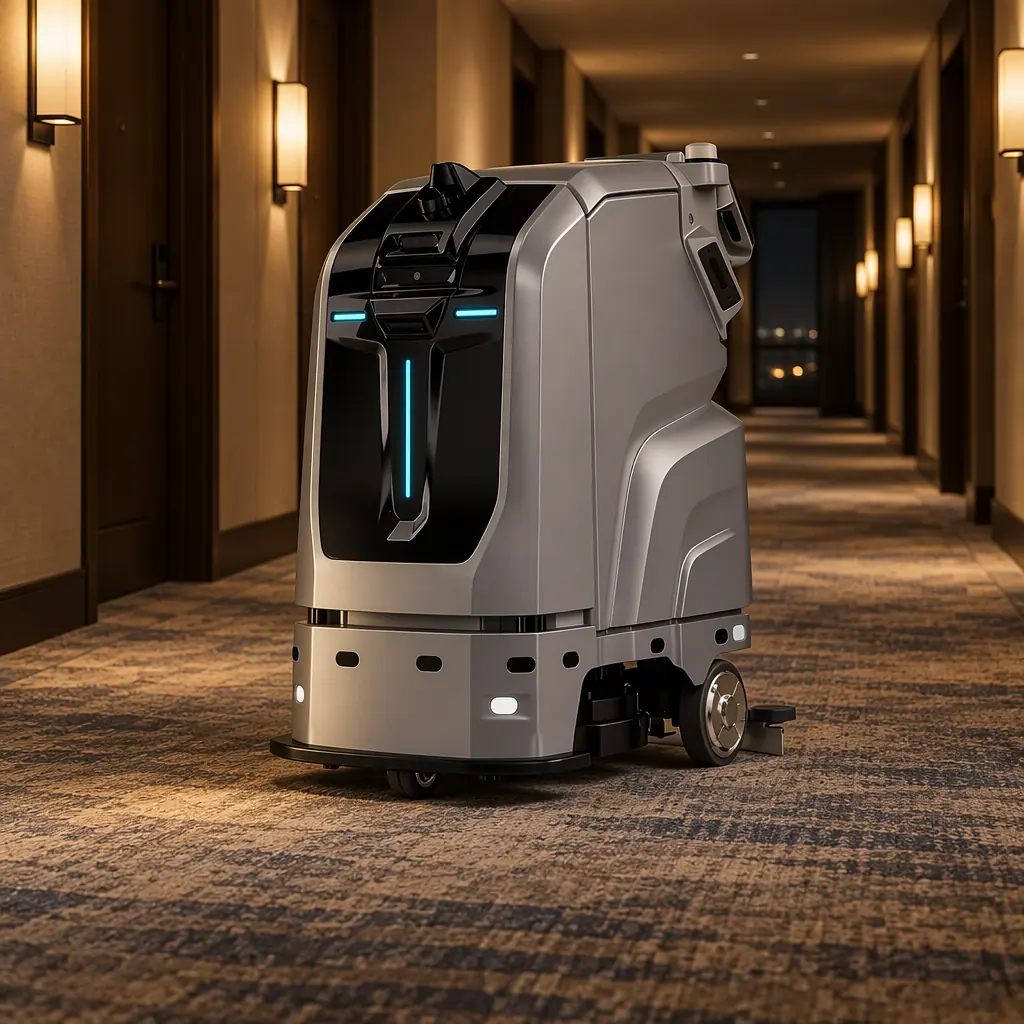
Why a Single dB Figure Is Not Enough
Robot datasheets quote one noise number, and it is almost always measured in the mode that flatters the machine. The number that matters to a hotel, a hospital ward or a library is the one produced during the duty the robot is actually assigned, at the hour it is actually scheduled, at the distance a person actually is. Those three variables can move the effective level by more than 15 dBA, which is the difference between unnoticed and unacceptable. A specification built on the datasheet figure alone will be met on paper and failed in the building.
The reason is that a service robot is not one sound source, it is several. Drive motors, brush or roller, vacuum turbine, water pump and squeegee all contribute, and they switch on and off with the duty cycle. Noise is therefore a function of duty, and the honest way to specify it is a table rather than a number. This is the same principle that makes scheduling, covered in cleaning robot night-shift scheduling, so important: the schedule determines which duty runs at which hour, and therefore which noise level the building actually experiences.
Measuring Properly: Method Before Numbers
A dBA figure is only comparable if the method is stated. Ask for, or specify, all of the following, because a vendor who quotes a level without them is quoting marketing.
| Parameter | Requirement | Why it matters |
|---|---|---|
| Weighting | A-weighted (dBA) | Approximates human hearing; C-weighting flatters low-frequency motor noise |
| Distance | 1 m and 3 m from the unit | Sound falls with distance; 1 m alone overstates the experience at 3 m |
| Duty stated | Each mode measured separately | Drive-only is far quieter than vacuum-plus-brush |
| Surface | Hard floor and carpet | Reflective floors and brushes differ markedly |
| Environment | Stated background level | Only the excess over background is actionable |
| Instrument | Class 1 or 2 sound level meter, recent calibration | Makes the figure defensible |
Insist on the duty-by-duty table at 1 m and 3 m, on both hard floor and carpet, with the background level noted. That table is the specification, and it is what the acceptance test measures against at commissioning. A single headline figure should be treated as unverified until the table exists.
Expected Levels by Duty Cycle
The table below gives the ranges a commercial service robot can reasonably be expected to produce. The spread within each row reflects machine size, brush type and whether the unit uses a turbine or a brush vacuum. Use it to sanity-check a vendor's claim and to plan the schedule.
| Duty | At 1 m (dBA) | At 3 m (dBA) | Notes |
|---|---|---|---|
| Idle, powered, screen on | 30 to 38 | 28 to 35 | Fan and electronics only; effectively silent in a normal room |
| Driving, no cleaning | 48 to 56 | 42 to 48 | Motor and drivetrain; the baseline for delivery duty |
| Sweeping only | 58 to 64 | 52 to 57 | Side and main brushes on hard floor |
| Scrubbing / mopping | 60 to 66 | 53 to 58 | Brush plus pump and squeegee |
| Vacuum-assisted cleaning | 66 to 74 | 58 to 66 | Turbine dominates; the loudest normal duty |
| Carpet vacuum duty | 68 to 76 | 60 to 68 | Highest draw; check the venue's limit before scheduling |
| Cue / announcement | 60 to 70 peak | 55 to 62 peak | Brief and intermittent; still counts in a quiet venue at night |
The practical reading is that a delivery robot driving a hotel corridor produces around 45 dBA at 3 m, which is comparable to a quiet conversation and rarely a problem at any hour. A carpet vacuum duty at 3 m is around 64 dBA, which is louder than normal speech and will be heard through a light partition. The venue and the hour decide whether that matters. The delivery case is covered further in service robots for hotels and resorts, where corridor noise at night is the recurring complaint.
Night-Window Limits by Venue Type
Few jurisdictions set a robot-specific limit, but almost all set a general environmental noise limit for the night period, and the robot is caught by it. The table below gives working figures for the level that should be measurable at the nearest sensitive receiver, which is usually the nearest guest room, ward or reading area rather than a point in the corridor.
| Venue | Night window | Target at nearest receiver |
|---|---|---|
| Hotel / serviced apartment | 23:00 to 07:00 | Drive-only duty; avoid vacuum near guest rooms |
| Hospital ward / clinic | 22:00 to 07:00 | Lowest practical; delay non-urgent cleaning to day |
| Library / archive | All occupied hours | Drive-only during opening hours |
| Office (occupied) | 08:00 to 18:00 | Vacuum duty relocated away from active desks |
| Residential communal areas | 22:00 to 08:00 | Drive-only; no scrubbing or vacuum |
| Retail / mall (public) | Trading hours | Full duty acceptable; observe local limits |
The operative rule for the quiet venues is duty restriction rather than model selection. Almost any modern service robot can drive quietly; the noise arrives with the cleaning head, so the schedule should separate transport duty, which can run at night, from processing duty, which is moved to day or to a window when the sensitive spaces are empty. This is a scheduling decision made possible by a fleet that reports its own duty, and it belongs in the deployment plan alongside the coverage arithmetic in service robot deployment and throughput planning.
Mitigation: Reduce, Relocate, Reschedule
Three levers, in order of effectiveness, solve most noise problems without changing the machine.
- Reduce. Choose the quietest capable unit for the venue, keep brushes and squeegees in good condition, and run lower-power vacuum modes where the soil load allows. Worn brushes are both less effective and louder.
- Relocate. Shift the duty away from sensitive receivers, or move the receiver, by scheduling vacuum passes on corridors away from guest rooms and using the quiet hours for transport. Where a route must pass a ward or reading room, split the duty so the head is off for that stretch.
- Reschedule. Move the loud duty into the window when the sensitive space is empty. A hospital can vacuum a corridor at 06:00 rather than 02:00 without changing anything about the robot.
Structural mitigation, such as acoustic doors or soft floor coverings, is usually a building project and rarely justified for a robot alone, but it is worth noting because a carpet that would reduce noise also changes the duty cycle. Where the venue is genuinely noise-critical, as in healthcare environments and libraries and knowledge centres, the duty restriction and the schedule are the controls that work, and they cost nothing but planning.
Writing Noise Into the Tender
A noise requirement is only enforceable if it is specific. Ask for: the A-weighted level per duty at 1 m and 3 m on hard floor and carpet; the measurement method and instrument class; a sample measurement from a comparable installation; and an acceptance test at commissioning using the same method. Then make the schedule conditional on the measured result. Where a vendor cannot supply the table, treat the claim as unproven and test it in a pilot before committing to a fleet, the approach set out in service robot pilot and trial programs. A measured table at acceptance turns a soft promise into a verifiable number, and it gives the operator the evidence to defend the schedule to a complaining occupant.
The Takeaway
Specify noise as a table, not a number. Measure A-weighted per duty at 1 m and 3 m, know that transport duty is quiet and cleaning duty is loud, apply the night-window limits that fit the venue, and use the reduce-relocate-reschedule sequence before spending on the robot. Most noise complaints are scheduling problems wearing a machine-specification costume, and both are fixed by the same discipline: know the level per duty, know the hour, and keep the loud duty away from the sensitive space.
Tell us your venue type, operating hours and floor build-up, and we will help you set the noise requirement and the schedule. Contact us.
Continue Reading
Get a Quote
Tell us about your space and workload, we reply within 24 hours.