
Robots as a Service for Janitorial Contractors, Winning Bids Without Adding Headcount
At a glance: A C1 scrubber covers roughly 2,040 m²/h against a manual auto-scrubber's 800–1,200 m²/h. For janitorial contractors, that is not a labour-replacement story, it is a bidding-capacity story. This guide covers the unit economics of RaaS for contractors, how to model a bid with robots, and how to protect margin in a historically thin industry.
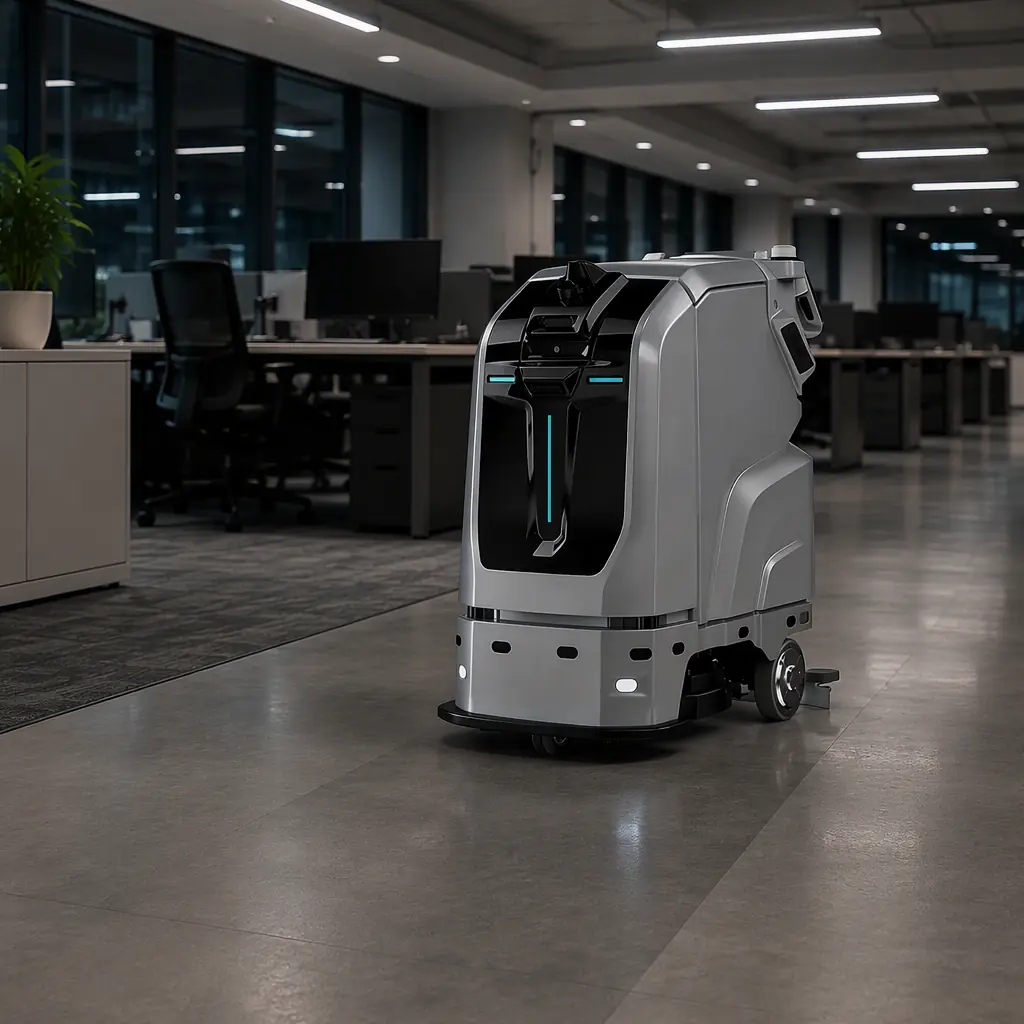
Janitorial and custodial contracting is a difficult business for a specific structural reason: the service is largely undifferentiated, the market is price-driven, and the primary cost input is labour that is both scarce and rising. Contractors compete for buildings on a price per square foot per month, win on the thinnest survivable margin, and absorb the consequence when a night-shift vacancy cannot be filled. Bidding a larger contract usually means hiring more people, a decision that increases revenue and risk in the same motion.
Robotics changes the shape of that constraint, but not in the way the industry conversation usually frames it. The value to a contractor is not primarily the labour saving on the contracts they already hold. It is the ability to bid work that would previously have required headcount they cannot reliably recruit.
Why the Contractor's Constraint Is Recruitment, Not Cost
Ask a janitorial operator what limits their growth and the answer is rarely demand. It is the inability to staff the contract they have already won. Night-shift and early-morning cleaning roles are among the hardest positions to fill in commercial facilities work, with vacancy rates in these shifts persistently high across municipalities, a pattern noted in the public-sector facilities review, where court and civic building cleaning rosters were found to carry high night-shift vacancy rates.
This reframes the robotics case. If the binding constraint were purely cost, the decision would be a straightforward comparison of loaded hourly rates. Because the binding constraint is the ability to fill shifts at all, a robot that performs 55–65% of the cleanable square footage on a contract does not primarily reduce the labour bill. It converts a contract the contractor could not have staffed into one they can.
The practical effect on bidding capacity is direct. A contractor with fifteen frontline staff who can reliably field twelve is currently constrained to the work twelve people can cover. Adding robots to a site means the same twelve people can carry a portfolio that previously required sixteen to eighteen, not because the people work harder, but because the machines absorb the large-area routine work that consumes most of the shift.

The Unit Economics: Robot Coverage Against Manual Methods
Contractor economics turn on a small number of ratios. The most important is coverage per labour hour, because it determines how many staff hours a contract requires and therefore whether the bid price is competitive and profitable at the same time.
| Method | Coverage Rate | Staff Hours per 100,000 sq ft per Night | Notes |
|---|---|---|---|
| Manual mopping | 250–400 m²/h | ~95 hours | Small-area and detail work only |
| Ride-on / walk-behind auto-scrubber | 800–1,200 m²/h | ~32 hours | Requires a trained operator for the full shift |
| AOMAN C1 autonomous scrubber | 2,040 m²/h | ~18 hours equivalent | Supervised rather than operated |
| AOMAN C2 Pro (compact) | Compact cycle, 85 cm clearance | , | Suites, corridors, tight-aisle areas a C1 cannot enter |
The coverage-rate gap between manual scrubbing and an autonomous scrubber is roughly five to eight times. Even discounting heavily for the fact that only a proportion of a contract's square footage is machine-cleanable: typically 60–75% in a commercial office, more in retail and industrial, the shift in required staff hours is substantial.
The second ratio is the one that determines whether the bid wins: the loaded cost of a staff hour against the robot's cost per hour of operation. This varies by market, but the structural relationship holds widely. A robot's fully-loaded hourly cost including lease, maintenance, and consumables is typically a fraction of an equivalent supervised labour hour, and unlike labour it does not carry overtime multipliers, holiday cover, or recruitment cost.
The comparison framework and the cost components to include on both sides: including the ones contractors habitually omit, such as supervision overhead and the cost of unfilled shifts, are set out in the ROI methodology.
Robots as a Service: Why RaaS Fits Contract Cash Flow
The structural reason RaaS suits janitorial contracting so well is timing alignment. A janitorial contract generates revenue monthly over a term of typically one to three years. Capital equipment is paid for up front. Contractors are therefore being asked to fund an asset whose payback period closely matches the contract they intend to serve with it. While carrying the risk that the contract is not renewed.
A RaaS structure converts the equipment into a monthly operating cost that runs alongside the contract revenue. The advantages for a contractor are concrete rather than theoretical:
Bid-time cost certainty. The monthly robot cost is known before the bid is submitted, which means the bid can be priced on a fixed machine cost rather than an estimate of future labour availability.
Contract-term matching. The RaaS term can be set to the contract term, so if the contract ends, the operating cost ends with it. Capital ownership does not leave the contractor holding an idle asset.
Balance-sheet treatment. Operating rather than capital treatment frequently matters for contractors with limited borrowing capacity, and it preserves the working capital needed to mobilise a new contract, uniforms, equipment, supervision, and the payroll float that precedes the first billing cycle.
Scaling without a capital decision. Adding a robot to an existing site becomes an incremental monthly decision rather than a board-level capital approval, which matters when a bid decision has to be made in days.
The structural mechanics of these agreements, including term, service inclusions, and end-of-term options, are covered in our guide to RaaS and financing models.

Modelling a Bid With Robots: A Worked Structure
Contractors pricing with robotics need a bid model that treats machines and labour as a single blended delivery cost. The structure below is illustrative, using round figures for a mid-size commercial office contract.
The scope. 220,000 sq ft of cleanable area across six floors, a lobby, and a two-level parking structure. Nightly service, five nights per week. Machine-cleanable portion: 68% of total area.
The labour-only bid. At an equivalent auto-scrubber productivity of roughly 1,000 m²/h and 32 staff hours per 100,000 sq ft of machine-cleaned floor, the nightly routine requires about 70 hours before supervision, consumables, and the detail work that machines do not perform. Apply the market loaded hourly rate and the monthly cost lands in a range the contractor knows well, and the bid competes on price against every other contractor calculating the same number.
The robot-assisted bid. Deploy three C1 units on the open floors and two C2 Pro units on suites and tight corridors. Coverage for the machine-cleanable area rises substantially; the human crew is retained for detail work, restrooms, glass, and the areas the machines cannot reach, but the large-area overnight hours drop markedly. The robot cost enters as a fixed monthly line.
The blended outcome. The contractor can price the contract competitively while improving contribution margin, because the fixed machine cost is lower than the variable labour hours it displaces, and, critically, the robot hours do not call in sick, do not require overtime multipliers, and do not need to be recruited in a market where those shifts are hardest to fill.
The Metrics a Contractor Should Track Per Contract
Contractors who deploy robots without measuring the right figures tend to conclude the technology has not worked, when the real problem is that they measured an unhelpful metric. Revenue per employee is the wrong measure, it rises mechanically when equipment is added.
Coverage per labour hour. The primary productivity measure, and the one that should trend upward with each deployment. Flat performance here means the robots are not being scheduled into the windows where they displace the most hours.
Shift fill rate. The proportion of required shifts actually staffed. For a contractor, this is often a more meaningful measure of robotics value than any cost metric, because unfilled shifts are lost revenue and contract risk, not just inefficiency.
Verified coverage compliance. The percentage of contracted scope with machine-generated evidence. Increasingly, this is what separates a contract renewal from a competitive rebid, and the underlying operational pattern is documented in the campus deployment review where measured cleanliness replaced visual inspection.
Contribution margin per contract. The figure that determines whether an aggressive bid was a growth decision or a mistake. Tracking it per contract rather than in aggregate is essential, because robotics changes the cost structure differently at different building types.
Fleet utilisation. Contractors often share robots across sites on different days, which works well when the platform supports multi-site scheduling. Under-utilised units are pure margin leakage. The mechanics of scheduling a fleet across buildings are covered in the fleet management analysis.

Winning the Bid: What Changes in the Proposal
A robot-assisted bid is not simply the same proposal with a lower price. There are three changes that materially improve win rates, and they are worth putting in the document explicitly.
Evidence instead of assurance. Most janitorial proposals promise a standard of cleanliness. A robotic deployment can offer machine-generated coverage records showing what was cleaned and when, available to the client. For procurement teams that have been disappointed before, verifiable reporting is often the deciding difference.
Consistency of delivery. Labour-based cleaning quality varies with who is on shift. Robot-performed routine coverage is identical in month one and month twelve, which lets the contractor make a defensible consistency commitment rather than an aspirational one.
Scalability as a stated capability. Contractors who can add capacity incrementally, through RaaS units rather than recruitment, can credibly bid multi-site and portfolio contracts where the client's concern is whether the contractor can actually staff a mobilisation in thirty days.
The last point is often the one that wins a competitive tender. A building owner choosing between two similarly priced contractors is frequently choosing between two recruitment promises, and only one of them is backed by equipment that is available on a fixed delivery schedule.
Where This Leaves the Crew
The honest answer, and the one that matters for workforce planning, is that crews get restructured rather than eliminated. In the deployments we see, the roles change in three predictable directions: machine supervision replaces machine operation, so an operator who drove a scrubber for a full shift becomes a supervisor covering several autonomous units plus a partner for detail work; the labour freed from large-area scrubbing moves to restrooms, glass, high-touch surfaces, and the areas robots cannot reach, which are frequently the areas clients complain about most and which are chronically under-served when a crew is stretched; and hours move from rigid night blocks toward more flexible scheduling that suits some workers better and others less.
This is not a story every incumbent worker experiences as positive, and contractors should plan for it rather than announce it. What matters commercially is that the restructuring is a deliberate operating decision rather than a response to a vacancy crisis. Which is exactly the position a contractor wants to be in when a large contract comes up for bid.
Tell us the sites you are bidding, the cleanable area, and your shift-fill constraints. We will help you model the fleet configuration and the RaaS structure so the bid is priced on known machine costs rather than on labour you are not certain you can hire. Contact us.