
Service Robot Battery Health and Replacement Planning
At a glance: Most fleets replace batteries either too early, paying for capacity they already had, or too late, after a robot starts missing shifts. The decision belongs to a number, not a feeling: state of health, the ratio of present capacity to rated capacity, measured against the runtime your route actually needs. This guide sets out how to instrument state of health, how to read capacity fade over a fleet, and the point at which replacement is cheaper than the work the pack can no longer do.

Why a Degraded Pack Does Not Announce Itself
A lithium pack does not fail at the end of its life; it shrinks. A pack rated for 100 amp-hours might deliver 92 amp-hours after four hundred cycles and 78 amp-hours after a thousand. Nothing breaks, no error appears on the dashboard, and the robot still completes a route it ran comfortably two years ago, until one day it does not. The failure is a missed shift, and by then the decision to replace was already a year overdue.
This is why battery health cannot be managed from a fault log. Faults describe what has broken; state of health describes what has worn out. A service robot fleet needs both, and the second is the one that governs the replacement budget. The pack that is quietly at 76 percent state of health is not a maintenance item yet, but it is a procurement item, and a fleet of twenty units with mixed ages will have packs spread across the whole degradation curve at any given moment.
The drivers of fade are known, and they are manageable. Cycle count is the largest single factor, followed by depth of discharge, average cell temperature, and how the pack is charged. A pack cycled shallowly to 40 percent depth on a cool floor fades far more slowly than one run to 100 percent depth on a hot mezzanine. That is not an abstract point for a buyer: it means the same pack model can last three years on one site and five on another, and any vendor quoting a single cycle-life figure without reference to duty cycle is quoting a datasheet, not a fleet. The pack-level behaviour behind that spread is set out in the guide to battery pack specification and sourcing.
What State of Health Actually Measures
State of health (SOH) is the ratio of a pack's present usable capacity to its rated capacity, expressed as a percentage. A new pack is 100 percent; end of life is conventionally defined as 80 percent, the point at which capacity fade accelerates and internal resistance climbs faster than the first portion of life. That 80 percent convention is a definition, not a physical cliff, and it is worth understanding what it does and does not tell you.
What it tells you is how much energy the pack can still store. What it does not tell you on its own is whether that energy is enough for the work. A pack at 82 percent SOH on a short route has years of service left; the same pack on a route that consumed 95 percent of its new capacity is already marginal. SOH is therefore only actionable alongside a fourth number: the depth of discharge the route demands. The three figures that matter are the ones in the table below, and a serious fleet dashboard shows all three side by side.
| Metric | What it means | Where it comes from |
|---|---|---|
| State of charge (SOC) | Energy in the pack right now, as a percentage | BMS coulomb counting, reported live |
| State of health (SOH) | Present usable capacity versus rated capacity | BMS capacity estimate, updated over full cycles |
| Depth of discharge (DOD) | How much of the pack a route consumes | Energy consumed per route, logged by the fleet |
| Round-trip efficiency | Energy stored versus energy put in | Charge and discharge logs, drifts with age |
| Internal resistance | Resistance proxy for age; rises as the pack wears | BMS, or derived from voltage sag under load |
The internal-resistance figure is the leading indicator that the BMS usually already computes but that buyers rarely look at. Resistance climbs before capacity falls off a cliff, so a fleet that tracks resistance sees the end of a pack coming a quarter earlier than one that waits for the SOH percentage to cross 80. That lead time is what turns a replacement from an emergency into a line item.
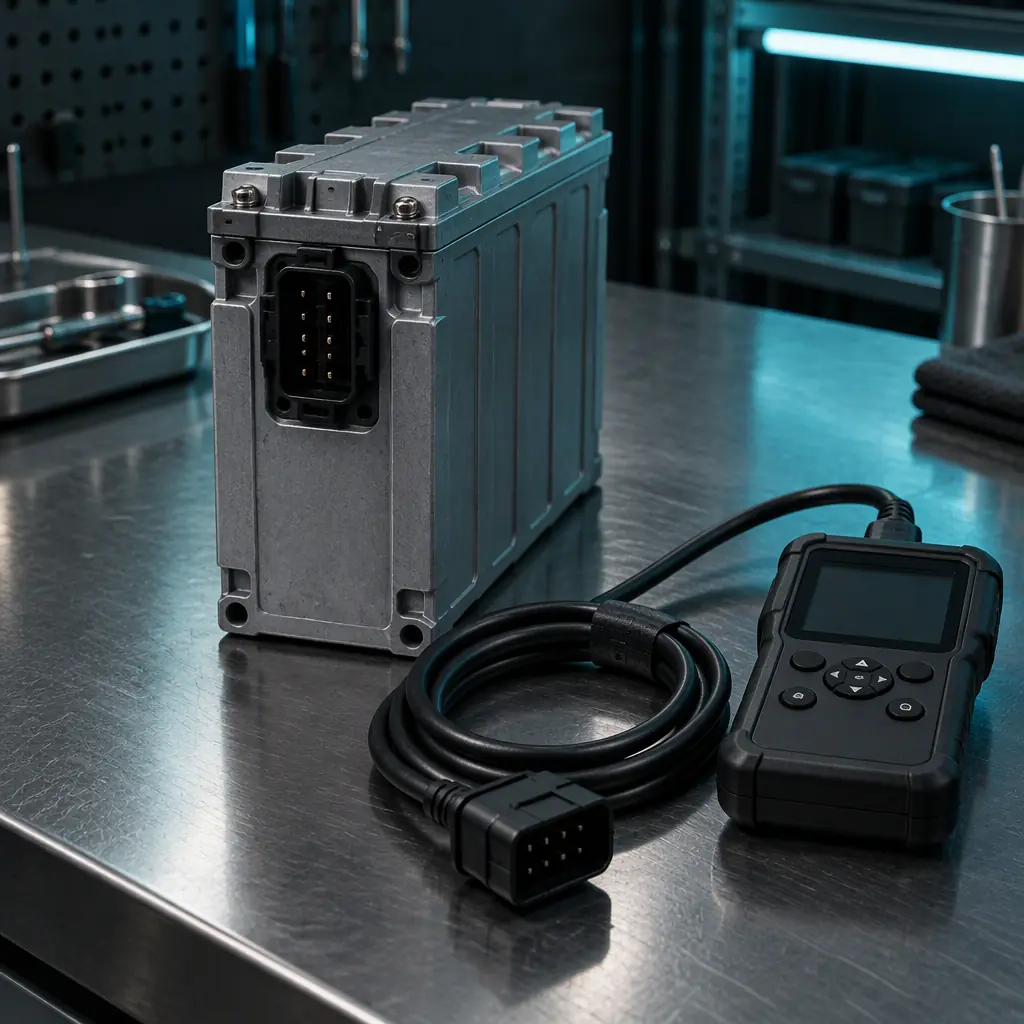
The Capacity-Fade Arithmetic Behind the Decision
The replacement decision is a comparison between the cost of a new pack and the cost of the work the old pack can no longer do. Both sides are calculable, and putting numbers on them removes the guesswork that makes battery planning contentious.
Start with the work the pack forfeits. If a route needs 9.0 kilowatt-hours of energy and the pack's usable capacity has fallen from 10.0 to 8.4 kilowatt-hours, the robot can no longer complete the route on one charge. The deficit is met in one of three ways: an opportunity charge in the middle of the shift, a slower route that leaves some area unserved, or a second robot deployed to cover the gap. Each has a cost. The mid-shift top-up consumes an hour of productive time; the unserved area becomes a complaint; the second robot is a five-figure capital decision made to avoid a four-figure maintenance one. Framed that way, the arithmetic usually settles itself.
Then amortise the new pack. A pack costing a few thousand dollars that restores two years of full-shift runtime carries a much lower cost per productive hour than the labour of the workaround. The comparison is not "pack price versus nothing"; it is "pack price versus the cost of the deficit", and the deficit compounds every cycle.
| Scenario | Route energy needed | Pack usable capacity | Consequence |
|---|---|---|---|
| New pack | 9.0 kWh | 10.0 kWh | Full route, one charge, comfortable margin |
| Mid-life pack | 9.0 kWh | 9.1 kWh | Route completes with almost no margin; sensitive to cold |
| Degraded pack | 9.0 kWh | 8.4 kWh | Route no longer completes; top-up, truncation, or a second unit |
The middle row is the trap. A pack at 91 percent of nameplate that exactly clears the route looks fine on the dashboard and behaves fine in summer, then starts failing on cold mornings when efficiency drops. A fleet that sets its replacement trigger at "route completes with 15 percent margin remaining" will replace that pack on schedule; one that waits for a fault will replace it after the third missed shift.

Setting a Fleet Replacement Trigger
A replacement trigger converts the arithmetic into a rule the operations team can apply without a spreadsheet debate each time. The trigger has two parts: a capacity threshold and a margin threshold, and whichever is crossed first starts the replacement process.
- Capacity threshold. Replace when measured SOH falls below the level at which the route's depth of discharge exceeds 85 percent of usable capacity, not at a flat 80 percent of nameplate. On a short route that might be 70 percent SOH; on a punishing one it might be 88.
- Margin threshold. Replace when remaining margin after the route drops below 15 percent, because cold weather and pack age each shave a few points and the margin is what absorbs them.
- Resistance trend. Begin procurement when internal resistance has risen by a defined percentage from the fleet baseline, even if capacity still looks acceptable, because the resistance curve leads the capacity curve.
- Fleet spread. Track the standard deviation of SOH across identical packs on identical routes. A widening spread means loading or thermal conditions are uneven, which is an operational fault to fix before it becomes a procurement one.
Taken together these four rules give a fleet manager a queue: which packs are near replacement, which are candidates next quarter, and which sites are aging batteries faster than the fleet average. That queue is what makes the battery budget predictable instead of reactive. The buying side of the same plan, including how replacement packs are matched to original specification, is covered under replacement lifecycle planning.
Warranty Clauses That Cover Degradation
Most pack warranties cover defects, not decline. A defect warranty promises the pack will not break; a degradation warranty promises the pack will retain a stated percentage of capacity for a stated time or cycle count. The two are different contracts and only the second one protects the buyer against the slow fade that motivates this entire exercise.
A degradation clause should state three things unambiguously: the capacity retention floor (for example, 80 percent of rated capacity), the term (for example, 24 months or 1,200 cycles, whichever comes first), and the measurement method (a defined test at a defined temperature and charge rate, so both parties agree on the number). A clause that guarantees "normal capacity retention" without a percentage and a test method is not a degradation warranty; it is a sentence that will be argued about. Buyers should check how the clause interacts with warranty and contract terms and with the service contract that sits alongside it.
The measurement question is where degradation warranties quietly fail. Capacity is temperature-dependent and rate-dependent, so a pack tested warm discharges more than the same pack tested cold. A clause that fixes the test protocol protects both sides; a clause that leaves it open lets the vendor test under the most favourable conditions and the buyer under the worst. Fleet data, meanwhile, gives the buyer an independent record: if the BMS has logged SOH declining through the warranty period, that log is evidence a vendor cannot easily dismiss.

Instrumenting Health Without Buying New Software
Battery health telemetry usually does not require a new platform. Most BMS units already publish SOC, SOH, cycle count, cell voltages, and temperature over the same bus the fleet controller already reads, whether that is RS485, CAN, or a network gateway. The communication layer that makes this data reachable is the subject of battery communication protocols, and the practical point is that the register map a buyer should demand in a specification is exactly the register map that feeds a health dashboard later.
Three data practices turn raw telemetry into a replacement plan. First, log energy consumed per completed route, not just charge cycles, because the route-consuming figure is what determines whether remaining capacity is enough. Second, timestamp every full charge so that SOH estimates are tied to cycle count rather than calendar age; a pack that sat idle for six months has aged less than its date suggests. Third, keep the logs for the life of the pack, because a degradation warranty claim depends on a history the vendor can be shown.
The same telemetry feeds the maintenance side of the fleet. A pack whose resistance is climbing is also a pack whose range is shrinking, which shows up in the same operational data used for telemetry-driven predictive maintenance. Instrumenting health once serves both the replacement decision and the broader reliability picture, which is why it belongs in the procurement checklist rather than the afterthought column.
What to Put in the Specification
A buyer who wants battery health to be manageable five years after purchase should specify it at the point of purchase. Six items carry the most weight.
- Expose SOH and cycle count over the fleet interface, not only inside a vendor app, so the operator owns the data.
- State the capacity-retention warranty with a percentage, a term, and a test protocol.
- Define the replacement-pack form factor now, so packs remain available when the first one wears out.
- Specify the BMS register map so health data can be read by third-party fleet software.
- Ask for the degradation curve at the route's actual depth of discharge, not the datasheet's standard test.
- Confirm cell-level access for diagnostics, so a single weak cell can be identified before the whole pack is replaced.
These six items cost little to negotiate at purchase and are difficult, sometimes impossible, to add later. The operator who specifies them buys a fleet whose batteries can be planned; the operator who does not buys a fleet whose batteries will be discovered, one missed shift at a time. The financial side of the same plan, and how the replacement spend is funded, is treated in battery replacement reserve planning.
The Takeaway
Battery health is a number, and the number that matters is not the datasheet's cycle life but the measured state of health against the depth of discharge your routes demand. Track SOH, cycle count, and internal resistance from day one; set a replacement trigger on route margin rather than a flat percentage; and buy a degradation warranty with a stated floor and test method. A fleet that does these three things replaces packs on a schedule it chose, at a cost it budgeted, instead of on a schedule the batteries chose for it.

Get a Quote
Tell us about your space and workload, we reply within 24 hours.