
Robot Audit Data: Turning Service Claims Into Verifiable Records
At a glance: A machine report that says a route was completed is a self-report, not evidence. The five properties a robot record needs before an invoice can be settled on it, how to validate coverage claims cheaply, the arithmetic of a monthly deduction, and the exit clause to negotiate before signature.
A contract that pays on evidence is only as good as the evidence. Cleaning contracts, service level agreements and building certifications increasingly accept a machine-generated audit record in place of a supervisor's signature, and that shift puts the robot's data in a new role: it becomes the currency the invoice is settled in. A robot report that says a route was completed is not a record of anything a buyer can act on. This article sets out the five properties a machine record needs before it can carry contract weight, the arithmetic of a monthly deduction, and what has to be negotiated at signature time rather than discovered at dispute time.

Three Kinds of Record, Three Different Jobs
Terminology in this category is loose, and the looseness produces bad contracts. Separate three records before writing a clause.
A completion log is the robot's claim about its own behaviour: route ID, start and end time, distance driven, battery consumed, any interventions. It is generated by the same software that drives the machine, which means it is a self-report. Useful for billing a number of runs, insufficient for proving a quality outcome.
A measurement record is an instrument reading: dirt load on a return filter, a particle count, a surface moisture reading, a captured image at a fixed waypoint. This is the layer that speaks to quality, and it does not come from the robot's schedule. Where the robot carries the instrument, the record has to name the instrument, its calibration date and its last verification against a reference.
An audit record is the binding of the first two to a specific time, place and configuration, in a form that can be checked later. The audit record answers four questions no completion log answers: who asked for the run, what the machine's configuration was, whether the record has been altered since, and how long it will remain available.
Most disputes are caused by one party holding a completion log while the other expects an audit record. Fix that mismatch in the contract and half the argument disappears.
The Five Properties a Machine Record Needs
Run each property as a yes or no question against the vendor's sample export before signing. A vendor who cannot produce a sample export of a recent real month is telling you the data exists only in a dashboard.
| Property | Question to ask | What a weak answer looks like |
|---|---|---|
| Completeness | Does the export contain every scheduled run in the period, including the ones that failed or were cancelled? | Only successful runs appear, so the failure rate cannot be computed from the data |
| Traceability to configuration | Does each record carry the robot serial, firmware version, map version and route file version? | A single site-level report with no per-robot identity, which makes a firmware regression invisible |
| Integrity | Is each record chained to the previous one, or signed, so an edit is detectable? | Plain database rows, editable by the vendor's support team, with no change history |
| Retention and export | How many months are retained, is export self-service, and in what format? | Twelve months retained, export by support ticket, PDF only |
| Independence of the measurement | Is the quality measurement produced by an instrument the operator can verify, or is it inferred from the robot's own motion? | Coverage claimed from odometry alone, with no external check on any run |
The third property is the one buyers under-specify. Integrity does not require a blockchain; a per-record hash chained to the prior record and a signed monthly manifest is enough to make after-the-fact editing detectable, and that is the entire purpose. Ask to see the manifest, not the architecture diagram.

Run Validation: Making Coverage Claims Checkable
Coverage is the most common contractual number and the easiest to inflate, because the robot's coverage map is a model of where the machine believes it cleaned. Two cheap checks close most of the gap.
Tagged runs. On a sample of at least one run per week, a supervisor walks the route with the record open and marks three or four waypoints against the timestamps. A record that says the machine was in the east corridor at 02:14 while the supervisor's own phone photo of the same corridor shows the machine absent at 02:14 is a record you can discard. This costs about twenty minutes a week and it is the single most effective audit control available.
Independent quality sampling. Pick two zones a month and measure them with an instrument that is not the robot. Surface ATP swabs, a gloss or friction reading, or a particle count on a defined area after the run. The numbers do not need to be laboratory grade; they need to be repeatable and taken by the party that will raise the dispute.
Neither check proves the whole month. Together they put a bound on how wrong the monthly report can be, which is all an audit needs: the buyer does not need certainty, only the ability to detect a systematic overstatement.
The Arithmetic of a Monthly Deduction
Work a concrete example so the clause is not abstract. An office building contracts 12,000 m² of nightly cleaning at a service charge of €0.09 per square metre, which is €1,080 per night and about €23,760 for a 22-working-day month. The contract states that any night with verified coverage below 95% is billed at 60% of the nightly rate, and any night with no run at all is not billed.
| Outcome for the night | Nights in month | Billed per night | Month total |
|---|---|---|---|
| Coverage at or above 95% | 16 | €1,080 | €17,280 |
| Coverage verified below 95% | 4 | €648 | €2,592 |
| No run, or record missing for the night | 2 | €0 | €0 |
| Month total | 22 | €19,872 |
The deduction is €3,888, or 16% of the nominal month. Two details in that table do real work. First, a missing record has to count as a failed night; otherwise the cheapest way to avoid a deduction is to lose the data. Second, the deduction has to be computed from records the buyer can read, not from a vendor summary, or every disputed night turns into a support ticket.
Note also what the arithmetic does not do: it does not attempt to value the actual cleanliness of the floor. Mixing a quality penalty and a coverage penalty into one number produces a figure neither party can explain. Keep the delivery measure and the quality measure separate, and price them separately.
Retention, Access and the Exit Clause
Audit data has a lifecycle that outlives the contract, and three questions decide whether it is useful beyond the term.
How long is it kept, and does the retention period match the dispute window? Insurance claims, building certification audits and contract disputes commonly reach back eighteen to thirty-six months. A twelve-month default retention is a mismatch waiting to happen, and the fix is cheap: an archived monthly export held by the operator in a format they can read without the vendor's software.
Who can export, and in what format? Self-service export of the raw records, at minimum CSV, with the measurement values as numbers rather than an embedded chart image. If the only export is a PDF dashboard, the buyer has licensed a picture, not a record.
What happens at the end? On termination, a single complete export covering the full term, delivered before the final invoice is settled, plus a written statement of how long the vendor retains its own copy and on what terms it will be produced for a later dispute. This clause costs nothing to write and is nearly impossible to negotiate after the relationship has soured.
There is a symmetry worth noting: an operator who demands verifiable records is also asking to be measured. The same data that supports a deduction against a service provider supports an operator's defence in an incident review, which is why the best contracts treat the record as a shared asset with defined access rather than as a weapon held by one side.
What AOMAN Provides and What It Does Not
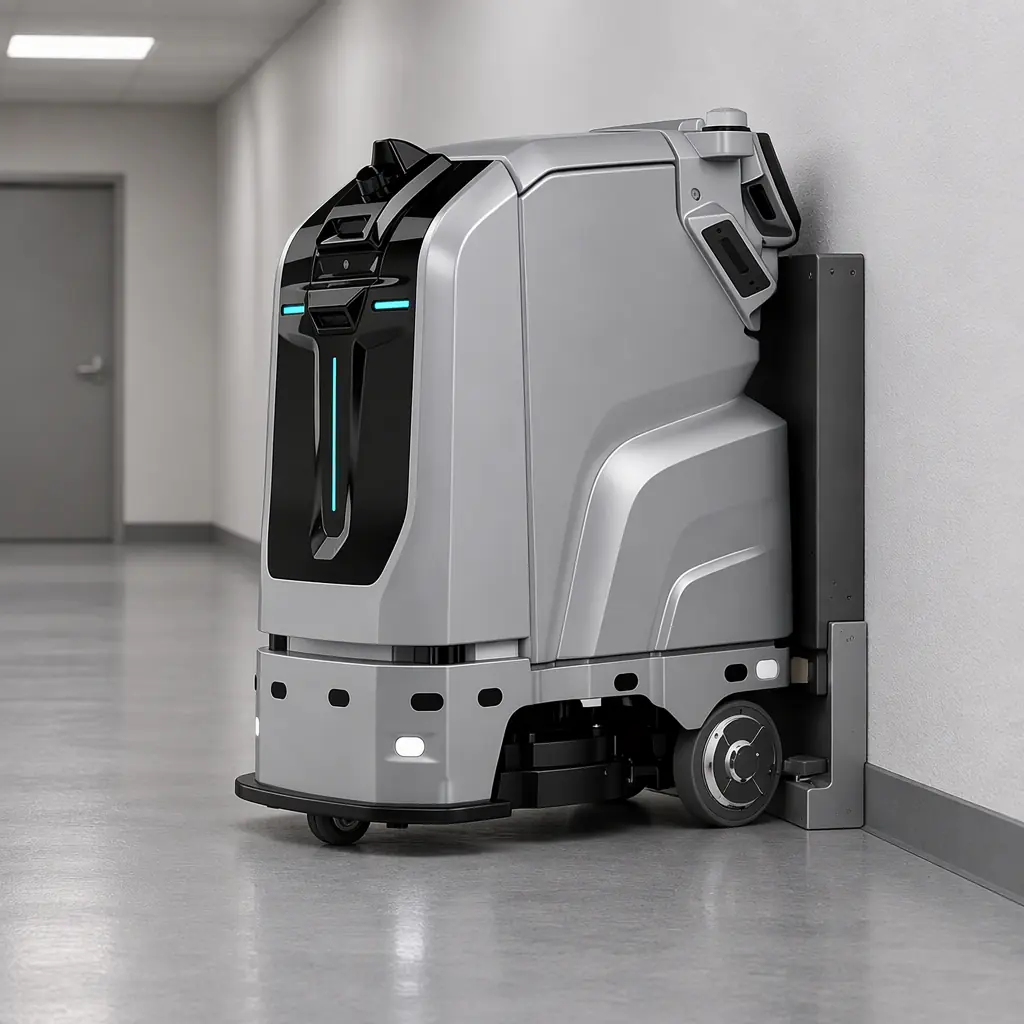
AOMAN machines export per-run records with robot serial, firmware version, map version, route file version, timestamps, distance, battery consumption and interventions, in a machine-readable format. Fault codes are documented with meanings so an operator can build their own dashboard rather than depend on ours. We provide the export structure and a sample month on request, and we support a chained monthly manifest where the contract requires detectable integrity.
What we do not do is certify cleanliness. The measurement layer, the sampling discipline and the deduction arithmetic belong to the operator and their contractor, and any vendor offering to supply both the run and the verdict on the run is asking to be the only witness to their own work.
The short version for a buyer writing this into a contract: require a complete export including failures, tie every record to a configuration, chain the records so edits are visible, sample at least one run a week against reality, and settle the exit export before the final invoice.

Get a Quote
Tell us about your space and workload, we reply within 24 hours.