
Robot Cleaning Verification: Automated Audit Trail Reporting
At a glance: Most fleet platforms answer yes to "do you offer automated audit trail reporting" and most of them mean only a route log. Four distinct layers sit under that phrase, and a client disputing a cleaning charge needs the fourth. This guide separates the layers, gives six questions that expose which one a platform really delivers, and works out what a defensible sampling programme costs to run per month.
Most fleet platforms now claim an audit trail. Few of them produce a record that survives a client review, because "audit trail" covers four different things: a route log, a task log, a tamper-evident export, and a signed verification pack that ties a measurement to a run. Buyers comparing cleaning verification systems are usually comparing the first two and then discovering at contract renewal that they needed the fourth. This guide separates the four layers, sets out the questions that expose which layer a platform actually delivers, and gives the arithmetic for what a verification programme costs to run either way.
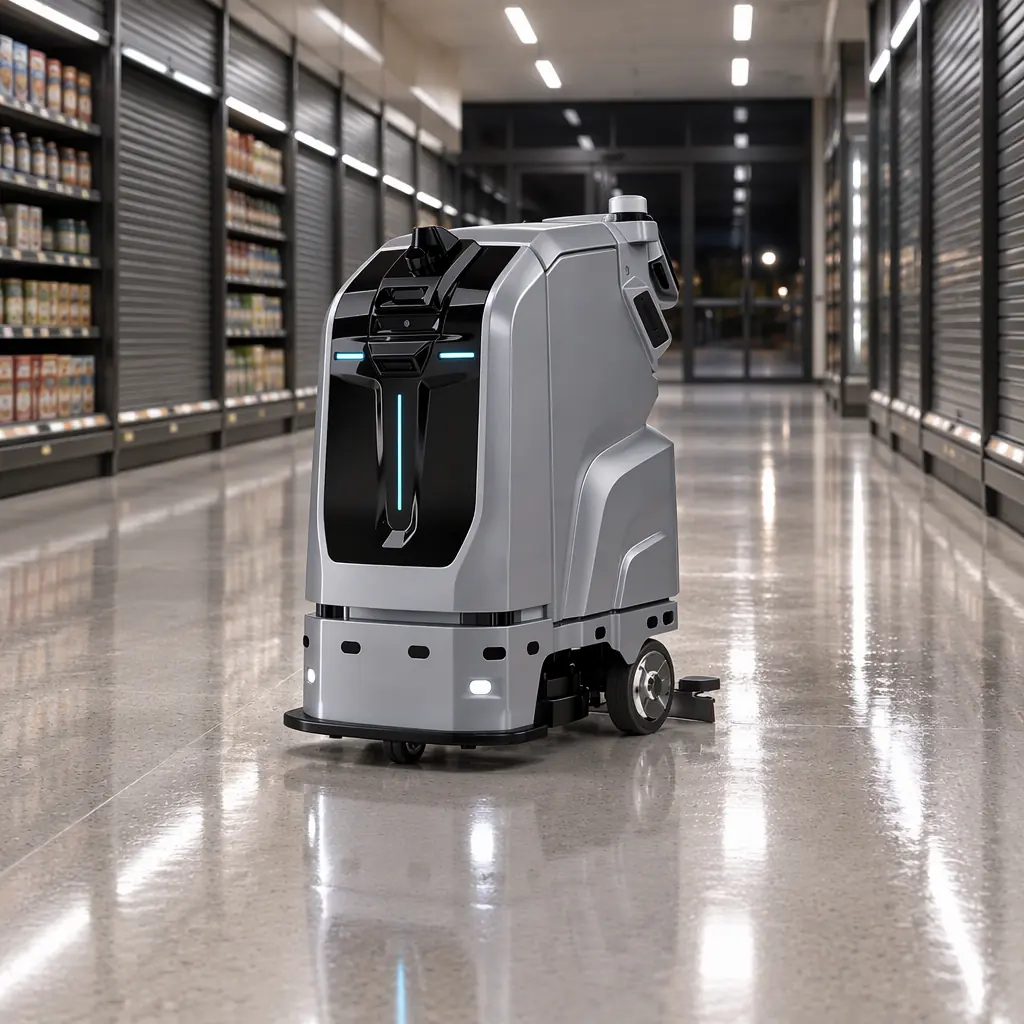
What "Automated Audit Trail Reporting" Actually Means
The phrase is used loosely enough that two vendors can both say yes and mean completely different products. Test the claim by asking what the system records at each of four levels.
Layer 1, the route log. The robot's executed path against the planned path, with timestamps, coverage percentage and any deviations. Nearly every commercial fleet platform produces this automatically because the navigation stack already generates it. It answers "did the machine go where it was told" and nothing more.
Layer 2, the task log. Route plus operational events: water and detergent draw, brush pressure changes, tank empties, docking cycles, faults, manual interventions. This is where platforms start to differentiate, because it requires the cleaning subsystem to publish telemetry rather than just the navigation subsystem.
Layer 3, the evidence-grade export. A log that can be exported in a form an auditor accepts: immutable or at least tamper-evident, timestamped against a reliable clock, retaining the raw values rather than a derived percentage, and covering a retention window at least as long as the contract's challenge period. Many platforms offer export but rewrite history when a route is re-run or a schedule is edited, which quietly breaks the chain.
Layer 4, the signed verification pack. The layer almost nobody ships out of the box: a document that binds a hygiene measurement (an ATP swab reading, a visual score, a client inspection result) to the specific run that produced the condition measured, with the sampling location identifiers and the operator who took the sample. This is what a facilities client asks for when they dispute a cleaning charge, and it is the layer the query "do any systems offer automated audit trail reporting" is really about.
The practical consequence: a system can score well on layers 1 and 2 and still fail a contract review, because the disagreement is almost never about whether the robot moved. It is about whether a surface was clean at a specific time.
The Four Questions That Separate the Layers
Rather than asking whether a platform has audit trail reporting, ask these four. Each one has a verifiable answer that a vendor cannot fudge for long.
- Can you export a single run, raw, without a support ticket? If the answer involves a professional services engagement, the export is a service, not a feature. You will use it three times a year and be charged for each.
- What happens to the log when a schedule changes? Ask them to change a route mid-week and then pull the previous week's record. If the historical record reflects the new schedule, the log is a view over current state, not an evidence store.
- Can the system accept an external measurement? Can a supervisor enter an ATP reading against a route segment and a time, and have it stored alongside the run? If not, layer 4 does not exist and never will without a manual spreadsheet.
- How long is the raw data retained, and what is deleted first? Most platforms retain aggregated coverage indefinitely and raw telemetry for 30 to 90 days. Contract challenge periods run three to twelve months. The gap is where disputes are lost.
The second question is the sharpest test and the cheapest to run. Ask it before signing, because retrofitting an evidence store onto a system designed around current state is a re-architecture, not a configuration change.
Where the Measurement Layer Has to Come From
No robot produces a hygiene number by itself, and any vendor claiming the robot "verifies" cleanliness is describing a proxy: coverage percentage, pass count, brush run-time. Those are process metrics. A client disputing a cleaning charge is making an outcome claim, and outcome requires an independent measurement.
That means a verification system's real job is to receive measurements, not to invent them. ATP swabbing remains the practical field method because it returns a number in about fifteen seconds with a handheld luminometer and needs no laboratory turnaround. The measurement is expressed in relative light units, and the threshold has to be agreed before the first swab rather than after the first failure. Two lines are typically set: one for the reading immediately after cleaning and a stricter one for high-touch or high-risk surfaces.
The system's contribution is the binding: this reading, at this location identifier, at this timestamp, against this run of this robot on this route. That binding is what converts a swab log into evidence, and it is precisely the thing a spreadsheet cannot do credibly because nothing prevents a row from being edited after the fact. For how to set the thresholds and structure the sampling grid before you go looking at software, see our guide to ATP testing, audit trails and evidence-based cleaning verification.
Running the Verification Programme: What It Costs
Software is the cheap part. The recurring cost is the sampling labour, and it scales with area and with how much of the contract is at risk. A worked example makes the trade-off concrete.
Take a site with 18,000 m² of cleanable floor under a contract with a monthly service charge of $14,000 and a 4% quality abatement clause, so $560 per month is contestable. A defensible sampling plan might be 12 swab points per 1,000 m² per verification cycle, so 216 points per cycle. At 45 seconds per point including the swab, the reading, the location confirmation and the entry into the system, that is 162 minutes, call it 2.7 labour hours. At a $28 loaded hourly rate the cycle costs about $76. Run it weekly and the programme costs roughly $330 per month against $560 of contestable revenue, before counting the value of not losing the contract at renewal.
Now vary one input. If you drop to 6 points per 1,000 m² the labour halves to about $165 per month, and the confidence interval on any single zone widens enough that a disputed zone may not have a sample at all. If you go to 24 points per 1,000 m² the cost doubles and you buy the ability to defend a per-zone claim rather than only a site-level claim. The right number is set by where the abatement clause operates: a site-level penalty justifies a thin grid, a per-zone penalty does not.
Two things are worth recording in the system from day one regardless of grid density. First, the sampling location identifiers, fixed and mapped, so that month four's reading is comparable to month one's. Second, the operator identity against each sample, because an unsigned swab log is an assertion rather than a record and a client's auditor will say so.
How the Layers Map to Contract Types
Which layers you actually need is decided by the contract, not by the software's feature list. Three common shapes:
- Fixed-price cleaning with a quality clause. You need layers 2 and 4. The route log alone will not settle an abatement dispute, and the signed pack is the deliverable that does. Verification cycle frequency should match the abatement measurement period exactly, not the cleaning frequency.
- Outcome-based or performance-based cleaning. You need all four, with layer 3 retention exceeding the challenge window. Here the audit trail is the invoicing instrument, so a gap in retention is a gap in revenue defence.
- Demonstration or pilot contracts. Layer 1 plus a manual sampling sheet is enough for eight weeks, and buying a layer 4 platform for a pilot is usually premature. Use the pilot to establish the threshold and the grid, then buy software that can ingest both.
The pilot case is where most operators overspend, and the multi-year case is where most operators underspend. A useful discipline is to write the verification requirement into the tender rather than selecting it afterwards: the scoring criteria for a robot tender should carry the audit-trail requirement as a scored line, not an assumed capability. Our cleaning contract tender and robot pricing guide covers how to weight that line against price, and our acceptance testing and commissioning guide covers the tests that prove layer 3 works before you sign off, notably the schedule-change test described above.
A Comparison Sheet You Can Send to Vendors
Send this as written and ask for a yes or no per line plus the document that evidences it. Vague answers are themselves the finding.
| Requirement | Layer | Evidence to demand |
|---|---|---|
| Export a single run raw, self-service, no ticket | 2 | Live screen share during evaluation, not a brochure |
| Historical record unaffected by schedule edits | 3 | Change a route, then pull last week's export |
| Raw telemetry retention ≥ contract challenge period | 3 | Written retention statement with deletion order |
| Accepts external ATP readings with operator ID | 4 | Demonstrate entering a reading against a run |
| Fixed, mapped sampling location identifiers | 4 | Show the location register and a month-on-month trend |
| Signed or tamper-evident export | 3/4 | Sample export with hash or signature and an explanation of how it is checked |
| Coverage, water and detergent draw, faults in one record | 2 | One redacted run record showing all fields populated |
Seven lines, one afternoon of vendor calls, and you will know more about the systems on offer than most of their own sales material discloses.
Where the Record Breaks in Practice
Four failure modes account for most of the disputes we see, and none of them are software bugs.
The threshold moves after the fact. A reading of 120 RLU fails a 100 RLU line and passes a 150 RLU line. If the threshold lives in a document amended by email, the audit trail proves a measurement happened but not whether it passed. Store the threshold version alongside each reading.
The sample cannot be located next month. "Aisle 4, mid" is not a location identifier. Where the same physical point is not re-sampled, the trend line is meaningless and the client's auditor will say so.
The run and the reading are separated by more than the interval claimed. A reading taken 90 minutes after the robot passed is measuring traffic, not cleaning. Record time-since-cleaning with each sample, as above, and let the system flag samples outside the agreed window rather than discovering it in a review.
The dataset outlives the person who understood it. A verification programme whose grid and thresholds live in one supervisor's head collapses at staff turnover. Written sampling plans and versioned thresholds are part of the evidence chain, not administration.
Each of these is cheaper to prevent than to argue. The pattern across all four is the same: the technology layer is solved and the governance layer is not, which is why buying more software rarely fixes a verification dispute.
What AOMAN Provides and What It Does Not
Our fleet platforms publish the operational telemetry that layers 2 and 3 depend on: coverage against plan, water and detergent draw, tank and fault events, docking cycles, and timestamped run records exportable per run. When a site runs a verification programme we support the interface rather than the measurement, and we are explicit about the boundary: the robot does not produce a hygiene number, and any supplier telling you otherwise is selling a coverage percentage as a cleanliness claim.
For operators running mixed fleets across several buildings, the practical constraint is that verification data has to land in one place even when the robots do not. Our guide to managing cleaning robots across multiple buildings covers the consolidation pattern, and our service robot KPI benchmarks give the coverage and utilisation ranges worth benchmarking a new programme against. If you are still deciding between verification approaches, the cleaning productivity baseline guide sets the pre-robot measurement you will need as a comparison point.
The Takeaway
Automated audit trail reporting exists as a feature on most commercial cleaning robot platforms, but what is automated is the route and task log, not the verification pack. Buyers who need to defend a cleaning claim should specify the measurement binding, the retention window and the schedule-change behaviour in the tender, and should test all three live rather than accepting a feature-list yes. The measurement itself will still come from a swab and a luminometer, and that is not a gap in the technology: it is the only number that answers the question a client is actually asking.

Get a Quote
Tell us about your space and workload, we reply within 24 hours.