Outdoor and Perimeter Cleaning Robots: A Realistic 2026 View
At a glance: AOMAN C1 covers 2,040 m²/h on sealed indoor floors, concourses, terminal halls and exhibitions go fully automated overnight. Rain-exposed paving still needs ride-on sweepers; this article marks exactly where the robots stop and the hybrid program begins.
Indoor cleaning automation is settled engineering: robotic scrubbers carry hotel lobbies, hospital corridors and terminal floors on schedule every night. Step outside, onto the parking apron, the loading dock, the forecourt, and the equation changes: unsheltered paving, weather, vehicle traffic and grit.
For 2026 the honest answer has two halves. Autonomous robots operate creditably on the covered, sealed zones; for the exposed perimeter the durable answer is still hybrid. Robots take what is cleanable, ride-on sweepers take what is out in the weather. This article marks that boundary precisely.
Why Outdoor Is Harder
| Factor | Inside | Outside / perimeter |
|---|---|---|
| Surface | Uniform sealed floors | Slopes, seams, cracks, gratings, gravel transitions |
| Environment | Climate stable | Rain, UV, temperature swings |
| Debris | Dust, spills | Sand, litter, leaves, standing water |
| Navigation | Walls as lanes | Open edges, moving vehicles, parking geometry |
| Water handling | Controlled recovery | Rain runoff, drainage points |
The consequence for procurement: sizing starts with a surface audit, not with a coverage number. What is sealed and covered is a robot's zone; what is exposed is a decision about equipment, not about autonomy.
And the water question is the boundary question in practice. Indoor cleaning controls the recovery cycle, the machine holds the water until the dock. Outdoor exposure means runoff, standing water, drainage points and freezing mornings: the equipment decision out there is not just about grit, it is about managing water you did not put down. That is why the line between covered and exposed is where the indoor platform's zone ends.
Where the AOMAN Lineup Fits
The AOMAN platform is built for the indoor and sheltered half of that boundary:
- AOMAN C1 . The large-format scrubber: 2,040 m²/h, 70 L + 50 L dual tanks, 790 mm squeegee, 85 cm working aisle. The machine for concourses, terminal floors, exhibition halls and mall halls on the night program.
- AOMAN C2 Pro . Compact and quiet: modular water tanks, passes under 70 cm table height, 85 cm aisle, built for offices, clinics, library and hotel corridors where the public is present while it works.
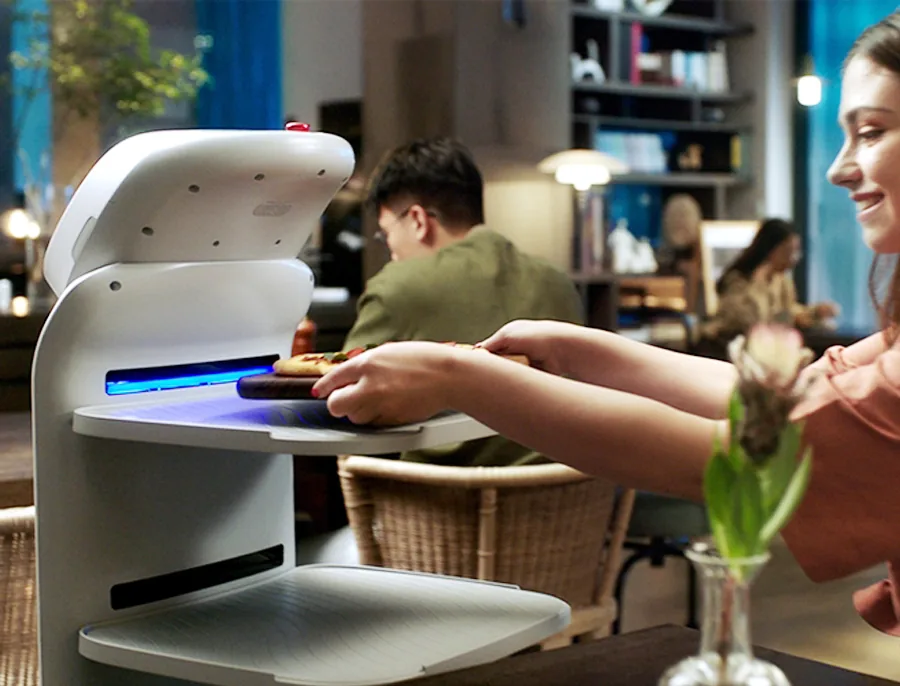
- AOMAN D1 . The delivery platform: 40 kg across four trays, for a site that wants one fleet across delivery and cleaning.
None of these is a street sweeper, and that is the point. For parking decks, truck bays and forecourt paving the recommendation is a hybrid program: robots hold the covered, sealed, predictable zones; a ride-on sweeper handles the exposed perimeter. A supersized robot is rarely the answer to a drainage question.
Where Autonomous Cleaning Pays First
Order the rollout by floor size and sealing: the biggest, most predictable sealed surfaces come first, and the exposed forecourts wait for the hybrid plan. Three site types carry the majority of the case study, in that order.
Airports and rail terminals
Terminal concourses, gate corridors and baggage reclaim are sealed, flat and hard-wearing. The C1 covers them overnight at up to 2,040 m²/h and leaves the night crew free for restrooms and back-of-house detail work, the zones a machine cannot reach. Typical program: an overnight zone route plus a morning polish before the first bank of departures.
Malls, hotels and exhibition centers
Concourses and event floors run wide and predictable. Malls and hotels run the C1 after closing and the C2 Pro during the day in lobbies and corridors. The compact platform is built to work quietly around guests. The same sites run the D1 on deliveries from the same fleet console: one dashboard, one service relationship.
Industrial halls and factory campuses
Production halls and logistics buildings split the same way. Sealed indoor floors are scriptable like a mall, C1 on the main hall. The outdoor half, truck bays, yard roads, forecourts, stays on ride-on equipment, with scheduled robot passes confined to the sheltered aprons beside building entrances where the paving is sealed and the exposure is low.
Sizing the Night Program
Night windows are where the wide-format machine earns its keep. The sizing math is simple: area divided by 2,040 m²/h gives the machine hours per night; add set-up, water refill and recovery to get the real window; compare that window to what the site can actually close. Most sites discover the constraint is not coverage but water and power. A 70 L + 50 L machine on a sizeable concourse runs through its tanks inside a single long pass, and the dock and refill route are part of the program, not an accessory. When the night window is short and the area is large, two machines in alternating zones is usually the better answer than one machine on the full area.
The day program is a different problem with different numbers: short loops, people present, quick recovery. The independent daytime unit covers the guest-adjacent zones, while the night machine takes the concourse, one site, two program designs, one console.
The Hybrid Team, Explicitly
Automation does not remove the cleaning crew, it re-arranges it. The realistic pattern: a smaller night crew owns the machine program plus the detail work; the day loop is supervised by whoever owns the facility schedule; the ride-on sweeper operator keeps the exposed perimeter. The roles shift; the headcount rarely collapses; what changes is that the covered floors now get done the same way every night, which is what inspection reports actually record.
The second consequence is skills: someone on each shift has to own the completion map, the dock and water handling, and the anomaly reporting. That is usually the existing supervisor's job. And it is why the pilot period pays double: the machine programs itself for the floor, the site programs the operation.
Building the Full Cleaning Stack
| Zone | Platform | Load-bearing spec |
|---|---|---|
| Lobbies, corridors, offices | AOMAN C2 Pro | Compact, quiet, modular water system, under-desk clearance |
| Concourses, terminal and hall floors | AOMAN C1 | 2,040 m²/h, 70 L + 50 L, 790 mm squeegee, 85 cm aisle |
| Sheltered aprons by entrances | AOMAN C1 (scheduled) | Sealed-surface passes, supervised |
| Guest deliveries | AOMAN D1 | 40 kg, four trays |
| Exposed paving, yards, truck bays | Ride-on sweeper plus staff | Outside robot scope |
Deployment Checklist
Before you buy
- Surface audit: sealed concrete, tile, carpet thresholds, map it. Capture slopes, thresholds and drainage gratings.
- Debris profile: a summer exhibition venue and the same venue in autumn produce different debris. Document the season you will actually operate in.
- Wireless coverage: test every planned operation zone; mark the dead zones.
- Operating windows: where can a machine run without traffic? Where can the floor stay wet long enough to recover?
- Dock placement: sheltered, powered, drained.
First week checks
- Walk the mapped perimeter yourself: no open pits, unmarked drops or missing zones.
- Run a measured test pass, pickup on pre-weighed debris, recovery rate, squeegee water quality.
- Verify the charging cycle completes unattended over three consecutive runs.
- Configure alerts: low battery, full tank, navigation failure, maintenance due.
Illustrative Cost Model
Model from three inputs. The same ones a cleaning consultant uses: night-shift hours currently spent on the floors the robot will cover, the zone cycle time from the coverage spec, and the consistency cost of the current program (complaints, re-runs, inspection findings).
Illustrative example: two operators on night scrub duty at four hours per night across 6,000 m² of concourse, $22 per hour fully loaded, about $24,000 a year. A C1 with charger, pads and service plan under standard fleet pricing sits in the upper $30,000s over three years. An illustrative payback around 18 months against the labor it replaces, before consistency and complaint value is counted. Your wage rates, zone size and schedule will move the number both ways; the shape of the model is the durable part.
What Comes Next
Three evident directions over the next year or two: coordinated multi-unit cleaning where robots divide a floor dynamically, predictive scheduling driven by calendar and season data rather than fixed routes, and larger water capacity plus smarter dock cycles that reduce the human hand-offs. In parallel, the less glamorous track matters more: software, docks and parts ecosystems mature faster than robot bodies do, which is why the platform decision, upgradeable software, parts stocked, console shared, outweighs the machine body decision. All of these extend the current boundary; none of them move past it, and outdoor exposure remains a class of its own.
The Bottom Line
Automate the covered, sealed zones, they are the proven returns. Keep ride-on equipment for the exposed perimeter and let the hybrid program be the plan. That is the realistic 2026 position, and it is exactly what a site assessment estimates. The zone-by-zone routing and cycle-time side of the same decision is worked through in the cleaning labour cost model.
Map your zones and contact our team for a site assessment and deployment proposal, or browse the product line.