Service Robots for Veterinary Clinics & Animal Hospitals, Automation Beyond the Exam Room
At a glance: One patient per exam room leaves fur, saliva, and allergen behind. At 150+ patients a day that is a full-time cleaning problem. This guide covers AOMAN C1 floor care (2,040 m²/h), D1 sample transport (40 kg), and G1 check-in assistance for vet facilities.
A veterinary practice never gets an off-hours window. The lobby, exam rooms, treatment area, and kennel ward are in continuous use, which means there is no quiet hour for a deep clean. And every surface is only a few patients away from being contaminated again.
On top of that, veterinary clinics share the staffing pressure of human healthcare. Overnight coverage is hard to staff, and between-patient cleaning is the first thing skipped when the schedule runs long. Autonomous cleaning, transport, and check-in assistance address the specific shape of that workload.
Why Veterinary Facilities Operate So Hot
- Continuous contamination load: veterinary patients shed fur, dander, saliva, and urine continuously through exam rooms, hallways, and waiting areas, not from a single bed. Manual cleaning between appointments takes minutes per room and is the most common point of schedule slippage in a multi-doctor practice.
- Overnight coverage: 24-hour emergency hospitals need cleaning at hours nobody wants to staff. Continuous autonomous cycles remove the overnight cleaning shift from the hiring problem list. The robot does not care what time it is. The premium rates and constant turnover that follow night cleaning jobs simply fall out of the staffing equation.
- Between-patient disinfection at scale: infection control guidance such as the AAHA guidelines calls for surface disinfection between patients. Compliance varies with caseload pressure: when three emergencies are waiting, a full wash-down can shrink into a quick wipe. A programmed unit does not skip steps because the schedule is tight.
Three Robot Applications That Map to Veterinary Workflow
Continuous floor sanitization across zones
Veterinary flooring carries different loads by zone, and different zones justify different cleaning frequencies.
| Zone | Surface Type | Contamination Risk | Cleaning Frequency Needed |
|---|---|---|---|
| Public lobby | Polished concrete or vinyl | Low, foot traffic, dander | Every 90 minutes during hours |
| Exam rooms | Seamless vinyl sheet | High, fluids, fur, pathogens | Between every appointment |
| Treatment / surgery | Epoxy or urethane | Critical, blood, surgical debris | Continuously during procedures |
| Kennel / ICU ward | Epoxy with drainage | Very high, urine, feces, vomit | Every 45–60 minutes |
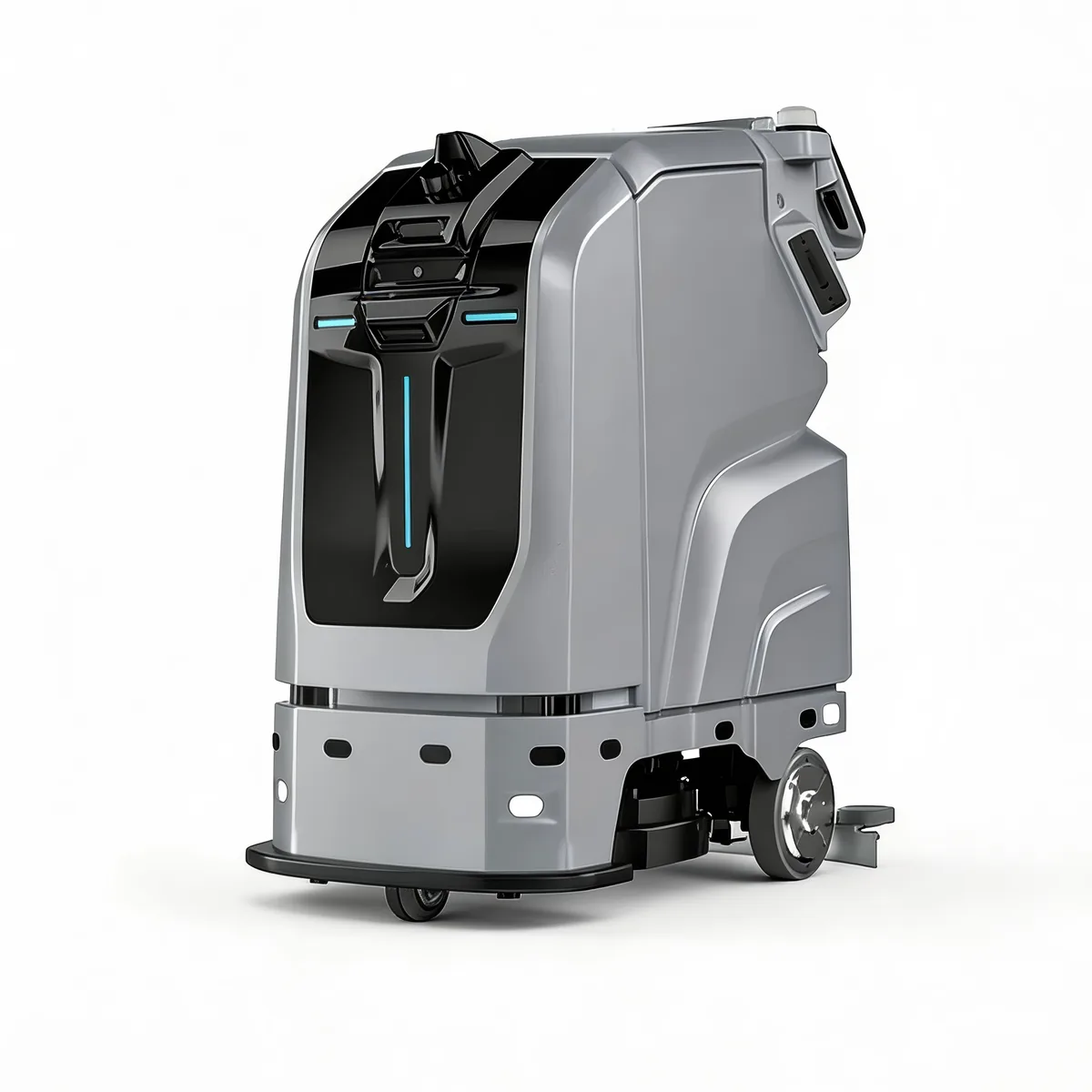
The AOMAN C1 covers up to 2,040 m²/h with a 790 mm squeegee and a 70 L freshwater / 50 L recovery tank pair. Tank separation matters in a veterinary setting: recovered water may contain pathogens that must not be redistributed onto clean floors. The C1 navigates the 85 cm corridor class typical of clinical zones and returns to its dock for water exchange and charging.
In exam rooms and treatment bays, the AOMAN C2 Pro runs the compact version of the job. 85 cm aisles, quiet operation, and below 70 cm desk height, which is what exam tables and treatment carts leave you to work with. It also suits clinic and lab pod settings where a large unit would be intrusive; the healthcare industry section covers the wider facility mix.
Lab sample transport and internal logistics
The most time-consuming non-clinical activity in a multi-doctor veterinary hospital is walking: blood samples to the lab, urine cups from the kennel ward to the analyzer, radiographs to the reading room, pharmacy supplies to each treatment station. A AOMAN D1 runs a dedicated loop between the treatment floor, in-house lab, pharmacy, and imaging suite: 40 kg payload across four trays, samples in sealed containers on the upper trays, results, prepared medications, and clean supplies on the lower trays. Contaminated and clean streams never share a compartment.
Front-of-house guest assistance
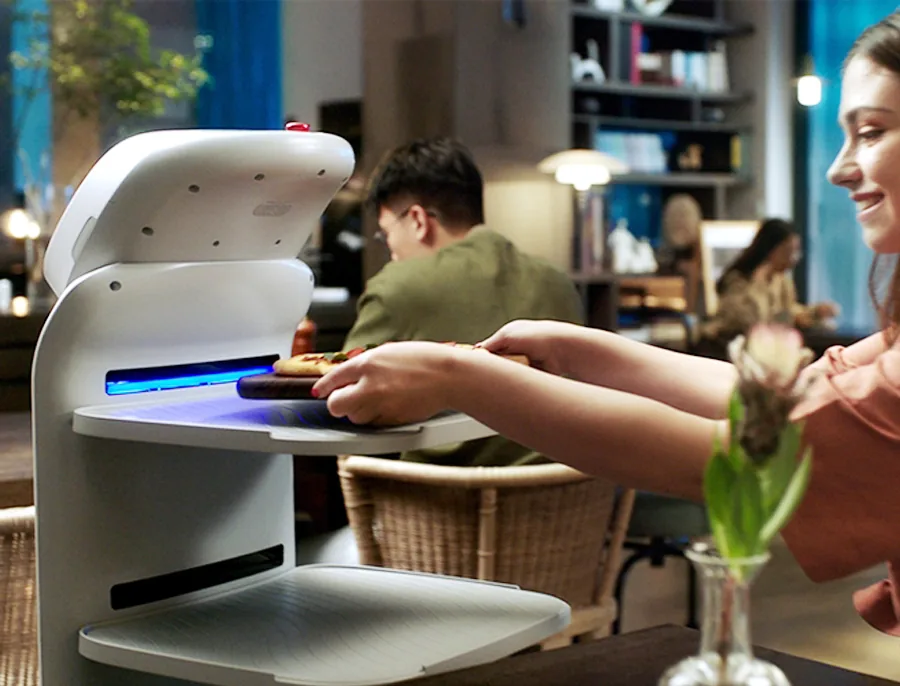
Veterinary waiting rooms are uniquely stressful, clients sit with anxious pets surrounded by other anxious pets, and check-in queues are among the top drivers of negative reviews. A AOMAN G1 guidance unit covers the front of house: it welcomes visitors and assists with check-in, verifies appointments against the practice management system, and handles routine questions with a six-microphone array that picks up speech over 5 m in a noisy lobby, with multi-language guidance for international clients. It surfaces wait status and, when a walk-in emergency presents, flags it to the triage nurse for immediate assessment. The human reception team stays on exceptions, phones, and judgment calls.
Route design and charging
In practice the fleet value comes from route design as much as hardware. The delivery loop should be one continuous circuit, treatment floor to lab to pharmacy to imaging and back, rather than a set of point-to-point errands, because every docking and re-dispatch cycle adds time. Cleaning routes run zoned: a surgical zone pass during the quiet window before the day case list, lobby and exam zones on a repeating cycle during hours. One 110V outlet per dock, placed in a housekeeping utility area out of client view, keeps charging out of the guest experience entirely. A useful convention: schedule the D1 to hit the lab on a fixed cadence, including every 20 minutes during clinic hours, say, so results come back predictably and triage stops asking when the last batch walked.
Infection Control: The Metric That Justifies the Investment
Surface transmission is the main pathway for the hospital-acquired infections that hit hospitalized pets, and the guidance is straightforward: disinfect between patients. The gap is between protocol and practice under caseload pressure. And that is exactly where programmed cleaning wins: same route, same coverage, same thoroughness, every run, at 2 AM as well as 2 PM. Cleaning logs with timestamps and coverage maps per session also give the practice evidence for its own infection control documentation.

Build-Out by Practice Size
- Solo / 2-doctor practice: one C2 Pro covering lobby, exam rooms, and treatment area. Map the facility, then program a route that cleans each exam room between appointments. Outcome: between-patient cleaning that a small team simply cannot staff.
- Multi-doctor specialty hospital: one C1 for corridors and kennel ward zones, one C2 Pro for exam and treatment areas, one D1 for sample and pharmacy delivery. Integration with the practice management system drives cleaning schedules from the appointment calendar.
- 24-hour emergency and referral center: full fleet with centralized fleet management, running around the clock. Sustained coverage through the 2–5 AM window when emergency caseload peaks and no human crew is present.
What to Verify Before Signing
First exposure . Animals notice new robots. Run a short desensitization period: introduce the unit in an empty room, then progressively into occupied spaces. Most dogs and cats settle within days, and a controlled introduction beats an unplanned one.
Floor drainage . Kennel areas on flat floors accumulate standing water that exceeds a scrubber’s recovery capacity; insist on sloped-to-drain surfaces wherever the robot operates.
Clearances . The C1 requires 85 cm lanes; the D1 operates in 70 cm corridors and the C2 Pro in 85 cm aisles. Measure before you order.
Staff buy-in . Technicians who fear replacement need the time-motion picture: transport and cleaning time returns to patient care, which is the work they were trained for and prefer doing.
The Financial Picture
Illustrative example. A 12-doctor specialty hospital spending roughly $68,000 a year on cleaning labor plus the equivalent of half a technician FTE on lab walking could trade that against a fleet lease (C1 + C2 Pro + D1) plus maintenance, and still have significant headroom. The upside continues beyond cost trade: each hospital-acquired infection adds multiple days of hospitalization cost, so a reduction in between-patient contamination transfers directly into avoided care cost. Model it with your own rates, labor load, and caseload.
The common hesitation is that a practice "isn’t big enough." The counter is the two-unit rule: one compact cleaning unit plus one delivery unit covers a 2–4 doctor practice, and the cleaning unit alone is a defensible first purchase. It runs during open hours, in the background, and the effect on scheduled visits is visible within a month. Practice owners who run the math on a single unit usually find the lease is less than the overtime line item.
Veterinary practices are also structurally advantaged to automate: labor costs trend up and the technician supply is constrained, while the workload, walking, mopping, carrying, is measurable and recurring. The robots do not replace veterinarians; they absorb the parts of the shift that drew nobody into the field.
The ordering of the purchase usually decides the outcome. Cleaning first: it is visible to clients within days, it needs no workflow restructuring, and it immediately de-risks the schedule for exam rooms. Delivery second: it is the bigger labor win, but it requires a route and a loading habit. Check-in assistance third: it touches client-facing experience and is best introduced once the fleet is familiar. Buying in that order makes each stage a reference for the next. The equivalent requirements in another regulated environment, including its audit expectations, are set out in dental clinics dental labs.
Tell us your floor plan and caseload, request pricing on a veterinary fleet and we will match unit types and routes within 24 hours.