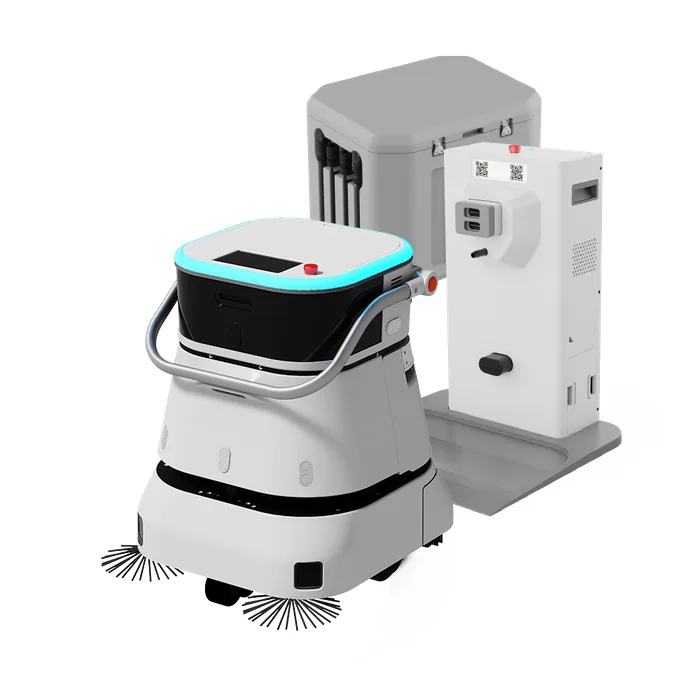
A travel center manager on I-40 ran the numbers for his 24-hour location and found his operation splitting into three businesses he never asked to run: a restroom block that logged 3,200 visitors on a peak Saturday, a truck lot that held 80 idling tractors overnight, and a quick-service food court serving drivers at 2 a.m. as reliably as at noon. The floor crew was on a treadmill — mopping the restroom corridor every 45 minutes during shower peaks, sweeping the lot after every truck turnover, and restocking the c-store shelves by hand while the register line backed up. Truck stops are the purest example of the 24/7 facility pattern: every surface is high-traffic, every hour is peak somewhere, and labor is the constraint that keeps the lights on. The petrol stations & highway service areas guide documents the fuel-retail version of this pattern; this guide covers the truck-stop and travel-center version, where restroom turnover cleaning, truck-lot sweeping and driver-facing delivery are the three highest-value robot roles.
The Restroom & Food Court Loop: Turnover Cleaning on a 24/7 Clock
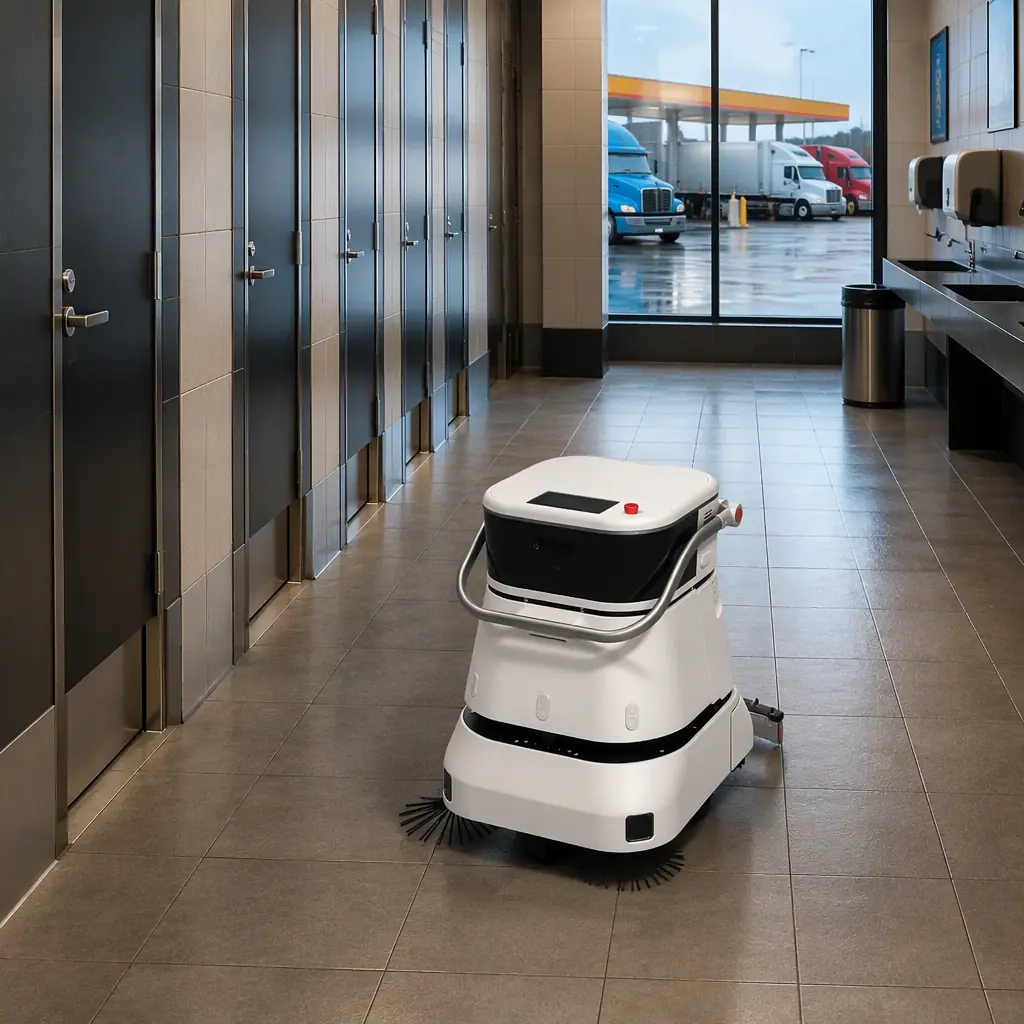
The restroom block of a busy travel center is the highest-turnover space in highway retail: drivers cycle through in waves tied to trucking hours — a surge after the morning dispatch window, another after the evening dinner run, and a steady overnight trickle from idling trucks. Between waves, the floor carries the combined load of road grime, tracked-in slush and the general wear of 3,000 daily visitors. The CLEINBOT C2 Pro covers the interior loop: 800 m²/h scrub coverage with IP54-rated chassis sealing for the wet zones, a squeegee system that leaves floors 90% dry within 90 seconds of pass completion — the difference between a safe corridor and a slip liability when the next wave of drivers arrives — and a compact footprint that threads the shower corridors, restroom vestibules and food court seating without blocking the register line. The specification framework in the commercial cleaning robot buyers guide applies; the travel-center rule is the shower-peak schedule: the C2 Pro runs the restroom corridor in the 20-minute windows between shower peaks and the food court immediately after the 2-4 a.m. driver lull, when the floor is at its quietest and the turnover is at its heaviest — the same "clean the high-traffic zone when the traffic isn't there" logic the fitness centers guide documents for 24/7 gyms, applied to a facility whose peaks are measured in driver waves rather than rush hours.
The Truck Lot & Fuel Island: Outdoor Sweeping at Distribution-Center Scale
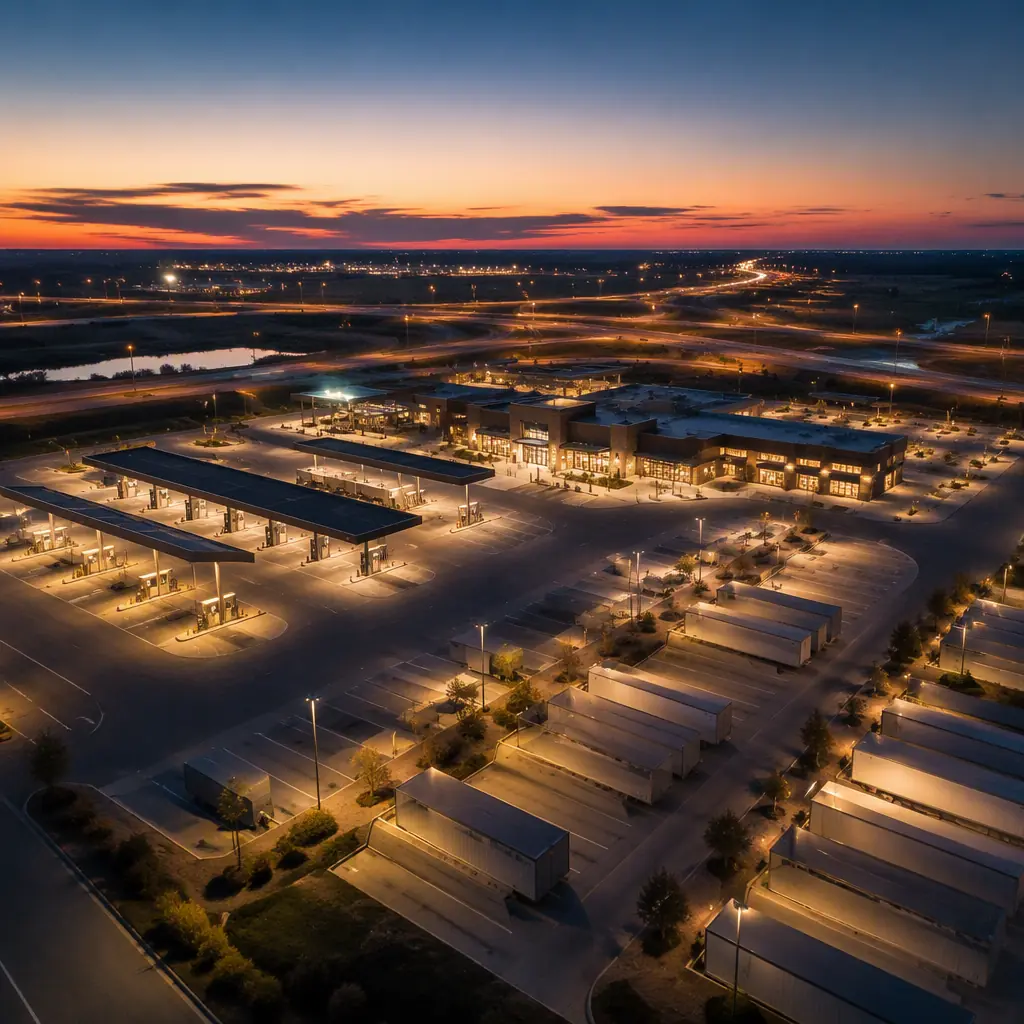
The outdoor loop is the part of a travel center most visitors never think about and every driver judges: the truck parking lot, the fuel islands and the entrance apron collect diesel drips, tire rubber, sand and the general debris of 200 heavy vehicles moving through a site every day. The CLEINBOT CC201 covers the exterior: a 1,020 mm sweeping width at 3,000 m²/h — a 14,000 m² truck lot and fuel-island network in under five hours — with a 130L dust container that auto-empties into an 800L docking station, IP67 sealing with a rain sensor, and GPS + LiDAR + IMU navigation that follows the approved lot perimeter and fuel-island lanes. Its 10-hour battery runs the pre-dawn pass before the first dispatch wave and the late-night pass after the last arrival, and its -10°C to 50°C range covers both northern corridor stops that operate through winter and southern sites that run year-round. The outdoor pattern the outdoor autonomous cleaning guide documents for public spaces applies directly; the travel-center addition is the truck-turnover sequence — the lot is swept from the building outward so the sand and gravel tracked off the bays is pushed back toward the entrance gate, and the fuel islands run on the off-peak schedule between truck arrivals.
Driver-Facing Delivery: Food, Restock & the Lounge Loop
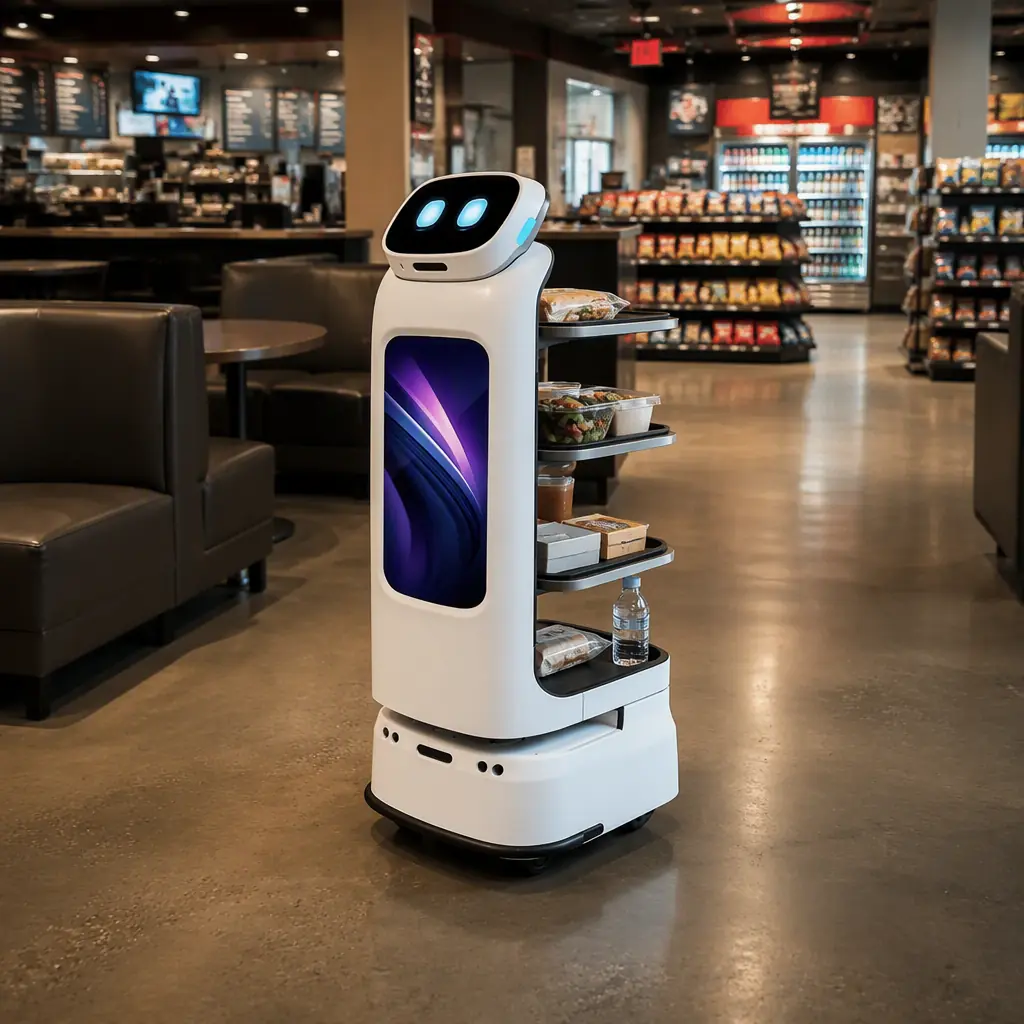
The most expensive walking in a travel center is done by staff serving drivers who are on a schedule that doesn't wait: food runners carrying trays from the QSR to the driver lounge, c-store clerks restocking shelves between register transactions, and kitchen staff ferrying supplies from the back storeroom to the prep line. The CADEBOT L100 covers the food loop: a 400 mm platform with four trays rated for 15 kg each and a 40 kg total payload that carries a full food-run in one trip — 6-8 deliveries per hour between the QSR counter, the driver lounge and the truckers' tables, including the 2 a.m. breakfast run that used to pull a cashier off the register for 10 minutes per trip. For two-destination runs — a food delivery to the lounge plus a restock drop at the c-store on the same pass — the 70L dual-cabin AOMAN DOUBLE handles both loads in one trip, the same architecture the delivery robot selection guide compares against the single-cabin L100. The restaurants & food service guide documents the kitchen-to-table pattern; the travel-center addition is the c-store restock loop the supermarkets guide covers — delivery trucks arrive once or twice daily, and the robot closes the gap between the 11 p.m. shelf check and the next morning's truck with a restock run that never leaves the register unattended.
Chain-Level Operations: One Fleet Across 500 Sites
Travel centers rarely operate alone — the industry's largest networks run 400-800 locations across interstate corridors, and the robot fleet runs on the same network logic. The multi-site deployment guide documents the pattern for operators running dozens of sites: every C2 Pro, CC201, L100 and DOUBLE reports to one cloud dashboard, routes and schedules are configured remotely by the corporate operations office, and a national chain running 200 sites runs the same restroom loop, the same lot sweep and the same food-delivery routes everywhere — with the fleet management guide covering the operational layer and the RaaS financing guide covering the subscription structure that fits travel-center budgets: most sites start with one C2 Pro on the interior loop and one CC201 on the lot, run one quarter with the documented numbers, and add the L100 when the driver-facing delivery walking time becomes the staffing bottleneck. The EV charging stations guide covers the adjacent pattern as travel centers add charging plazas to the fuel-island mix.
Deployment Table for Facility Types
| Facility type | Interior fleet | Exterior fleet | Monthly cost (RaaS) | Staff hours returned |
|---|---|---|---|---|
| Independent truck stop (8-16 fuel bays) | 1 × C2 Pro (restrooms + food court) | 1 × CC201 (lot + fuel island) | $2,400-3,800 | 220-340/month |
| Regional travel-center chain (10-25 sites) | 1 × C2 Pro + 1 × L100 per site (food + lounge) | 1 × CC201 per site | $3,200-4,800 per site | 300-460/month per site |
| National network (100+ sites) | 1 × C2 Pro + 1 × DOUBLE per site (dual-destination runs) | 1 × CC201 per site | $4,600-6,800 per site | 380-560/month per site |
| Multi-format operator (travel centers + EV plazas) | 1-2 × C2 Pro + 1 × L100 per site | 1 × CC201 per site | $14,000-26,000 across 4-6 sites | 1,500-3,000/month across portfolio |
A travel center is judged by the restrooms a driver finds at 3 a.m. and the lot a dispatcher sees on the morning camera feed, and both run on the same clock: the corridor has to be dry when the next shower wave empties into it, and the lot has to be presentable when the first dispatch line forms. The C2 Pro keeps the wet-zone floors safe through the night, the CC201 keeps the lot and fuel islands clean in all weather, and the L100 or DOUBLE keeps food and restock moving so staff stay with the drivers. That is the automation pattern that fits a 24/7 highway budget, and it starts with the same step every successful deployment starts with: a walk-around audit of where the mopping hours, the sweeping hours and the delivery trips actually are.