A regional grocery chain operations director stares at the P&L for Store #47 in suburban Chicago. Labor costs have climbed 18% in three years. The overnight floor crew is perpetually short-staffed — three call-outs this week alone. Shelf audit accuracy has dropped to 82%, meaning nearly one in five out-of-stock items goes unreported until a customer complains. The frozen foods aisle needs hourly temperature spot-checks per food safety protocol, consuming 90 minutes of manager time per shift. And the curbside pickup program — launched to compete with Instacart — is hemorrhaging $4.20 per order because staff walk 2,800 steps per fulfillment run.
"We're running a 55,000-square-foot food facility with the staffing model of a convenience store," she tells the CFO.
Supermarkets are the most operationally complex segment of physical retail. Unlike department stores or shopping malls, grocery stores layer food safety compliance, cold chain management, perishable inventory velocity, and near-continuous cleaning requirements on top of standard retail operations — all while defending net margins that average 1–3%. Service robots, which have proven their ROI in warehouses, hospitals, and hotels, are now crossing into the grocery aisle. And the economics are compelling for the operators who deploy them correctly.
Why Supermarket Automation Is Fundamentally Different from General Retail
Three operational characteristics separate grocery stores from the shopping malls and retail complexes where service robots have already gained traction — and each characteristic creates a distinct automation requirement that general-purpose retail robots cannot meet.
Food Safety Is the Non-Negotiable Overlay
Every robot operating in a supermarket — whether it's scrubbing floors, scanning shelves, or delivering curbside orders — operates in a FDA-regulated food environment. Floor cleaning robots must use food-safe cleaning agents and avoid cross-contamination between raw protein zones (meat, seafood) and ready-to-eat areas (produce, bakery). Shelf-scanning robots must not shed particulates onto open food displays. Delivery robots moving through back-of-house must stay clear of receiving-dock cross-traffic that introduces external contaminants. For the compliance framework governing robot safety certifications across environments, see our safety standards and compliance guide.
This is not a "nice-to-have" spec — it's a USDA/FDA inspection requirement. A robot deployment that fails a health department audit is worse than no robot at all, because it triggers a compliance remediation cycle that can suspend store operations.
Margin Pressure Demands Verifiable ROI Within 12 Months
A shopping mall operator deploying wayfinding and cleaning robots can amortize the investment across a 10-year property lifecycle at 6–8% cap rates. A grocery chain operating at 2% net margin cannot afford a pilot that doesn't pay for itself within the fiscal year. This changes the deployment math: grocery operators should start with the single highest-ROI application, prove the economics on one store, and scale only after the general ledger confirms the savings. For a structured approach to evaluating robot vendors against procurement criteria, our vendor evaluation framework provides a 12-point assessment methodology.
Customer Proximity Is Constant and Unavoidable
In a warehouse, robots operate behind secure barriers away from the public. In a hospital, robots travel through staff corridors and service elevators. In a supermarket, robots share aisles with shoppers pushing carts, children reaching for cereal boxes, and elderly customers using mobility aids — 14 hours a day, 7 days a week. The safety system design — obstacle detection, emergency braking, speed governance — must meet a higher standard than any back-of-house deployment. And the robot's physical presence must not degrade the shopping experience that drives $680 per square foot in annual revenue for a well-run grocery store.

Five High-Impact Robot Applications in Grocery Stores
The following applications are ranked by verifiable ROI within a 12-month deployment window, starting with the application that pays for itself fastest.
1. Autonomous Food-Safe Floor Cleaning
Grocery store floors require cleaning frequency that exceeds any other retail environment. Produce sections accumulate water and leaf debris hourly. Meat and seafood counters develop protein-based residues that become slip hazards. Bakery aisles collect flour dust. The average 55,000-square-foot supermarket requires 8–12 labor-hours of floor cleaning per day — roughly 1.4 FTE dedicated exclusively to floor maintenance.
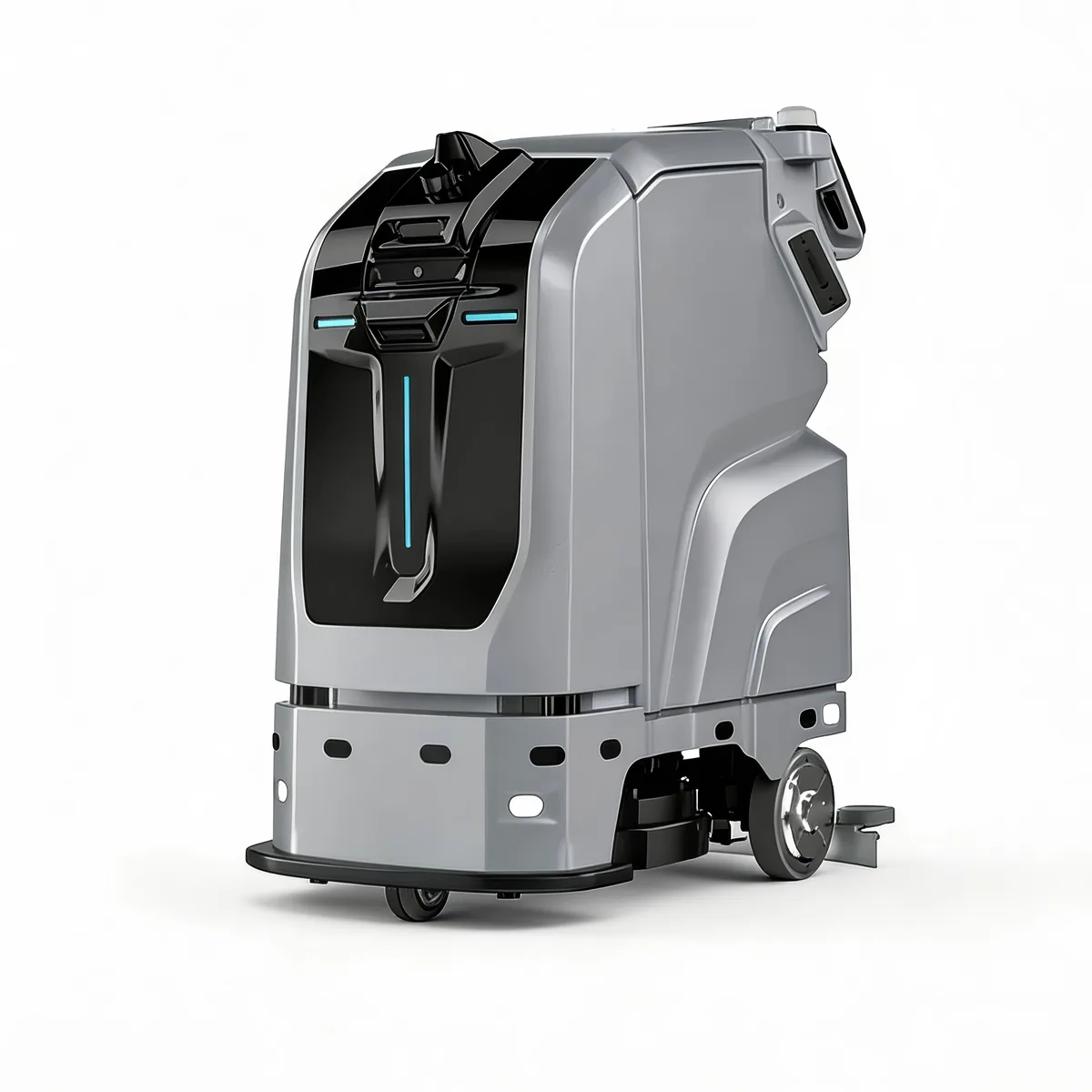
Indoor autonomous cleaning robots like the CLEINBOT M79 and CLEINBOT C2 Pro scrub, sweep, and dry floors autonomously during overnight hours or low-traffic daytime windows. A single unit covers approximately 4,000–5,000 square feet per hour with food-safe cleaning solutions, completing a full-store floor cycle in 10–12 operating hours. At a cost of approximately $800–1,200/month on a lease model, one robot replaces 0.8–1.2 FTE of cleaning labor — saving $18,000–28,000 per store annually. For a comprehensive comparison of cleaning robot options across environments, see our commercial cleaning robot buyer's guide.
The food safety ROI compounds beyond labor savings. Consistent automated cleaning at prescribed intervals reduces health department violation risk and the slip-and-fall liability that costs grocers $4.1 billion annually in the US alone.
2. Shelf Scanning and Inventory Accuracy
Out-of-stock items in grocery represent roughly $75 billion in lost sales annually in the US market. The problem is structural: shelf inventory accuracy in manually audited stores hovers at 70–80%, meaning 20–30% of stockouts go undetected between audit cycles. A customer who encounters an empty shelf for their preferred brand converts to a competitor purchase 31% of the time — and 15% switch stores entirely for that category.
Autonomous shelf-scanning robots equipped with computer vision cameras and RFID readers traverse aisles during store hours, capturing real-time inventory data at the SKU level. They detect out-of-stocks, misplaced items, pricing errors, and planogram compliance issues without disrupting customer traffic. A single unit can audit a 55,000-square-foot store in under 90 minutes — versus 4–6 hours for a manual audit that covers a fraction of the SKU count. The immediate recovery comes from reducing out-of-stock duration by 60–80%, which translates to 1–3% incremental revenue — $250,000–750,000 annually for a $25M-revenue store.
3. Curbside Pickup and Last-Meter Delivery
Curbside grocery pickup grew 400% during 2020–2023 and has stabilized at 4–6% of total grocery sales — but it's margin-negative for most operators. The cost driver is labor: staff walk an average of 2,500–3,000 steps per fulfillment run, and loading 12–15 orders per hour maxes out what a human can physically achieve.
Delivery robots like the CADEBOT L100 and the AOMAN DOUBLE with its 70L dual-cabin configuration transport curbside orders from staging areas to pickup zones. A single delivery robot completes 18–22 curbside deliveries per hour versus 12–15 for a human runner — a 40–50% throughput increase. At $18/hour loaded labor cost, the throughput gain saves $21,000–32,000 annually per store, and the robot's continuous availability during peak hours (4–7 PM, when 40% of curbside orders flow) eliminates the surge-staffing problem that erodes curbside margins most.
For a broader assessment of delivery robot selection criteria across environments, our delivery robot selection guide covers payload, range, and integration considerations.
4. Customer Guidance and Wayfinding
Grocery shoppers spend an average of 3.5 minutes per trip searching for products — and 12% of customers leave without finding at least one item on their list. In a 55,000-square-foot store with 40,000+ SKUs re-merchandised quarterly, even regular customers lose orientation when categories shift.
Humanoid service robots like CRUZR positioned at store entrances and major aisle intersections provide voice-activated product location, promotional information, and recipe-based shopping list guidance. Unlike static digital kiosks (which grocery shoppers ignore 87% of the time, per in-store behavior studies), an interactive robot generates the curiosity effect that drives engagement: 45–60% of passing shoppers interact with a CRUZR-class humanoid robot at least once during a visit. For grocery chains running loyalty programs, the robot becomes a data-collection touchpoint that captures product interest signals at the moment of shopping intent — more valuable than post-purchase survey data.
5. Back-of-House Logistics and Receiving Automation
Grocery receiving docks process 15–25 pallets per day for a mid-size store, with perishables requiring temperature-verified transfer from refrigerated trucks to cold storage within 20 minutes. Back-of-house material movement consumes 3–5 labor-hours daily — moving pallets, staging delivery carts, transporting cleaning supplies, and restocking front-end supplies.
Delivery robots operating in the back-of-house zone transport receiving-dock shipments to cold storage, move cleaning supply carts to overnight staging areas, and restock front-end bagging stations — all tasks that don't require a human decision but consume paid staff time. The labor recovery is modest (0.3–0.5 FTE per store, $7,000–12,000/year), but the operational value compounds when the same robot fleet coordinates cleaning, shelf scanning, and curbside delivery — because the fleet management infrastructure is already in place. For the architecture behind multi-robot coordination across distributed facilities, see our fleet management systems guide.

The Grocery-Specific ROI Model
Grocery operators evaluating service robots should model ROI across four cost categories, weighted by the unique margin structure of food retail.
| Cost Category | Annual Store Cost | Robot-Driven Reduction | Annual Savings |
|---|---|---|---|
| Floor cleaning labor | $42,000–$52,000 | 55–70% | $23,000–$36,000 |
| Out-of-stock revenue loss | $250,000–$750,000* | 60–80% recovery | $150,000–$600,000 |
| Curbside fulfillment labor | $38,000–$55,000 | 25–35% throughput gain | $9,500–$19,000 |
| Back-of-house material handling | $15,000–$22,000 | 30–50% | $4,500–$11,000 |
| Total per store (single unit per category) | $187,000–$666,000 |
*Revenue opportunity, not cost saving — out-of-stock recovery adds top-line revenue rather than reducing expense.
The weighted deployment sequence that maximizes first-year ROI: Floor cleaning → Shelf scanning → Curbside delivery → Customer guidance → Back-of-house logistics. This sequence prioritizes the highest-certainty, fastest-payback applications that build operational confidence for the larger investment categories.
For a detailed methodology on modeling multi-year robot ROI including maintenance, training, and fleet management costs, our service robot ROI guide provides the full framework with downloadable templates.
Multi-Robot Deployment Architecture for Grocery Store Layouts
Grocery stores are uniquely suited for multi-robot deployment because their physical layout — long parallel aisles, wide perimeter paths, clearly separated front-of-house and back-of-house zones — provides natural navigation corridors that simplify SLAM-based autonomous operation. The deployment architecture for a 55,000-square-foot supermarket follows a zoned-coordination model.
The Three-Zone Grocery Model
Zone A — Front-of-House Sales Floor (approximately 35,000 sq ft): Aisles, produce, bakery, deli, checkout. Cleaning robots operate here overnight (10 PM–6 AM). Shelf-scanning robots traverse here during business hours. Customer-facing CRUZR units station at entrance and center-store. All front-of-house robots operate at pedestrian speed (0.5–1.0 m/s) and maintain 1.5-meter minimum customer clearance.
Zone B — Curbside/Perimeter (approximately 5,000 sq ft): Curbside pickup lanes, cart corrals, entrance vestibules. Delivery robots operate here during peak pickup windows. Outdoor-rated robots like the CLEINBOT CC201 handle exterior walkways and pickup-zone cleaning. This zone requires weather-hardened hardware and obstacle detection calibrated for vehicle traffic at pickup lanes.
Zone C — Back-of-House (approximately 15,000 sq ft): Receiving dock, cold storage, dry storage, prep areas, employee break room. Delivery robots transport pallets and supplies. This zone operates on a separate navigation map from the sales floor, with a one-way airlock transition at the back-of-house door to maintain food safety separation.
Fleet Coordination Across Zones
A single fleet management dashboard coordinates all robots across the three zones, with zone-transition rules that prevent cross-contamination. When a delivery robot moves from Zone C (back-of-house, where raw product enters) to Zone A (sales floor), the system logs the transition and enforces a mandatory cleaning cycle before food-contact-zone entry. This level of coordination is why grocery deployments benefit from integrated fleet management rather than point-solution robots from different vendors. For the technical architecture that enables this coordination, our fleet management guide details the API and middleware layer required.

Implementation Roadmap: From Pilot to Chain-Wide Rollout
Grocery chains that have successfully deployed service robots follow a disciplined three-phase approach that prioritizes operational proof over technology enthusiasm.
Phase 1: Single-Store Floor Cleaning Pilot (Months 1–3)
Deploy one autonomous cleaning robot at the highest-volume store. Track labor-hours recovered, cleaning consistency scores (using ATP surface testing before and after), customer complaint frequency, and slip-and-fall incident rate. The pilot succeeds when three conditions are met: labor savings exceed robot cost by 20%+, ATP scores are equal or better than manual cleaning, and customer complaints do not increase. At a typical mid-size grocery store, this pilot costs $3,000–$5,000 in lease payments over three months and delivers $5,500–$9,000 in labor savings — net positive even in the pilot phase.
Phase 2: Multi-Application Expansion (Months 4–9)
Add shelf-scanning and curbside delivery at the pilot store, then replicate the cleaning deployment across 3–5 additional stores. The second application is always shelf scanning because it adds revenue recovery on top of the cost savings from cleaning — the combination shifts the internal conversation from "cost reduction" to "revenue protection," which secures executive sponsorship for further investment. The multi-store expansion validates that deployment procedures, training, and maintenance workflows scale beyond a single champion location. On the organizational dimension of scaling automation, our multi-site deployment strategy guide covers the change management and training framework.
Phase 3: Fleet Integration and Chain-Wide Rollout (Months 10–18)
Deploy the full four-application suite (cleaning, shelf scanning, curbside delivery, customer guidance) across all stores in the chain, with fleet management software providing real-time visibility into robot utilization, maintenance cycles, and labor savings across every location. At this scale, the economics shift from per-store ROI to chain-level operational leverage: centralized fleet monitoring, bulk maintenance contracts, and standardized training reduce the marginal cost of each additional robot by 25–35% compared to single-store pricing.

The Bottom Line for Grocery Operators
Supermarkets are the most operationally demanding retail format — and the one with the most to gain from service robot automation. The combination of labor-intensive floor maintenance, perishable inventory that punishes stockouts, margin-negative curbside programs, and food safety compliance overhead creates a multi-dimensional cost structure that point-solution automation cannot address. A zoned, multi-robot deployment with integrated fleet management targets all four cost categories simultaneously.
The operator who deploys floor cleaning robots first, then layers shelf scanning for revenue recovery, then adds curbside delivery for throughput gain, follows a path validated across hospitality, healthcare, and manufacturing sectors. The grocery-specific adaptations — food-safe cleaning protocols, cold chain integrity, customer-proximity safety — are engineering problems with proven solutions, not open research questions.
For procurement teams evaluating robot vendors against grocery-specific requirements, our vendor evaluation framework provides the structured assessment methodology. For a complete financial model including lease-vs-buy analysis, maintenance reserves, and training amortization, see our service robot ROI guide.