A 28,000-square-foot premium gym in Chicago runs 18 class slots daily across four studios — HIIT, yoga, spin, and functional training. Between the 6 AM CrossFit class and the 7 AM yoga session, the cleaning crew has 15 minutes to turn over the functional training zone: disinfect 800 square feet of rubber flooring, wipe down 12 kettlebells and 8 medicine balls, and restore the mirrored wall to streak-free condition. The yoga studio needs the same 15-minute window for hardwood floor sanitation and mat disinfection, because the 7 AM vinyasa class will have 45 barefoot participants. On any given Tuesday, 2,100 members pass through the facility, generating a continuous layer of sweat residue, chalk dust from the weight room, and tracked-in road salt during the Chicago winter. The monthly cleaning labor cost: $34,000 for 7 FTEs and a nightly deep-clean contractor. The member satisfaction score on "facility cleanliness": 3.4 out of 5 — the second-lowest-rated metric behind parking availability.
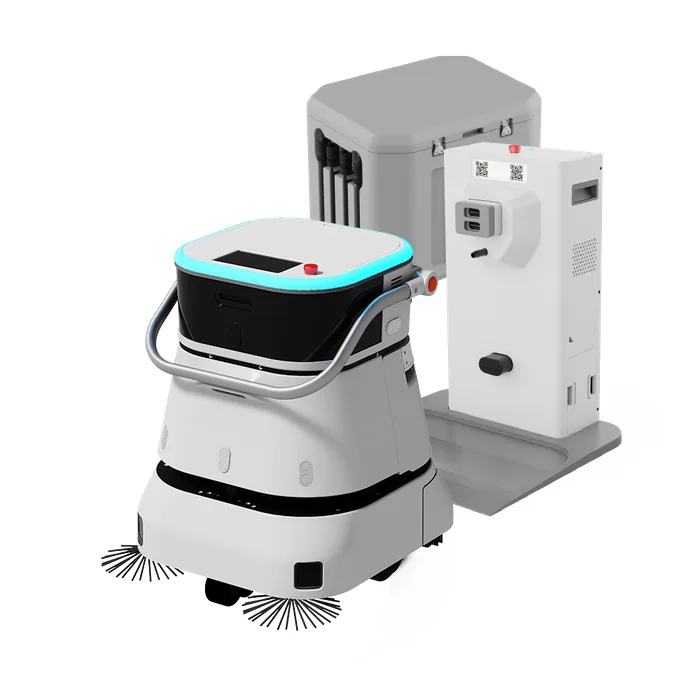
In April 2026, the gym's operations director deployed two CLEINBOT M79 autonomous floor scrubbers — one dedicated to the weight room and functional training zone, one cycling between the three group fitness studios on a class-schedule-aware cleaning routine — and one CLEINBOT C2 Pro for the locker room and sauna corridor. The results at month 3: cleaning labor reduced from 7 FTEs to 4, with the three displaced staff reassigned to member-facing roles (personal training consultations and front-desk coverage). The "facility cleanliness" satisfaction score rose from 3.4 to 4.6. The deeply buried metric that mattered most — member retention rate — improved from 68% to 76% annualized, worth an estimated $187,000 in saved acquisition costs for a gym that was previously losing 960 members per year to competitor facilities with newer build-outs.
The fitness industry's cleaning problem is not a janitorial problem. It is a member-experience problem, a retention problem, and — increasingly — a brand-differentiation problem in a market where 67% of gym members say they have cancelled a membership because the facility "didn't feel clean," according to IHRSA's 2025 Member Retention Survey. Autonomous cleaning robots address this problem not by replacing cleaning staff — most operators redeploy staff to higher-value roles — but by solving the temporal mismatch between cleaning requirements and facility usage patterns that human-only staffing cannot close.
The Three Cleaning Zones Every Gym Operator Needs to Automate First
Gym environments differ from the commercial spaces covered in existing deployment guides — hotels, corporate offices, and retail complexes — in one critical respect: contamination is continuous, not episodic. An office lobby gets dirty in predictable peaks (morning arrival, lunch rush). A gym floor gets contaminated at a near-constant rate from 5 AM to 10 PM because every member on every piece of equipment deposits sweat aerosol, skin cells, and external particulate. The cleaning strategy must match the contamination curve, not the staffing schedule.
Zone 1: Weight Room and Functional Training Flooring
Rubber flooring in weight rooms absorbs impact but also traps chalk dust, sweat residue, and — on a microscopic level — epidermal debris that becomes a bacterial substrate within 4-6 hours at gym-typical temperatures of 20-24°C and relative humidity of 55-70%. A CLEINBOT M79 running on an hourly schedule can maintain a 2,500-square-foot weight room floor at a consistent cleanliness level that is physically impossible for human crews to sustain because the cleaning frequency required (12-14 passes per day) would cost more in labor than the cleaning equipment itself.
| Metric | Human-Only Cleaning | CLEINBOT M79 Autonomous |
|---|---|---|
| Passes per 14-hour operating day | 3 (pre-open, mid-day, post-close) | 12-14 (hourly cycle) |
| Coverage per pass | 2,500 ft² in 45 min | 2,500 ft² in 25 min |
| Consistency (audit score variance) | ±22% between shifts | ±4% between cycles |
| Monthly labor cost for this zone | $5,200 | $890 (lease + maintenance) |
| Downtime during cleaning | 45 min × 3 = blocked zones | Zero — operates alongside members |
The consistency metric matters more than the cost metric. A human cleaning crew working a 5 AM shift is at peak alertness and scores well on audits. The same crew at 8 PM after an 8-hour shift scores 20-30% lower because fatigue degrades attention to floor edges, under-rack areas, and the seam lines between rubber tiles where biofilm accumulates. Autonomous robots do not fatigue; the 14th pass at 9 PM is identical to the 2nd pass at 7 AM.
Zone 2: Locker Rooms, Sauna Corridors, and Wet Zones
Locker room surfaces present a different cleaning challenge: non-porous tile and epoxy flooring that is continuously wet from shower runoff, pool deck traffic, and condensation from steam rooms. The primary risk is slip-and-fall liability, followed by microbial growth in grout lines that produces the "locker room smell" that is the #1 member complaint in post-visit surveys.
CLEINBOT C2 Pro is designed for wet-environment operation with IP54-rated chassis sealing and a squeegee system that leaves floors 90% dry within 90 seconds of pass completion. Deployed in a 1,200-square-foot locker room with 18 shower stalls and a 400-square-foot sauna corridor, the unit runs a 12-minute cleaning cycle every 90 minutes during operating hours and a continuous 45-minute deep cycle during the 1 AM–4 AM off-peak window when the facility is closed but the overnight staff is minimal. The slip-incident rate at the Chicago gym described earlier dropped from 1.8 incidents per month pre-deployment to 0.3 post-deployment — a reduction that directly impacts the facility's general liability premium, which is typically $18,000-$35,000 annually for a mid-size gym.
For operators evaluating autonomous cleaning across a broader facility portfolio, the commercial cleaning robot buyer's guide provides a vendor-neutral framework for comparing floor-scrubber specifications, wet-zone capabilities, and total cost of ownership models across equipment categories.
Zone 3: Group Fitness Studios with Mixed Flooring
Yoga studios (hardwood), spin studios (sealed concrete or vinyl composite), and HIIT studios (rubber mat with turf sections) each require different pad pressures, solution concentrations, and drying times. The operational challenge is the 15-minute turnover window between back-to-back classes — the narrowest cleaning window in any commercial facility type.
The CLEINBOT M79's programmable zone profiles allow a single unit to switch between a yoga-studio profile (pH-neutral solution, microfiber pads, 2-pass pattern with edge-to-edge coverage) and a HIIT-studio profile (enzymatic cleaner for protein-based residue, medium-abrasion pads, 3-pass pattern with overlap) without manual reconfiguration. The unit reads the class schedule via a simple API integration with the gym's booking system and positions itself at the studio entrance 3 minutes before class end, entering the moment the last participant leaves. The 15-minute window becomes a 12-minute actual cleaning window, which is sufficient for a 900-square-foot studio at the M79's coverage rate of 1,200 m²/hr. For context on how robot performance specifications translate to real-world operational outcomes, the delivery robot selection framework covers the same specification-to-deployment mapping logic applied to logistics environments.

The Member Experience ROI That Most Operators Overlook
Most gym operators evaluate cleaning robots on a cost-reduction spreadsheet: labor savings × 12 months ÷ lease cost = payback period. That calculation understates the actual ROI by 60-80% because it ignores the member-retention and premium-pricing effects that clean facilities command.
Data from the IHRSA 2025 Global Report supports three claims that are directly relevant to robot-cleaning ROI:
Cleanliness is the #2 reason members choose a gym, behind only location convenience and ahead of equipment quality, class variety, and trainer credentials. In markets with three or more competing facilities within a 15-minute drive radius, cleanliness becomes the #1 differentiator.
The cost of member acquisition is 5-7× the cost of member retention. A gym spending $200 per new member acquisition and losing 30% of its membership annually spends $60,000 per 1,000 members on replacement acquisition — before spending a dollar on actual facility improvement. If robot cleaning improves retention by 8-10 percentage points (as the Chicago gym's data suggests), the savings in acquisition cost alone covers the robot lease in 6-8 months.
Members who rate cleanliness ≥4.5/5 are 3.2× more likely to upgrade to premium membership tiers. The premium pricing uplift — typically $25-$45/month over standard membership — compounds across the member base. For a 1,200-member gym with 18% premium penetration, a cleanliness-driven increase to 25% premium penetration generates $100,800-$181,440 in incremental annual revenue.
For operators thinking through the broader operational economics of robot deployment beyond cleaning alone — including multi-robot fleet cost allocation, lease-versus-purchase analysis, and cross-departmental ROI stacking — the service robot ROI guide and the RaaS financing models overview provide financial frameworks that extend across cleaning, reception, and delivery applications.

The Multi-Site Deployment Playbook for Fitness Franchises
Franchise operators managing 8-40 locations face a deployment challenge that single-location gyms do not: consistency across sites. A member who visits Location A (spotless locker rooms, streak-free mirrors) and Location B (standing water on the locker room floor, visible dust on rubber flooring) experiences cognitive dissonance that erodes brand trust across the entire franchise.
The deployment sequence that has produced the strongest multi-site outcomes follows a "lighthouse → cluster → network" model:
Phase 1 (Months 1-2): Single-site lighthouse deployment. Select the highest-revenue, highest-member-count location. Deploy 2-3 CLEINBOT units across the three zones described above. Run for 60 days with aggressive data collection: cleaning audit scores, member satisfaction surveys, slip-incident logs, and labor-hour reallocation tracking. Produce a site-specific ROI case study that the franchisee can reference for Phase 2 budget approval.
Phase 2 (Months 3-5): Regional cluster rollout. Expand to 3-5 locations within the same metro area. This phase validates that the operational playbook — cleaning schedules, zone profiles, staff retraining workflows — transfers across sites without per-location re-engineering. A shared service technician covering the cluster reduces per-unit maintenance cost by 30-40% compared to single-site deployments.
Phase 3 (Months 6-12): Network-wide deployment. Roll out to all remaining locations, with a centralized fleet management platform that provides the franchise operations director with a single dashboard showing cleaning completion rates, battery health, maintenance alerts, and audit scores for every unit across every site.
The critical insight from multi-site operators who have completed the full deployment cycle is that Phase 2 is not a scaled-up Phase 1. New failure modes emerge at the cluster level: inconsistent WiFi coverage in older gym locations can interrupt robot navigation, which a single-site deployment never exposes; cleaning staff at Location C may resist adoption in ways that Locations A and B did not, requiring a change management approach that accounts for site-level cultural differences; and the franchisee's capital budgeting cycle may not align with the deployment timeline, making lease-structured procurement essential for maintaining rollout momentum.

Selecting the Right Robot for Your Facility Size and Type
Not every gym requires the same cleaning robot configuration. The table below maps facility profiles to recommended deployments, based on the specification framework detailed in the vendor evaluation guide:
| Facility Profile | Square Footage | Recommended Units | Deployment Focus | Estimated Monthly Lease Cost |
|---|---|---|---|---|
| Boutique studio (yoga, Pilates, spin) | 2,000-5,000 ft² | 1 × CLEINBOT M79 | Single zone: studio flooring between classes | $450-$650 |
| Full-service gym (single location) | 10,000-25,000 ft² | 2 × CLEINBOT M79 + 1 × C2 Pro | Three-zone coverage: weight floor, studios, locker rooms | $1,300-$1,900 |
| Luxury health club (pool, sauna, multiple studios) | 25,000-50,000 ft² | 3 × CLEINBOT M79 + 2 × C2 Pro | Full facility: dry zones, wet zones, outdoor pool deck (CC201) | $2,500-$3,800 |
| Multi-site franchise (8-40 locations) | Varies | Cluster-level: 2-3 units per site | Centralized fleet management + shared maintenance | Volume-discounted lease rates |
For facilities with outdoor amenities — pool decks, rooftop training areas, outdoor basketball courts — the outdoor autonomous cleaning guide covers the CLEINBOT CC201's wet/dry vacuum capabilities and weather-resistant operation specifications.
Implementation Checklist for Gym Operators
A six-week deployment sequence based on the operational playbooks validated across multi-site robot deployments:
Week 1: Facility mapping. The robot performs an initial SLAM mapping pass during off-hours, generating a digital floor plan with zone boundaries, no-go areas (free-weight drop zones, stretching areas with floor-level equipment), and charging station placement. This is a one-time setup that requires approximately 90 minutes of facility manager time.
Week 2: Zone profile configuration. Program the cleaning parameters for each zone: solution type and concentration, pad material and pressure, number of passes, and scheduling rules (class-aware scheduling for studios, continuous maintenance for weight room, deep-clean windows for locker rooms during closed hours).
Week 3: Staff training and workflow integration. Run parallel operations — robot cleans alongside human crew — for one week. Train staff on robot supervision (error recovery, solution refill, pad replacement), zone handoff protocols, and the new labor allocation plan (which staff move to which member-facing roles).
Week 4: Member communication. Deploy signage, app notifications, and front-desk messaging explaining the autonomous cleaning program. Frame it as a member-experience investment, not a cost-cutting measure. The language that tests best: "We've invested in technology that cleans more frequently so your workout environment stays fresher throughout the day."
Weeks 5-6: Data collection and optimization. Run the robot fleet in production, collecting the metrics that will justify ROI to ownership: cleaning audit scores, member satisfaction survey results, slip-incident counts, labor-hour reallocation, and — after 90 days — member retention rate comparison to the pre-deployment baseline.

The Bottom Line
The fitness industry's cleaning standard in 2026 is several generations behind the member expectation. Gyms that rely on a pre-open mop-and-wipe, a mid-day spot-check, and a post-close deep clean are delivering three cleaning events across a 16-hour contamination cycle — the equivalent of washing your hands three times across a 16-hour shift in an emergency room. Members notice. They notice the chalk dust accumulating on the weight-room floor by 10 AM. They notice the locker room that smells like a locker room. And they vote with their wallets — 67% have cancelled a membership because the facility "didn't feel clean."
Autonomous cleaning robots close the temporal gap between contamination and cleaning by running 12-14 passes per day instead of three, at a monthly cost per zone that is 60-80% lower than the human labor equivalent, with consistency metrics that human crews cannot match across a full shift. The ROI is not just labor savings — it is the retention improvement and premium-tier conversion that clean facilities command in competitive urban and suburban gym markets.