
A 3,200-member megachurch in the US Sun Belt operates a 118,000-square-foot campus: a 2,800-seat sanctuary, a 600-seat youth auditorium, a children's wing with 34 classrooms, a fellowship hall that seats 900, a commercial kitchen, and a parking operation covering 14 acres. The church employs four full-time facilities staff and one facilities director, and relies on a volunteer base of 220 people who contributed 31,000 hours last year — the equivalent of 15 full-time positions. A volunteer-hour study the church conducted in 2025 found that 44% of those hours went to cleaning and setup tasks: vacuuming the sanctuary between the Saturday evening and three Sunday morning services, resetting the children's wing after Wednesday night programs, setting up and tearing down the fellowship hall for events, and sweeping the parking lot before holiday services.
The church's leadership identified the problem not as a cleaning problem but as a volunteer-retention problem. The same study found that volunteer turnover ran 38% annually, and exit interviews cited cleaning and setup fatigue as the top reason volunteers stepped back. The facilities director's estimate: the church was spending $46,000 per year in recruiting, training and volunteer-coordination overhead on the cleaning function alone. In early 2026, the church deployed CLEINBOT M79 floor scrubbers in the sanctuary, children's wing and fellowship hall; CRUZR humanoid concierge robots at the main entrance for greeting and wayfinding on high-attendance weekends; and CADEBOT L100 delivery robots for fellowship hall event logistics and the church's weekly food pantry operation.
The Volunteer Economics: 44% of 31,000 Hours on Cleaning and Setup
The megachurch above is not an outlier — it is the median profile of large American congregations. The Hartford Institute for Religion Research's 2025 facilities study found that the average US congregation with 500+ weekly attendees spends 11-15% of its operating budget on facilities, and that cleaning is the single largest controllable line item. The volunteer dimension makes the economics worse: faith-based nonprofits operate on a staffing model where 60-80% of facilities labor is donated, and donated labor has a hidden cost — the coordination overhead of recruiting, scheduling, training and retaining volunteers, which facilities directors estimate at 15-25% of the value of the hours themselves.
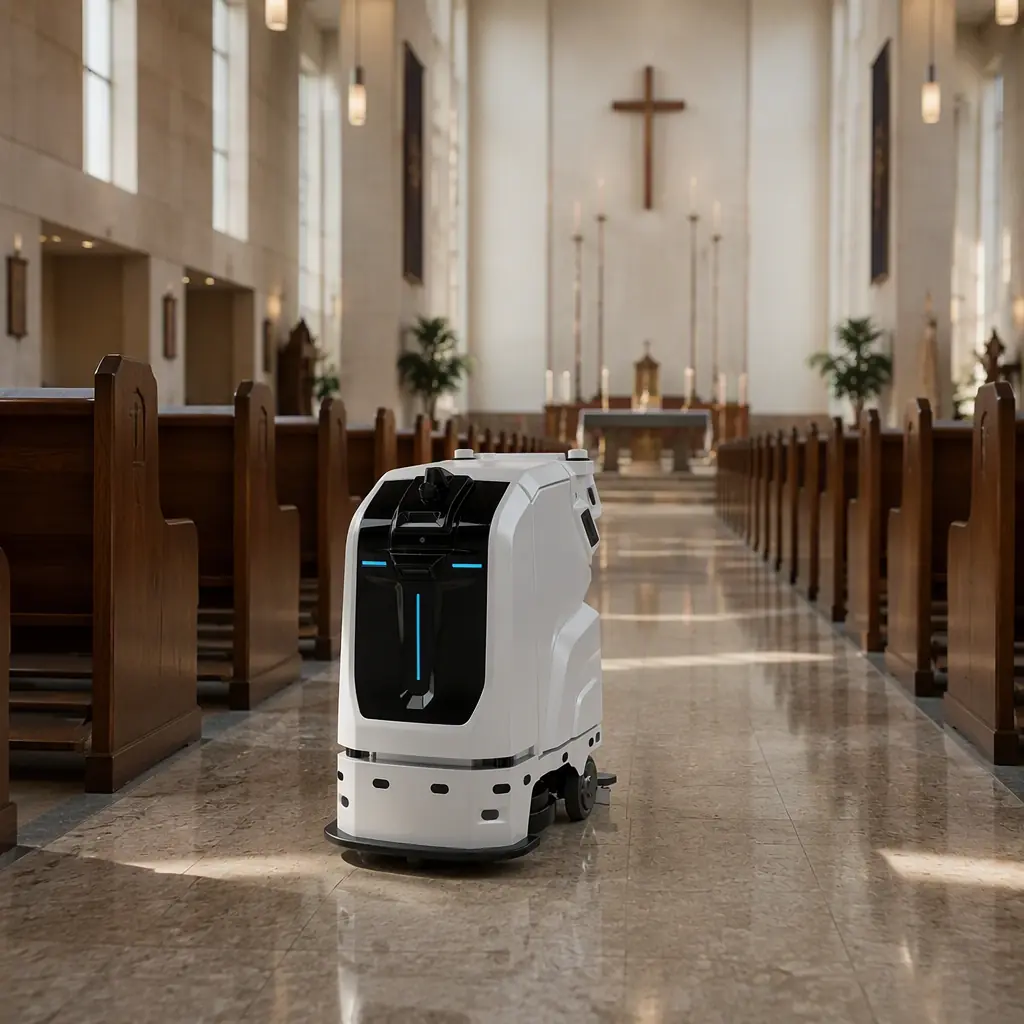
The automation case is unusually strong in this sector because the alternative to a robot is not a paid worker — it is a volunteer who burns out and leaves. An M79 floor scrubber cleaning the sanctuary's 14,000 square feet of floor in under an hour replaces 6-8 volunteer-hours per cleaning cycle, and because it runs on a schedule, the floor is cleaned every cycle instead of when a volunteer team happens to be available. The senior living facilities guide documents the same economics in a different nonprofit-heavy sector: organizations with thin paid staff and high-touch missions deploy robots to absorb the repetitive physical work so human energy goes to the mission. The facility management and cleaning buyer's guide provides the general framework for comparing scrubber specifications against manual cleaning baselines.
Sanctuary Cleaning Between Services: The 45-Minute Window
The sanctuary is the most sensitive cleaning environment in a worship facility for three reasons: the acoustics (a worship space is designed to carry sound, so cleaning noise is amplified), the scheduling (back-to-back services leave a 45-minute window between the last congregant leaving and the next arriving), and the reverence expectation (congregants should never see a cleaning operation in progress during a service). The M79's quiet mode at approximately 58 dB(A) — comparable to a normal conversation — lets it clean the sanctuary while the worship team runs sound checks on the stage, and its scrub, vacuum and mop single-pass operation returns the 14,000-square-foot floor to presentation standard in under an hour. The 45L water tank covers the full sanctuary pass on a single fill, and auto-return docking with automated water exchange means the robot self-services between the Saturday and Sunday cycles.
The same quiet-cleaning dynamic is documented in museum and cultural institution deployments, where the M79 runs after closing in galleries with the same acoustics-and-reverence constraints, and in performing arts centers, where the decibel specification is the decisive procurement criterion. The safety standards compliance guide covers the ISO 3691-4 requirements for autonomous mobile robots in public gathering spaces — the standard that governs the M79 sharing the sanctuary aisle with elderly congregants and families during setup hours.
Congregation Greeting and Wayfinding: CRUZR at the 1,200-Car Arrival
High-attendance weekends at large congregations create a front-door problem identical to a convention center: 1,200-2,500 people arriving in a 30-minute window, most of them first-time visitors or infrequent attendees who do not know where the children's check-in, the main auditorium, the restrooms or the welcome desk are. The church above counts 40-60 first-time visitors per weekend, and its own visitor survey found that 31% of first-time guests rated "finding my way around" as the most stressful part of their first visit — a metric directly tied to the 52% first-time-to-second-time return rate the church tracks.
CRUZR's humanoid form factor with RGB-D face recognition (0.3-second match), 7-category emotion detection and configurable voice persona handles the greeting layer at scale: welcoming arriving families, directing first-time visitors to children's check-in, answering the three most common questions (restrooms, coffee, service start time), and running the welcome-desk information loop while human greeters handle the personal connections.
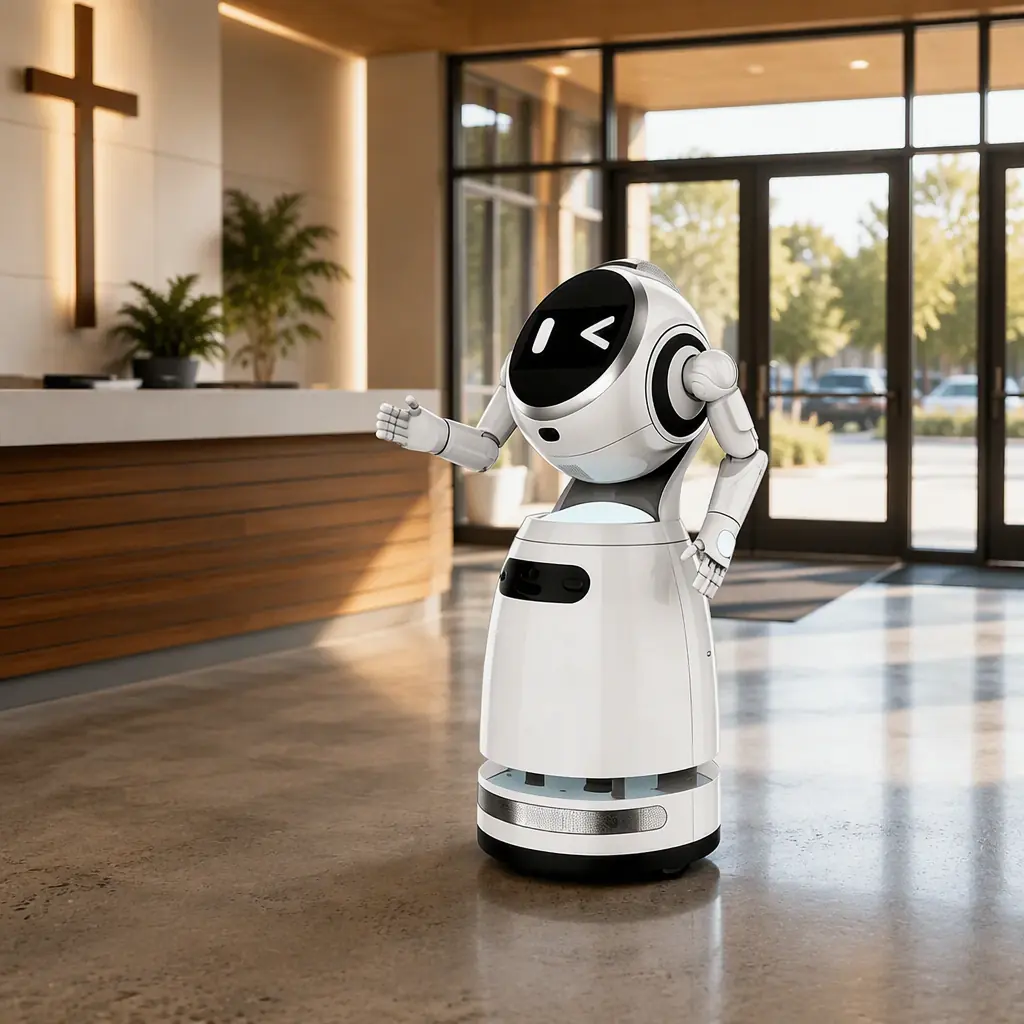
The reception and concierge deployment model and the events and trade shows guide document the same split at corporate lobbies and large events: the robot absorbs the information repetition, the humans deliver the hospitality. Congregations deploying CRUZR report the same pattern documented in university campus deployments — the robot becomes the reliable first layer of wayfinding, freeing volunteers for the interactions that actually build community.
Fellowship Hall and Food Pantry Logistics: The L100 on Mission
Large congregations run a surprising volume of logistics operations. The fellowship hall hosts 40-60 events a year — weddings, funerals, fundraisers, community dinners — each requiring setup, service and teardown cycles. Many congregations also operate food pantries and community kitchens; the church above runs a weekly pantry serving 400 families that requires moving 3-4 tons of food from the receiving dock to the pantry floor each week. These operations consume volunteer hours in the least visible way: the walking and carrying between storage, kitchen and hall.
CADEBOT L100's four open trays (15 kg per tray, 60 kg total payload), 13.3-inch HD touchscreen and SLAM 3.0 navigation at 0.3-1.2 m/s adapt to both workflows. For fellowship events, it shuttles tables' worth of place settings, chairs and AV equipment between storage and the hall — the same transport dynamic documented in restaurant and food service deployments, where robots cut staff walking distance by up to 70%. For the pantry, it moves stacked food totes from the dock to the distribution tables in continuous loops, and its 24-hour continuous work rating means it can run the overnight restock shift that volunteers hate most. The warehouse and delivery robot selection guide covers the payload and navigation trade-offs, and the hospital logistics guide documents the same dock-to-destination workflow in a mission-critical setting.

Budget-Sensitive Deployment: RaaS and the Donor-Dollar Question
Congregations face a procurement constraint commercial venues do not: every facilities dollar competes with mission spending, and capital purchases require board approval cycles that can stretch a year. The deployment model that fits the sector is subscription-based and phased. The RaaS and financing models guide shows how a $900-1,300/month all-in subscription for an M79 maps to the volunteer hours it displaces — at the church above, replacing 25-30 volunteer-hours per week of cleaning at an imputed $15/hour volunteer value offsets the subscription before the board notices the line item. The budget planning framework provides the line-by-line model congregations can adapt, and the vendor evaluation framework applies with two added criteria: the vendor must provide references from other nonprofit deployments, and the contract must include volunteer training — the staff training and certification guide shows how two facilities volunteers can become certified robot operators, creating a skills pathway that actually improves volunteer retention.
The deployment sequence that works in congregations mirrors the multi-site deployment strategy used by commercial operators: Phase 1 — one M79 on the sanctuary and fellowship hall floors, run for 60 days, measure volunteer-hours reclaimed; Phase 2 — expand M79 coverage to the children's wing and classrooms; Phase 3 — introduce CRUZR at the main entrance for high-attendance weekends; Phase 4 — add the L100 for event and pantry logistics. The change management playbook covers the congregation-specific dynamic: volunteer teams initially resist the robots, then discover the machines absorb the tasks that were driving volunteers away — the same pattern documented in government facilities and senior living communities, where the robots became the most reliable members of the team.
The congregation is the last institution where hospitality and labor economics meet on a volunteer budget. The churches and temples growing their attendance in 2026 are the ones treating the cleaning cart the way they treat the worship platform — as infrastructure that must be excellent every single service. Robots that polish the sanctuary floor in silence between services, concierges that greet 1,200 cars without a single volunteer burning out, and delivery robots that move the pantry's four tons of food every week are how a congregation keeps its doors open and its people fresh for the mission that matters.