A regional hospital system deployed 4 cleaning robots across its 400-bed facility in January 2026. By March, average daily robot utilization had dropped to 58% — well below the 85% modeled in the procurement business case. The vendor's remote diagnostics showed no hardware faults. The fleet management dashboard showed no software errors. The problem, discovered after a two-day on-site audit, was simpler: the night-shift environmental services team didn't know how to clear a LIDAR occlusion warning, so they powered the robot down and called the morning supervisor. Every. Single. Time.
Training isn't the footnote in your service robot procurement spreadsheet. It's the difference between a fleet that runs at 85% utilization and one that sits idle for 42% of its operational hours — not because the robots failed, but because nobody on shift knew they hadn't.
This guide covers what facility managers, operations directors, and HR leaders need to build an in-house training and certification program for service robot operations across delivery, cleaning, and humanoid platforms — based on deployment data from 2025-2026 across hospitality, healthcare, retail, and corporate facilities.

Why Internal Expertise Matters: The Vendor Dependency Trap
The first 90 days after deployment define the long-term trajectory of a service robot program. During this window, facilities either build internal operational competence or become permanently dependent on vendor support — at dramatically different cost profiles.
A facility that relies on vendor support for every robot stoppage pays a hidden operational tax: a 4-hour mean time to resolution (MTTR) for issues that trained internal staff resolve in 12 minutes. Here's how that math works across a year for a medium-sized deployment of 8 robots:
| Resolution Source | Stoppages/Year | Average MTTR | Total Downtime | Labor Cost/Incident | Annual Cost |
|---|---|---|---|---|---|
| Vendor ticket (remote) | 120 | 2.8 hours | 336 hours | $0 (warranty) | 336 robot-hours lost |
| Vendor ticket (on-site dispatch) | 50 | 36 hours | 1,800 hours | $350-850 | $17,500-42,500 |
| Internal Tier 2 technician | 170 | 12 minutes | 34 hours | $0 (absorbed in salary) | ~$700 (loaded labor) |
The internal technician resolves problems faster not because they're more technically skilled than the vendor's engineers — they aren't — but because they're on-site and already know the facility's layout, the specific environmental failure modes of each corridor, and which door tends to stick when the HVAC system cycles. That contextual knowledge is the asymmetric advantage of internal training.
The vendor evaluation framework covers supplier selection — but the supplier you choose only matters for the first 12 months. After that, your internal team's competence determines whether the fleet delivers on its ROI model. Vendor training programs are designed to make you operational, not self-sufficient. Building self-sufficiency requires a deliberate training architecture.
The Three-Tier Training Model: Operator, Supervisor, Technician
Effective service robot training programs follow a three-tier structure mapped to existing facility roles. Each tier has a defined scope, certification requirement, and escalation boundary:
| Training Tier | Role | Scope | Duration | Certification |
|---|---|---|---|---|
| Tier 1: Operator | Frontline staff interacting with robots daily | Daily startup/shutdown, obstruction clearing, consumable replenishment, basic error acknowledgment, safety stop procedures | 4-6 hours | Internal, valid 12 months |
| Tier 2: Supervisor | Shift supervisors overseeing robot zones | Tier 1 scope plus: error code diagnosis, route reprogramming, fleet dashboard monitoring, performance reporting, new staff onboarding | 16-24 hours (2-3 days) | Internal + vendor co-certification, valid 18 months |
| Tier 3: Technician | Designated facility robotics specialist | Tier 1-2 scope plus: sensor calibration, firmware updates, hardware diagnostics, battery management, preventive maintenance scheduling, vendor escalation coordination | 40-80 hours (5-10 days) | Vendor-certified, valid 24 months |
This structure mirrors the incident response hierarchy described in the failure modes and business continuity guide: 80% of stoppages are environmental (Tier 1 resolves them), 15% are operational/configurational (Tier 2 resolves them), and 5% are hardware/firmware (Tier 3 resolves or escalates). Training every staff member to Tier 3 is expensive and unnecessary. Training nobody beyond Tier 1 means every Tier 2-3 incident becomes a vendor ticket.
Staff-to-Robot Ratios: How Many Trained People Per Robot
A common procurement question is "how many staff do we need per robot?" The answer depends on the tier of training coverage, not headcount:
| Facility Size | Robots | Tier 1 (operators) | Tier 2 (supervisors) | Tier 3 (technicians) |
|---|---|---|---|---|
| Small (3-5 robots) | 3-5 | 6-10 staff (all shifts) | 2-3 shift supervisors | 1 (shared across site) |
| Medium (6-15 robots) | 6-15 | 15-25 staff (all shifts) | 4-6 shift supervisors | 1-2 dedicated |
| Large (15-30 robots) | 15-30 | 30-50 staff (all shifts) | 8-12 shift supervisors | 2-3 dedicated (1 per shift) |
The Tier 1 coverage ratio is approximately 2-3 trained operators per robot per operational shift — not because the robot needs 2-3 people, but because any given operator is only on shift 8 hours per day and the robot operates 16-24 hours. The fleet management guide covers how fleet orchestration software reduces the hands-on management burden, but the physical tasks — clearing obstructions, refilling consumables, wiping sensors — still require a human within the facility.
For multi-site deployments, the multi-site deployment strategy covers the economics of shared Tier 3 technicians across sites: a single Tier 3-certified technician can support 3-5 small sites within a 50-mile radius, reducing per-site costs from $8,000-12,000 (dedicated) to $2,500-4,000 (shared).
Skills Matrix by Robot Type
Not all service robots demand the same skill profile. A delivery robot navigating hotel corridors requires different operator competencies than a humanoid reception robot interacting with guests. Here is the competency matrix by robot category:
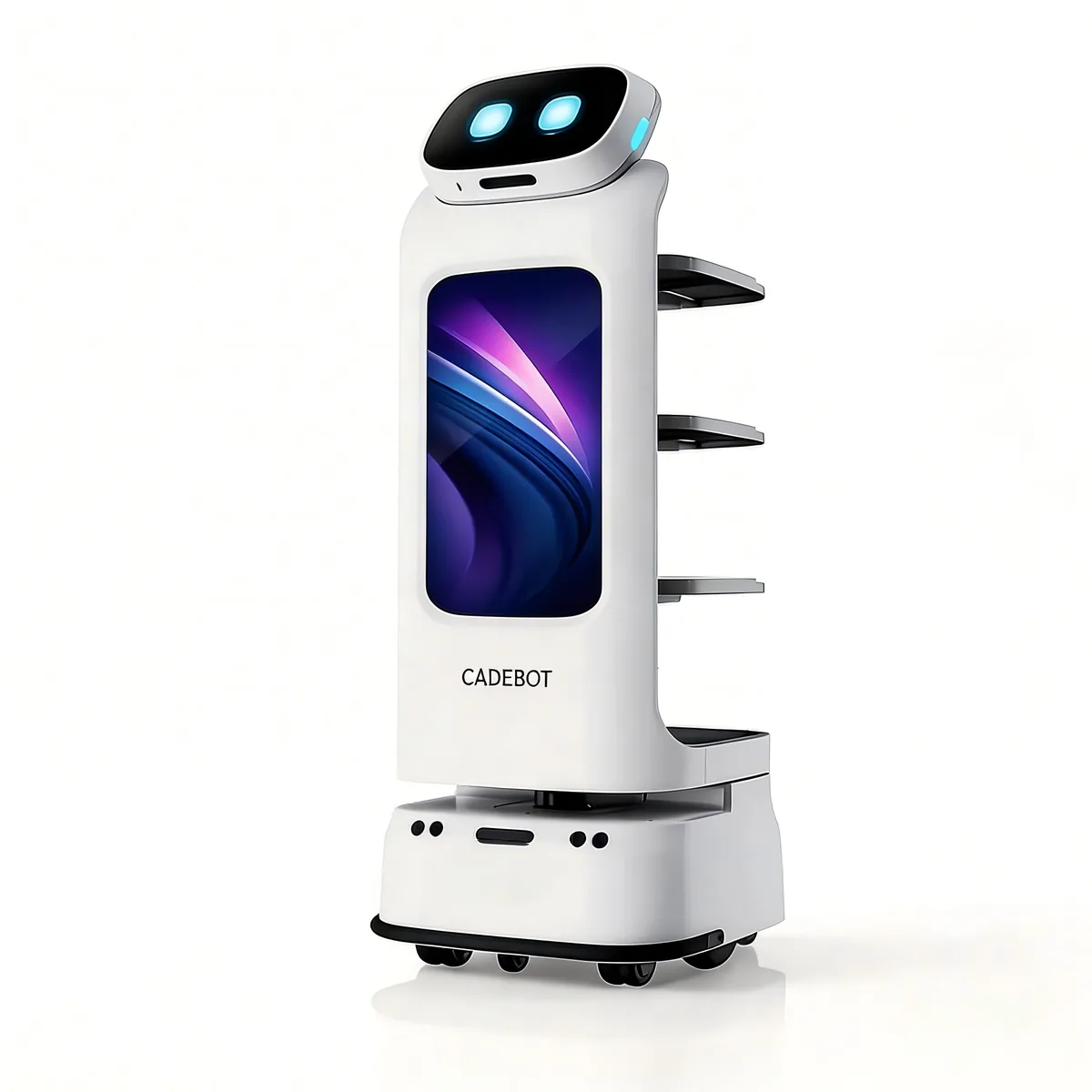
| Competency | Delivery Robots (CADEBOT L100, AOMAN DOUBLE) | Cleaning Robots (CLEINBOT M79, CC201) | Humanoid Robots (CRUZR) |
|---|---|---|---|
| Daily startup | Verify charge, clear cargo bay, confirm route schedule | Fill solution tank, check brush/battery levels, verify cleaning map | Boot sequence, screen diagnostics, scheduled interaction script review |
| Real-time monitoring | Track delivery completion rate, battery mid-shift | Monitor solution usage rate, coverage completion %, wet-floor triggers | Monitor conversation logs, guest interaction completions, voice recognition accuracy |
| Common Tier 1 interventions | Clear path obstructions, resend failed deliveries, free stuck cargo door | Refill cleaning solution, replace mop pad/brush, clear debris from intake | Reboot frozen display, redirect lost navigation, reset audio module |
| Common Tier 2 interventions | Reprogram delivery route around construction zone, adjust elevator call timing | Recalibrate cleaning pattern after furniture rearrangement, adjust chemical dosing | Update script content for seasonal promotions, adjust speech cadence/language settings |
| Key Tier 3 skills | Motor torque calibration, door sensor alignment, cargo bay weight sensor recalibration | LiDAR cleaning and calibration, pump pressure testing, battery deep-cycle diagnostics | Touchscreen calibration, microphone array testing, facial recognition database management |
| Highest-frequency failure mode | Path obstruction (22% of stoppages) | Floor surface anomaly (7% of stoppages) | Wi-Fi dead zone / network latency (3% of stoppages) |
The TCO and maintenance guide provides the hardware economics behind each failure mode — training accelerates resolution, but maintenance prevents recurrence.
Certification Pathways: From Internal to Industry-Recognized
As of 2026, no universally recognized third-party certification for service robot operations exists equivalent to, say, CompTIA for IT or NATE for HVAC. However, three certification pathways are emerging:
1. Vendor-Specific Certification
Most major service robot manufacturers — including AOMAN — offer structured certification programs for Tier 3 technicians. These typically involve a 5-day on-site or virtual course covering hardware diagnostics, firmware management, sensor calibration, and fleet management platform administration. Certification is valid for 18-24 months, after which a 1-2 day recertification is required to cover firmware updates and new product features.
The competitive advantage of vendor certification: it typically includes priority support access, discounted spare parts pricing (10-15% below list), and early access to firmware updates. The limitation: it's vendor-specific. A technician certified on AOMAN platforms cannot directly transfer that certification to another manufacturer's robots — though the underlying competencies (LiDAR principles, motor control, battery management) are broadly transferable.
2. Internal Ladder Certification
Large enterprises with multi-site deployments — hotel chains, hospital systems, retail franchises — are building internal certification ladders that span vendors. The model: a centralized training team develops a vendor-agnostic curriculum covering the 80% of robot operations that are universal (safety protocols, fleet management concepts, environmental troubleshooting), then adds vendor-specific modules for the 20% that vary by platform.
This model's advantage is scalability: when a hotel chain deploys across 140 properties, training 2-3 Tier 3 technicians per site through vendor programs costs $400,000-600,000. An internal train-the-trainer model, where 5-8 regional trainers are certified by vendors and then cascade training to local staff, reduces that to $80,000-120,000.
3. Industry Consortium Certification (Emerging)
The International Facility Management Association (IFMA) and the Association for Advancing Automation (A3) have each announced working groups in 2026 to develop cross-vendor certification standards for service robot operations. These are not yet available for enrollment, but procurement teams signing multi-year robot contracts should include language requiring vendor support for any industry-standard certification that emerges during the contract term.
The Cost of Training vs. The Cost of Untrained Mistakes
Training budgets are easy to cut and hard to defend — until you calculate what untrained mistakes actually cost. Here's the math from real deployments:
| Incident | Frequency (Untrained Staff) | Cost Per Incident | Annual Cost (8-robot fleet) |
|---|---|---|---|
| Unnecessary power-cycling (robot loses task queue) | 3-5/week | $15-25 (lost task time, battery wear) | $2,300-6,500 |
| Incorrect cleaning solution used (pump damage) | 1-2/year | $800-2,200 (pump replacement) | $800-4,400 |
| Obstruction not cleared — robot idle for full shift | 1-2/month | $120-240 (lost utilization per shift) | $1,440-5,760 |
| Sensor damaged during incorrect cleaning | 2-4/year | $400-1,500 (sensor recalibration or replacement) | $800-6,000 |
| Safety stop misinterpreted — staff override unnecessary | 4-6/month | $0 direct, but 30-60 min lost productivity per | $2,880-8,640 |
| Total annual cost of untrained mistakes | $8,220-31,300 |
A comprehensive training program covering 10 operators (Tier 1), 3 supervisors (Tier 2), and 1 technician (Tier 3) costs approximately $6,000-12,000 — including vendor course fees, internal trainer time, and staff backfill during training hours. The ROI breakeven against untrained-mistake costs is 3-7 months. After that, training is pure operational margin improvement.
The change management playbook covers the parallel ROI of training on staff adoption and morale — trained staff become robot advocates; untrained staff become robot saboteurs, passively (by ignoring alerts) or actively (by bypassing safety protocols).
Onboarding Timeline: The 12-Week Ramp to Competence
The training program isn't a one-time event. It's a 12-week ramp structured around the robot deployment timeline:
| Week | Activity | Tier | Hours |
|---|---|---|---|
| 1-2 | Pre-deployment awareness sessions: what robots will do, how roles change, safety basics | All staff | 2 hours |
| 3 | Vendor-led hands-on orientation: robot anatomy, touchscreen operation, emergency stop | Tier 1 + 2 | 4 hours |
| 4 | Supervised operation: robots running with vendor engineer on-site, staff shadowing | Tier 1 + 2 | Full shift |
| 5-6 | Independent operation with escalation support: vendor remote, Tier 3 on-call | Tier 1 + 2 | Normal shift |
| 7-8 | Tier 2 certification assessments: error code diagnosis test, fleet dashboard proficiency, route reprogramming practical | Tier 2 candidates | 8 hours |
| 9-10 | Tier 3 deep-dive: sensor calibration, firmware management, preventive maintenance scheduling | Tier 3 candidates | 40 hours |
| 11-12 | Simulated failure drills: staged obstructions, sensor occlusions, network interruptions — staff respond without vendor support | All tiers | 4 hours (drills) |
| Ongoing | Monthly Tier 1 refresher (30 min), quarterly Tier 2 skills check (2 hours), annual Tier 3 recertification (8 hours) | All tiers | ~20 hours/year |
The simulated failure drill in weeks 11-12 is the highest-ROI component of the entire program. Facilities that skip it discover their training gaps during real failures at 3 AM. Facilities that run it discover them during a controlled simulation with a trainer in the room.
The pilot program guide covers how to structure the initial 30-60-90 day deployment window — the training timeline above should be layered directly onto the pilot framework so that staff competence grows in lockstep with robot operational scope.
Train-the-Trainer: Scaling Training Across Multi-Site Organizations
For organizations deploying robots across 5+ sites, sending every Tier 2 supervisor and Tier 3 technician to vendor training is economically unworkable. The train-the-trainer model solves this:
Select 1-2 regional trainers per 10-15 sites. These individuals attend the full vendor certification program (Tier 3) and additionally complete a 3-day instructional design module — learning how to teach the material, not just perform the tasks.
Develop standardized training materials — slide decks, hands-on exercise guides, assessment rubrics — that are version-controlled and updated quarterly as firmware changes. The vendor provides baseline materials; the regional trainers adapt them for local facility layouts and workflows.
Cascade in cohorts. Regional trainers run a 2-day Tier 1-2 bootcamp for 8-12 staff at a time, typically at a single "training site" facility. Each bootcamp produces 2-3 Tier 2 supervisors who can then handle day-to-day Tier 1 training for their own facility's frontline staff.
Calibrate quarterly. All regional trainers convene (virtually or in-person) to calibrate assessment standards, share failure-mode case studies from their sites, and update training materials. This prevents the drift that occurs when each region develops its own informal training norms.
The cost comparison is straightforward: 20 sites × 3 supervisors × $2,500 vendor training = $150,000. Train-the-trainer: 2 regional trainers × $5,000 (full certification + instructional design) + materials development ($15,000) + trainer travel ($20,000) = $45,000. The $105,000 saved buys 2-4 additional robots.
Ongoing Recertification: Why Training Decays
Service robot training has a half-life of approximately 6-9 months. Three mechanisms drive this decay:
Firmware updates change the interface. A robot that operated one way in January may operate differently in September after two firmware updates. Staff who learned the January interface develop workarounds for the September interface rather than learning the new workflow properly.
Edge cases are forgettable. A LIDAR occlusion from a potted plant placed in a new location happens once. The staff member who resolved it remembers the procedure. Six months later, when a different staff member encounters the same scenario on a different shift, the institutional knowledge is gone.
Staff turnover erases training. The hospitality industry averages 73% annual turnover. If 3 out of 4 Tier 1 operators leave within a year, the trained workforce is continuously diluting. Without a structured recertification program that includes new-hire onboarding, training ROI erodes to zero within 18 months.
The recertification cadence that maintains operational competence:
| Cadence | Activity | Duration | Audience |
|---|---|---|---|
| Monthly | 30-minute refresher: last month's top 3 stoppage types, how they were resolved | 30 min | Tier 1 (all shifts) |
| Quarterly | Skills check: practical assessment on error code diagnosis, route reprogramming | 2 hours | Tier 2 |
| Semi-annual | Firmware update briefing: what changed, what's new, what workflows are affected | 1 hour | All tiers |
| Annual | Full recertification: written test + hands-on practical | 4-8 hours | Tier 3 |
| On new hire | Standardized onboarding: robot safety, basic operation, escalation protocol | 2 hours | All new staff |
The safety standards compliance guide covers the regulatory dimension: under OSHA's General Duty Clause and the EU Framework Directive 89/391/EEC, employers must ensure staff operating autonomous equipment are trained on safety procedures. Documented recertification records are your first line of defense in a post-incident workplace safety investigation.
Building the Internal Training Function: 2026 Recommendations
For facility managers building a service robot training program in 2026, the evidence from real deployments points to five non-negotiable practices:
1. Budget training as a line item, not a footnote. The training line should be 3-5% of Year 1 deployment cost. On an $80,000 deployment, that's $2,400-4,000 — roughly the cost of one Tier 3 certification plus materials. If your procurement spreadsheet doesn't have a training line, your deployment plan is incomplete.
2. Never deploy on a Friday. Robots that arrive on a Friday sit untouched until Monday. The staff who attend Monday's orientation have already formed opinions based on weekend rumors. Schedule robot arrival for a Tuesday, with Tier 1-2 training beginning Wednesday. The change management playbook covers the communication timeline that precedes physical deployment — training slots into week 3 of that framework.
3. Designate a "robot champion" before the robots arrive. The single strongest predictor of long-term fleet utilization is whether the facility has a named individual — not a committee, not a department — who is accountable for robot performance. This person should be Tier 3-certified within the first 90 days and have robot fleet KPIs in their performance review.
4. Run failure drills quarterly. Not annually. Not "we'll do one after the first real failure." Quarterly simulated failures — staged obstructions, sensor occlusions, dead zones — keep response procedures in muscle memory. Facilities that run quarterly drills achieve MTTR of 8-14 minutes for common stoppages; facilities that don't average 35-60 minutes.
5. Track training coverage as a KPI. Add a simple metric to the fleet dashboard: percentage of active-shift staff who have current (non-expired) training certification at their tier. When this number drops below 80%, fleet utilization predictably drops within 2-4 weeks. The correlation is strong enough to make training coverage a leading indicator for operational performance.
Service robots are a workforce multiplier — they amplify the effectiveness of the staff who manage them. A well-trained team makes 8 robots perform like 10. An untrained team makes 8 robots perform like 4. The training program is not overhead. It's the leverage that converts capital expenditure into operational capability.
AOMAN's 50,000+ deployed robots across 70 countries have generated one consistent finding: the facilities with the highest robot utilization rates — consistently above 90% — are not the ones that bought the most robots. They're the ones that invested the most in the people who manage them.

Training Investment by Deployment Scale: A Cost Reference Table
| Deployment Scale | Robots | Training Budget (Year 1) | Training Budget (Annual Ongoing) | Key Milestone |
|---|---|---|---|---|
| Single-site pilot | 2-4 | $3,000-6,000 | $1,500-3,000 | 1 Tier 3 certified by Day 90 |
| Single-site full deployment | 6-12 | $8,000-15,000 | $4,000-7,000 | All supervisors Tier 2 certified by Day 60 |
| Multi-site (5-10 sites) | 15-40 | $25,000-45,000 | $12,000-20,000 | 2 regional trainers certified by Day 120 |
| Enterprise (20+ sites) | 50-150 | $45,000-80,000 | $25,000-40,000 | Internal certification program operational by Month 6 |
First-year investment scales sub-linearly with fleet size because the train-the-trainer model and standardized materials avoid linear multiplication of vendor training fees. The enterprise-scale program that costs $60,000 in Year 1 training could cost $300,000 if every Tier 3 technician were trained directly by the vendor — the 5x savings funds the internal training infrastructure that pays dividends across the entire deployment lifecycle.