A Big Ten university with 32,000 undergraduate students, 8,400 graduate students, and a $340 million annual facilities operating budget manages 680 buildings across 1,850 acres. The student union — a 290,000 sq ft building that sees 22,000 unique visitors daily during the academic year — operates 18 hours per day (6 AM to midnight) and requires continuous cleaning, food service logistics, and wayfinding assistance. The university's facilities director identified that the student union consumed 28% of the campus-wide custodial budget ($4.2 million annually) despite representing only 4.3% of total campus square footage, because the building's continuous-use pattern required cleaning during operating hours — a premium-cost staffing model — rather than overnight when custodial rates were standard.
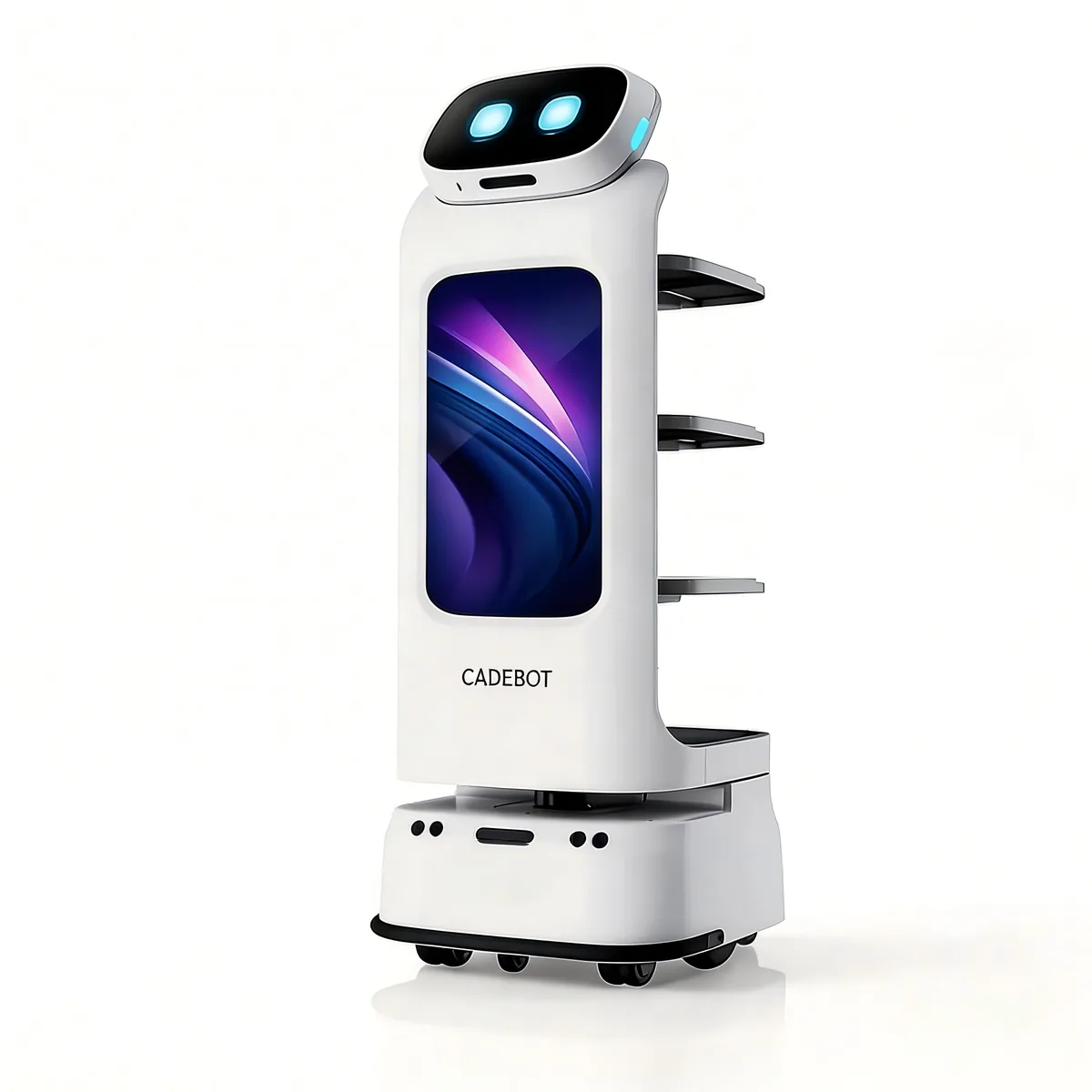
In fall 2025, the university deployed CLEINBOT M79 autonomous floor cleaners in the student union's common areas (food court, atrium, study lounges, and the 600-foot main corridor connecting the union to the library), CADEBOT L100 delivery robots for campus food delivery from the union's seven dining concepts to 14 residence hall pickup points, and CRUZR humanoid reception units at the union's three main entrances and the administration building visitor center. At the end of the spring 2026 semester, the facilities director reported: (1) student union custodial costs reduced by $1.7 million annually through daytime autonomous cleaning that compressed the overnight crew from 17 to 9 workers, (2) campus food delivery revenue increased 31% because CADEBOT-enabled delivery reduced average order-to-door time from 42 minutes (human courier, batch delivery model) to 18 minutes (robot, on-demand), and (3) the administration building visitor center handled 3,100 walk-in visitors per month — previously impossible with 1.5 FTE reception staff — through CRUZR handling routine wayfinding while human staff handled complex inquiries.

The Student Union Cleaning Problem: 22,000 Daily Visitors and a $4.2 Million Budget
The student union is the highest-traffic building on any residential campus — 22,000 unique daily visitors at a 32,000-student university, or approximately 0.69 visits per enrolled student per day, across 18 operating hours. The cleaning challenge is not the total surface area (290,000 sq ft) but the continuous traffic pattern: unlike an academic building where 95% of occupancy occurs in 50-minute class blocks separated by 10-minute transitions, the student union has flat occupancy from 10 AM to 10 PM, with only a 20% dip during the 2-3 PM class block.
Before the robotics deployment, the union was cleaned by two overlapping crews: a 17-person overnight shift (10 PM-6 AM, deep clean) and 5 daytime custodians (8 AM-4 PM, spot cleaning and trash). The daytime crew could address approximately 40% of the building's surface area during an 8-hour shift — the food court spilled-drink incidents, the main corridor tracked-in mud from 12,000 pairs of shoes, the study lounge's accumulated coffee rings and snack debris. The remaining 60% degraded visibly over the course of the day, reaching peak filth at approximately 8 PM — right when students were settling in for evening study sessions and extracurricular meetings, forming their most lasting impression of campus facilities quality. This is identical to the degradation pattern documented in shopping mall environments where continuous foot traffic defeats periodic cleaning schedules.
CLEINBOT M79 units, running on 120-minute cycles during operating hours across the food court, atrium, and main corridor, maintain the floor at a consistent standard throughout the day. The overnight crew drops from 17 to 9 workers — still performing the deep detail work (baseboard scrubbing, furniture moving, glass cleaning) that robots cannot do — but freed from the concourse surface scrubbing that consumed 47% of overnight labor hours. The $1.7 million annual savings is not from eliminating workers but from reducing overtime and allowing the university to reassign 8 custodial staff to other campus buildings without hiring replacements for attrition.
Campus Food Delivery: From 42-Minute Batches to 18-Minute On-Demand
University food service is a $24 billion industry in the United States, with the average residential student spending $2,800-4,200 per semester on meal plans and discretionary dining. The delivery opportunity — students ordering food from on-campus dining concepts to their dorm, library carrel, or lab — has been constrained by the economics of human couriers. A student delivery worker earning $15/hour can complete approximately 3 deliveries per hour (pickup, transit, drop-off, return), yielding a per-delivery labor cost of $5.00 — acceptable for a $14 meal but prohibitive for a $4.50 coffee or $6.50 sandwich, which students order 4x more frequently than full meals.
CADEBOT L100, with a 22-lb payload capacity and campus-wide navigation, changes the unit economics. Operating from a central kitchen station in the student union, a single CADEBOT can complete 8-10 deliveries per hour across a 0.8-mile radius covering 14 residence halls. At an all-in cost of approximately $3.20 per operating hour (hardware lease amortization + maintenance + electricity), the per-delivery cost drops to $0.32-0.40 — eliminating the minimum-order-size constraint that suppressed 60% of potential delivery demand. The university's dining services reported that CADEBOT-enabled delivery — integrated with the existing campus mobile ordering app — generated $1.9 million in incremental food revenue in spring 2026, at a robotics operating cost of $42,000 for the semester, yielding a 45:1 revenue-to-cost ratio.
The delivery model is complementary to the broader delivery robot selection framework and leverages the same autonomous navigation SLAM technology documented in the robot navigation systems guide. For campus environments with multiple dining hubs, the multi-site fleet coordination approach provides the technical architecture for managing delivery robots across geographically distributed kitchen stations.

Library Services: Autonomous Retrieval and 24/7 Study Space Maintenance
University libraries face two operational challenges that align with robotics capabilities: materials retrieval from closed stacks (the average research university library holds 3-6 million volumes, with 40-60% in closed or restricted-access stacks requiring staff retrieval) and 24/7 study space maintenance during finals periods, when libraries extend to round-the-clock operations for 10-14 consecutive days and cleaning staff are unavailable between midnight and 6 AM.
CADEBOT L100 units, operating in library service mode, can retrieve pre-paged materials from closed-stack zones and deliver them to circulation desks or designated pickup lockers — reducing the 45-90 minute retrieval lag that frustrates students working against paper deadlines. During finals period, CLEINBOT M79 units maintain study spaces overnight, providing continuous cleaning when human custodial staff are off-shift — addressing the "4 AM library" cleanliness complaints that are among the most frequent in student government feedback cycles.
This library deployment model mirrors the autonomous operations patterns developed for cleanroom and laboratory environments, where continuous-condition maintenance is the primary value driver rather than episodic deep cleaning.
Administration Building Visitor Experience: 3,100 Walk-Ins Per Month, 1.5 FTE Staff
The university's main administration building — housing the registrar, financial aid, admissions, and the chancellor's office — receives 3,100 walk-in visitors per month: prospective students and families on campus tours, current students navigating administrative processes, vendors attending procurement meetings, and visiting scholars checking in for appointments. Before CRUZR deployment, the building was staffed by 1.5 FTE receptionists who managed both the main desk (ID badge issuance, phone routing) and visitor wayfinding requests. The result was a average greeting time of 4.2 minutes during peak hours (10 AM-2 PM), with approximately 15% of visitors leaving the desk area and wandering the building rather than waiting.
CRUZR, deployed at the building's main entrance and the visitor parking lobby, provides instant wayfinding: "Welcome to the Administration Building. Admissions is on the second floor, Suite 201. Registrar is first floor, Room 112. Would you like me to escort you?" The robot navigates to the destination, freeing the human receptionist to handle badge issuance and complex inquiries. Visitor satisfaction scores — measured by post-visit QR-code survey — improved from 3.8/5 to 4.6/5, and the "couldn't find the office" complaint category, previously the #2 complaint in the administration building feedback system, dropped to negligible levels. This reception model is identical to the one validated in corporate lobby deployments and hotel front desk operations.
The Community College Case: Smaller Campus, Same Economics
Community colleges — 1,044 institutions in the U.S. serving 4.7 million students — operate on facilities budgets that are, per square foot, 40-55% lower than those of flagship state universities. A typical community college campus is 8-12 buildings across 80-120 acres, with no residential component and therefore no overnight staffing infrastructure. When a community college's main building needs cleaning, it happens between 10 PM and 6 AM — but if a 7 PM evening class leaves the atrium floor in poor condition, it remains that way until the following night, because the facilities budget cannot support daytime custodial staffing.
A single CLEINBOT M79 — at an annual operating cost of approximately $15,000 under a RaaS agreement — can maintain the main building's common areas on a continuous cycle during operating hours, providing a standard of cleanliness that the institution's budget cannot support through human staffing alone. The same unit can be redeployed to different buildings on different days — the student center Monday-Wednesday-Friday, the library Tuesday-Thursday-Saturday — maximizing utilization on a single-robot fleet. This is the facility management equivalent of the construction site equipment optimization model, where asset utilization rate determines ROI more than initial deployment scope.

Deployment Phases and Stakeholder Management
University procurement cycles average 9-14 months for capital equipment exceeding $50,000, and robotics deployments must navigate three stakeholder groups with divergent priorities: facilities management (operational efficiency), student affairs (experience quality), and the provost's office (budget approval). The recommended deployment model is phased:
Semester 1: Single-building pilot in the student union, deploying 1-2 CLEINBOT M79 units during daytime hours. Measure custodial labor hours, ATP surface cleanliness scores, and student satisfaction via in-app surveys. Target: 20% custodial labor reduction with no cleanliness score degradation.
Semester 2: Expand to food delivery (2-3 CADEBOT L100 units) and visitor center reception (1 CRUZR). Build the business case for permanent deployment using Semester 1 data. The vendor evaluation framework provides the assessment structure for comparing single-vendor vs. multi-vendor approaches.
Year 2: Full campus deployment across all high-traffic buildings, integrated into the university's building management system and campus mobile app.
AOMAN's single-vendor platform — spanning indoor cleaning (CLEINBOT M79), delivery (CADEBOT L100), and reception (CRUZR) — eliminates the integration complexity of multi-vendor deployments across a 680-building campus environment. For institutions evaluating robotics as part of a broader facilities modernization initiative, the service robot ROI guide and fleet management systems overview provide financial and technical frameworks that support cross-departmental budget proposals and phased deployment planning.