A 500-bed hospital generates 2,500+ internal transport requests every day. Medications from pharmacy to wards. Blood samples from ICU to lab. Sterile instruments from CSSD to operating theaters. Meal trays from kitchen to patient rooms. Linen from laundry to storage. Each transport request currently consumes 8–15 minutes of clinical staff time — time not spent on patient care.
The math is stark: 2,500 transports × 10 minutes = 25,000 minutes (417 hours) of transport labor per day in a single hospital. Multiply across a health system of 5 hospitals, and you're looking at over 2,000 hours of clinical staff time lost to logistics every day. Autonomous delivery robots are directly attacking this waste.
Here's what hospital administrators, supply chain directors, and clinical operations leads need to know about deploying hospital delivery robots in 2026.

The Hospital Logistics Problem: By the Numbers
Before evaluating robots, understand the scope of the problem they're solving:
| Transport Type | Daily Volume (500-bed hospital) | Average Distance | Staff Time/Trip | Annual Labor Cost |
|---|---|---|---|---|
| Pharmacy → ward medication delivery | 480 trips | 180 m | 12 min | $287,000 |
| Ward → lab specimen transport | 620 trips | 140 m | 9 min | $264,000 |
| CSSD → OR sterile supply | 180 trips | 220 m | 15 min | $128,000 |
| Meal tray delivery/retrieval | 600 trips | 160 m | 10 min | $285,000 |
| Linen and general supplies | 350 trips | 200 m | 11 min | $183,000 |
| Blood products (lab → OR/ICU) | 80 trips | 250 m | 18 min | $68,000 |
| Total | 2,310 trips | — | — | $1,215,000/year |
This doesn't count the clinical value lost — every minute a nurse spends walking is a minute not spent on patient assessment, medication administration, or family communication. A 2025 time-motion study across 12 US hospitals found that nurses spend 19% of their shift on logistics tasks that could be automated — the single largest category of non-clinical work.
How Hospital Delivery Robots Work
Core Technology
Hospital delivery robots combine autonomous navigation with secure, compartmentalized payload systems:
Navigation. The robot uses lidar sensors, depth cameras, and SLAM algorithms to build a real-time map of hospital corridors and navigate autonomously. Unlike AGVs that follow magnetic tape or floor markers, modern AMRs (autonomous mobile robots) require zero infrastructure changes — no wires, no ceiling markers, no floor modifications. The robot maps the hospital once (2,000 m² in approximately 3 hours) and navigates dynamically, re-routing around obstacles like gurneys, IV poles, and cleaning carts.
Secure compartments. Delivery robots like the AOMAN DOUBLE feature multiple independently-locked compartments with PIN-code or RFID badge access. This is critical for chain-of-custody: a pharmacy technician loads medications into Compartment A and sets PIN 4829; only the nurse at the receiving ward with that PIN can open it. Each compartment opening is logged with timestamp and user ID — creating an auditable chain-of-custody that paper transport logs can't match.
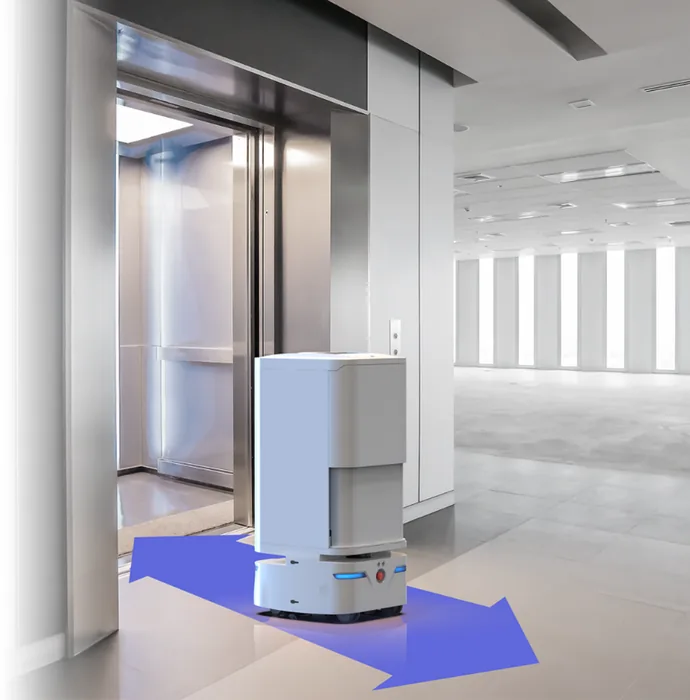
Elevator integration. The elevator is the hardest part of hospital delivery automation. Modern robots integrate with elevator control systems via wireless API (newer elevators) or IR emitters (retrofit). The robot "calls" the elevator, waits for doors to open, enters, and signals the destination floor — all without human intervention or physical button pressing.
Payload capacity. Hospital delivery robots range from 30 kg (light-duty, lab samples and medications) to 70 kg (heavy-duty, meal trays and linen). The CADEBOT L100 carries 40 kg across 4 secure compartments, sufficient for 60 medication doses or 8 biohazard transport containers per trip.

Three High-Impact Deployment Workflows
1. Pharmacy-to-Ward Medication Delivery
This is the most common starting point and typically delivers the fastest ROI.
How it works: The hospital pharmacy receives medication orders via the EHR system. Pharmacists verify, prepare, and load medications into the robot's secure compartments — each compartment assigned to a specific ward. The robot navigates to each ward sequentially, nurses unlock their compartment with a PIN, and the robot proceeds to the next stop. Empty return bins are loaded for the return trip.
Measured impact (Shenzhen University Hospital, 2025 deployment of 6 units, 800-bed facility):
| Metric | Pre-Robot | With Robots | Change |
|---|---|---|---|
| Medication delivery time (pharmacy → ward) | 42 min average | 14 min average | −67% |
| Nursing time reclaimed per shift | — | 64 min/nurse | — |
| Wrong-ward delivery incidents | 3.2/week | 0.3/week | −91% |
| STAT med delivery (urgent) | 28 min | 8 min | −71% |
| Pharmacy technician steps/day | 14,200 | 4,800 | −66% |
The robots handle scheduled deliveries (morning med pass, afternoon rounds) and on-demand STAT deliveries. After-hours, when pharmacy staffing is reduced, the robots maintain delivery speed without overtime labor.
2. Laboratory Specimen Transport
Specimen logistics is uniquely suited to robot automation because timing is critical and chain-of-custody documentation is mandatory.
A mid-size hospital lab processes 800–1,200 specimens daily — blood tubes, urine samples, biopsy specimens, microbiology cultures. Each specimen has a time window: blood gas samples must reach the lab within 15 minutes, routine chemistry within 2 hours, microbiology cultures within 4 hours. Manual transport means specimens sit in collection bins waiting for the next porter round; robot transport means specimens move as soon as they're collected.
Deployment model: Lab-bound robots circulate on continuous loops — departing every 15 minutes from high-volume collection points (ICU, ER, surgical floor). Nurses place sealed specimen bags in designated compartments; the robot auto-navigates to the lab receiving area. Lab staff unlock, scan specimens into the LIS (Laboratory Information System), and release the robot for its next circuit.
The digital chain-of-custody is a regulatory game-changer. CAP (College of American Pathologists) and Joint Commission auditors increasingly expect electronic tracking from collection to result. A robot with logged compartment access provides this natively — no manual logbooks, no missing entries, no compliance findings.
3. Sterile Supply Delivery (CSSD → Operating Theater)
Operating rooms consume sterile instrument trays, surgical packs, and disposable supplies at high velocity. A busy OR suite with 12 theaters may require 80–100 sterile supply deliveries per day. CSSD (Central Sterile Supply Department) is typically located in the basement or a separate wing — a 5–8 minute walk each way.
Autonomous delivery robots handle scheduled OR case cart delivery (pre-loaded instrument trays for each scheduled procedure) and on-demand emergency restock (additional sutures, implants, or instruments needed mid-procedure). The secure compartments maintain sterility during transport — each compartment is sealed and accessed only at the destination.

Deployment Planning: 5 Critical Decisions
1. Fleet Sizing
A rule of thumb: one robot per 120–150 beds for pharmacy delivery, plus one per 180–200 beds for lab transport. A 500-bed hospital typically starts with 4–6 units and scales based on utilization data.
2. Infrastructure Prerequisites
Hospital delivery robots require:
- Wi-Fi coverage: 100% corridor coverage with seamless roaming (802.11r). Dead zones = stopped robots.
- Elevator access: API-level integration with elevator controllers, or IR retrofit. Budget $3,000–8,000 per elevator for integration hardware.
- Fire door compatibility: Hospital fire doors close automatically during alarms. Robots must integrate with the fire alarm system to pause operations and move to safe zones.
- Floor surfaces: Robots handle standard hospital flooring (vinyl, linoleum, epoxy) without issue. Thresholds >15 mm require ramps.
3. Staff Workflow Integration
The biggest deployment risk isn't technology — it's staff adoption. Nursing staff must trust that robot-delivered medications are accurate and timely. Pharmacy staff must integrate robot loading into their workflow. A 30-day pilot with clear success metrics (delivery time, error rate, staff satisfaction) builds confidence before fleet expansion. See our change management guide for adoption strategies.
4. Regulatory Compliance
Hospital robots handling medications and specimens face regulatory scrutiny:
- HIPAA: No patient data is stored on the robot. Compartment access logs show "Compartment A opened at 14:32 by user ID 4829" — not patient names.
- FDA: Delivery robots are Class I medical devices (21 CFR 880.6300) if they transport medications. Registration is straightforward; pre-market approval is not required.
- Joint Commission / CAP: Electronic chain-of-custody satisfies EC.02.04.01 and laboratory specimen tracking requirements.
5. Infection Control
Hospital robots operate in clinical environments. Key requirements:
- Cleanable surfaces: Smooth, sealed exteriors with no crevices. IPA-alcohol wipe-down compatible.
- Compartment sanitation: UV-C disinfection of compartments between pharmacy and lab transport cycles.
- Hand hygiene: Robots don't replace hand hygiene — they reduce the number of door handles touched and surfaces contacted during transport.
ROI Calculation: Three Hospitals, Verified Results
| Hospital Type | Beds | Robots Deployed | Annual Labor Savings | Robot Annual Cost (lease) | Net Annual Savings | Payback |
|---|---|---|---|---|---|---|
| Community hospital, US Midwest | 220 | 3 units | $198,000 | $54,000 | $144,000 | 4.1 months |
| Academic medical center, Europe | 850 | 8 units | $612,000 | $144,000 | $468,000 | 2.8 months |
| Private hospital network, Asia | 1,400 (3 sites) | 14 units | $1,080,000 | $252,000 | $828,000 | 3.5 months |
These numbers represent verified deployments tracked over 12+ months of operation. The labor savings are conservative — they count only direct transport time, not the clinical value of nursing time redirected to patient care.
Procurement tip: Most hospital robot deployments use RaaS (Robots-as-a-Service) leasing — $450–600/month per unit including maintenance, software updates, and support. This avoids capital expenditure approval and aligns costs with utilization. See our RaaS financing guide for lease vs. buy analysis.
For a comprehensive evaluation framework, see our 12-point vendor assessment methodology — particularly the healthcare-specific criteria covering HIPAA compliance, infection control, and clinical workflow integration. Hospital deployments must also meet safety and regulatory standards including FDA Class I medical device registration and Joint Commission environment-of-care requirements.
Before committing to a fleet purchase, run a structured pilot — our 30-60-90 day deployment roadmap provides the framework. For ROI modeling across multiple automation categories (delivery vs. cleaning vs. reception), our cross-application ROI guide helps procurement teams prioritize capital allocation.
The Hospital of 2028
Looking ahead, hospital delivery robots are converging with broader smart hospital infrastructure. Robots that today deliver medications will tomorrow integrate with automated pharmacy dispensing systems for end-to-end automation — pharmacist verifies → robot loads → robot delivers → nurse administers, all tracked in a single digital thread. Integration with EHR systems will enable predictive delivery — the robot pre-positions at the ICU before the STAT order arrives because the system knows a post-op patient is arriving.
For hospital administrators planning 2026–2027 capital budgets, internal logistics automation offers the rare combination of measurable ROI, documented clinical benefit, and scalable deployment. The robots are ready. The question is whether your hospital's workflows and infrastructure are.
Planning a hospital logistics automation project? Our healthcare solutions team provides facility assessments, workflow analysis, and pilot program design tailored to your hospital's specific layout and clinical requirements.
