A 2,400-seat regional performing arts center in the eastern United States runs three venues under one roof: a 2,400-seat concert hall with a 28-second reverberation time tuned for orchestral performance, a 900-seat proscenium theater, and a 350-seat black box studio. The building hosts 620 performances a year — symphony subscription series, touring Broadway, opera, dance companies, comedy and 40 school matinees — and its operations team of 11 housekeepers and 6 front-of-house supervisors face a rhythm that repeats up to four times a day: a 25-minute intermission window in which the lobby must be cleaned, restrooms restocked and 2,400 patrons guided back to their seats, and a 45-minute post-show window in which the auditorium floor must be returned to a pristine state before the midnight load-out crew takes the stage.
The venue's 2025 operating statement shows the structural pressure: housekeeping labor ran $1.9 million (14% of the $13.6 million operating budget), front-of-house another $2.4 million, and the venue reported 31% annual turnover among part-time housekeeping staff — each departure costing an estimated $3,800 in recruiting, training and overtime. The operations director's own time study found that 41% of housekeeping shift hours were spent on lobby and restroom turnover tasks that happen in identical bursts every single performance, and that the auditorium floor — 18,000 square feet of sloped seating deck and aisles — required a crew of four working 40 minutes to sweep, spot-clean and polish between matinee and evening shows.
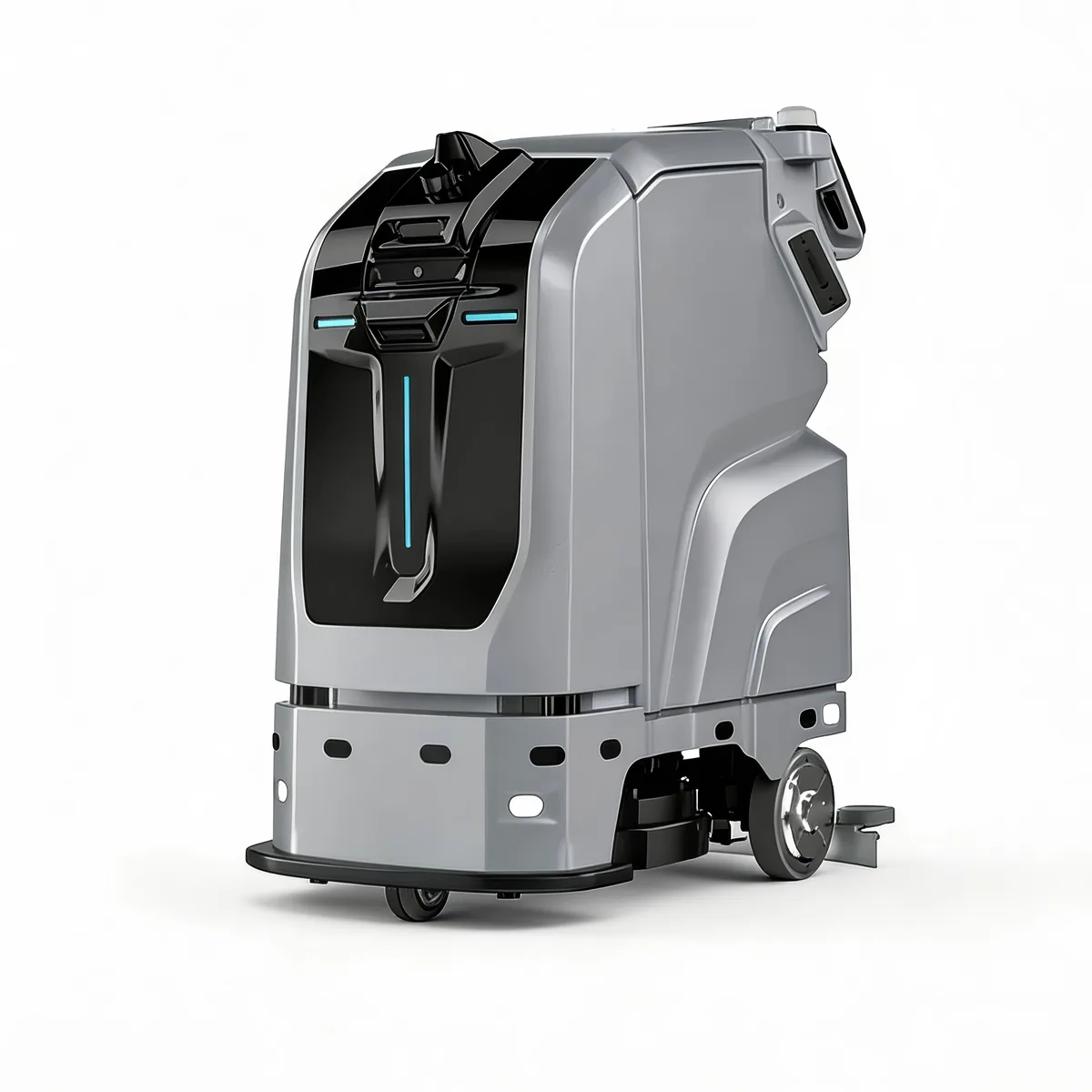
In early 2026 the center deployed CLEINBOT M79 floor scrubbers on the auditorium deck and lobby, CRUZR humanoid concierge robots at both main entrances for intermission wayfinding and membership check-in, and CADEBOT L100 delivery robots for backstage logistics between the loading dock, wardrobe and stage-level storage. The operations director's summary after six months: "We got the housekeeping crew out of the auditorium entirely and gave them back to the lobby, where patrons actually see them."
The Acoustics Constraint: Why Cleaning a Concert Hall Is a Performance Problem
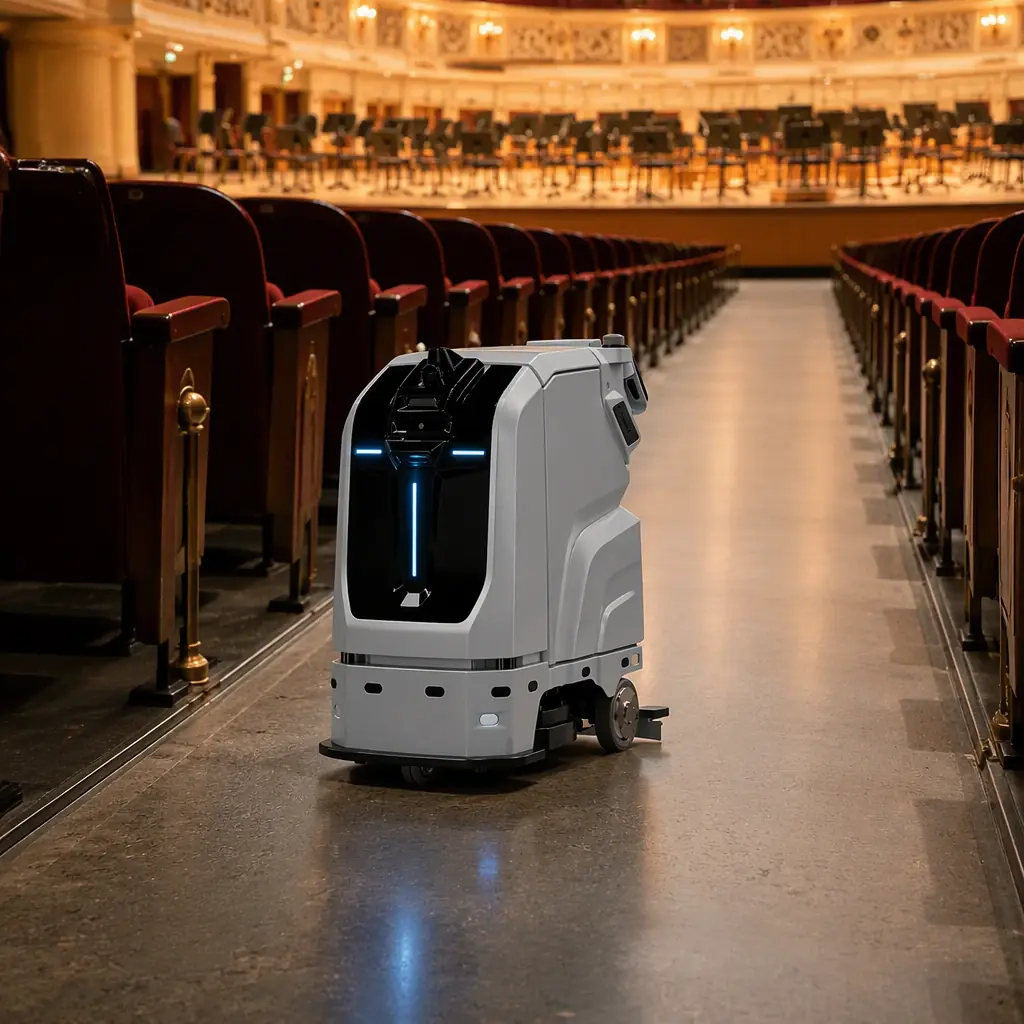
Every performing arts venue lives with a specification that hotels, malls and offices do not have: the room's acoustics are a revenue asset. The 28-second reverberation time of the concert hall above is the reason the symphony's subscription renewal rate holds at 82% — and it is also the reason the operations team cannot use a standard commercial floor scrubber during performance hours. A conventional scrubber at 65-72 dB(A) is audible from the stage during rehearsal and from the balcony during any quiet passage; venue noise policies at union houses typically cap allowable backstage and auditorium noise at 55-60 dB(A) during load-in and 45 dB(A) during technical rehearsals.
CLEINBOT M79's quiet mode at approximately 58 dB(A) — comparable to a normal conversation — is the specification that makes auditorium cleaning possible between shows. The robot scrubs, vacuums and mops in a single pass across the sloped deck, and its LiDAR SLAM + RGB-D navigation maps the aisle geometry so it never touches the stage edge or the orchestra pit rail. The 45L water tank and auto-return docking station let it run a full cleaning cycle on the deck, return to the dock for water exchange, and resume — a complete auditorium pass in under an hour with zero staff in the room. The same noise-first logic is documented in the museum and cultural institution guide, where galleries run the M79 after closing precisely because collection rooms tolerate no disruptive sound, and in cinema deployments, where auditorium cleaning between screenings is the highest-frequency task in the building.
The Intermission Window: 25 Minutes to Turn the Lobby
The performing arts lobby is the most intense cleaning and service environment in commercial real estate. A 2,400-person intermission creates, in 25 minutes: 2,400 patrons moving through two levels of lobby, bar lines at six stations, restroom queues, and a floor that accumulates the entire footprint of a small crowd in a single surge. The venue's housekeeping standard requires the lobby floor to be dry, swept and polished before the house lights dim — and the bar staff require their spills cleared within minutes to avoid slip liability.
The M79's 500-800 m²/h coverage cleans a 12,000-square-foot lobby in about 15 minutes, and because it runs in quiet mode, it can work the perimeter and bar zones while patrons are still in the room — a task manual crews avoid because a scrubber among 2,400 standing patrons is both slow and a safety hazard. The restaurant and food service deployment guide documents the same continuous-turnover pattern: robots working live floor spaces during peak service windows, absorbing the spill-and-debris layer while staff handle the customer-facing work. Venues that deploy the lobby robot report the same outcome as hotel and resort operations: the visible cleanliness score on post-show patron surveys rises because the floor never accumulates to the threshold patrons notice.
Lobby Concierge and Wayfinding: CRUZR at the 2,400-Patron Scale
Intermission wayfinding is a measurable cost at performing arts centers. The venue above employs two front-of-house supervisors whose primary intermission job is answering the same five questions from hundreds of patrons: where are the restrooms, where is my seat (section B, row 12), where is the bar, where is coat check, and when does the second half start. A 2025 patron-flow study by the venue found that 38% of front-of-house supervisor time during intermissions was spent on wayfinding repetition — time that disappears entirely when the information layer is automated.
CRUZR's humanoid form factor with RGB-D face recognition (0.3-second match), 7-category emotion detection and a configurable voice persona handles the routine layer: greeting patrons at the door, reading tickets for seat location, directing to restrooms and coat check, and reminding about the second-half start time. Its 10.1-inch touchscreen displays venue maps, and the robot's ability to move through crowds — rather than stand at a fixed kiosk — is the differentiator in a lobby where the queue forms wherever the help is. The reception and concierge deployment model and the events and trade shows guide document the identical dynamic: the robot absorbs the information repetition, the human staff handle the exceptions — the patron with a mobility issue, the lost child, the VIP guest.
Backstage Logistics: The L100 on the Loading Dock
The backstage of a performing arts center is a 24-hour logistics operation disguised as a theater. The loading dock receives scenery, wardrobe trunks, musical instruments and catering deliveries on a schedule driven by tour itineraries; the wardrobe department moves costumes between the dock, the laundry room and dressing rooms; and the stage crew shuttles props, chairs and equipment between storage, the stage and the workshop. At the venue above, the operations team measured 14,000 annual backstage hand-carried movements — each one a crew member walking 150-600 feet with a load that a robot could carry.
CADEBOT L100's four open trays (15 kg per tray, 60 kg total payload), 13.3-inch HD touchscreen and SLAM 3.0 navigation at 0.3-1.2 m/s make it the backstage workhorse.
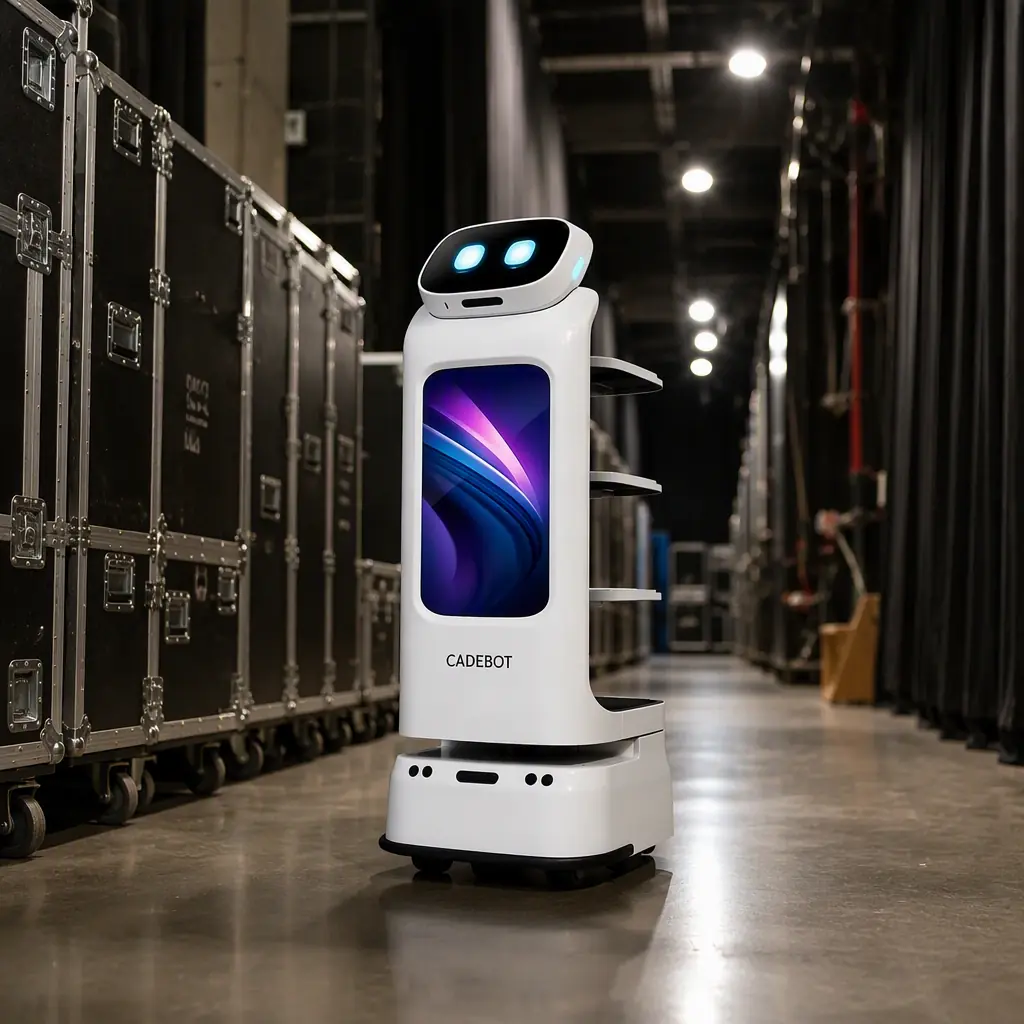
Wardrobe trunks ride between the dock and wardrobe on a tray while the crew member walks alongside; catering totes move from the dock to the green room without a single stagehand diverted from the load-in; and the robot's 24-hour continuous work rating means it runs the overnight shift that union agreements make expensive for human labor. The hospital internal logistics guide documents the same workflow — robots absorbing the predictable transport layer so specialized staff stay at their stations — and the warehouse and delivery robot selection guide covers the payload and navigation trade-offs for venues comparing the L100 against smaller delivery platforms.

Union Compatibility: Working Within the Crew Agreements
Performing arts centers are among the most union-dense facilities in commercial operations. The IATSE agreement covers stage crew and backstage work; building service unions cover housekeeping; and the boundaries between them are enforced daily. The deployment model that works at union houses treats robots as crew-support tools, not crew replacements: the M79 operates under the housekeeping department's purview and reduces the physical burden of the cleaning shift, while the L100's backstage movements are configured so that the union steward's jurisdiction (load-in, stage-level movement) is never crossed — the robot carries between departments, and crew members handle the final placement. The human-robot collaboration and change management playbook covers the staff-integration dynamics in detail, including how venues position robot deployment in union negotiations as a workload-reduction tool rather than a headcount reduction — the same framing that succeeded in government facilities and museums. The safety standards compliance guide documents the ISO 3691-4 requirements for autonomous mobile robots in public venues, which venues should review with their risk and insurance teams before pilot.
Deployment Roadmap: Phasing Robots into a Performing Arts Campus
The venues that succeed follow a four-phase sequence. Phase 1 — auditorium proof: deploy one M79 on the concert hall deck, run it for 60 days between shows, and measure cleaning hours per week against the manual baseline. Phase 2 — lobby expansion: add the second M79 for lobby and restroom-adjacent zones, running during intermission windows. Phase 3 — front-of-house: introduce CRUZR at the main entrance for wayfinding and membership check-in, starting with subscription nights when the patron base is most predictable. Phase 4 — backstage: add the L100 for dock-to-wardrobe and dock-to-green-room transport once the operations team is comfortable with the fleet.
The financing path for performing arts centers is different from commercial venues because operating budgets are subsidized — earned revenue covers 40-60% of costs at most regional centers — which makes capital purchases harder to justify and operating leases easier. The RaaS and financing models guide and the budget planning framework show how a $1,000-1,500/month per-robot subscription maps to the labor hours it displaces, and the vendor evaluation framework applies with one added criterion: the vendor must provide the decibel specification in writing and the noise data must be verified on-site before acceptance. The multi-site deployment strategy covers venues that operate multiple buildings, where one fleet management console coordinates robots across the concert hall, theater and studio.
The performing arts center is the only venue type where the cleaning machine must be quieter than the audience. The venues winning the subscription renewal war in 2026 are the ones treating robotics as an extension of their acoustic and service standards — scrubbers that polish the deck without a whisper reaching the balcony, concierges that guide 2,400 patrons through a 25-minute intermission without a single queue forming, and delivery robots that move the wardrobe while the stagehands move the show.