A regional industrial laundry in Ohio processes 22 million pounds of healthcare linen annually — scrubs, bed sheets, patient gowns, towels, thermal blankets, and surgical drapes — for 14 hospitals, 62 nursing homes, and 8 outpatient surgery centers across a three-state service area. The 90,000 sq ft plant operates 22 hours per day, 6 days per week, running two 11-hour shifts with a 2-hour sanitization window between shifts. The plant employs 72 production workers — and in 2025, experienced 41% annual turnover, meaning 30 positions turned over at least once during the year at an average replacement cost of $4,200 per hire (recruiting, training, lost productivity during vacancy). The material-handling positions — soiled-linen cart transport, clean-linen cart staging, and folding-station replenishment — had the highest turnover rate (61% annually) and the highest injury rate (8.4 recordable injuries per 100 FTE, versus 3.2 for the plant average), driven by repetitive lifting of 40-80 lb linen bundles in a 38°C, 75% RH environment where heat exhaustion contributed to 23% of recorded safety incidents.
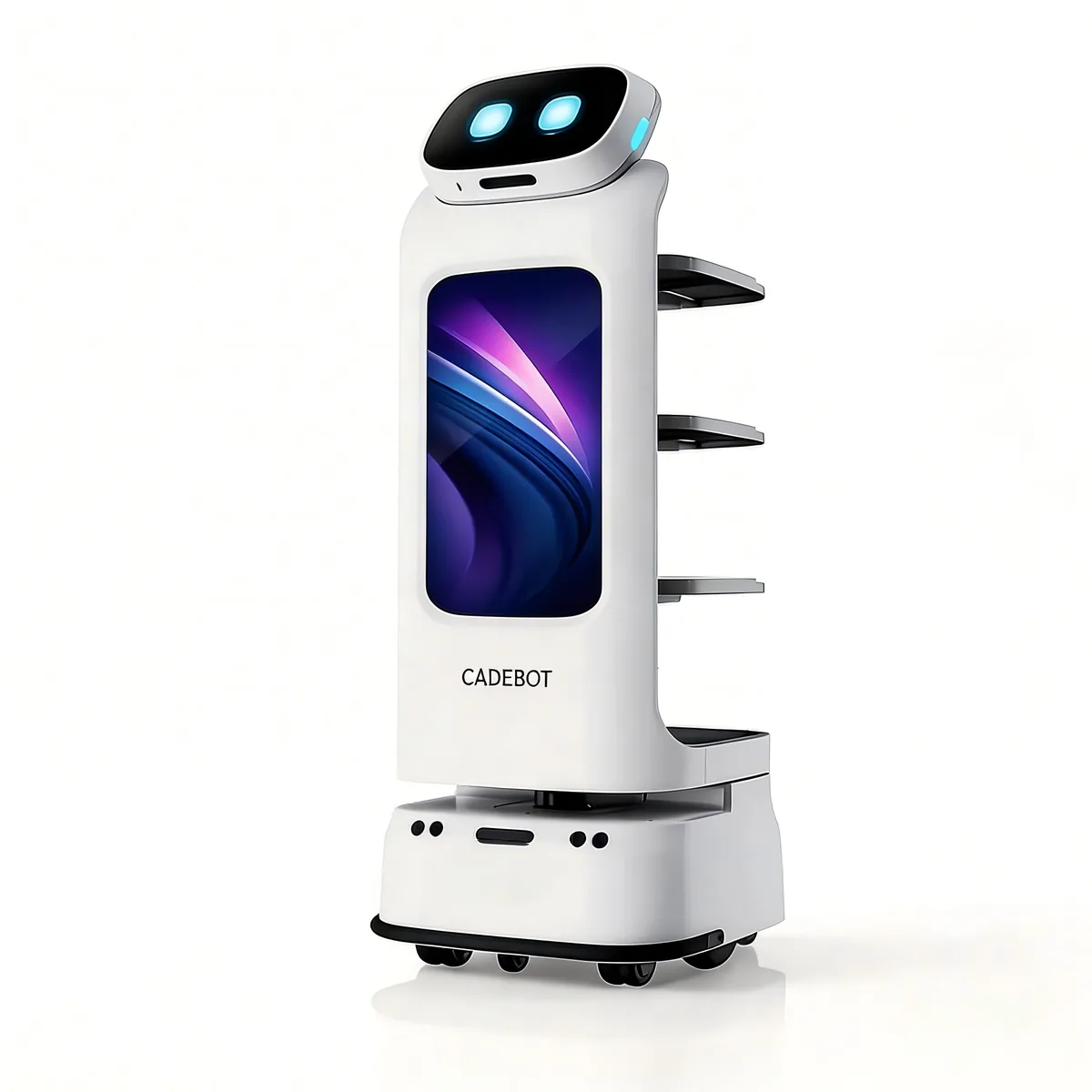
The plant manager deployed CADEBOT L100 units on the soiled-linen transport loop — a 340-foot path from the receiving dock through weighing to 8 sorting stations, a route that each material handler walked 25-30 times per shift carrying 60-80 lb bundles. Three CADEBOT units, each carrying 180 lbs of bagged soiled linen on a flatbed cart attachment, run on a continuous 12-minute loop: receiving dock → weighing station (automatic RFID tag scan) → sorting station drop (robot stops at assigned station, attendant unloads bag) → return to receiving dock. The loop runs 110 times per shift — the equivalent of 5.5 material handlers' worth of transport volume — at a robotics lease cost of approximately $2,100 per month per unit. The 4 material handlers previously assigned to this loop were reassigned to sorting stations, increasing sorting throughput by 15% without adding headcount, and the injury rate on the transport function dropped to zero (robots don't file workers' comp claims).
The Industrial Laundry Workflow: 340 Feet of Repetitive Motion
The standard industrial laundry workflow follows a linear path through the plant, designed for gravity-fed material flow but creating an unavoidable material-handling burden at each transition point:
- Receiving: Soiled linen arrives in 200-400 lb carts, is weighed (for customer billing), and staged for sorting. Transition: cart from receiving to sorting — 60-120 feet.
- Sorting: Workers at conveyor stations separate linen by type (sheets, towels, gowns, scrubs), fabric (cotton, polyester-cotton, microfiber), and soil classification (standard, infectious, heavy-soil). Transition: sorted batches to wash-aisle hoppers — 40-80 feet.
- Washing: Tunnel washers (continuous-batch) or conventional washer-extractors process 120-180 lb batches. Cycle time: 22-28 minutes. Transition: clean, damp linen to dryers — 20-40 feet.
- Drying: 200-400 lb capacity gas-fired dryers. Cycle time: 18-24 minutes. Transition: dry linen to finishing — 30-60 feet.
- Finishing: Ironers (flatwork: sheets, tablecloths), steam tunnels (garments: scrubs, gowns), and folding stations. Transition: finished linen to pack-out — 40-80 feet.
- Pack-Out: Clean linen sorted by customer, packed into delivery carts. Transition: carts to dispatch dock — 60-100 feet.
Each transition point requires human material-handling — lifting, carrying, or pushing carts — across a combined 300-500 feet of plant-floor distance. At 22 million lbs per year, flowing through 6 transition points, the plant moves 132 million lbs of material across the plant floor annually, the vast majority of it by human muscle. This is the automation opportunity: not replacing the skilled labor at sorting, washing, or finishing stations, but eliminating the unskilled repetitive material-handling that connects them. The same point-to-point autonomous transport model that enables keeper-station logistics at zoological facilities and ski-rental equipment shuttling at mountain resorts applies directly to industrial laundry cart transport — the payload weight, route complexity, and environmental conditions differ, but the core automation logic is identical.
Material-Handling Automation: The 12-Minute Loop That Replaces 5.5 Workers
The ROI of automating soiled-linen transport (the highest-volume, lowest-skill material-handling task in the plant) is straightforward arithmetic. A material handler on the receiving-to-sorting loop walks 340 feet per trip, carrying a 60-80 lb bag, making 25-30 trips per shift — that's 1.7-2.1 miles of walking and 1,700-2,200 lbs of cumulative lifting in a 38°C environment. The average tenure on this position is 4.2 months; at 41% annual turnover, the plant spends $126,000 annually on recruiting and training for the 4 positions on this loop alone. Add the workers' compensation cost of the 8.4-injury-per-100-FTE rate — averaging $18,200 per claim (OSHA industry average for sprains and strains) — and the total cost of the 4-position transport loop is approximately $198,000 annually in direct labor plus $44,000 in turnover costs plus $26,000 in injury costs: $268,000 total.
Three CADEBOT L100 units on a 12-minute continuous loop handle 110 trips per shift — 5.5 FTE equivalent — at a cost of $75,600 annually ($2,100/month × 3 units × 12 months). The robotics deployment does not eliminate the 4 material-handling positions so much as it eliminates the need to hire their replacements 2.4 times per year as workers quit. The existing workers are reassigned to sorting stations, where the work is stationary, air-conditioned (sorting stations have spot cooling), and less physically demanding — reducing turnover and injury rates while increasing throughput. This is the same workforce-stabilization dynamic seen in construction site automation and manufacturing floor deployments, where robotics absorb high-turnover, high-injury positions while human workers are reassigned to higher-value, lower-risk roles.

Lint Management: The Fire Hazard That Never Sleeps
Industrial laundries generate airborne lint at a rate of 2.5-4.0 lbs per 1,000 lbs of linen processed, depending on fabric composition (cotton sheds more than polyester blends). In a 90,000 sq ft plant processing 22 million lbs annually, that's 55,000-88,000 lbs of airborne lint per year — and approximately 60% of it settles on plant-floor surfaces, overhead pipes, ductwork, and machinery within 24 hours of becoming airborne. Accumulated lint presents two operational risks: (1) fire — lint is highly combustible, and the NFPA 652 standard for combustible dust requires industrial laundries to maintain documented lint-removal schedules with surface accumulation not exceeding 1/32 inch (0.8mm), and (2) equipment degradation — lint accumulation on motor housings, conveyor bearings, and electrical panels reduces cooling efficiency, increasing energy consumption by 3-7% and accelerating component wear.
CLEINBOT CC201 outdoor scrubbers, adapted for indoor plant-floor operation, run on a continuous 3-hour cycle across the 65,000 sq ft of accessible plant-floor surface (excluding machinery footprints). The robot's vacuum system captures surface lint into a HEPA-filtered collection bin; the scrubbing module removes the fine oil-and-detergent film that causes lint to adhere to concrete flooring. Operating 3 cycles per day, each unit captures approximately 18-22 lbs of settled lint per day — roughly 5,500-6,700 lbs annually per unit — directly reducing the combustible-dust loading on plant surfaces. The continuous-cleaning model is identical to the outdoor plaza and concourse maintenance approach used in large-scale paved-surface environments, adapted for indoor industrial conditions.
For healthcare laundries processing surgical linens and isolation-unit textiles, the clean-pack area — where finished sterile linen is packed for hospital delivery — requires a higher standard: ISO Class 8 (formerly Class 100,000) cleanliness with particulate monitoring. CLEINBOT C2 Pro units, operating in the clean-pack area on a 90-minute cycle, maintain floor-level particulate counts within ISO 8 limits while generating a documented cleaning log that satisfies Joint Commission and AORN (Association of periOperative Registered Nurses) environmental monitoring requirements for sterile processing areas. This is the same environmental-monitoring approach used in pharmaceutical GMP cleanroom automation and laboratory and cleanroom deployments, where documented cleanliness verification is a regulatory compliance requirement.
The Healthcare Linen Standard: Infection Control and HLAC Accreditation
Healthcare linen processing — the largest segment of the industrial laundry industry at 42% of revenue — operates under HLAC (Healthcare Laundry Accreditation Council) standards that require documented process control at every stage from soiled-linen receipt to clean-linen dispatch. The key process-control requirements that robotics address: (1) segregation verification — soiled linen from isolation units must be processed separately from standard soiled linen, and robotics transport with RFID tracking provides an auditable chain of custody that manual cart-pushing cannot match; (2) thermal disinfection verification — tunnel washers must maintain 71°C for a minimum of 25 minutes (HLAC standard), and robotic transport with integrated temperature-logging confirms that no batch bypasses the thermal kill step; and (3) clean-pack environmental monitoring — the clean-pack area must maintain positive air pressure, filtered air supply, and documented surface cleanliness, all of which the C2 Pro's onboard environmental sensors continuously log.
The HLAC audit process, conducted annually, reviews 300-400 documented data points across the plant's quality management system. Robotics-generated data — transport logs, environmental readings, cleaning-cycle records — directly satisfy approximately 25% of the audit's documentation requirements, reducing the manual record-keeping burden on plant management. For laundry operators considering vendor evaluation for enterprise procurement, the compliance-documentation capability is often the deciding factor for healthcare-focused operations where accreditation status directly determines revenue eligibility.
ROI Framework: The 22 Million Pound Plant Model
For a regional industrial laundry processing 22 million lbs annually, 72 production workers, 90,000 sq ft:
| Line Item | Pre-Robot Annual Cost | Post-Robot Annual Cost | Annual Savings |
|---|---|---|---|
| Soiled-linen transport (4 positions) | $198,000 labor + $44,000 turnover + $26,000 injury = $268,000 | $75,600 (3 robot lease) | $192,400 |
| Plant-floor lint removal (manual crew) | $72,000 (1.5 FTE, nightly sweeping) | $36,000 (1 CC201 lease) | $36,000 |
| Clean-pack area maintenance | $48,000 (1 FTE) | $24,000 (1 C2 Pro lease) | $24,000 |
| Sorting throughput gain (labor reallocation) | — | +15% throughput ($86,000 revenue) | $86,000 |
| Injury-cost reduction (transport function) | $26,000 (annual claims) | $0 | $26,000 |
| Energy savings (lint-free equipment) | — | $18,000 (3% motor efficiency gain) | $18,000 |
| Total | $414,000 | $135,600 | $278,400 + $86,000 revenue |
Total annual robotics cost under a 36-month RaaS contract: approximately $135,600 for a 5-robot fleet (3 CADEBOT, 1 CC201, 1 C2 Pro). Net annual savings: $142,800 after RaaS costs, plus $86,000 in incremental sorting throughput revenue. Payback period: approximately 11.5 months on direct savings alone, 8 months including throughput gains. This ROI profile — rapid payback on non-discretionary labor costs in a high-turnover environment — is characteristic of the industrial and manufacturing robot deployments where the labor savings are direct and non-cyclical.
For laundry operators managing multiple plants — regional chains operating 3-8 facilities — the multi-site deployment framework provides a centralized approach to procurement, training, and fleet management, and the fleet management system enables cross-plant performance benchmarking and predictive maintenance scheduling.
Implementation Roadmap: 4 Phases Over 5 Months
Phase 1 (Month 1): Plant-floor mapping and route planning. Map soiled-linen transport loop (receiving → weigh → sort), plant-floor cleaning zones, and clean-pack area. Install Wi-Fi 6 mesh with industrial-rated access points (ambient 42°C, 75% RH). Map all RFID tag readers for integration with CADEBOT scan points. Duration: 4 weeks.
Phase 2 (Month 2-3): Transport-loop pilot. Deploy 3 CADEBOT L100 units on soiled-linen loop. Run 60-day trial. Measure: transport-loop throughput (trips per shift), material-handler reassignment effectiveness (sorting station throughput change), injury incident rate on transport function. Success threshold: ≥100 trips per shift per 3-unit fleet, zero transport-function injuries.
Phase 3 (Month 4): Cleaning deployment. Deploy 1 CLEINBOT CC201 on plant-floor cycle, 1 CLEINBOT C2 Pro in clean-pack area. Integrate environmental logging with plant quality management system. Measure: surface lint accumulation (depth gauge per NFPA 652), clean-pack particulate counts.
Phase 4 (Month 5): Full integration and HLAC documentation. Integrate all robot data streams into plant QMS. Generate compliance documentation package for next HLAC audit. Train shift supervisors on fleet management dashboard. Establish monthly KPI review cycle aligned with the 30-60-90 day pilot evaluation framework.