A 14-screen multiplex in a suburban Dallas retail center generates $8.2 million in annual revenue — $5.1 million from concessions (popcorn, fountain drinks, candy, and the expanded hot-food menu added during a 2024 renovation) and $3.1 million from ticket sales. Operating costs run at 94% of revenue, and in Q1 2026 the theater's profit margin was 2.1% — meaning a single underperforming weekend could push the location into the red. The general manager's P&L shows three pressure points: (1) concession counter staffing requires 4-6 employees during peak hours at a fully-loaded labor cost of $18.50 per hour, creating a $370-555 per-peak-hour cost that eats 38% of concession revenue before food costs; (2) the third-party overnight cleaning crew costs $2,800 per week for 14 screens, and a single auditorium that doesn't meet the chain's 92-point cleanliness audit standard generates a negative online review that costs an estimated $1,200 in lost ticket sales over the following 30 days; and (3) during matinee hours when staffing is minimal, customers routinely walk the wrong direction down the concessions corridor looking for their auditorium, creating a low-grade friction that the GM suspects — but cannot prove — depresses repeat visitation rates.
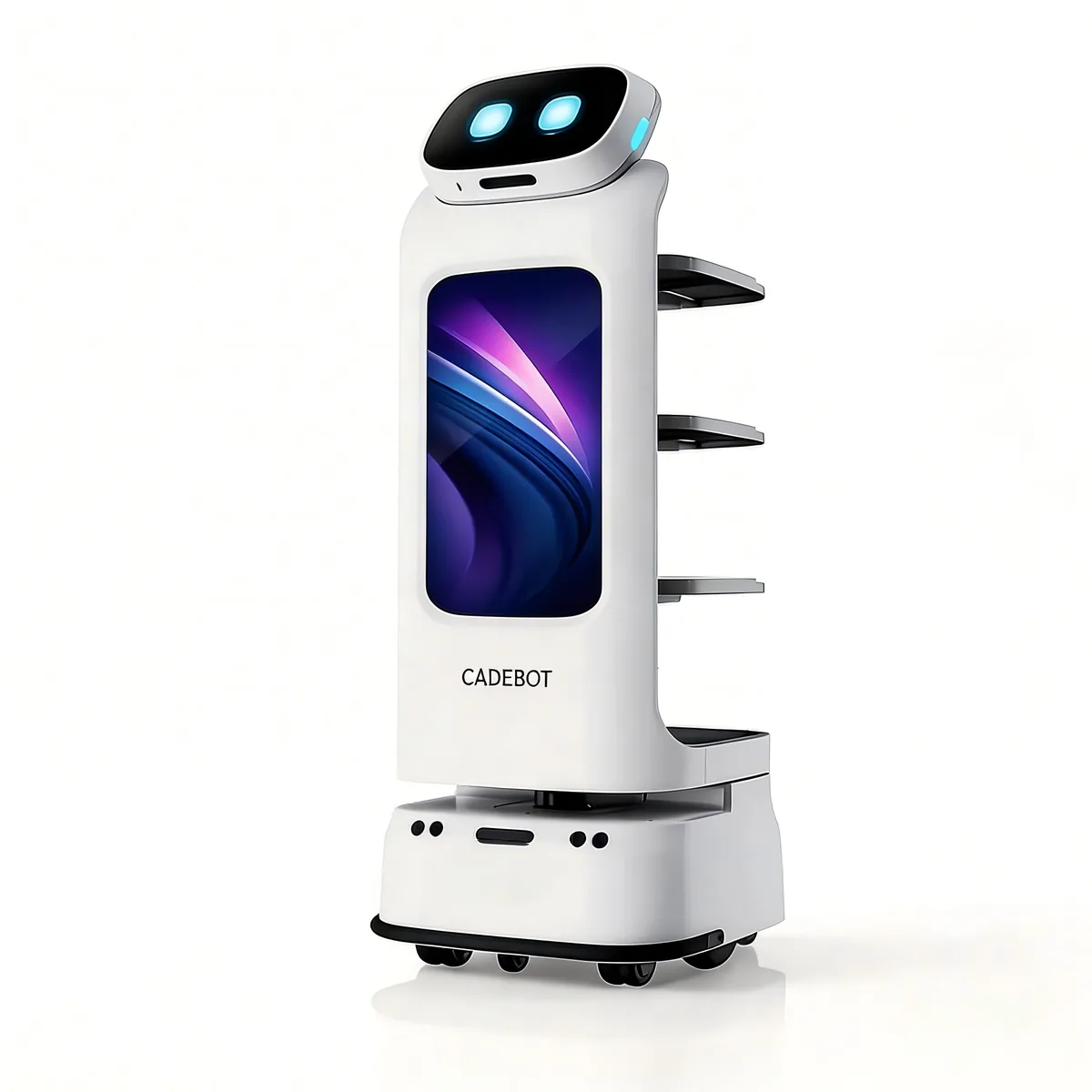
In Q2 2026, the multiplex piloted CADEBOT L100 delivery robots for in-seat concession delivery in its premium large-format auditoriums, CLEINBOT M79 autonomous floor scrubbers for continuous lobby and corridor maintenance, and CRUZR humanoid reception robots at the box office entrance for showtime navigation and upsell prompts. The results at month 3: premium-auditorium concession revenue increased 22% (patrons ordered more when they didn't have to carry food from the counter), overnight cleaning costs dropped $1,400 per week (the cleaners now handle only the deep-cleaning tasks the robots cannot perform, reducing crew size from 5 to 2), and the Google review score for "cleanliness" and "staff helpfulness" — the two factors most correlated with repeat visitation — each improved by 0.3 stars.
The Cinema Profitability Equation That Robots Rebalance
Movie theater economics are uniquely unforgiving because the two largest cost categories — film rental (which averages 52% of ticket revenue) and occupancy (rent, utilities, insurance) — are largely fixed or outside the operator's control. The only cost category large enough to meaningfully impact profitability through operational improvement is labor, and the only revenue category with headroom for growth is concessions.
Autonomous robots address both simultaneously. A CADEBOT delivery robot that brings a customer's popcorn and drink to their seat eliminates the "carrying friction" that suppresses order size — industry data shows that customers who order at the counter and must carry food to their seats order an average of 2.1 items, while in-seat delivery customers (in theaters that offer human-server delivery) order 2.9 items. The robot delivers the same order-size uplift at approximately 15% of the labor cost of a human server.
This dynamic — automation improving the revenue side of the equation, not just the cost side — parallels what operators have observed in restaurant and food service deployments, where delivery robots increased average check size by enabling customers to order in stages without concern for carrying capacity. The same behavioral pattern applies in cinemas: a customer who has already ordered a large popcorn and drink at the counter may add a second drink or a dessert item when prompted by the robot's in-seat upsell interface, because the carrying constraint has been removed from the equation.
The Three Robot Roles in a Multiplex Deployment
Role 1: In-Seat Concession Delivery (CADEBOT L100)
The CADEBOT L100's cinema configuration includes a tray module designed to carry up to four concession items — a large popcorn, two large drinks, and a candy or hot food item — through the darkened, sloped aisles of an auditorium during a screening. The robot navigates using a combination of pre-mapped auditorium geometry and real-time LiDAR that detects obstacles (a customer's outstretched leg, a dropped phone, a child moving between seats) and adjusts its path without disrupting the viewing experience. The drive motors are acoustically damped to <45 dB at 1 meter, quieter than the ambient sound of a movie soundtrack at reference level.
The operational flow is straightforward: a customer places a concession order through the theater's mobile app (or through a QR code displayed on their seat armrest), the order prints at the concession counter, counter staff prepare the items and load them onto the CADEBOT's tray, the robot navigates to the customer's seat, the customer removes their items, and the robot returns to the counter for the next order. The entire cycle — counter to seat to counter — averages 4.2 minutes for auditoriums up to 300 seats, compared to 7-9 minutes for human servers who must navigate the same path at walking speed while carrying trays.
For multiplex operators, the CADEBOT model creates a new revenue stream: premium in-seat delivery can be offered as an upsell ($2-3 per order) or bundled into premium-format ticket pricing (IMAX, Dolby Cinema, 4DX), creating a service differentiator that competing theaters without robot delivery cannot replicate without hiring additional staff — which, given the labor cost structure described above, most cannot profitably do.
The delivery robot selection guide provides a cross-industry evaluation framework for autonomous delivery platforms, while the fleet management guide covers the software layer for coordinating multiple delivery robots across different auditoriums and showtimes.
Role 2: Continuous Auditorium and Lobby Cleaning (CLEINBOT M79)
The cleaning challenge in a multiplex is defined by the schedule, not the square footage. A 14-screen theater shows approximately 56 screenings per day (4 per screen), with each auditorium turning over every 2.5-3 hours. The cleaning window between screenings is 15-20 minutes, during which ushers must remove trash, spot-clean spills, and reset the auditorium to the chain's cleanliness standard. In practice, the 15-minute window is sufficient for trash removal but not for floor cleaning — auditorium floors accumulate popcorn butter residue, spilled soda, and candy fragments that the between-screening crew can only address superficially, leaving the deep clean to the overnight crew.
A CLEINBOT M79 operating continuously in the lobby and corridor areas between auditoriums changes the cleaning model from "reactive spotting between screenings plus one overnight deep clean" to "continuous maintenance cleaning during all operating hours." The robot's low noise profile (56 dB at 1 meter — comparable to a quiet conversation) allows it to operate in the lobby during screenings without disturbing audiences, while its compact footprint navigates the narrow corridors between auditorium entrances that larger floor-care equipment cannot access.
The labor impact is concentrated in the overnight cleaning crew, not the between-screening usher team. When the robot maintains floors throughout the day, the overnight crew's workload shifts from "deep clean 14 auditorium floors plus lobby and corridors" to "spot-treat the 3-4 auditoriums that experienced a major spill plus sanitize surfaces the robot cannot reach." The Dallas multiplex reduced its overnight cleaning crew from 5 workers at 8 hours each (40 hours per night) to 2 workers at 6 hours each (12 hours per night) — a 70% reduction in overnight cleaning labor costs, from $2,800 to $840 per week.
For cinema operators evaluating autonomous cleaning across their full facility portfolio — including the corporate office spaces that house their administrative teams — the cleaning robot buyer's guide provides a structured evaluation framework that covers the full range of autonomous cleaning platforms.
Role 3: Lobby Reception and Showtime Navigation (CRUZR)
The CRUZR humanoid robot, positioned at the multiplex entrance or box office area, performs three guest-facing functions:
Showtime and auditorium navigation. "Your screening of Avatar 5 starts in 22 minutes in Auditorium 7. Follow the blue carpet to the left corridor — it's the third door on your right. Would you like me to show you the concession pre-order menu while you walk?" This interaction addresses the most common front-of-house friction: customers who arrive early, receive their ticket, and then wander uncertainly toward the concessions area looking for their auditorium. The CRUZR's interactive screen displays a 3D-rendered path to the correct auditorium, reducing the "wrong auditorium" incidents that create awkward mid-movie interruptions when latecomers enter the wrong screen.
Concession upsell without checkout friction. When a customer interacts with the CRUZR for showtime information, the robot surfaces concession bundles: "Your screening qualifies for the Premium Duo — a large popcorn and two large drinks delivered to your seat 5 minutes before previews begin. Would you like to add that to your ticket?" This pre-screening upsell captures concession revenue that would otherwise be lost to the "I don't want to stand in line at the counter" decision that approximately 30% of moviegoers make between the box office and their seat.
Real-time occupancy and crowd management. During peak periods — Friday and Saturday evenings, major opening weekends — the CRUZR monitors lobby occupancy through its integrated cameras and alerts management when concession queue length exceeds a threshold (typically 12-15 people waiting), triggering a push notification to staff tablets that requests additional counter coverage. This automated crowd-management function replaces the ad-hoc "manager glances at the lobby and decides whether to call someone in" process that most multiplexes rely on, with measurable improvement in concession throughput during peak hours.
The reception and concierge function in cinemas shares operational DNA with corporate lobby deployments and retail environments, where the same CRUZR platform handles visitor routing, queue management, and service education. The cinema deployment adds the showtime-synchronization layer — the robot must know the screening schedule and auditorium assignments for the current and next showtime blocks — which integrates through the theater's existing cinema management system API.
Integration with Cinema Management Systems
Autonomous robots in a multiplex environment must connect to the theater's cinema management system (CMS) — the software that manages showtimes, ticket sales, auditorium assignments, and concession inventory. The integration requirements differ by robot role:
The CRUZR reception robot needs read-only access to showtime data (film title, start time, auditorium number, runtime) to provide accurate navigation and upsell information. This integration typically uses the CMS's existing REST API, with the same authentication model used for the theater's mobile app.
The CADEBOT delivery robot needs real-time order data from the concession POS system — which item belongs to which seat — and auditorium schedule data to know when a screening is ending (after which delivery robots should not enter the auditorium). The integration uses a middleware layer that translates POS order data into robot dispatch commands, with a human-in-the-loop confirmation step at the concession counter (staff verify the order before loading it onto the robot's tray).
For cinema chains managing multi-site deployments across dozens of locations, the integration layer standardizes so that a robot configuration developed for one multiplex can deploy to any location in the chain with the same CMS — a critical factor in achieving chain-wide ROI that justifies the initial integration investment.
Getting Started: The Cinema Robot Pilot
A multiplex chain should pilot autonomous robots in a single location following a phased approach:
Phase 1 (weeks 1-4): Single-role deployment. Deploy one CLEINBOT M79 in the lobby and corridor areas, measuring overnight cleaning labor hours, guest cleanliness scores (from post-visit surveys), and Google review sentiment before and during deployment. This low-risk entry point validates autonomous operation in the cinema environment without guest-facing complexity.
Phase 2 (weeks 5-8): Guest-facing deployment. Add one CRUZR reception robot at the box office entrance, measuring concession pre-order uptake rate, "wrong auditorium" incident reports from usher logs, and customer interaction data (how many guests choose to interact with the robot vs. walk past it).
Phase 3 (weeks 9-12): Revenue-impact deployment. Deploy CADEBOT delivery in 2-3 premium-format auditoriums, measuring the critical metric: concession revenue per patron in robot-served auditoriums vs. control auditoriums. This phase generates the revenue data that justifies the capital expenditure request for chain-wide deployment.
For the financial modeling framework, the service robot ROI guide provides cost models applicable to entertainment venues, and the vendor evaluation framework covers the 12-point assessment process for selecting a robot provider that can support chain-wide deployment across locations with varying layouts and attendance volumes.