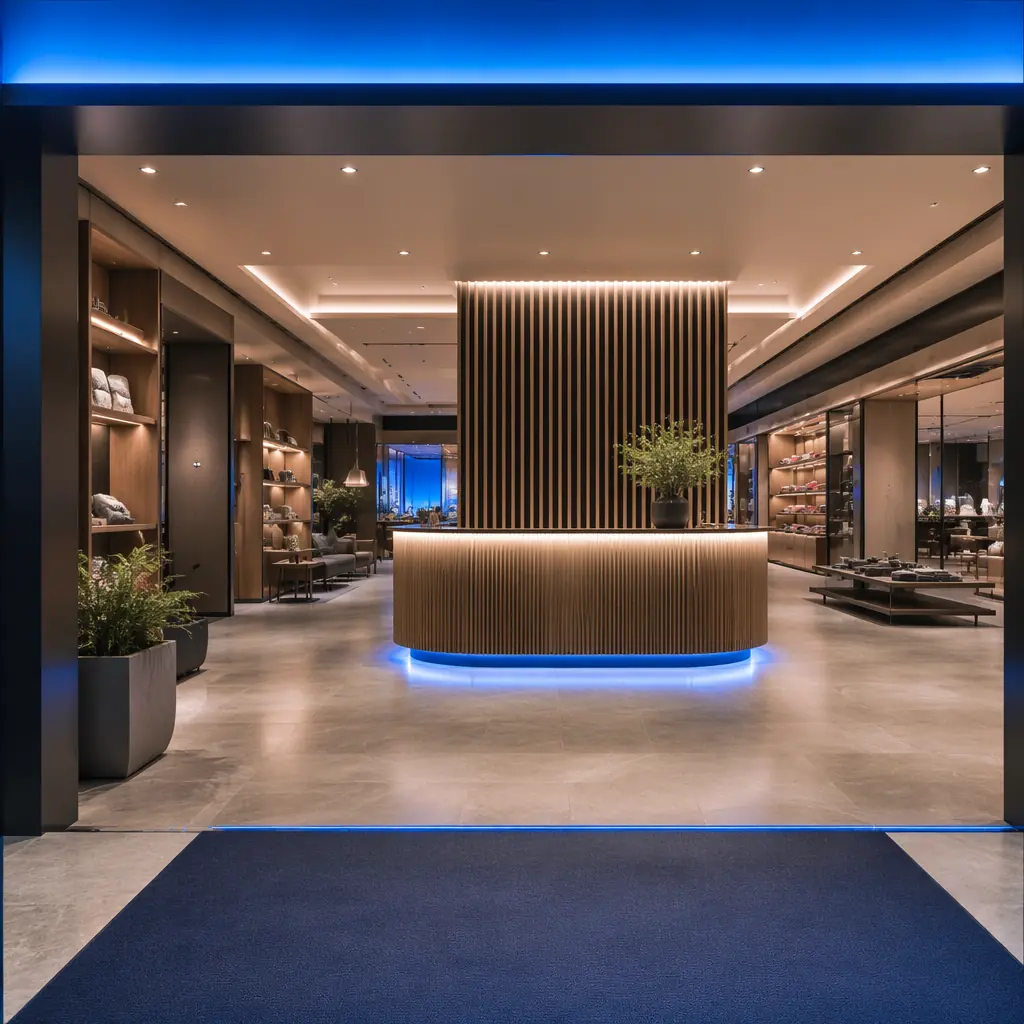
Self-checkout kiosks handle transactions. Digital signage broadcasts promotions. But when a customer walks into your store and asks "Where can I find this product in my size?", neither of those technologies can help.
This is the gap humanoid service robots fill in 2026. Not as gimmicks — as the missing layer between self-service and human staff. Here's what retail operators, bank branch managers, and commercial property owners need to know about deploying AI-powered humanoid robots today.
What a Humanoid Service Robot Actually Does
A humanoid service robot like CRUZR operates as an interactive front-of-house agent. Unlike a kiosk that waits for input, a humanoid robot initiates engagement, responds to natural speech, recognizes returning customers, and guides people to physical locations.
Core capabilities in 2026:
- Natural language conversation in 50+ languages with 96% intent accuracy — customers speak normally, not in robot commands
- Face recognition in under 0.3 seconds, with a 7-category emotion detection system that adjusts tone and responses
- Physical navigation via SLAM 3.0 — the robot escorts customers to specific aisles, counters, or meeting rooms
- Custom knowledge base integration — product catalogs, store layouts, promotion calendars, and FAQ databases all accessible through conversation
The distinction from earlier robot generations is that CRUZR doesn't require a tablet interface or a trained operator. It works the way a skilled retail associate works — observing, approaching, assisting.
Where Humanoid Robots Deliver Measurable Results
Retail Stores
In flagship electronics stores and fashion boutiques across Asia, humanoid service robots generate a 23% increase in foot traffic to promoted product zones and a 19% lift in per-customer basket size when deployed as greeters who guide shoppers to specific departments.
What they handle:
- Product location queries ("Where are the bluetooth headphones?")
- Stock availability checks via backend integration
- Promotion announcements with visual display on the robot's screen
- Queue management — directing customers to open registers
Retailers using CRUZR report that the robot handles 60–70% of direction-based customer queries, freeing human staff for high-value interactions like fitting room consultation and complex product comparisons.
Banking and Financial Services
Bank branches face a unique challenge: routine transactions have moved to mobile apps, but customers still visit branches for account opening, loan consultation, and complex service issues. The staff who remain are specialists — expensive to deploy on greeting and wayfinding.
Humanoid robots in banking handle:
- Visitor triage: Identify the purpose of each visit and route to the correct service desk
- Queue management: Issue digital queue numbers, estimate wait times
- Product education: Explain loan types, investment products, and account features through interactive conversation
- VIP recognition: Face recognition identifies premium customers for priority service
One regional bank deploying CRUZR across 15 branches reduced average customer wait time from 11 minutes to 4 minutes, primarily because visitors arrived at the correct service counter on the first attempt.
Corporate Lobbies and Exhibition Halls
Corporate headquarters, convention centers, and exhibition halls use humanoid robots for visitor management at scale:
- On-site navigation: Escort visitors to meeting rooms, exhibition booths, or office floors
- Multi-tenant support: In shared office buildings, robots maintain separate knowledge bases for each tenant
- Event-specific programming: Trade show robots switch to exhibition floor plans and exhibitor directories
The CADEBOT L100 complements humanoid robots in these environments by handling material delivery — welcome kits to meeting rooms, brochures to exhibition booths, catering to conference areas.
The Technology Stack: What Makes It Work in 2026
Voice AI and Natural Language Understanding
The difference between a 2022 chatbot and a 2026 humanoid robot is contextual multi-turn dialogue. When a customer says "I'm looking for a gift for my mother," the robot doesn't just look up "gift" — it follows up: "What does she enjoy? What's your budget? Does she have any mobility considerations?" This is the same conversation flow a skilled salesperson uses.
CRUZR's NLP engine processes this in real-time, maintaining conversation context across 8–10 turns. It can seamlessly switch languages mid-conversation when, for example, a multilingual retail environment has staff and customers speaking different languages.
Computer Vision and Emotion AI
The 7-category emotion detection system — happy, neutral, confused, frustrated, surprised, sad, angry — enables the robot to adjust its approach. A confused customer gets slower, clearer explanations. A frustrated customer gets immediately escalated to human staff. This isn't a gimmick; it's a service recovery mechanism that prevents negative experiences from escalating.
Fleet Management and Analytics
Individual robots are useful. A fleet with centralized management is transformational. The cloud dashboard provides:
- Real-time interaction analytics: Which questions are being asked most often? What products are generating the most interest?
- Heat mapping: Where in the store do customers stop and engage?
- Sentiment tracking: What time of day do customer satisfaction scores dip?
- OTA updates: New product knowledge, promotions, and language packs pushed to the entire fleet simultaneously
This data layer transforms the robot from a hardware deployment into a business intelligence platform. Retailers discover patterns they never saw — a specific product category generating high interest but low conversion, pointing to a pricing or display issue.
Deployment: What It Takes to Get Started
Environment Preparation
| Requirement | Detail |
|---|---|
| Wi-Fi coverage | Minimum 50 Mbps per robot, seamless roaming between APs |
| Floor plan | Digital map loaded during setup; robots self-navigate after initial mapping |
| Elevator integration | For multi-floor deployments, VDV module connects robot to elevator control via IoT bridge |
| Charging infrastructure | One docking station per 2–3 robots; auto-return when battery hits 15% |
Staff Integration
The single biggest predictor of deployment success is whether staff see the robot as a tool or a threat. The most effective approach, validated across 50+ CRUZR deployments, is the "third team member" framing:
- Position the robot as handling repetitive queries so staff can focus on revenue-generating activities
- Train one "robot champion" per shift who handles basic troubleshooting
- Share interaction analytics with staff — when they see the robot is driving customers to their department, resistance drops
Content and Knowledge Base
A humanoid robot is only as useful as its knowledge base. The initial setup requires:
- Product catalog with SKU-level detail and location mapping
- Store policy documents (returns, exchanges, warranties)
- FAQ database built from actual customer inquiries (not guessed questions)
- Promotional calendar with start/end dates for automated campaign switching
This is typically a 2–3 day process handled by the deployment team, not the retailer's IT staff.
ROI: What to Expect
Based on deployment data from 50+ CRUZR installations in retail and commercial environments:
| Metric | Before Robot | After Robot |
|---|---|---|
| Directional queries handled by staff | 100% | 30–40% |
| Average customer wait time | 8 min | 3 min |
| Staff time reclaimed for sales | 0 hrs/day | 3.5 hrs/day |
| Customer satisfaction (post-visit survey) | 78% | 89% |
The financial model typically shows positive ROI within 8–12 months. See our service robot ROI guide for a detailed TCO breakdown that includes hardware, software licensing, maintenance, and staff retraining costs.
Humanoid vs. Kiosk vs. Tablet: What's the Right Fit?
| Factor | Humanoid Robot | Touchscreen Kiosk | Staff Tablet |
|---|---|---|---|
| Proactive engagement | Yes — approaches customers | No — waits for interaction | Depends on staff |
| Physical guidance | Escorts to location | Shows map on screen | Staff escorts |
| Multi-language | 50+ languages, instant switch | Pre-configured languages | Requires multilingual staff |
| Data collection | Interaction analytics + sentiment | Clickstream only | Manual notes |
| 24/7 availability | Yes (with charging rotations) | Yes | No |
| Upfront cost | Higher | Lower | Lowest |
| Best for | High-traffic, premium environments | Self-service, simple queries | Personalized service, complex sales |
For most deployments, the optimal approach is hybrid: humanoid robots at key entry points and high-traffic zones, kiosks for self-service transactions, and human staff for complex consultations. These three layers together create a complete customer service architecture.
What's Next: The 2026–2027 Roadmap
The trajectory for humanoid service robots points toward deeper integration:
- LLM-powered conversation: Next-generation models enable truly open-ended dialogue beyond scripted knowledge bases
- Gesture recognition: Understanding pointing, waving, and body language cues without verbal input
- Multi-robot coordination: Lobby robots handing off to floor-specific delivery robots for end-to-end guided experiences
- Predictive engagement: Using computer vision to identify confused or hesitant customers before they ask for help
These are not science fiction. They are features on current development roadmaps, informed by real deployment data from the 1,000+ CRUZR units already operating across 30 countries.
For retail and commercial operators evaluating automation, the question in 2026 is no longer "Should we use robots?" It's "Which interactions should robots handle, and which should stay human?" Answering that question correctly is the difference between automation that saves costs and automation that grows revenue. For a broader look at how service robots integrate across industries, see our solutions overview covering healthcare, hospitality, logistics, and retail deployments.
Learn more about CRUZR or contact us to schedule a demonstration at your facility.