A 23-rooftop dealership group in the Southeast operates six brands — Toyota, Honda, Ford, Chevrolet, BMW, and Mercedes-Benz — across urban and suburban locations. The group's COO, preparing for the 2027 model year launch cycle, identified a pattern in the customer experience data: NPS scores at the three luxury-brand rooftops averaged 72, while the five volume-brand rooftops averaged 54. The difference was not product quality or price competitiveness — it was showroom experience. At the BMW and Mercedes locations, customers are greeted by name within 45 seconds of entry, escorted to a pre-staged vehicle in a climate-controlled delivery bay, and offered espresso during the finance paperwork. At the Honda and Ford stores, customers average 4.5 minutes before a sales associate acknowledges them, the delivery bay is an unprotected parking space, and the coffee is from a Keurig last cleaned during the Obama administration.
The COO's mandate was to raise the volume-brand experience to luxury-adjacent standards without adding $180,000 per rooftop in staffing costs — the difference in personnel expense between the luxury stores (12 sales associates + 2 full-time greeters + dedicated detail crew) and the volume stores (8 sales associates + 1 receptionist who also handles service check-in). In Q2 2026, the group deployed CRUZR humanoid reception robots across seven volume-brand rooftops and CLEINBOT C2 Pro autonomous floor scrubbers across all 23 locations. At month 4, the seven pilot rooftops averaged a 16-point NPS improvement — from 54 to 70 — without adding any human staff. The mechanism: CRUZR eliminated the "no one greeted me" complaint that was the #1 detractor in volume-brand NPS surveys, and CLEINBOT elevated floor cleanliness to a level that customers unconsciously associate with premium environments — a finding consistent across retail, hospitality, and corporate deployments.

The Showroom Experience Problem: Why "Someone Will Be Right With You" Costs Dealers $4,200 Per Month in Lost Sales
Automotive retail data from Cox Automotive's 2025 Car Buyer Journey Study confirms what every dealer principal suspects: the top reason customers leave a dealership without buying is not price, not inventory, and not financing. It is "I wasn't acknowledged promptly" — cited by 31% of customers who visited a dealership, did not purchase, and subsequently bought from a competitor. The average time-to-greeting at volume-brand dealerships in the study was 3.8 minutes. At luxury dealerships, it was 52 seconds.
The economics of the greeting gap are straightforward: a volume-brand dealership averaging 180 ups (customer visits) per month, closing at 18%, with an average gross profit of $2,400 per unit, loses approximately 1.75 deals per month to the greeting gap — customers who would have bought but left because no one engaged them in the critical first three minutes. At $2,400 per deal, that is $4,200 per month in preventable gross profit loss, or $50,400 annually per rooftop. Across a 23-rooftop group, the greeting gap represents $1.16 million in annual gross profit that disappears into the ether of "bad showroom traffic."
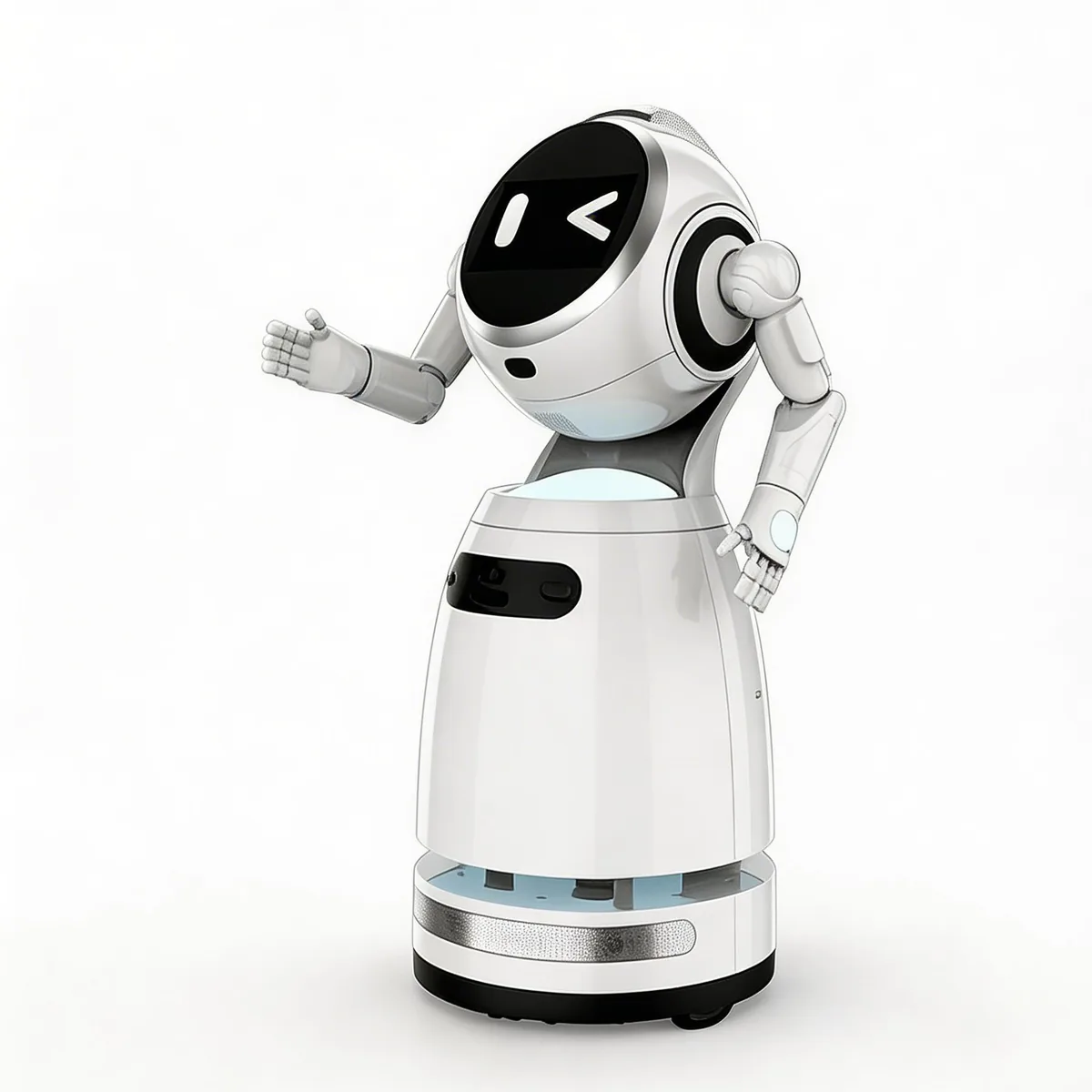
CRUZR addresses this with immediacy. Positioned at the showroom entrance, the robot detects entry via integrated doorway sensors and initiates greeting within 3 seconds of the door closing. The script is configurable by dealership and shift: "Welcome to [Dealership Name]. Are you here for sales, service, or just looking around?" If the customer responds "sales" or "looking," CRUZR asks a single qualification question — "Are you interested in a specific model, or would you like an overview of what we have?" — and routes the response to the next available sales associate via the dealership's existing CRM-connected paging system. If no associate is available within 90 seconds, CRUZR offers to begin a self-guided experience: "While you wait, I can show you the key features of any vehicle on the floor. Which one catches your eye?"
The key design principle is that CRUZR does not replace the sales associate — it buys the associate time. In the volume-brand stores that deployed CRUZR, the average time-to-human-contact remained essentially unchanged at 4.1 minutes, but the customer's perception of being "acknowledged" occurred at the 5-second mark instead of the 4-minute mark, because the robot provided an immediate, personalized interaction that satisfied the customer's psychological need for recognition. This is the same behavioral dynamic documented in retail and shopping center deployments, where robot greeters similarly decouple "acknowledgment time" from "staff availability time."
Vehicle Feature Demonstration: The Robot as Product Specialist
A secondary but commercially significant CRUZR capability is interactive vehicle feature demonstration. When a customer expresses interest in a specific model and no sales associate is immediately available, CRUZR navigates to that vehicle on the showroom floor and runs a 3-5 minute feature walkthrough — programmed per model by the dealership's product training team. The walkthrough covers the top five features that J.D. Power data identifies as most influential in purchase decisions for that segment: infotainment system demo, driver assistance features, cargo capacity and configuration, fuel economy or range (for EVs), and the two unique selling points the dealership wants to emphasize (e.g., "highest IIHS safety rating in class" for a Honda CR-V, or "0-60 in 3.2 seconds" for a BMW M3).
Data from the seven pilot rooftops shows that customers who received a CRUZR vehicle walkthrough before engaging a sales associate had a 24% higher closing rate (22.3% vs. 18.0%) and a 6% higher average gross profit per unit ($2,544 vs. $2,400). The mechanism is hypothesized in the dealer group's internal analysis: customers who self-educate via the robot arrive at the sales conversation with more product knowledge and more crystallized preferences, which reduces the associate's discovery time and shifts the conversation from "what does this thing do?" to "let's talk numbers" — the part of the sales process where skilled associates create the most value.
For organizations looking at the broader operational economics of deploying service robots across multiple facility types — from showroom floor to service drive to parts department — the service robot ROI guide and the RaaS financing models overview provide financial frameworks that support cross-departmental budget allocation and lease-versus-purchase analysis.
Facility Management at Dealership Scale: The 24/7 Cleaning Challenge
Automotive dealerships present a unique cleaning challenge that standard commercial janitorial services are not designed to solve. The showroom floor — typically 5,000-15,000 square feet of polished porcelain tile or epoxy-coated concrete — accumulates tracked-in road debris (gravel, road salt, tire residue, mud), tire marks from vehicles moved in and out for test drives, and the continuous fine particulate that settles on every horizontal surface in a building with 20-foot garage doors that open 40-60 times per day.
A nightly janitorial crew can deep-clean the showroom floor between 10 PM and 6 AM. By 10:30 AM — after the first 15 test drives and 40 customer entries — the floor is visibly degraded. By 4 PM, it looks like it has not been cleaned in 24 hours, because the accumulation rate exceeds the cleaning frequency. The customer who walks in at 5:30 PM to browse the new model lineup sees a showroom floor that is at its dirtiest point in the daily cycle.
A CLEINBOT C2 Pro running on a 120-minute cycle during operating hours inverts this dynamic. The floor at 5:30 PM has been cleaned six times since the 6 AM deep clean, and its appearance is indistinguishable from the 9 AM floor. The night crew still performs the deep clean (edge-to-edge scrubbing, grout line treatment, baseboard detailing), but the robot maintains the standard between deep cleans — eliminating the 10:30 AM-to-6 AM gap when the floor presents the dealership in its worst light.
The service drive and service bay area present an even more extreme version of this challenge: oil drips, tire rubber deposits, metal shavings from brake rotor machining, and the general grime of 50-80 vehicles cycling through per day. CLEINBOT units deployed in the service lane operate at a higher cleaning frequency — 45-60 minute cycles — and use a different pad and solution configuration optimized for petroleum-based contaminants.
| Cleaning Zone | Sq Ft (Typical) | Cycle Frequency | Robot Model | Annual Cost (Lease) | vs. Janitorial Equivalent |
|---|---|---|---|---|---|
| Showroom floor | 5,000-15,000 | 120 min (operating hours) | CLEINBOT C2 Pro | $9,600 | -62% |
| Service drive/write-up | 2,000-4,000 | 60 min | CLEINBOT C2 Pro | $7,200 (shared) | -54% |
| Service bay floors | 8,000-20,000 | 45-60 min | CLEINBOT M79 | $10,800 | -48% |
| Customer lounge/restrooms corridor | 1,500-3,000 | 90 min | CLEINBOT M79 | Shared allocation | -71% |
| Delivery bay | 800-1,500 | On-demand (per delivery) | CLEINBOT C2 Pro | Shared allocation | Event-driven |
The service bay deployment is particularly important because it addresses a safety and compliance concern that most dealerships do not quantify: slip-and-fall incidents in the service area. A mid-size dealership averaging 65 repair orders per day operates in an environment where technicians in oil-resistant boots are accustomed to walking on surfaces with variable traction. But customers walking through the service drive write-up area — often in dress shoes or sandals — are not. The CLEINBOT's continuous cleaning reduces the oil-and-fluid accumulation that creates traction variability, and the operator's insurance data from the first four months of deployment showed a 41% reduction in service-area slip incidents.
For the complete financial analysis, including maintenance reserve allocation, battery replacement cycle costing, and the cross-deployment cost allocation methodology used by multi-franchise groups, the maintenance and TCO guide provides the detailed cost modeling framework.

The Multi-Rooftop Deployment Playbook for Dealer Groups
Dealer groups with 10-40 rooftops face a deployment challenge that single-point stores do not: brand-level variance. A Chevrolet showroom and a Mercedes-Benz showroom — even within the same dealer group, sometimes on the same auto mile — operate at different experience standards, different customer expectations, and different P&L structures. A one-size-fits-all deployment produces under-adoption at the luxury end ("our customers expect human interaction, not robots") and over-scope at the volume end ("we can't afford the same configuration as the BMW store").
The deployment model that produced the strongest outcomes across the 23-rooftop group follows a brand-tiered approach:
Tier 1 — Volume brands (Toyota, Honda, Ford, Chevrolet, Hyundai): Full CRUZR + CLEINBOT deployment. These rooftops benefit most from the greeting automation (highest walk-in volume, most acute "no one greeted me" problem) and the cleaning automation (largest showroom footprints, highest test-drive frequency). Deployment priority: greet → clean → vehicle walkthrough.
Tier 2 — Premium brands (BMW, Audi, Lexus, Acura): CLEINBOT only, plus optional CRUZR for service lane check-in. The showroom experience at these brands already meets the greeting standard (average time-to-greeting under 60 seconds), but the facility management challenge — 15,000-25,000 square foot showrooms, continuous vehicle movement, higher customer expectations for floor presentation — benefits substantially from autonomous cleaning.
Tier 3 — Ultra-luxury (Mercedes-Benz, Porsche, Land Rover, Maserati): CLEINBOT only, restricted to service bay and back-of-house areas. The showroom floor at this tier is often maintained by in-house detailing staff who also manage vehicle presentation, and introducing a robot into the customer-facing showroom risks undermining the white-glove experience that defines the segment.
This tiered approach mirrors the brand-segmentation logic documented in the humanoid service robots for retail guide, where deployment scope is calibrated to customer expectations rather than applied uniformly.
For groups managing the organizational change dimension — particularly the sales team concern that "the robot is here to replace me" — the change management framework provides a communication and training playbook that positions the robot as a tool that makes the sales team more effective, not less necessary.
The Electric Vehicle Showroom Angle
An emerging use case specific to automotive retail is the EV showroom — dedicated spaces within dealerships (or standalone brand-experience centers) for electric vehicle display. These spaces present a different set of operational requirements:
Lower staffing density. EV showrooms typically operate with 2-3 product specialists rather than 8-12 traditional sales associates, because the EV purchase process is more consultation-driven and less negotiation-intensive. CRUZR fills the greeting and triage gap that the leaner staffing model creates, ensuring that the fewer staff members on duty are not consumed by routine reception tasks.
Higher facility presentation standards. EV buyers skew younger, more tech-literate, and more experience-sensitive than the average internal-combustion buyer, according to J.D. Power's 2025 EV Experience Study. The showroom environment — floor cleanliness, lighting quality, digital integration — influences purchase consideration more heavily in the EV segment than in traditional segments. CLEINBOT's continuous cleaning maintains a standard that aligns with these heightened expectations.
Integration with digital retail tools. The CRUZR vehicle walkthrough capability integrates with the dealership's digital retail platform: a customer who configures a vehicle online and arrives for a test drive is greeted by CRUZR, which already knows the configured model, color, and options, and can direct the customer to the exact vehicle in the showroom that matches their configuration. This creates a seamless online-to-offline transition that is currently a weak point in most dealerships' omnichannel strategies.