
Acceptance Test Procedure for Service Robots: What ISO 3691-4 Site Validation Requires
At a glance: Most robot contracts are settled on a site test with no stated sample. This one sets out a procedure with a defined population: the four safety items that cannot be negotiated, stopped-distance measurement on the floor the robot will actually drive, five performance gates, and the six-section sign-off document.
Most robot contracts say the machine will be accepted after a "successful site test". That phrase is where projects go wrong, because a site test has no defined population: two hours of watching a robot drive a clean corridor passes, and six weeks later the same robot stops dead in a loading bay at shift change. A written acceptance test procedure fixes the population in advance, so the decision at the end is a comparison against numbers rather than an opinion. This guide sets out what such a procedure has to contain, how the safety-related parts differ from the performance parts, and the arithmetic behind the most contested item on the sheet, the stopping distance.
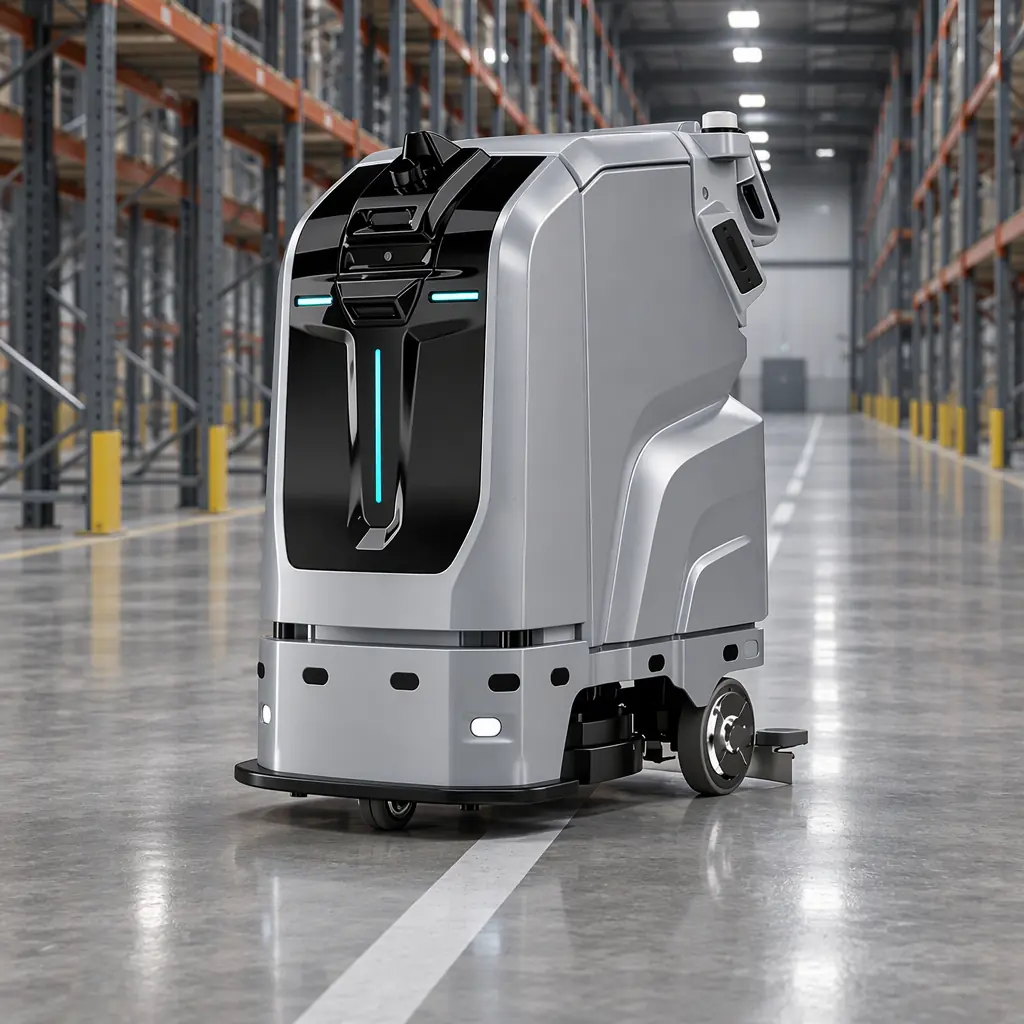
Why "Successful Site Test" Is Not a Test
An acceptance test is a sampling exercise, and every sampling exercise needs a stated sample, a stated measurement method and a stated pass mark. The typical site test has none of the three. The contractor runs the robot down the main aisle for twenty minutes, the buyer's operations manager nods, and the invoice is released.
The problem is that the failure modes of an autonomous machine are not randomly distributed over time. They cluster around the conditions the demo never reproduces:
- Peak occupancy. A robot that navigates an empty atrium at 09:00 meets its real obstacle population at 12:30, and the reroute logic under load behaves differently from the reroute logic on an empty floor.
- Transition zones. Lifts, fire doors, thresholds, ramps and loading bays are where localisation degrades. A single-floor loop proves nothing about a multi-floor cycle.
- Charging and dock handover. The dock is a mechanical interface with tolerances, and dock misalignment appears after the floor has been polished a few dozen times.
- Network state. A robot that has a clean Wi-Fi survey on acceptance day will meet congested channels when the building fills up.
A procedure that samples only the empty-floor case has tested perhaps a fifth of the operating envelope. It is not a weaker test, it is a different one, and the difference is not visible in the acceptance report because the report never stated what was sampled.
The Two Halves of the Procedure: Safety and Performance
Split the document in two at the start, because the two halves are governed by different logic and different people.
The safety half is pass or fail against a standard, with no negotiation. For an industrial truck the relevant text is ISO 3691-4, the safety requirements and verification for driverless industrial trucks and their systems. For an autonomous mobile platform on a public-facing site, the machinery directive route in EN ISO 3691-4 combined with the site-specific risk assessment is the usual basis. Either way, the standard tells you what has to be verified, and a machine that fails a safety verification item cannot be accepted on the grounds that operations like it.
The performance half is a negotiated service level. Coverage rate, cycle time, dock success rate, uptime and the fault rate are commercial numbers, not legal ones. They belong in the contract as measurable targets with a measurement window, and they should be negotiated rather than inherited from a datasheet.
Conflating the halves produces two familiar failures. A buyer accepts a machine because it is safe, and later discovers it cannot keep up with the cleaning rota. Or a buyer rejects a machine because it misses an aggressive cycle-time target, when the actual failure was that the target was written for a different floor type.
The Safety Verification Items That Cannot Be Negotiated
Four items carry most of the weight in a site validation. Each one is a measurement, not a description.
| Item | What is verified | How the result is recorded | Typical failure |
|---|---|---|---|
| Protective stop function | Every stop input, including the emergency stop on the machine and on the dock, brings the machine to a safe state and requires a deliberate reset | Function tested at each input, recorded per input with a witness signature | A reset that happens automatically when the obstruction clears, so the machine restarts into a person who is still there |
| Personnel detection and speed reduction | The detection field is active in the direction of travel at the measured height, and the machine slows before entering the reduced zone | Field pattern measured at floor level and at 300 mm, 900 mm and 1500 mm above floor | Detection tuned for a standing adult that misses a crouching child or a pallet edge |
| Stopped distance in the real environment | The distance travelled from detection to standstill on the actual floor surface, with the actual payload | Ten repeats per surface type at maximum rated speed, worst case reported | Measured on sealed concrete and assumed to hold on epoxy, tile or a damp floor |
| Manual control and recovery | The machine can be moved, immobilised and recovered by a trained person without power tools and without entering the hazard zone | Demonstrated by two nominated site staff, not by the integrator | Recovery requires a laptop and a vendor technician, which makes every stoppage a service call |
The fourth row is the one most often left out of the acceptance sheet and the one that costs the most per year, because it sets the cost of every stoppage for the life of the machine.
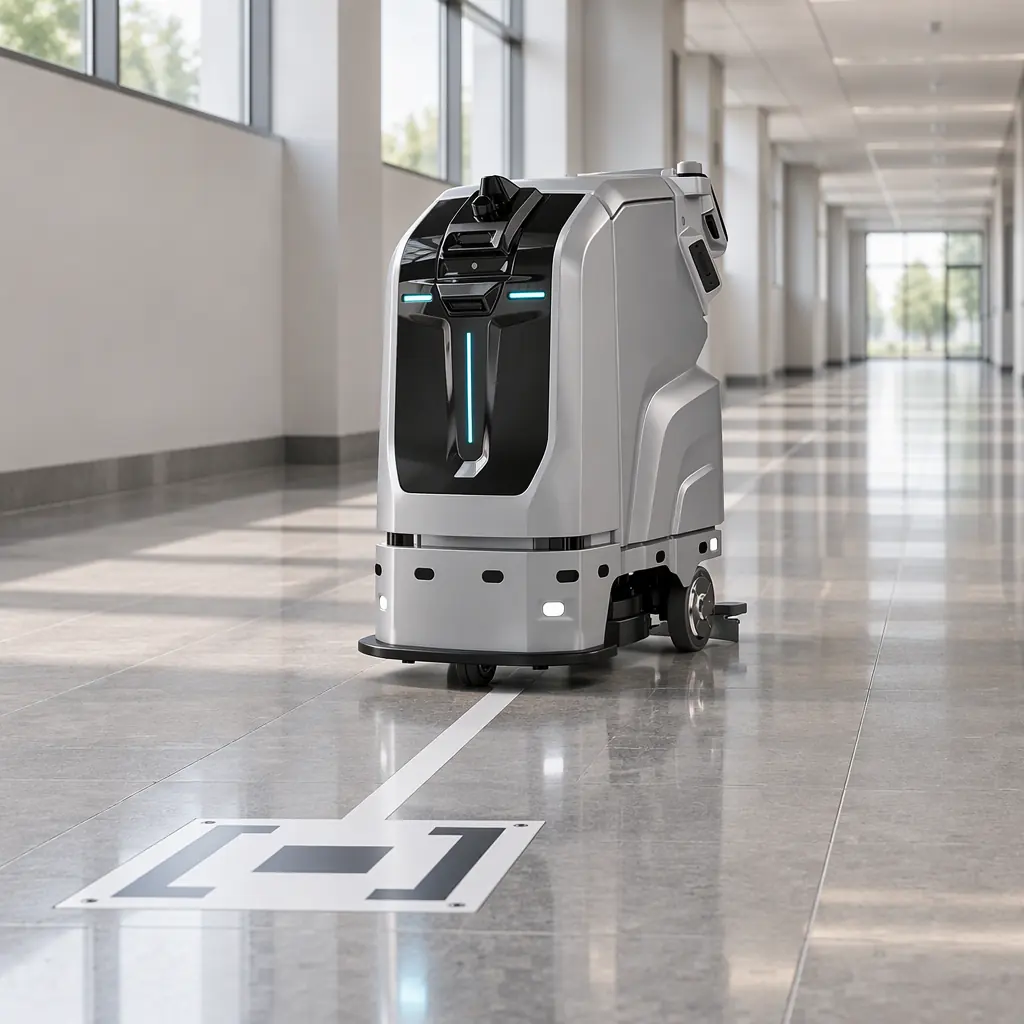
Measuring Stopped Distance Honestly
Stopped distance is the number that makes the safety case defensible and the number most easily overstated. Work it as a sum rather than a single figure:
Total stopping distance = reaction distance + braking distance + measurement margin. Reaction distance is the distance travelled between the hazard entering the detection field and the drive controller receiving the stop signal, and at 1.5 m/s a 120 ms latency is already 180 mm before the brakes are asked to do anything. Braking distance depends on the friction between the drive wheels and the floor, which is why a damp floor or a polished epoxy floor changes the result more than a firmware update does.
Then the margin: standards work in tolerance bands, and a machine that passes at exactly the calculated value has no margin left for a worn tyre, a heavier payload or a floor that has just been washed. Measure the worst case and report it, and where the measured value sits within 15% of the calculated limit, treat that surface as a condition for slower operation rather than as a pass.
| Surface state | What changes | Practical acceptance action |
|---|---|---|
| Sealed concrete, dry | Reference case; highest friction | Baseline measurement for the site |
| Epoxy or polished tile, dry | Lower friction, longer braking distance | Re-measure, do not extrapolate from concrete |
| Any surface, wet or just washed | Friction drops sharply; the scrubber's own trail is the hazard | Cap speed in the cleaning route, or require a trailing dry pass before the next robot enters |
| Ramps and dock approaches | Gravity component changes both acceleration and braking | Measure uphill and downhill separately |
This is also where a fleet of mixed models becomes complicated: the same site can hold three robots with three different drive trains and three different stopping distances, and the route rules have to be set for the worst of them rather than the newest.
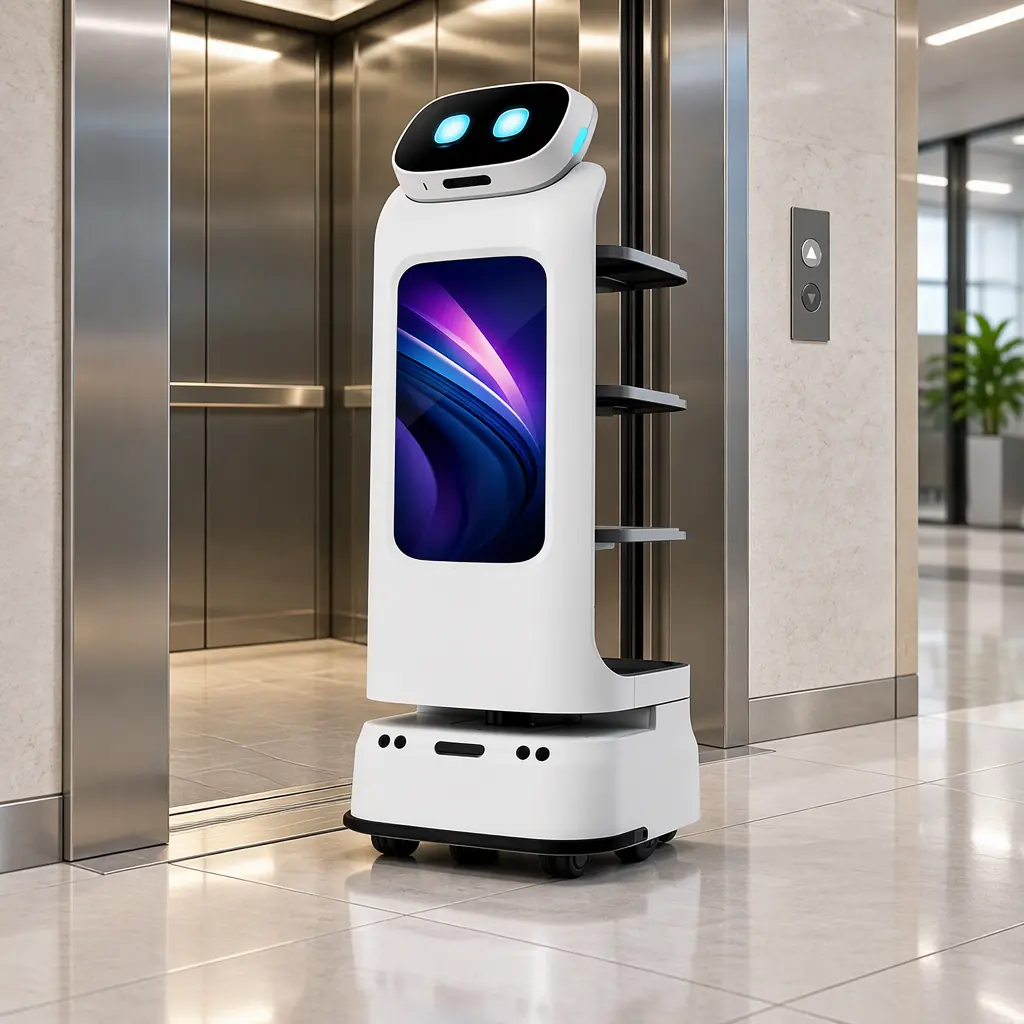
The Performance Gates: Numbers a Contractor Can Be Held To
The commercial half is easier to measure than the safety half, provided the measurement window is stated. Five gates cover most of the value:
- Coverage. The percentage of the contracted floor area actually cleaned on each of ten consecutive runs, measured by the robot's own coverage map and spot-checked by a supervisor on two of the ten. A machine that cleans 92% of the area quickly is not meeting a 98% contract.
- Cycle time. Wall-clock time from route start to dock, including every reroute and every human interruption, over ten runs at normal occupancy. Not the fastest run, not the median of a quiet week.
- Dock success rate. Successful dockings divided by attempts, over at least 50 attempts. This is the single most predictive number for whether the fleet will need an attendant.
- Fault rate. Stops requiring human intervention per 100 operating hours, with the fault log exported and read by the buyer rather than summarised by the vendor. A log that only records "mission completed" is not a fault log.
- Uptime. Hours available divided by hours scheduled, with the definition of available written down, since a robot that boots but cannot localise is not available.
The fault log deserves its own clause. Ask for the raw export with timestamps, error codes, and the sensor state at the moment of the error, for every intervention in the acceptance window. Thirty interventions is a workable sample; below that the rate estimate is too noisy to argue about.

Building the Sign-Off Document
The document that ends the acceptance should let a third party who was not present reconstruct the decision. Six sections do that:
- Scope and sample. Which routes, which days, which occupancy conditions, and how many repetitions. This is the section that most procedures omit and the one that decides whether the result means anything.
- Configuration baseline. Firmware version, map version, route file version, payload, and the battery state of health at test. A pass that cannot be tied to a configuration cannot be defended three firmware releases later.
- Safety verification results. Per item, measured value, pass or fail, witness name and signature. Photograph the measurement setup for the stopped-distance tests.
- Performance results. Per gate, the sample and the result, including any gate that failed. A document with no failures is a document that was written after the fact.
- Open items and conditions. Every deficiency with an owner and a date, and the operational restriction that applies until it is closed. A robot can be accepted with conditions, and the conditions are what protect the buyer.
- Retention and access. How long the test evidence and the fault logs are kept, and who can retrieve them. If an incident occurs in month eight, the acceptance evidence is the first thing an insurer will ask for.
What AOMAN Provides and What It Does Not
AOMAN supplies the machine-level data an acceptance procedure needs: rated speed and payload, the deceleration profile, the detection field pattern at the sensor heights specified by the integrator, the fault code list with meanings, and the dock mechanical tolerances. For a fleet order we also run a factory-side functional test of each unit against a checklist before shipment, and the results travel with the unit.
What we do not supply is the site validation itself, and buyers should be suspicious of any vendor that offers to sign their own acceptance. The site risk assessment, the floor surface measurements, the witness signatures and the decision on conditions belong to the operator and, where required, to an independent assessor. Our role is to make that verification straightforward: every value on the safety sheet should be one the machine can be measured against without a special build.
The practical summary: write the sample before you see the robot, split safety from performance, measure stopping distance on the floor the robot will actually drive on, and make the fault log a deliverable rather than a favour.

Get a Quote
Tell us about your space and workload, we reply within 24 hours.