Hospital Delivery Robots: Internal Logistics Automation for Pharmacy, Lab & Patient Care, The 2026 Procurement Guide
At a glance: A 500-bed hospital can generate 2,000+ internal transport requests a day; at 10 minutes per run, that is roughly 350 walking hours of clinical time. This guide maps how an AOMAN D1 (40 kg, four tray positions) covers the pharmacy, lab, and sterile-supply loops, and what to verify before you buy.
Medications from pharmacy to wards. Blood samples from ICU to lab. Sterile instruments from CSSD to operating theaters. Meal trays from kitchen to patient rooms. Each transport request consumes minutes of clinical staff time, minutes not spent on patient care. As an illustrative baseline: a 500-bed hospital commonly logs 2,000-2,500 internal transport requests per day, and if each run takes about 10 minutes of a nurse's or porter's time, the arithmetic works out to roughly 350 walking hours per day. The exact numbers for your facility differ; the structure of the problem does not.
Here is what hospital administrators, supply chain directors, and clinical operations leads need to know about deploying delivery robots in 2026, the workflows that work, the decisions that matter, and the compliance and infection-control questions to ask before signing.

How Hospital Delivery Robots Work
Core Technology
Hospital delivery robots combine autonomous navigation with secure, compartmentalized payload systems.
Navigation. The robot uses lidar, depth cameras, and SLAM algorithms to build a real-time map of corridors and navigate autonomously, no wires, no ceiling markers, no floor modifications. It maps the hospital once and navigates dynamically, re-routing around gurneys, IV poles, and cleaning carts. For the technical layer behind this, see our SLAM navigation technology.
Secure delivery runs. The AOMAN D1 keeps each load separated across four tray positions, with destination logged per tray. That structure matters for chain of custody: a pharmacy technician loads medication for the receiving ward, and only staff at that ward unload it. Each delivery is logged with timestamp and user ID, creating an auditable trail that paper transport logs cannot match.
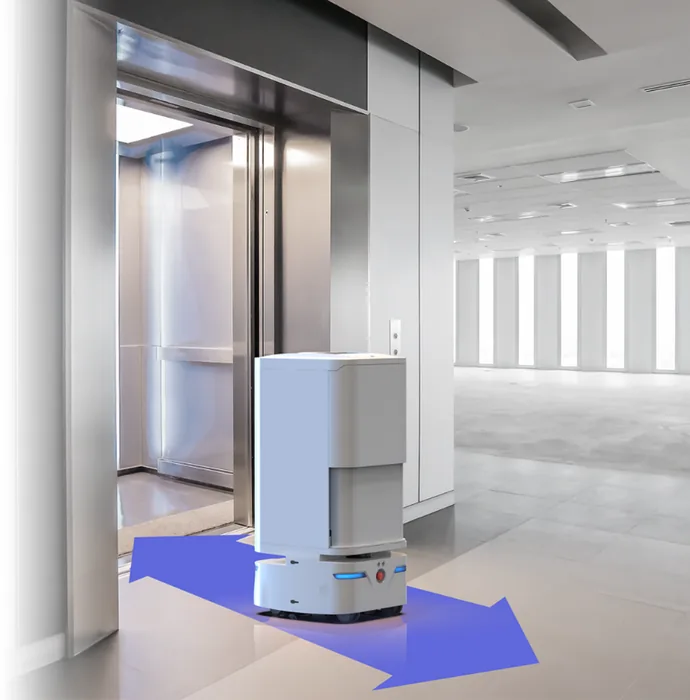
Elevator integration. The elevator is the hardest part of hospital delivery automation. Modern robots integrate with elevator control systems via wireless API on newer elevators or IR emitters on retrofits, the robot calls the elevator, waits, enters, and signals its destination floor without human intervention.
Payload capacity. Delivery robots for hospital use typically range from light-duty to heavy-duty weight classes. The AOMAN D1 carries 40 kg across four secure compartments, sufficient for a full medication pass to several wards, or roughly a dozen biohazard transport containers, in one tour.

Three High-Impact Deployment Workflows
1. Pharmacy-to-Ward Medication Delivery
This is the most common starting point. The pharmacy receives orders via the EHR system; pharmacists verify, prepare, and load medication into the robot's compartments, one ward per compartment. The robot navigates to each ward sequentially, nurses unlock their compartment with a PIN, and the robot moves to the next stop. Empty return bins are loaded for the return trip.
What such a workflow measures: delivery time from pharmacy to ward, nursing time reclaimed from porting trips, wrong-ward delivery incidents, and STAT turnaround. A D1 carrying 40 kg across four tray positions with PIN-coded dispatch and elevator integration is sized for a full ward med pass; the fleet console schedules morning med rounds and on-demand STAT runs without overtime labor. Scheduled deliveries (morning med pass, afternoon rounds) run alongside on-demand STAT work. And after hours, when pharmacy staffing is reduced, the robots keep the delivery cadence without adding labor.
2. Laboratory Specimen Transport
Specimen logistics is uniquely suited to robot automation because timing is critical and chain-of-custody documentation is mandatory. A mid-size hospital lab processes hundreds to over a thousand specimens daily, blood tubes, urine samples, biopsy specimens, microbiology cultures, and each has a transport time window.
Deployment model: lab-bound robots circulate on continuous loops, departing every ~15 minutes from high-volume collection points (ICU, ER, surgical floors). Nurses place sealed specimen bags in designated compartments; the robot auto-navigates to the lab receiving area, where staff unload, scan specimens into the LIS, and release the robot for its next circuit. The digital chain of custody satisfies an existing regulatory expectation: CAP and Joint Commission auditors increasingly look for electronic tracking from collection to result. Compartment-access logging provides this natively, no manual logbooks, no missing entries.
3. Sterile Supply Delivery (CSSD to Operating Theater)
Operating rooms consume instrument trays, surgical packs, and disposable supplies at high velocity, a busy OR suite with 12 theaters may need 80-100 sterile supply deliveries a day. CSSD is typically in the basement or a separate wing, a walk of several minutes each way. Delivery robots handle scheduled OR case-cart runs (pre-loaded instrument trays per scheduled procedure) and on-demand emergency restock mid-procedure. Each compartment stays sealed until it reaches its destination, so sterility is preserved throughout transit.

Deployment Planning: The Decisions That Matter
1. Fleet Sizing
A common starting rule: roughly one delivery robot per 120-150 beds for pharmacy delivery, plus one per 180-200 beds for lab transport. A 500-bed hospital typically starts with 4-6 units and scales from utilization data rather than bed count alone.
2. Infrastructure Prerequisites
- Wi-Fi coverage: full corridor coverage with seamless roaming (802.11r). Dead zones equal stopped robots.
- Elevator access: API-level integration with elevator controllers, or IR retrofit for older pulls. Budget integration hardware per elevator.
- Fire door compatibility: hospital fire doors close during alarms, so robots must integrate with the fire alarm system to pause and move to safe zones.
- Floor surfaces: standard hospital flooring (vinyl, linoleum, epoxy) is fine; thresholds above ~15 mm need ramps.
3. Staff Workflow Integration
The biggest deployment risk is not technology, it is staff adoption. Nursing staff must trust that robot-delivered medication is accurate and timely; pharmacists must integrate loading into their workflow. A 30-day pilot with clear success metrics (delivery time, error rate, staff satisfaction) builds confidence before fleet expansion. The communication and training side of this is covered by our change-management playbook on human-robot collaboration.
4. Regulatory and Compliance Considerations
- HIPAA: no patient data is stored on the robot. Compartment access logs record operator ID and timestamp, not patient names.
- Device classification: where robots transport medication, US FDA registration may apply; classification and registration paths are straightforward for equipment that does not administer or modify contents, confirm with your compliance team.
- Accreditation: electronic chain-of-custody supports Joint Commission environment-of-care and lab specimen tracking expectations.
5. Infection Control
- Cleanable surfaces: smooth, sealed exteriors with no crevices, compatible with isopropyl-alcohol wipe-down.
- Compartment sanitation: scheduled sanitation of compartments between pharmacy and lab transport cycles.
- Hand hygiene: robots do not replace hand hygiene, they reduce the number of door handles touched and surfaces contacted during transport.
Cleaning during operating hours is the adjacent workflow. In a publicly documented deployment, an AOMAN C2 Pro runs quiet cleaning cycles through a nursing care facility in Tokyo. Its 70 cm under-furniture profile and 85 cm aisle clearance keep it out of clinical paths while corridors are still in use. For large-area work (same-floor corridors, lobbies, supply access), an AOMAN C1 covers 2,040 m² per hour.
ROI: An Illustrative Calculation
ROI for hospital delivery robots is an operational arithmetic problem before it is a financial one. Here is an illustrative example with stated assumptions . Substitute your own local wages, lease quotes, and transport counts:
- A hospital automates 300 transport runs per day (pharmacy plus lab plus CSSD), each previously taking an average of 10 minutes of staff time: 3,000 minutes = 50 hours per day of reclaimed clinical time.
- At, for example, $35/hour loaded cost for the staff time involved, that is about $1,750 per day, roughly $640,000 per year if the freed time converts to actual redistribution of work (and it only counts if you act on it).
- A fleet of 6 AOMAN D1 units on a leasing plan typically lands in the range of a five-figure monthly all-in figure depending on lease terms, software, and support tiers, quote-based, not fixed.
- Break-even in this illustrative model lands within approximately the first year; the conservative posture is to treat the number as the direct-labor side only, not any clinical value uplift.
In short: the savings case is built mostly on staff time, so the plan must state what the freed time goes to. Count the reclaimed hours into redeployed tasks, bedside rounds, patient communication, discharge coordination, or the workforce sees automation only as a reduction in headcount, and adoption stalls.
The Hospital of 2028
Looking ahead, delivery robots are converging with broader smart-hospital infrastructure. Robots that today deliver medication will integrate with automated pharmacy dispensing units, pharmacist verifies, robot loads, robot delivers, nurse administers, all tracked in one digital thread. EHR integration adds the next layer: the robot pre-positions before a STAT order arrives when the system already knows an admissions wave is coming.
For hospital administrators planning capital budgets, internal logistics automation offers measurable direct-labor return, documented chain-of-custody advantages, and a deployment path that starts with one workflow and scales to three. The robots are ready; the question is whether your hospital's workflows and infrastructure are. Tell us your number of beds, your floor configuration, and the workflows you want to automate first. The healthcare team will size the fleet and produce a 30-day pilot plan for your layout. Start a conversation with the hospital logistics team, or send your floor plan for a free feasibility check across the relevant parts of our product line. A venue with a different traffic pattern, and how the configuration changes for it, is covered in delivery robot selection.