A Tier 1 U.S. carrier's central office in a major metropolitan market houses 45,000 square feet of switching equipment, optical transport systems, and power infrastructure across four floors — supporting approximately 380,000 subscriber lines, 90,000 business data circuits, and 12,000 fiber-to-the-home connections. The facility's operations manager identified a maintenance paradox: the more critical the equipment, the more difficult it is to clean around it. A Class 5 telephone switch or an OTN (Optical Transport Network) shelf cannot be powered down for cleaning without triggering a 60-day maintenance-window request that must be approved by every carrier whose traffic traverses the equipment. The result is that equipment bays accumulate dust, fiber-optic connector end-faces degrade from particulate contamination, and raised-floor plenum spaces fill with years of dislodged cable insulation and construction debris — all while the equipment runs continuously.
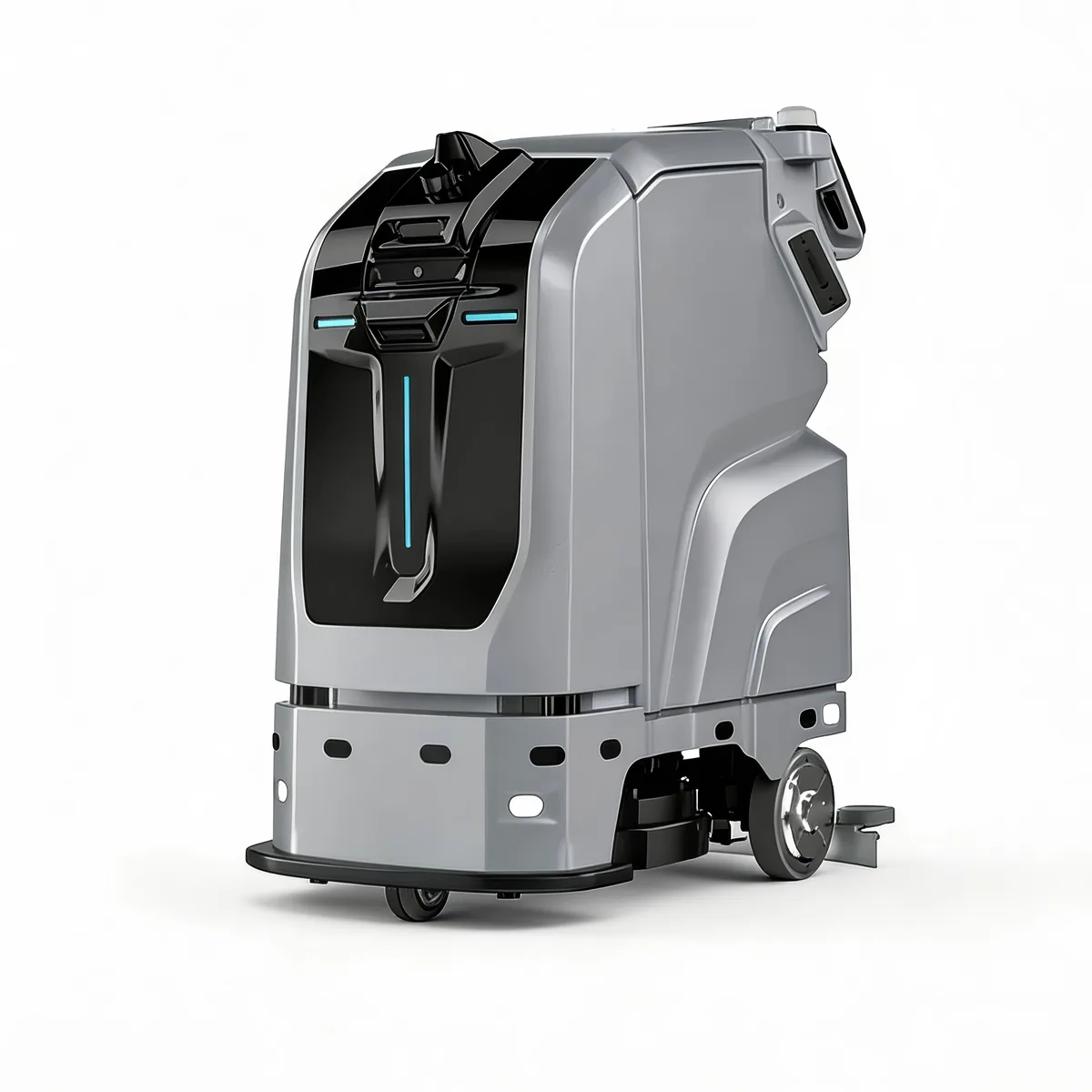
In 2026, the carrier deployed CLEINBOT M79 autonomous floor scrubbers across all four equipment floors and CADEBOT L100 delivery robots for equipment logistics between the loading dock and equipment bays. The CLEINBOT units operate on a daily cleaning cycle during the 2 AM-6 AM low-traffic window, maintaining the raised-floor surface and aisle-way cleanliness that prevents dust from being drawn into equipment cooling fans. The CADEBOT units handle the physical transport of line cards, optical modules, and replacement power rectifiers from the loading dock to the target equipment bay — eliminating the most common cause of ESD (electrostatic discharge) damage in telecom environments, which is a technician carrying an unprotected circuit board through a carpeted corridor on a dry winter day.

The Dust Problem: How Particulate Contamination Causes $180,000 in Annual Equipment Degradation
Telecommunications equipment is far more sensitive to particulate contamination than most facility managers realize. A single-mode optical fiber core is 9 microns in diameter — approximately 1/8 the width of a human hair. A dust particle 2-5 microns in diameter, invisible to the naked eye, sitting on a fiber-optic connector end-face will block 40-90% of the optical signal at the connector interface. At 10 Gbps and above, this signal degradation triggers forward error correction (FEC) events, increasing the bit error rate and consuming the system's error-correction margin — the optical budget headroom that the network designer allocated for component aging and environmental factors, not for dirty connectors.
The practical consequence is that data-center floors in telecom central offices — the raised-floor plenum space through which tens of thousands of fiber jumpers, copper cables, and power feeders are routed — must be maintained to a cleanliness standard closer to a semiconductor cleanroom than to a commercial office. The Telcordia GR-2923-CORE standard for fiber-optic connector inspection specifies end-face contamination limits measured in individual particles per square millimeter, with a single particle exceeding 5 microns constituting a rejection criterion. This standard cannot be met in a facility where the floor is cleaned once per week by a commercial janitorial crew using conventional equipment that stirs up as much dust as it removes.
CLEINBOT M79 addresses this with HEPA-filtered autonomous cleaning. The robot's vacuum system captures 99.97% of particles down to 0.3 microns — the same filtration standard used in cleanroom environments. Operating on a nightly cycle during the low-traffic window, the robot maintains a continuous level of floor cleanliness that prevents dust accumulation from reaching the point where it becomes airborne and enters equipment intake vents. The cleaning-cycle data — area covered, duration, dust-bin fill level — is logged and available for the facility's ISO 14644 cleanliness-class documentation, supporting the same compliance framework described in laboratory and cleanroom deployments.
The equipment-lifecycle economics of dust control are substantial. Fiber-optic connector contamination is the #1 cause of network outages attributed to "equipment degradation," according to NTT's 2025 Optical Network Reliability Study, accounting for 23% of unplanned network events exceeding 60 seconds. A single OTN shelf replacement — necessitated by a backplane connector that developed high insertion loss from years of particulate accumulation — costs $8,000-22,000 in hardware plus 4-8 hours of service-affecting maintenance-window labor. A facility with 120 OTN shelves experiencing a 2% annual contamination-related failure rate incurs $19,000-53,000 annually in avoidable hardware replacement costs — before accounting for the regulatory reporting and SLA penalty implications of the associated outages.

ESD Protection: The Hidden Cost of Walking Across Carpet With a Line Card
Electrostatic discharge (ESD) is the silent killer of telecommunications electronics. A technician walking across a standard commercial carpet on a day with 30% relative humidity — typical of a climate-controlled central office in winter — generates 12,000-35,000 volts of static charge. The discharge to a circuit board held in the technician's hand — a 48-port line card, a 100G optical transceiver, a route-processor module — occurs at a voltage far below the threshold of human sensation (approximately 3,500 volts), so the technician has no awareness that the event occurred. The damaged component may fail immediately (a "catastrophic" ESD failure, detectable at installation), or it may be weakened and fail 6-18 months later (a "latent" ESD failure, the most expensive category because it manifests as an in-service outage that triggers a truck roll, a maintenance window, and a root-cause investigation that rarely identifies ESD as the cause).
The industry data on ESD damage is sobering. The ESD Association estimates that 25-40% of electronic component failures classified as "no defect found" or "manufacturing defect" are actually latent ESD failures. For a carrier operating 500,000 line cards across its central-office footprint with an annual failure rate of 1.2% (6,000 cards), the latent-ESD subset represents 1,500-2,400 cards annually — $3.8-6.1 million in hardware replacement cost, plus the truck rolls, maintenance windows, and outage-minutes that accompany each card replacement.
CADEBOT L100 addresses ESD risk by eliminating the most common failure vector: the technician carrying the component. The robot's equipment-transport compartment is ESD-protected — conductive surfaces, grounding straps, and humidity control that maintain the compartment interior at a static-safe 40-60% relative humidity. The line card or optical module is placed in an ESD-shielded container at the loading dock or equipment-staging area, loaded into the robot's compartment, transported to the target equipment bay, and removed by the installing technician at the point of installation — eliminating the carpet-corridor walk that generates the static charge.
The cost justification follows the same logic as the maintenance and TCO analysis: a robot lease at $8,000-12,000 annually eliminates one technician-walking ESD event per month — a conservative estimate for a central office with 15-25 technicians moving equipment daily. At an average hardware cost of $2,500 per ESD-damaged line card (including the cost of the truck roll and maintenance window), the annual savings of $30,000 against a $10,000 robot lease produces a 3:1 ROI before accounting for the outage-avoidance benefit, which is typically 5-10x the hardware cost when SLA penalties and regulatory-reporting obligations are included.
Remote Site Maintenance: The Tower Shelter That Gets Cleaned Twice a Year
Wireless tower shelter sites — the 120-300 square foot prefabricated buildings at the base of cell towers housing baseband units, power rectifiers, battery banks, and backhaul equipment — present an extreme version of the telecom maintenance challenge. These sites are unmanned, unstaffed, often located in rural or semi-rural areas with dirt-road access, and typically visited only when equipment alarms trigger a truck roll — which, for a well-functioning site, might be once every 4-8 weeks.
The cleaning frequency at these sites is effectively zero. A technician dispatched to replace a failed power rectifier does not carry cleaning equipment and is not allocated time for facility maintenance — the dispatcher assigns a 90-minute service window that barely covers the drive time, equipment swap, and alarm clearance. The result is that tower shelters accumulate dust, insect debris, small-animal nesting material, and the fine particulate that rural locations produce in abundance (agricultural dust, road gravel, pollen) — all of which enters equipment intake vents and accelerates the very equipment failures that trigger the truck rolls in the first place.
The operational model for remote-site cleaning is a periodic-deployment robot fleet: a CLEINBOT M79 unit mounted on a service vehicle that visits a cluster of 8-12 tower sites on a monthly rotation, spending 45-60 minutes per site performing autonomous cleaning while the accompanying technician handles the routine maintenance tasks (battery-voltage checks, generator fuel-level verification, HVAC filter replacement) that are currently deferred because the technician's only dispatch trigger is an equipment alarm. This model — combining autonomous cleaning with technician-driven preventive maintenance — converts the tower-shelter maintenance model from reactive (respond to failures) to preventive (maintain conditions that prevent failures), following the same shift in maintenance philosophy documented in the data center and critical infrastructure deployments where the cost of a failure vastly exceeds the cost of prevention.
The economic case for remote-site cleaning is built on truck-roll reduction. A carrier operating 2,500 tower sites with an average of 1.8 unplanned truck rolls per site per year (4,500 total) at a fully loaded cost of $350 per roll (vehicle, fuel, technician time, dispatch overhead) spends $1.575 million annually on reactive maintenance dispatch. If improved site cleanliness — reducing dust-induced rectifier failures, battery-terminal corrosion from accumulated humidity-and-dust paste, and HVAC clogging from unfiltered particulate intake — eliminates 15% of these truck rolls (675 per year), the annual savings of $236,000 funds the robot fleet, the service vehicle, and the preventive-maintenance technician with a positive margin.

Submarine Cable Landing Stations: Where a Cleaning Mistake Can Disconnect a Continent
Submarine cable landing stations (CLSs) represent the highest-stakes telecom facility type. A single building on a coastline houses the terminal equipment for 4-8 submarine fiber-optic cables, each carrying 100-400 Tbps of intercontinental traffic. The optical power levels on these cables — typically +14 to +17 dBm per channel on the submarine line-terminating equipment (SLTE) — are orders of magnitude higher than terrestrial fiber systems, making connector contamination exponentially more dangerous. A contaminated connector at +17 dBm can instantly fuse the contaminant to the fiber end-face, destroying the connector and requiring a fusion-splice repair that interrupts traffic on a cable whose outage costs the consortium $50,000-250,000 per minute in service-credit penalties.
The cleaning protocol at CLSs is correspondingly stringent: no commercial janitorial service is permitted in the SLTE equipment area. Cleaning is performed by the station's own certified technicians using HEPA-filtered vacuums, isopropyl-alcohol-wetted lint-free wipes, and connector-inspection microscopes that must show zero particles >2 microns before a connection is made. This protocol is labor-intensive and must be performed during scheduled maintenance windows — typically 4 AM-6 AM local time — when the least amount of traffic traverses the cable.
CLEINBOT M79 with HEPA filtration provides a continuous background level of floor and aisle-way cleanliness that reduces the frequency at which manual cleanings must be performed. The robot operates nightly, maintaining the equipment-room environment to the Telcordia GR-2923-CORE standard, while the certified technicians perform the precision connector-cleaning tasks that require human judgment and microscopic inspection. The same model — autonomous routine cleaning + human precision intervention — has been validated in pharmaceutical cleanroom environments and semiconductor-class laboratory facilities, where the division of labor between robots (continuous, consistent, documented) and humans (judgment-based, precision, exception-handling) maximizes both cleanliness and cost-efficiency.
Deployment Economics for Telecom Infrastructure
The telecom central office deployment model follows different economics than commercial office or hospitality deployments because the comparison baseline is not janitorial labor cost but equipment-failure cost. A CLEINBOT unit at $9,600-14,400 annually (lease, including maintenance and battery replacement) is compared against the hardware-replacement and outage cost of dust-induced failures — a comparison where the robot almost always wins. A single OTN shelf failure, at $15,000 in hardware plus $8,000-25,000 in outage-related costs (SLA penalties, regulatory reporting, engineering investigation), more than covers the robot's annual cost. The operational question is not "can we afford the robot" but "how many dust-induced failures per year are we currently experiencing?"
For organizations building the financial analysis, the ROI framework and the vendor evaluation guide provide the cost-modeling structure and the evaluation criteria for selecting robot platforms that meet the unique environmental requirements of telecom facilities: ESD-safe operation, HEPA-level filtration, network-independent navigation (telecom central offices often have significant RF interference that degrades Wi-Fi-based navigation systems), and the documentation and logging capabilities that satisfy the regulatory and audit requirements of FCC-mandated outage reporting.