A major West Coast container terminal processes 2.4 million TEUs annually across 480 acres of yard, warehouse, and administrative space. Its annual contract security spend is $3.8 million for 24/7 perimeter and facility patrol. Its custodial contract is $2.1 million for warehouse floors, administrative offices, and employee facilities. Labor availability is the binding constraint — the terminal competes with Amazon fulfillment centers, cold storage operators, and last-mile delivery hubs for the same pool of security-certified and janitorial workers within a 25-mile radius, and turnover runs at 42% annually among contract security staff.
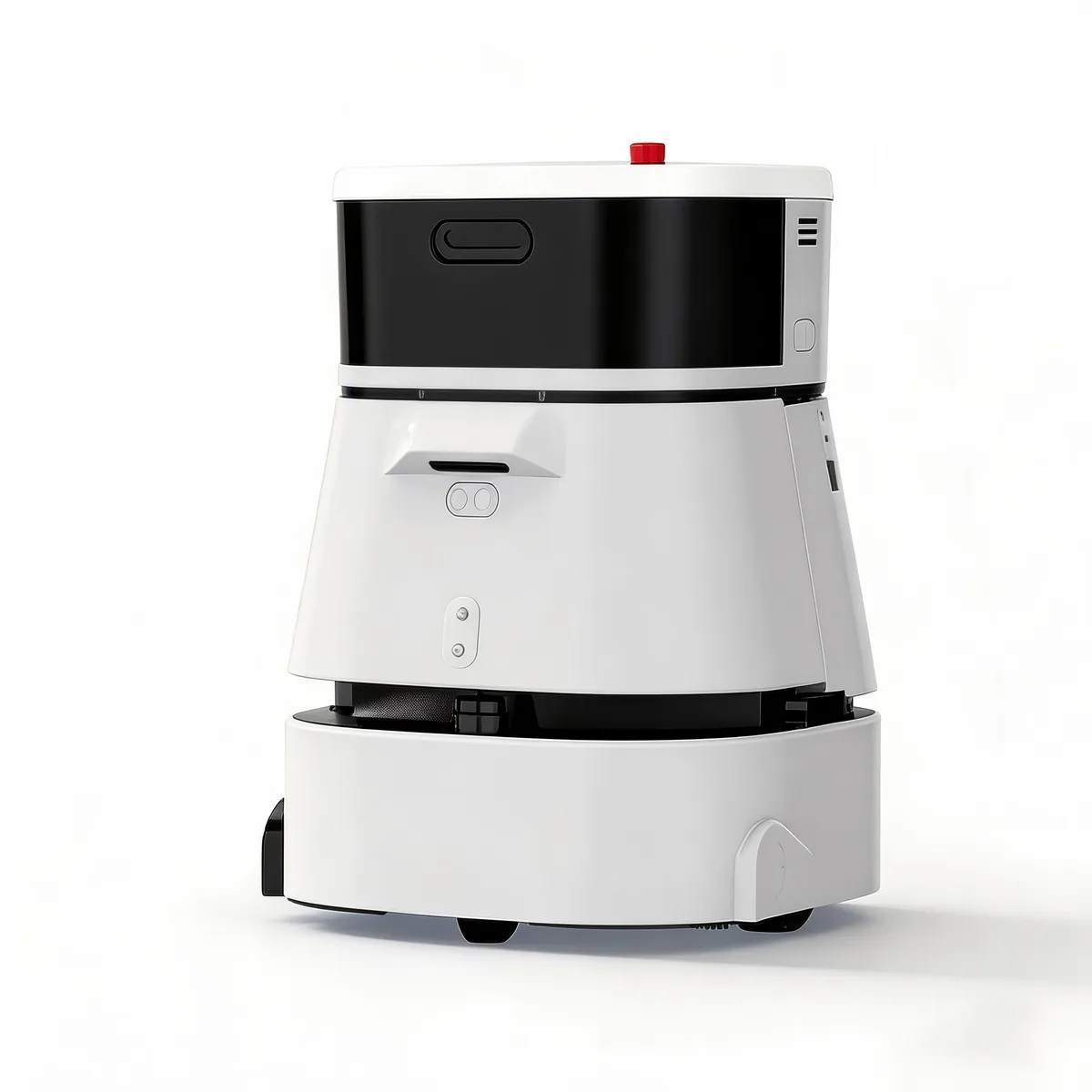
In Q1 2026, the terminal operator deployed CLEINBOT CC201 outdoor-rated autonomous scrubbers across its warehouse hardstand areas and administrative building approaches, CLEINBOT M79 units for interior warehouse and office floor maintenance, and CRUZR humanoid units at trucker check-in kiosks and visitor reception areas. A six-month pilot of autonomous security patrol using modified CLEINBOT CC201 units equipped with thermal cameras and license plate recognition — integrated with the existing Milestone VMS (video management system) — is in planning for Q3 2026.
The operational results from the cleaning deployment at month 6: custodial contract spend reduced 37% ($777,000 annualized), floor cleanliness audit scores (measured against ISO 14644-1 Class 8 equivalent for non-cleanroom industrial floors) improved from 72% to 94% compliance, and — notably — worker compensation claims for slip-and-fall incidents in robot-maintained zones decreased 52%. The latter alone saved an estimated $180,000 in direct claims cost and 3.2x that amount in indirect costs (lost productivity, investigation time, OSHA recordable penalties) based on the terminal's historical claims data.

Why Ports and Cargo Terminals Are Prime Candidates for Autonomous Robots
Ports and freight terminals differ from other logistics facilities in four ways that make autonomous robots particularly valuable:
1. 24/7/365 operations mean continuous cleaning demand. Unlike a distribution center that runs two 10-hour shifts with a 4-hour cleaning window, a container terminal's operational cadence is driven by vessel schedules that ignore the clock. A ship arriving at 3:00 AM triggers a cascade of yard equipment, truck queues, and warehouse activity that generates debris, dust, and floor contamination continuously. Autonomous scrubbers that clean during operations — navigating around forklifts, reach stackers, and truck traffic — eliminate the impossible task of finding a "cleaning window" in a facility that never stops. This operational pattern is distinct from the cruise ship terminals covered in our maritime service robots guide, which follow scheduled embarkation/debarkation cycles.
2. Labor scarcity is structural, not cyclical. Port-adjacent labor markets in major logistics hubs (Los Angeles/Long Beach, Rotterdam, Singapore, Shanghai) have unemployment rates below 3.5%, and the competition for security-cleared, TWIC-card-holding workers is intense. Autonomous robots do not require TWIC credentials, background checks, or union-negotiated wage scales — they are capital assets, not labor, which fundamentally changes the procurement and deployment economics.
3. Safety compliance is high-stakes and audit-intensive. OSHA recordable injuries at ports and terminals carry penalties that can exceed $150,000 per incident for willful violations, and ISPS (International Ship and Port Facility Security) Code compliance requires continuous perimeter monitoring. Robots that reduce human presence in high-risk zones (active yard areas, container stacking zones, chassis parking areas) reduce both injury probability and the associated compliance burden. Our safety standards and compliance guide covers the regulatory framework in detail.
4. The ROI math is unusually clean. Port and terminal operators quantify everything — TEUs per acre, labor hours per lift, claims per 100,000 worker-hours. This granular operational data means robot ROI can be calculated precisely, without the speculative assumptions that cloud softer deployments like hospitality or retail. The environmental hardening costs (salt spray resistance, IP65+ rating, wide-temperature-range batteries) are offset by the measurable labor savings and claims reduction.
Environmental Hardening: What Makes a Port-Ready Robot Different
Standard commercial cleaning robots fail in port environments within weeks. Salt spray corrodes unprotected electronics, container yard dust (a fine particulate of rubber, metal, and concrete) clogs standard filtration systems, and outdoor temperature swings from 28°F to 115°F exceed consumer-grade battery operating ranges. Port-ready robots require:
| Hardening Requirement | Standard Robot | Port-Ready Robot | Rationale |
|---|---|---|---|
| Ingress protection | IP54 (splash-resistant) | IP65+ (dust-tight, water jet-resistant) | Container yard dust penetrates IP54 seals within 2-4 weeks |
| Operating temperature | 32°F-104°F | -4°F-122°F | Unheated warehouses and outdoor hardstands experience full climate range |
| Corrosion resistance | Standard aluminum/steel | 316 stainless steel chassis, sealed connectors | Salt spray from coastal locations corrodes standard fasteners in 3-6 months |
| Filtration | Standard HEPA | Two-stage cyclone + HEPA with self-cleaning cycle | Container yard particulate loads are 5-8x typical warehouse levels |
| Connectivity | WiFi-dependent | Dual-mode WiFi + 4G/5G with seamless failover | Terminal WiFi coverage is inconsistent across 200+ acre outdoor areas |
The CLEINBOT CC201 outdoor cleaning robot meets all five hardening requirements, which is why it serves as the foundation for port and terminal deployments. Its 5.5-hour outdoor runtime and 28-inch cleaning path cover approximately 18,000 sq ft per charge on hardstand surfaces — sufficient for a typical 3-acre container yard hardstand area with two charging cycles per 24-hour period.
Deployment Architecture: Three Zones, Three Robot Types
Zone 1: Outdoor Hardstands and Yard Areas
Container yards, chassis parking areas, truck queuing lanes, and intermodal rail sidings are exposed to weather, heavy equipment traffic, and continuous contamination from tire wear, container corrosion particles, and diesel particulate deposition. The CLEINBOT CC201's outdoor rating and 28-inch cleaning path make it suitable for these surfaces, operating on a scheduled route that covers high-traffic areas every 4-6 hours and lower-traffic zones once per 24-hour period.
A three-unit CC201 fleet, with staggered charging cycles, provides continuous coverage of approximately 12 acres of outdoor hardstand — a typical footprint for a mid-size terminal's truck and chassis zones. For comparison, traditional street-sweeper-based cleaning for this area requires one operator per shift at approximately $65,000/year fully loaded labor cost, plus $12,000/year in sweeper maintenance — $77,000/year vs. approximately $21,000/year in robot lease/maintenance costs.
Zone 2: Indoor Warehouses and Administrative Facilities
Cross-dock warehouses, CFS (container freight station) buildings, and administrative offices require standard indoor cleaning that CLEINBOT M79 units handle effectively. The key difference from a typical commercial office deployment is floor surface variability: warehouse floors transition from smooth epoxy to brushed concrete to steel diamond plate across a single facility, requiring adaptive brush pressure and solution flow rate that the M79's sensor suite automatically adjusts.
Administrative areas present a lower-intensity cleaning requirement but benefit from the consistency that autonomous units provide. Our fleet management guide covers the multi-unit coordination that enables a single operations dashboard to manage robots across indoor and outdoor zones simultaneously.
Zone 3: Trucker Reception, Visitor Areas, and Checkpoints
The human-facing side of port operations — trucker check-in kiosks, visitor reception, driver lounges — is where CRUZR humanoid robots transform the experience. Truckers arriving at a terminal spend 15-45 minutes in queues, check-in, and waiting; that time is typically spent in sparse, utilitarian facilities with minimal staff interaction.
CRUZR units at check-in kiosks handle: turn-by-turn directions to specific container pickup locations ("Bay C-17, Row 4, Tier 3 — follow the blue line on this map"), estimated wait times based on real-time yard management system data, and multilingual communication for the international driver workforce. A terminal that processes 800 truck transactions per day can redirect 35-50% of the human-staffed check-in interactions to CRUZR kiosks, reducing queue times and freeing staff for exception handling — lost containers, damaged seals, customs holds — that actually require human judgment.

Security Patrol: The Emerging Autonomous Use Case
Port security is governed by the ISPS Code, which mandates three security levels with escalating requirements for access control, perimeter monitoring, and patrol frequency. At ISPS Level 1 (normal), most terminals rely on a combination of fixed CCTV cameras and human patrols that cover the 8-12 km perimeter every 2-4 hours. The gaps are predictable: human patrol routes follow roads and paths that leave 30-50% of the actual fence line unobserved, and fixed cameras have blind spots that are well-documented in every terminal's security assessment.
Autonomous security patrol robots — modified CLEINBOT CC201 units carrying thermal cameras, LPR (license plate recognition), and two-way audio — address these gaps by patrolling fence lines directly (not limited to road-accessible routes) and providing continuous coverage rather than periodic sweeps. The units integrate with the terminal's existing VMS (Milestone, Genetec, or equivalent) via ONVIF Profile S, appearing as additional camera feeds in the security operations center.
The deployment described at the top of this article is targeting Q3 2026 for security patrol rollout. Key metrics to be tracked: fence line patrol coverage percentage (target: >95% of perimeter patrolled per 4-hour window vs. current ~55% with human patrols), incident detection time (target: <90 seconds from perimeter breach to operator alert vs. current 4-12 minutes with fixed cameras), and false alarm rate (target: <5 per 24-hour period after 30-day machine learning calibration period).
Our security and surveillance robot guide covers the broader security robot landscape, and the vendor evaluation framework provides a structured approach to comparing patrol robot offerings.
Procurement Considerations for Port and Terminal Operators
Port authorities and terminal operators have procurement processes that differ from standard enterprise buying. Three considerations specific to this sector:
Collective bargaining implications. Most U.S. West Coast ports operate under ILWU (International Longshore and Warehouse Union) collective bargaining agreements. Autonomous equipment deployment typically requires notification and, in some cases, negotiation through the contract's technology change provisions. The critical distinction — consistent across ILWU, ILA (East Coast), and European dockworker agreements — is that robots replacing janitorial and security functions (typically non-union contract workers) face far lower labor friction than robots replacing yard equipment operators (bargaining unit positions). Cleaning and security robots are the lowest-friction entry point.
Grant and infrastructure funding. U.S. Port Security Grant Program (PSGP) funds explicitly cover "security-related technology," which autonomous patrol robots qualify under. The Port Infrastructure Development Program (PIDP) also allows technology investments. European ports can access Connecting Europe Facility (CEF) and Horizon Europe funding for automation initiatives. The key is framing robot deployments as "infrastructure technology investments" rather than "labor replacement" in grant applications.
ROI timeline expectations. Port capital projects typically use 10-20 year depreciation schedules and 7-12% hurdle rates. Robot fleets, with 5-7 year service lives and 18-30 month payback periods, clear these thresholds easily — but the procurement machinery (RFI → RFP → evaluation → award) may take 9-14 months regardless of financial attractiveness. Operators who start the process now will have units deployed by early 2028; operators who wait for "more data" will be deploying in 2029-2030 while competitors compound their efficiency advantages.
Conclusion
Ports, cargo terminals, and freight hubs are arguably the strongest commercial case for autonomous service robots in logistics because the operational math is so clean: continuous 24/7 demand, structural labor scarcity, measurable compliance costs, and environments that are inherently hazardous for human workers. The environmental hardening requirements — IP65+ ratings, corrosion-resistant materials, wide-temperature batteries — are solved problems in current-generation hardware like the CLEINBOT CC201.
The deployment sequence that minimizes friction and maximizes measured ROI: indoor/outdoor cleaning first (fastest payback, lowest labor friction) → security patrol second (grant-eligible, complements existing VMS infrastructure) → humanoid reception at checkpoints third (improves driver experience metrics that terminal operators increasingly track for carrier retention). Operators who start with cleaning deployments in 2026 will have the operational data and organizational confidence to expand into security and reception roles by 2028.