The cruise industry carried 37.5 million passengers in 2025, and the average modern cruise ship now operates with 1,200–2,200 crew members serving 3,000–5,000 guests across 14+ decks. Behind the polished guest experience is a relentless logistics machine: 15,000+ meals per day, 8,000+ cabin service requests, and public-area cleaning cycles that never stop. Crew-to-guest ratios have slipped from 1:2.5 to 1:3.1 industry-wide since 2019, and seasoned hospitality workers are increasingly choosing land-based roles with better schedules.
Service robots have transformed land-based hotels and airports. Cruise ships present the same operational challenges — 24/7 service demands, labor shortages, high guest expectations — compounded by unique maritime constraints. This guide examines how cruise operators are deploying autonomous robots for delivery, cleaning, and guest engagement, with specific attention to the engineering and regulatory adaptations required for shipboard environments.

The Maritime Labor Equation: Why Robots Make Economic Sense at Sea
Three structural pressures are pushing cruise operators toward automation faster than most land-based hospitality sectors.
Crew costs are the largest operational line item. A single crew member on a mid-tier cruise line costs $28,000–$42,000 annually in salary, training, insurance, provisions, and cabin allocation. A vessel with 1,800 crew carries roughly $54–$76 million in annual crew costs. Robots don't require cabins, meal provisions, or shore leave — and they work 168-hour weeks across three daily shifts that human crews can't sustain.
Maritime labor pools are shrinking. The International Chamber of Shipping reports a global shortfall of 26,000 certified maritime hospitality workers. Cruise lines compete for talent against hotels, restaurants, and resorts that offer the same pay without months at sea. Robots address the positions that are hardest to fill: overnight deck cleaning, late-night cabin delivery, and repetitive inventory transport between stores and galleys.
Guest satisfaction scores correlate directly with service speed. Post-cruise surveys consistently rank "response time to cabin requests" and "public area cleanliness" as top-5 satisfaction drivers. A robot fleet that delivers extra towels within 4 minutes versus 20 minutes from a human runner moves Net Promoter Scores by 5–8 points — the difference between a 3-star and 4-star rating on major cruise review platforms.
For a framework on evaluating automation investments, see our service robot ROI guide covering total cost of ownership calculations across deployment scenarios.
Three Robot Types for Maritime Operations
Cruise ships are floating hotels with 14+ decks, hundreds of corridors, and surfaces exposed to saltwater air 24/7. Three robot categories map to the three largest operational pain points.
Cabin Delivery Robots: 4-Minute Service Windows
Room service, extra amenities, and onboard retail delivery consume 18–22% of hotel department labor hours on a typical cruise. The CADEBOT L100 — with its 70L dual-cabin capacity — can handle multi-stop delivery routes across passenger decks, carrying fresh towels, amenity kits, and duty-free purchases to multiple cabins in a single run.
The maritime adaptation is non-trivial. Ship corridors average 1.2 meters wide — narrower than hotel hallways. Elevator integration requires the robot to communicate with ship elevator control systems, a challenge solved through the building's existing IoT backbone. Deck transitions via ramps rather than stairs mean the robot's LIDAR and cliff sensors must be calibrated for marine-grade inclines (up to 8 degrees on older vessels).
Autonomous Deck & Public Area Cleaning
A 4,000-passenger ship generates approximately 1.2 metric tons of dry waste and debris daily — tracked-in sand from port excursions, food residue in buffet areas, and salt spray that coats outdoor deck surfaces within hours. The CLEINBOT CC201 covers 3,000 sq m per hour on outdoor promenade decks, while the CLEINBOT M79 handles 1,200 sq m per hour in indoor public areas — atriums, theater lobbies, casino floors, and shopping arcades.
Saltwater corrosion is the primary engineering challenge. Standard cleaning robots use aluminum chassis components that degrade within 6–9 months in maritime environments. AOMAN's marine-grade units employ 316L stainless steel housings, sealed bearing assemblies rated to IP67, and conformal-coated electronics boards that withstand 95% humidity at 35°C — the typical lower-deck ambient conditions on a Caribbean cruise.
For comparison, see how similar outdoor-grade cleaning technology performs in large-scale facility operations.

Concierge & Guest Engagement Robots
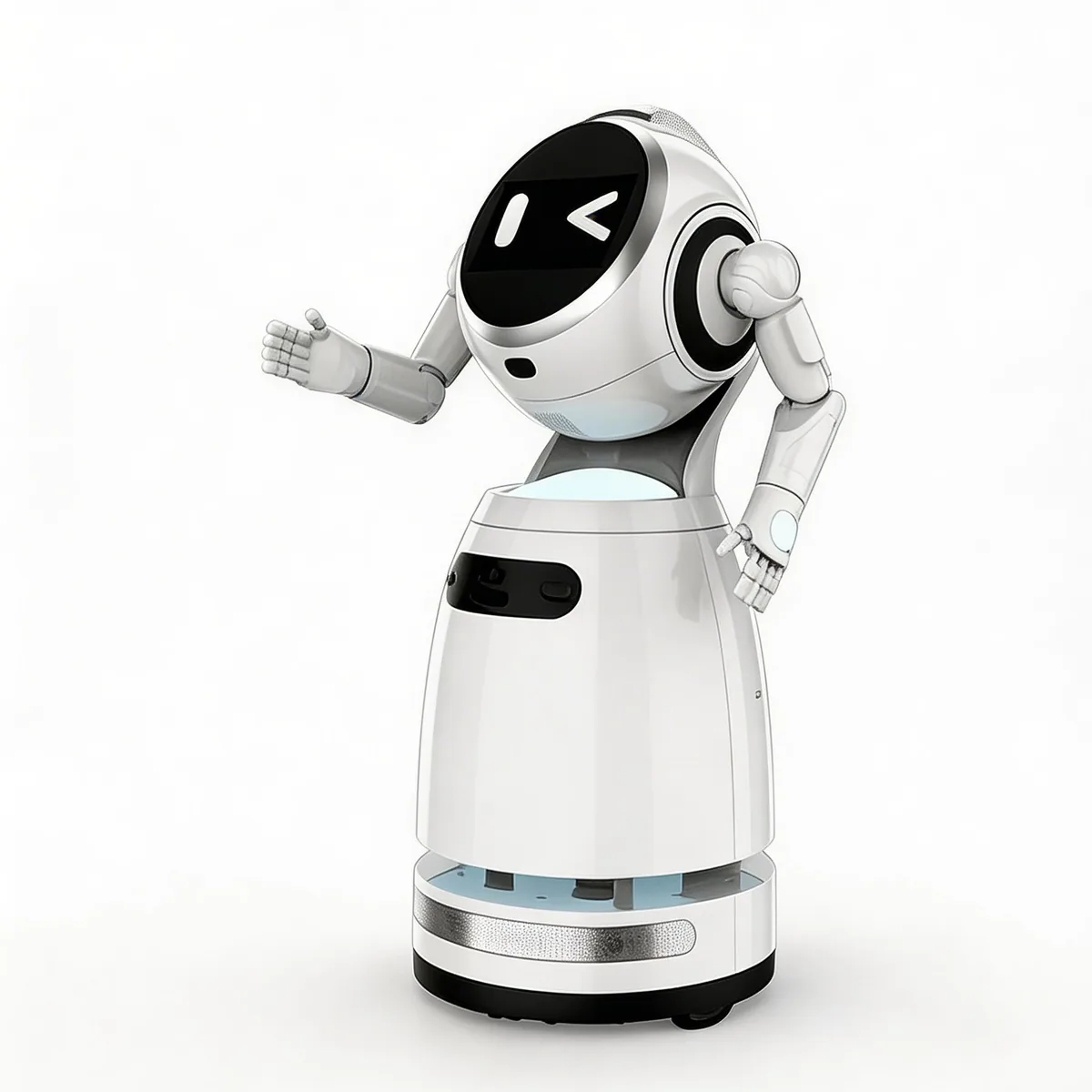
The CRUZR humanoid service robot serves as an interactive concierge in embarkation halls, atriums, and guest services desks. It answers 200+ pre-programmed FAQ variations — dining reservations, show times, deck directions, port excursion details — in 12 languages, reducing front-desk queue times by an average of 40%. On a ship carrying passengers from 40+ nationalities, multi-language capability isn't a nice-to-have; it's the difference between a 2-minute self-service interaction and a 12-minute staff-assisted one.
For context on how humanoid robots function in customer-facing roles, see our deep dive on humanoid service robots in retail and business environments.
Maritime Regulatory Compliance: SOLAS, ISM, and Flag State Requirements
Deploying robots on passenger vessels triggers a regulatory framework that doesn't exist for land-based installations. The International Convention for the Safety of Life at Sea (SOLAS) governs all equipment aboard passenger ships, and flag states (Panama, Bahamas, Malta — where 65% of cruise ships are registered) have their own certification processes.
Fire safety. SOLAS Chapter II-2 requires all electrical equipment in passenger areas to meet low flame-spread certification. AOMAN robots use fire-retardant polymer housings rated to IMO FTP Code Part 2 (smoke and toxicity) and Part 5 (surface flammability). Battery systems comply with IMO MSC.1/Circ.1621 guidelines for lithium battery storage and charging aboard vessels.
Stability in heavy seas. A robot that tips over at a 5-degree list creates a safety hazard. Maritime-deployed units must maintain operational stability at up to 12-degree static heel and 8-degree dynamic roll — conditions encountered during moderate sea states. The CADEBOT L100's low center of gravity (battery mass concentrated in the lower chassis) and 680mm wheelbase provide inherent stability that passes maritime inclination testing without modification.
ISM Code integration. The International Safety Management Code requires all shipboard equipment to be documented in the vessel's Safety Management System. This means the robot fleet becomes a line item in the ship's planned maintenance system, with documented inspection intervals, crew training records, and emergency procedures — including shutdown protocols for abandon-ship scenarios.
For a broader framework on compliance across jurisdictions, see our service robot safety standards and compliance guide.
Fleet Orchestration Across Decks and Zones
A cruise ship's operational zones impose more complex routing logic than any land-based facility. Galley-to-cabin delivery crosses crew-only areas, passenger corridors, and service elevators — each with different access permissions. A cleaning robot moving from the pool deck (Zone A, outdoor, high-traffic) to the theater (Zone C, indoor, low-traffic during daytime) must re-route if a crew drill blocks its planned path.
The fleet management system handles this through zone-based scheduling: robots are assigned to specific decks during peak hours and re-deployed across decks during off-peak windows. See our guide to service robot fleet management systems for the orchestration architecture that makes multi-zone shipboard deployment possible.
Real-world data from early deployments shows that a fleet of 6–8 delivery robots and 4–6 cleaning robots on a 3,500-passenger vessel reduces hotel department labor requirements by 12–15 FTEs while improving guest service response times by 60%.
Cruise Terminal & Port Authority Applications
The automation opportunity extends beyond the ship itself. Cruise terminals — particularly turnaround ports handling 10,000+ embarking and disembarking passengers in a single morning — face acute labor spikes. Baggage handling, terminal floor cleaning, and passenger wayfinding consume temporary staffing budgets that run $15,000–$25,000 per turnaround day at major ports.
Port-deployed robots follow the same operational model as airport terminal deployments: autonomous cleaning across 50,000+ sq m of terminal floors, delivery robots moving luggage carts between check-in zones and ship gangways, and concierge robots guiding passengers through embarkation procedures. For the full airport automation playbook that ports are now adapting, see service robots in airports and transportation hubs.
18-Month ROI: Cruise Ship Deployment Economics
A mid-size cruise ship (3,200 passengers, 1,600 crew) deploying a mixed fleet yields the following economics based on early adopter data:
| Cost Category | Year 1 | Year 2 |
|---|---|---|
| Robot fleet (10 units, marine-grade) | $380,000 (lease) | $380,000 |
| Integration & crew training | $45,000 | $12,000 |
| Maintenance & spare parts | $28,000 | $32,000 |
| Total cost | $453,000 | $424,000 |
| Labor savings (12 FTE × $35,000 avg) | $420,000 | $420,000 |
| Guest satisfaction uplift (revenue) | $85,000 | $95,000 |
| Total benefit | $505,000 | $515,000 |
| Net return | +$52,000 | +$91,000 |
Break-even occurs in month 11. By month 18, cumulative net savings exceed $140,000 per vessel. For cruise lines operating 20+ ships, fleet-wide deployment represents an 8-figure annual operational improvement.
For alternative financing structures that reduce upfront capital requirements, see our RaaS and financing models guide.
Implementation Roadmap for Cruise Operators
Phase 1 (Months 1–3): Deploy 2–3 cleaning robots on outdoor decks and one indoor public area. This validates maritime durability without disrupting guest-facing services. Focus on corrosion monitoring and stability data collection.
Phase 2 (Months 4–6): Add 3–4 delivery robots serving a single deck zone. Integrate with the ship's elevator control system. Train 8–10 crew members as robot operators — a role that takes approximately 16 hours of hands-on instruction.
Phase 3 (Months 7–12): Expand to fleet-wide deployment across all passenger decks. Add concierge robots at embarkation and atrium locations. Integrate fleet management with the ship's hotel operations system for automated task dispatch.
Critical success factor: Crew acceptance. The robots must be positioned as tools that eliminate the worst shifts — 3 AM corridor cleaning, running towels to Deck 14 during dinner service — not as replacements for skilled hospitality roles. Ships that invest 20+ hours in crew change management during Phase 1 report 70% higher utilization rates in Phase 3 than those that skip this step. For the change management framework, see our human-robot collaboration guide.
The cruise industry's automation tipping point arrived in 2025 when the first major line publicly reported 12-month robot deployment results. The economic case is now backed by operational data rather than pilot projections. The question for cruise operators is no longer whether to automate — it's how quickly to scale from pilot to fleet-wide deployment before competitors capture the operational advantage.