
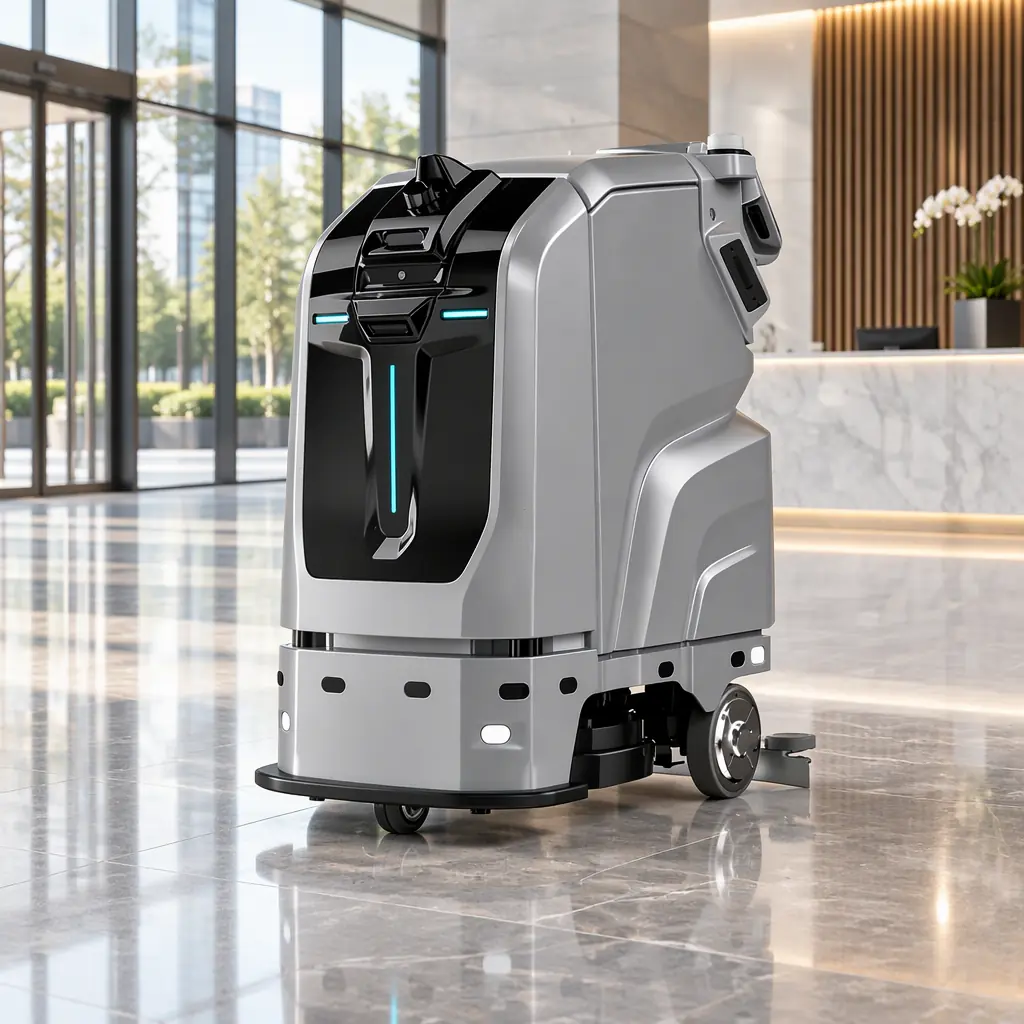
A service robot tender is not one contract. It is a chain of four instruments that each transfer a different part of the risk, and most procurement teams read them in isolation. The purchase order transfers delivery. The acceptance test transfers performance. The availability SLA transfers ongoing uptime. The payment and security schedule decides who is carrying the cash while the first two are unresolved. When a fleet project goes wrong commercially, the failure is almost always a gap between two of those instruments rather than a defect in any one of them.
This page maps the chain, quantifies the two clauses that cause the most argument — liquidated damages and retention — and lists the import-side line items that regularly add 8–15% to a delivered cost that the buyer budgeted from a factory price. It follows tender evaluation and scoring, and assumes you have already selected a supplier.

The Four Instruments and What Each Actually Transfers
The useful question to ask of any clause is not "is this fair" but "which instrument carries this risk, and what does it cost to move it". A risk that is not named in any instrument stays with the buyer by default, and that is where most disputes originate.
| Instrument | Transfers | Typical Trigger | Common Gap |
|---|---|---|---|
| Purchase order + Incoterms | Title and transit risk up to the named place | Shipment handed to carrier, or on arrival at named place | Risk transfers at the port but the buyer has no import entity set up, so the goods sit in bond |
| Acceptance test (FAT / SAT) | Fitness for purpose and site validation | Signed acceptance certificate | Acceptance is signed on a partial fleet, then measured against full-fleet SLA figures |
| Availability SLA + service contract | Ongoing uptime, response times, credits | First month after the warranty start date | Warranty start date is set at shipment instead of acceptance, so warranty burns in transit |
| Payment and security schedule | Counterparty credit and performance risk | Each milestone, plus the retention or guarantee release | Retention is held against a milestone that is never formally completed, so it never releases |
Two structural points sit above the table and cause more trouble than any individual clause. First, the definition of "acceptance" must be objective and testable, because everything after it is measured against the same word. Second, the warranty start date must be tied to the acceptance certificate rather than to the shipment date. A fleet that spends six weeks in customs and a further four weeks in a commissioning queue has consumed a fifth of a twelve-month warranty before it cleaned a single square metre, and that is a decision made by a single date field.
Liquidated Damages: The Number, the Cap and the Mathematics
Liquidated damages are a pre-agreed sum per day of late delivery, intended to compensate the buyer for the loss without having to prove it. They are the most negotiated clause in a robot tender and the least useful if sized badly. There are three numbers to fix: the rate per day, the cap as a percentage of order value, and whether the rate applies to the whole order or to each unit.
The rate should be derived from something real. If the business case in the tender assumes the fleet saves a stated amount per unit per week, the daily LD rate has a defensible floor at that figure divided by seven. A typical robot fleet business case produces a per-unit saving in the range of €90–€220 per week for a cleaning platform in a commercial building, which implies a daily LD of €13–€31 per unit. Most tenders in this sector settle at 0.3–0.5% of unit value per day with a 10% cap, which for a €28,000 unit gives €84–€140 per day — far above the business case saving, and therefore a number the supplier prices into the bid rather than a genuine risk transfer.
| LD Structure | Rate per Day | Cap | Effect on Bid Price | When It Is Appropriate |
|---|---|---|---|---|
| Business-case derived | €13–€31 per unit | 5% of order value | Small — supplier can absorb from schedule buffer | Standard fleet order, real deployment date |
| Percentage of unit value | 0.3–0.5% per unit | 10% of order value | Visible, typically 1–3% added to unit price | When the deployment date is contractually fixed by a client commitment |
| Availability-based (not delay) | Credit against monthly service fee | 30–100% of that month's fee | Low if the fleet is proven, high if not | Post-acceptance, as part of the SLA rather than the PO |
| Whole-order LD with no cap | Any rate | None | 10%+ or declined outright | Effectively never. An uncapped LD is a bid rejection |
The interaction that matters most is between delay LDs and the availability SLA, because they can both fire for the same day. If acceptance is delayed, LDs accrue. If acceptance is signed and the fleet then underperforms, SLA credits accrue. There is a window — usually the first four to eight weeks after a disputed acceptance — where a buyer who has signed under pressure can collect both, and a supplier who has priced both will have priced the overlap twice. Pin down explicitly that the two do not run concurrently, and state which governs during commissioning. That single sentence resolves more post-handover argument than the LD rate itself.

Retention Versus Bank Guarantee: The Cash Cost of Trust
Retention holds back a percentage of each payment until a defect-liability period expires. It is the traditional instrument and on a robot fleet it is usually the wrong one, because the retention period is set to match a construction defect period — twelve to twenty-four months — while the robot's real performance risk is concentrated in the first three months after acceptance and is already covered by the availability SLA.
The arithmetic is straightforward once you put a cost on cash. A 5% retention on a €500,000 fleet holds €25,000 for eighteen months. At a buyer's cost of capital of 7% that is roughly €2,600 of financing cost borne by whoever's cash it is, and if it is the supplier's cash the bid includes it. A bank guarantee for the same amount typically costs the supplier 1–2.5% per annum, and an on-demand performance bond at 0.8–1.5% — cheaper for the supplier, and better for the buyer because the money is still callable rather than sitting on a balance sheet.
| Instrument | Annual Cost to Supplier | Buyer's Protection | Release Condition |
|---|---|---|---|
| 5% cash retention, 18 months | ~7% cost of capital on the retained sum | Cash held, easy to claim | Defect-liability expiry, often disputed because completion is not formally recorded |
| Performance bond, 10% of order value | 0.8–1.5% p.a. | Callable on demand or on a certificate | Acceptance plus the SLA stability period |
| Parent company guarantee | Nil cash, contingent | Depends entirely on the parent's balance sheet | Acceptance |
| Extended warranty in lieu of retention | Warranty reserve, typically 2–4% of unit price | Service obligation rather than cash | None — nothing to release |
The last row is worth considering when the supplier has a service organisation in the buyer's country. Trading retention for an extended warranty shifts the security from cash to capability, which is worse if the supplier becomes insolvent and better if they do not. It is a judgement about the counterparty, not about the contract mechanics.
The Import Line Items That Are Not in the Factory Price
A factory price quoted EXW or FOB and a delivered, installed unit cost are different numbers, and the gap is where fleet budgets break. The line items below are the ones that recur on every imported robot fleet. The percentages are indicative for a commercial service robot entering the EU or the US from China and will vary by classification and by country, but the categories do not.
| Line Item | Typical Share of Unit Value | Who Usually Forgets It | Mitigation |
|---|---|---|---|
| Freight, insurance, port handling | 3–6% | Buyer comparing an FOB price to a delivered budget | Quote the Incoterm explicitly in the tender response: DAP, not FOB |
| Import duty | 0–8% depending on HS classification | Buyer assuming "robot" has one classification | Get the HS code in writing before the PO, and have a customs broker confirm it |
| VAT / sales tax, recoverable or not | 19–25% EU, state-dependent US | Cash-flow planning, not cost — recoverable only if the buyer is VAT-registered | Model it as working capital, not as cost |
| Compliance marking and local documentation | 1–3% | Buyer assuming CE is included | Name the directives and the declaration of conformity as a deliverable |
| Site survey, commissioning, training | 4–9% | Buyer budgeting hardware only | Ask for commissioning as a separate priced line, not bundled |
| Spares float and first-year consumables | 2–4% | Buyer assuming warranty covers consumables | Read the warranty exclusions; brushes, squeegees and filters are almost always excluded |
The HS classification point deserves emphasis because it is the one that is both avoidable and expensive to fix after the fact. Mobile robots, robot vacuum cleaners and industrial trucks do not sit in the same heading, and the difference between two plausible classifications can be several percentage points of duty on a six-figure order. Reclassification after import is possible in most jurisdictions and always involves a broker, a retroactive assessment and a delayed refund at best. Get the code agreed before the goods ship.
Payment Milestones: Weighting Against Real Completion
Standard terms in this sector are 30% on order, 60% on shipment, 10% on acceptance. That schedule is supplier-friendly and it front-loads almost all the cash before the buyer has seen a machine work. A schedule that tracks the actual risk transfer looks different: 20% on order, 30% on FAT at the factory, 30% on SAT at the site, 10% after thirty days of measured availability, and 10% at the end of the stability period.
The shift is not about squeezing the supplier. A schedule weighted to acceptance gives the buyer a lever during commissioning, when the remaining balance is still material, and it aligns both parties on getting the site validation done rather than on getting the container out of the door. Suppliers with genuine installation capability generally accept it; suppliers reselling hardware without field presence usually will not, which is itself useful information during evaluation. The commissioning sequence that generates a defensible SAT signature is set out in the acceptance test procedure guide, and the credit mechanics on the other side of acceptance are in the uptime SLA contract guide.
A Ten-Line Clause Checklist
Acceptance defined by named tests and a signature. Warranty start tied to acceptance, not shipment. Incoterm named with a place. HS code agreed in writing. LD rate derived from the business case, with a cap, and expressly not concurrent with SLA credits. Retention replaced by a bond where the counterparty allows it. Milestones weighted to SAT and the stability period. Consumables explicitly in or out of warranty. A single named escalation contact with a response time in hours, not working days. And a written exit: what the buyer receives, in what format, if the relationship ends — which service contract versus warranty economics covers alongside the payment-structure variants in fleet financing and payment structures.
AOMAN FUTURE quotes DAP with the commissioning scope as a separate line and states the HS code on the commercial invoice, because an unclear customs position costs more in delay than it saves. For a tender response against your own contract template, send the tender documents and we will return the completed compliance matrix with the line items above priced explicitly rather than bundled.