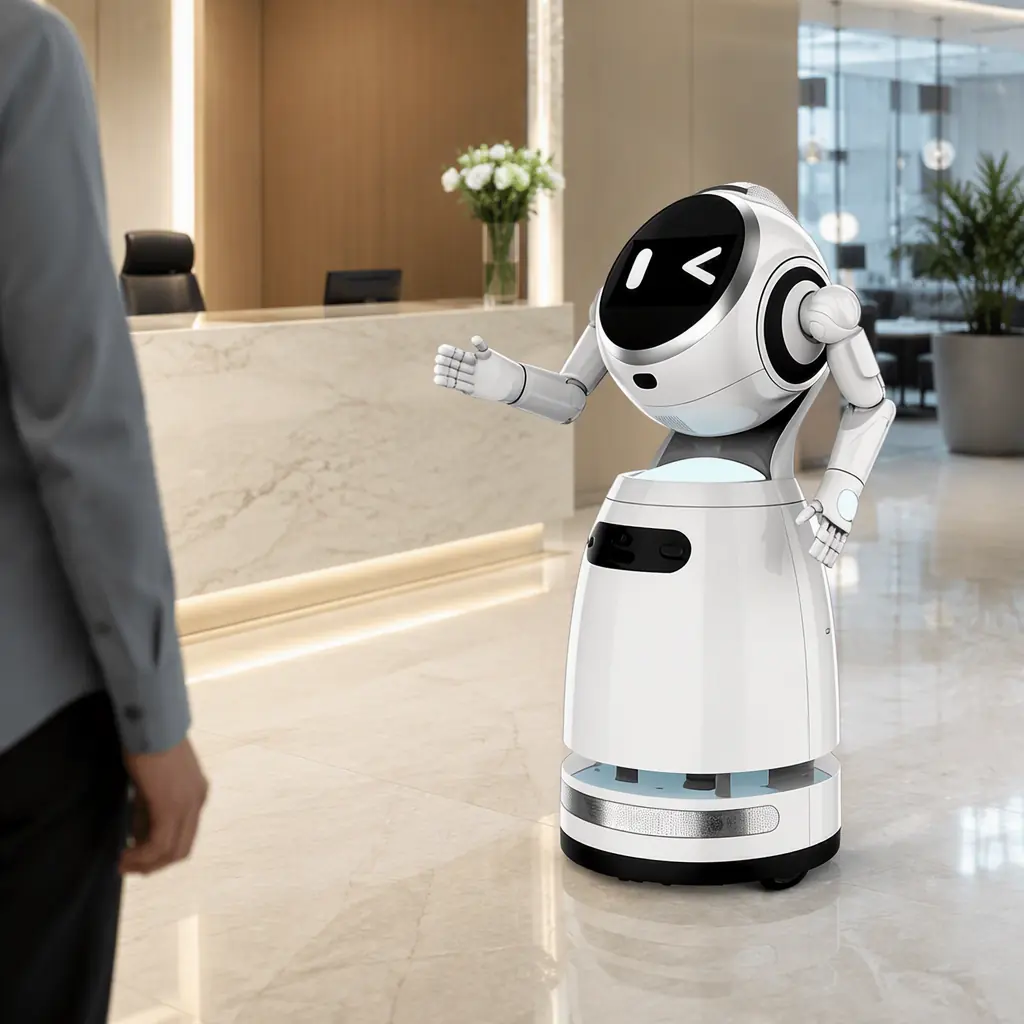
A service robot that cannot talk is a cart. A service robot that can talk — and can hold a natural, useful conversation — is a member of staff. That jump is driven by one technology: the large language model (LLM). In 2024–2026, LLMs took reception robots from "press a button for cleaning" to "ask me where the HR office is, in your language." Here is what is actually inside that conversational stack, the trade-offs that decide cost and reliability, and what it means for a fleet.
Why LLMs Changed the Reception Robot
Older conversational robots ran on intent trees: a fixed set of hard-coded triggers where "elevator" mapped to one scripted response. They broke on any phrasing the developer did not anticipate. An LLM flips the problem — instead of coding every path, you give the model the facility's knowledge and let it reason over natural language. The result is a reception robot that can answer a visitor's "where is the third-floor meeting room? And how do I get a visitor pass?" without a bespoke script, and a robot that keeps working when guests phrase things a dozen different ways.
The practical benefit for a facility: you front-load a knowledge brief once instead of scripting dialogue branches forever. That is a real reduction in integration effort over the life of the deployment.
Inside the Conversational Stack
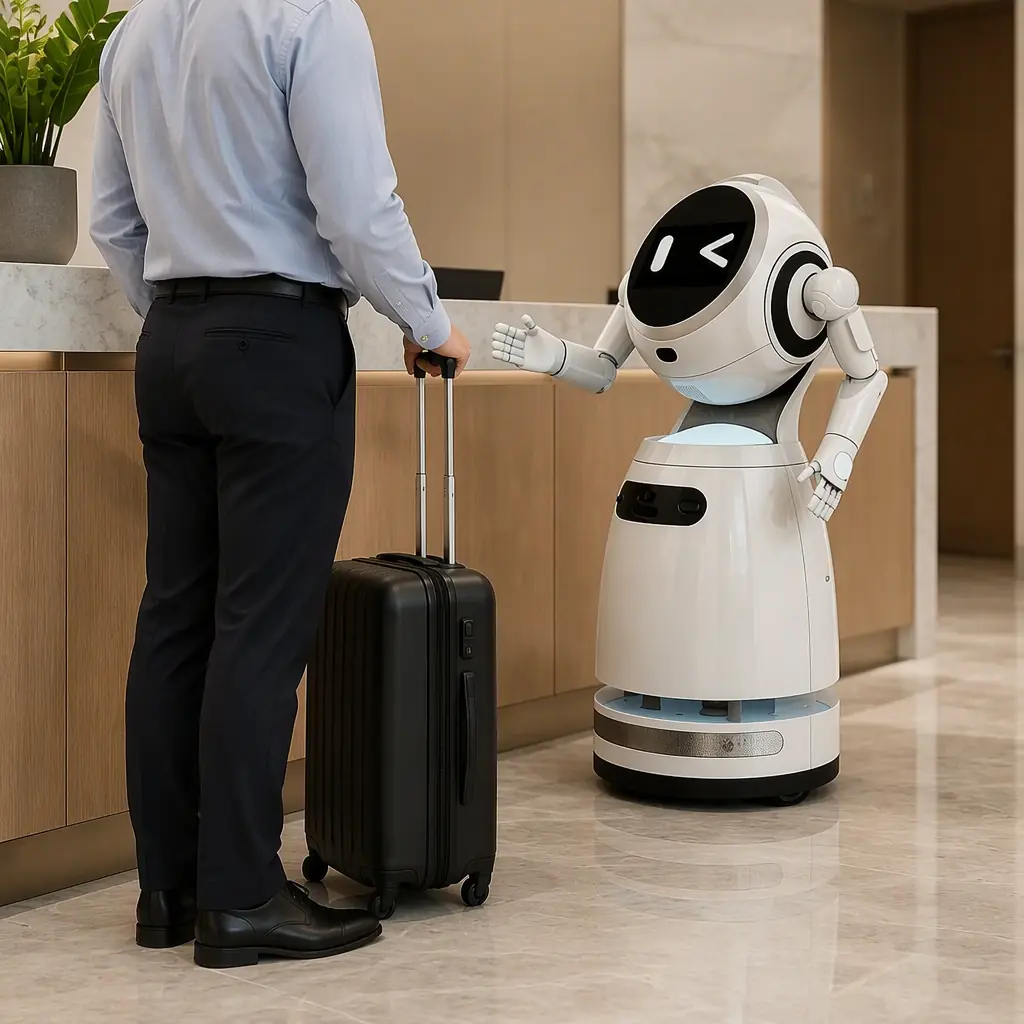
The pipeline is wider than the LLM. A working reception robot runs four stages, each with its own failure modes:
- Automatic speech recognition (ASR) — turning audio into text. Background noise in a lobby or trade-show hall is the top accuracy killer.
- LLM reasoning — the model parses intent, pulls the answer from your facility knowledge base, and composes a response.
- Text-to-speech (TTS) — synthesising natural speech, with prosody that does not sound robotic.
- Action layer — the robot can actually do something: call an elevator, print a badge, or log a guest at the smart building system.
Multilingual & Accent Handling
For an international reception point — a hotel, an airport, a convention centre — language is the headline feature. Modern LLM stacks handle 30+ languages natively in a single model, which removes the old per-language penalty. The trade-off is quality: accents and code-switching (a visitor mixing two languages in one sentence) still degrade accuracy. Ask the vendor for the language set and a recorded accuracy benchmark, not just "supports multiple languages." Expect strong performance in the major European and Mandarin, with more variability in regional accents.
Multi-language capability is also a reason a single robot model scales across your multi-site deployment — the same hardware is re-purposed by swapping the knowledge brief, not the unit.
Edge vs Cloud Inference: Latency & Privacy
Where the model runs decides two things: responsiveness and data risk.
| Approach | Latency | Privacy posture | Best fit |
|---|---|---|---|
| Cloud LLM | 0.6–1.5 s added | Audio leaves the site | Low sensitivity, budget builds |
| Edge/on-device | 0.1–0.4 s | Audio stays on device | Privacy-sensitive, high-traffic |
Cloud gives you a bigger model and cheaper compute; edge gives you lower latency and keeps audio on-premise. The hybrid split is now common: a compact model on the robot handles the "yes/no" quick intents locally, while a larger model in the cloud handles open-ended questions. The latency budget matters in a lobby — a visitor is not patient beyond about 1.5–2 seconds.
If the facility handles sensitive data — a hospital, a bank, a law office — the privacy posture of the inference stack should be a scored line in your vendor evaluation, not an afterthought. See the cybersecurity guide for the data-handling clauses to negotiate.

Guardrails Against Hallucination
The risk of an LLM is a confident wrong answer. A customer-facing robot that tells a guest "the meeting is on floor 8" when it is on floor 3 is worse than one that says "I do not know." So a production reception robot needs three guardrails:
- Grounding — the model answers only from your curated facility knowledge base, and citations are checked against it before the robot speaks.
- Refusal policy — the model is trained to say "I do not know that, let me find someone" rather than improvise an answer. A polite refusal with escalation beats a hallucination every time.
- PII and prompt-injection defence — the robot must not be talked into revealing other guests' information or executing an unintended action. See the security-serialisation guide for layered controls.
You can test this before you buy: ask a demo robot a decision it does not have on file and watch whether it improvises a false answer or escalates. That single test tells you a lot about the stack's maturity.
Use Cases Beyond Reception
The same conversational layer carries the robot well past the front desk:
- Wayfinding — turn-by-turn guidance through a large campus or mall.
- Ticketing and queueing — a robot that answers capacity questions and hands off to staff at the right moment.
- Cleaning orchestration — a facility manager asking a cleaning robot to report floor status by voice, rather than through a dashboard.
- Escalation — the robot knows when a question is out of scope and routes it to a human, which is the difference between automation and frustration.

What It Means for Your Fleet
The conversational layer is software, which means it improves over time. That favours a vendor that issues regular model and knowledge updates — the warranty and SLA guide is where you lock that in. It also means your fleet management system should be able to push a new knowledge brief to every robot in one step. Verify the update path before you commit; a robot that ships with today's answers but never improves is a static asset with moving parts.
The Bottom Line
LLMs made service robots conversational, and the stack behind that capability — ASR, reasoning, TTS, action — is where the real quality differences live. Prioritise latency, privacy posture, and hallucination guardrails when you compare vendors, and test refusal behaviour on a live demo. Start with a piloted unit in one high-traffic lobby to measure response time and guest satisfaction before you roll out fleet-wide. See the solutions page to match a conversational robot to your greeting volume.