A 300-slip full-service yacht club ran its 2025 operations review and found its two most expensive surfaces were the ones members walked on every day. The first was the boardwalk: sand tracked from the docks, leaf litter from the landscaped entrance, and the salt film that left the timber looking weathered weeks after the spring maintenance pass — and with 1,800 metres of boardwalk and dock fingers, the grounds crew was spending 4 hours a day on broom duty. The second was the clubhouse: the restaurant and lounge floors carried the combined load of wet shoes from the docks, food service traffic and the humidity of a waterfront building, and the after-hours cleaning cycle kept the restaurant team an extra hour past close. The third was the supply loop: provisions, linens and club supplies moved between the storage building, the galley and the dock side in a walking pattern that the club's own time study measured at 22 minutes per shift per crew member.
Marinas are a weather-exposed hospitality business with a logistics layer, and the cruise ships & maritime guide documents the adjacent maritime pattern; this guide covers the marina-specific version, where boardwalk sweeping, clubhouse floor care and dock-side supply logistics are the three highest-value robot roles — the outdoor loop that keeps the member-facing surfaces presentable in a salt-air environment, the interior loop that keeps the clubhouse running on hospitality standards, and the delivery loop that keeps provisions moving between dock and galley.
The Salt-and-Sand Design Rule: Boardwalks & Dry-Storage Lanes
Marina exteriors are the most demanding outdoor-cleaning environment a service robot can run in: salt air, sand, wet surfaces and continuous pedestrian traffic. The CLEINBOT CC201 outdoor sweeper covers the boardwalk loop: a 1,020 mm sweeping width at 3,000 m²/h — the full 1,800-metre boardwalk and dry-storage lane network in under three hours — with a 130L dust container that auto-empties into an 800L docking station, IP67 sealing with a rain sensor, and GPS + LiDAR + IMU navigation that follows the approved boardwalk loop between dock fingers. Its 10-hour battery runs the early-morning pass before members arrive and the evening pass after the last launch, and its -10°C to 50°C range covers both northern marinas that winterize and Gulf-state clubs that run year-round. The outdoor pattern the outdoor autonomous cleaning guide documents for public spaces applies directly, with the marina-specific rule being the salt-and-sand sequencing: the boardwalk is swept from the water side inward so sand and debris are pushed back toward the source rather than across the member-facing walkway, and the dry-storage lanes run on the off-peak schedule.
The corrosion question is the one marina operators ask first: the CC201's IP67 sealing and rain-sensor pause keep saltwater exposure to the swept surfaces rather than the robot's internals, and the dock-side charging point is positioned clear of the splash zone — the same "keep the equipment out of the hazard zone" logic the petrol stations guide documents for weather-exposed retail sites, applied to a marine environment where the hazard is salt instead of fuel.
Clubhouse Restaurant & Lounge Floors: The Wet-Zone Loop
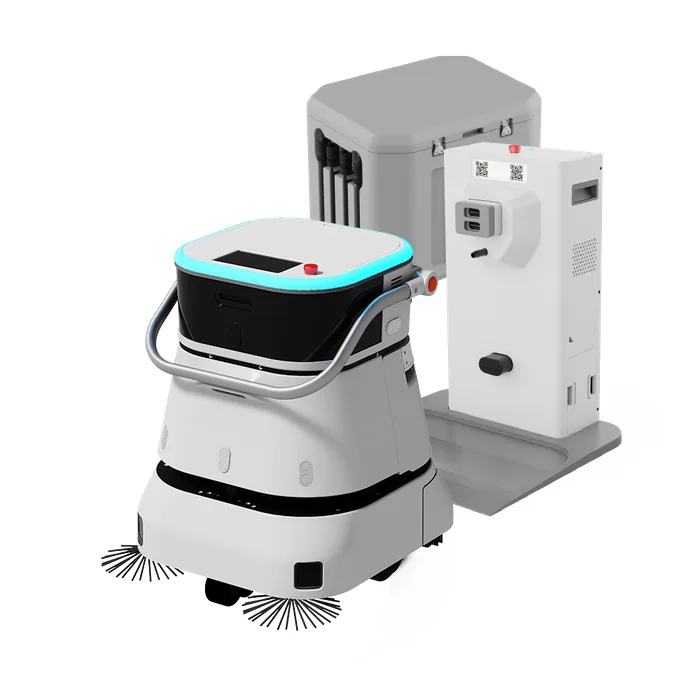
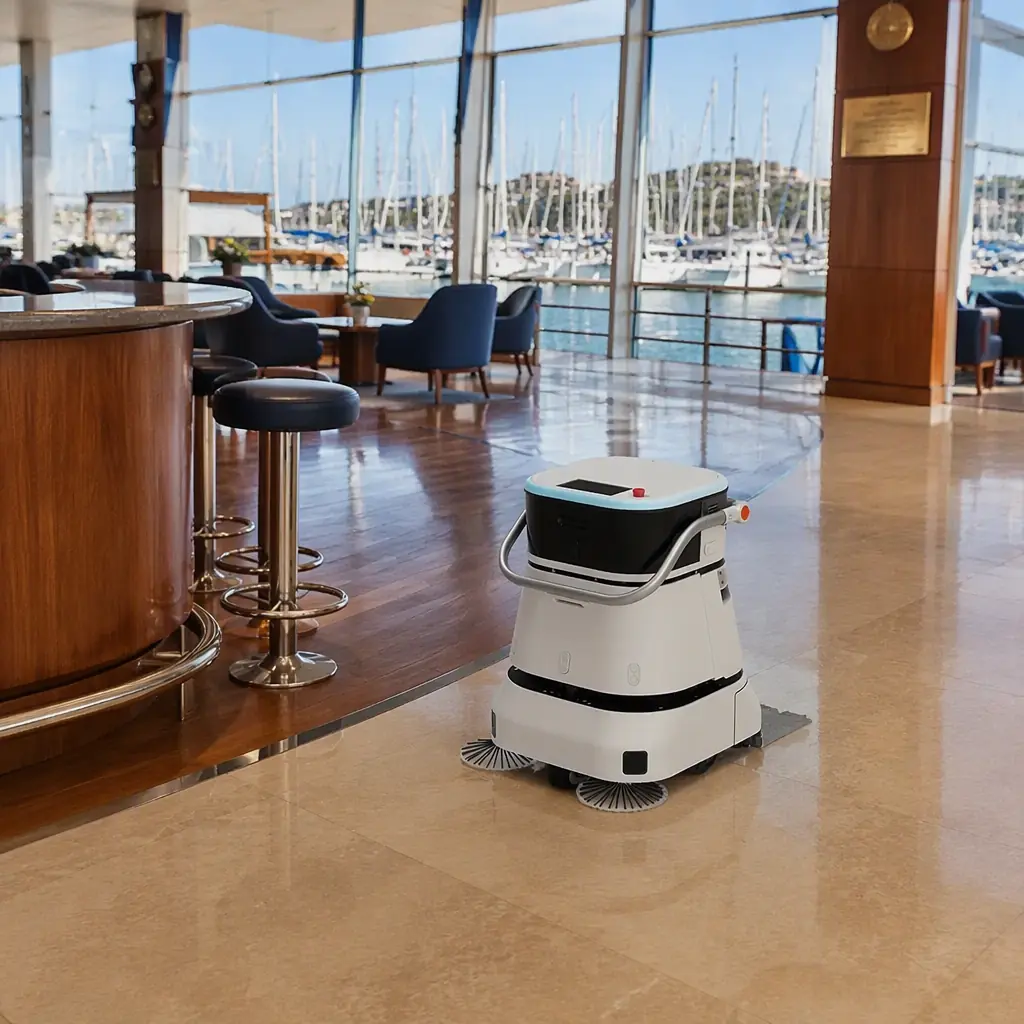
The clubhouse runs on hospitality standards, and its floors carry the combined load of wet shoes, food service and waterfront humidity. The CLEINBOT C2 Pro covers the interior loop: IP54-rated chassis sealing for the wet zones, a squeegee system that leaves floors 90% dry within 90 seconds of pass completion — critical on the restaurant floor, where a wet surface during lunch service is a slip liability — and the compact footprint that threads the lounge, locker-room and galley-adjacent corridors. The specification framework in the commercial cleaning robot buyers guide applies; the marina-specific rule is the wet-zone sequencing: the C2 Pro runs the restaurant floor before lunch and before dinner, the lounge after the evening service, and the locker rooms on the off-peak schedule, so every member-facing surface is dry and presentable when members arrive — the same "clean the high-traffic zone when the traffic isn't there" logic the golf courses & country clubs guide documents for clubhouse operations at country clubs, applied to the waterfront variant.
Dock-Side Supply Logistics: Provisions That Move Themselves
The most expensive walking in a marina is done by crew members moving provisions, linens and club supplies between the storage building, the galley and the dock side. The CADEBOT L100 covers the supply loop: a 400 mm platform with four trays rated for 15 kg each and a 40 kg total payload that carries a full provisioning run in one trip — 6–8 deliveries per hour across the club, including the dock-side run that used to cost a crew member a 20-minute round trip per boat. The same pattern the hospital delivery robots guide documents for pharmacy and lab runs applies at marina scale: the robot runs the route, the crew stays with the members, and every delivery is logged by the fleet dashboard — including the provision handoffs that the club's inventory records require.
Seasonal & Multi-Marina Operations: One Dashboard, Every Dock
Marina operators run seasonality that most facilities never see — full fleet in summer, winterization in the off-season — and multi-marina operators run the same boardwalk, clubhouse and supply pattern across several sites. The multi-site deployment guide documents the fleet pattern: every CC201, C2 Pro and L100 reports to one cloud dashboard, routes and schedules are configured remotely by the operations office, and an operator running five marinas runs the same boardwalk loop, the same clubhouse schedule and the same provision routes everywhere — with the fleet management guide covering the operational layer and the RaaS financing guide covering the subscription structure that fits marina budgets: most clubs start with one CC201 on the boardwalk and one C2 Pro in the clubhouse, run one full season with the documented numbers, and add the L100 when the provision-walking time becomes the crew-productivity bottleneck.
Deployment Table for Facility Types
| Facility type | Exterior fleet | Interior fleet | Monthly cost (RaaS) | Staff hours returned |
|---|---|---|---|---|
| Community marina (50–150 slips) | 1 × CC201 (boardwalk + parking) | — | $1,400–2,200 | 80–140/month |
| Full-service yacht club (200–400 slips) | 1 × CC201 (boardwalk + dry storage) | 1 × C2 Pro (restaurant + lounge) | $2,800–4,600 | 200–340/month |
| Resort marina with clubhouse & restaurant | 1–2 × CC201 (boardwalk + grounds) | 1–2 × C2 Pro (restaurant + lockers) + 1 × L100 (provisions) | $4,200–7,000 | 320–560/month |
| Multi-marina operator (5+ sites) | 1 × CC201 per site | 1 × C2 Pro + 1 × L100 per full-service site | $18,000–34,000 | 2,000–4,200/month |
A marina's reputation is measured in the surfaces members walk on and the service they receive, not in slip count. The CC201 keeps the boardwalk and dry-storage lanes clean in a salt-air environment, the C2 Pro keeps the clubhouse restaurant and lounge dry and presentable on hospitality schedules, and the L100 keeps provisions moving so crew stay with the members — all on schedules that survive the seasonality of the waterfront. That is the automation pattern that fits a marina budget, and it starts with the same step every successful deployment starts with: a walk-around audit of where the broom hours, the wet-zone cleanup and the provision trips actually are.