A mid-size poultry processing plant in the Southeast United States runs two 10-hour shifts, processing 140,000 birds per day across 85,000 sq ft of USDA-inspected production floor. Its sanitation team of 18 workers executes a full wet clean between shifts (8:00 PM-5:00 AM), plus continuous mid-shift cleaning of kill floor, evisceration, and cut-up areas. The plant operates under a USDA HACCP plan with 14 critical control points and is audited quarterly against SQF Level 3 certification — the highest tier of the Safe Quality Food program.
The plant's persistent operational tension: mid-shift cleaning halts production on the affected line segment for 8-12 minutes per cleaning cycle, accumulating to approximately 90 minutes of lost production time per shift. Multiply across 250 operating days per year, and the plant loses roughly 375 hours of production capacity — equivalent to 18 full production days — to mid-shift sanitation pauses. Meanwhile, the overnight sanitation crew operates at 22% annual turnover, and finding replacements willing to work the 8:00 PM-5:00 AM shift in a wet, cold (38°F) processing environment is the plant's #1 HR challenge.
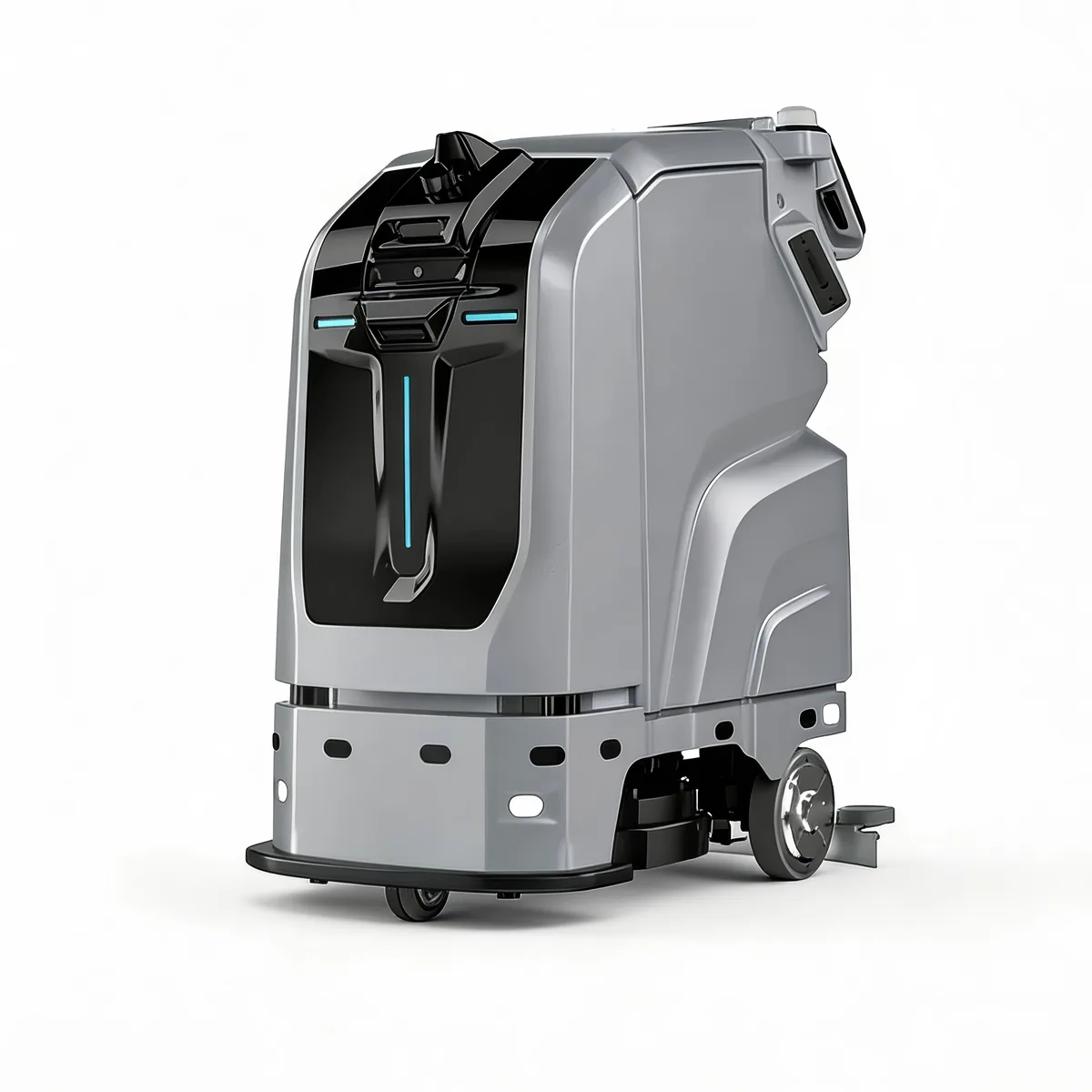
In Q1 2026, the plant deployed four CLEINBOT M79 autonomous scrubbers modified for food processing environments — stainless steel chassis, IP65 sealing, food-grade lubricants in all drive components, and HACCP-compatible cleaning validation (ATP bioluminescence swabbing ports integrated into the robot's cleaning path tracking). The M79 units operate continuously during production shifts, maintaining floor cleanliness in non-contact surface zones (corridors, break areas, loading docks, packaging areas adjacent to but not inside the primary processing zones). The overnight sanitation crew was reduced from 18 to 14 workers, with the four remaining positions redirected from broad-area floor cleaning to higher-value tasks — equipment teardown, belt inspection, and CCP (Critical Control Point) monitoring.
At month 6: mid-shift production pauses for floor cleaning eliminated entirely (robots clean continuously around active lines), overnight sanitation labor costs reduced $168,000 annualized, and — most critically for an SQF Level 3 facility — floor ATP swab pass rates in robot-maintained zones improved from 83% to 97%. The latter metric alone justified the $184,000 total hardware investment: one SQF major non-conformance triggered by a floor hygiene failure would cost an estimated $50,000-120,000 in corrective actions, re-audit fees, and at-risk customer contracts.
The Food Safety Case for Autonomous Cleaning Robots
Food processing hygiene and commercial facility cleaning — like in supermarkets or restaurants — share surface-level similarities, but processing plants operate under a fundamentally different regulatory framework. The FDA's Food Safety Modernization Act (FSMA) Preventive Controls rule (21 CFR Part 117) requires that facilities implement "sanitation preventive controls" as part of their food safety plan — procedures, practices, and processes to ensure that the facility is maintained in a sanitary condition to minimize hazards.
Autonomous cleaning robots contribute to sanitation preventive controls in three specific ways:
1. Continuous vs. periodic cleaning reduces hazard accumulation windows. A traditional mid-shift cleaning schedule means contamination accumulates for 3-4 hours between cycles. Continuous autonomous cleaning reduces the hazard accumulation window to minutes. From a HACCP perspective, this shifts the sanitation control from a "periodic intervention" to a "continuous preventive control" — a stronger position during FDA or third-party audits.
2. Validated, repeatable cleaning paths eliminate operator variability. Human sanitation workers, regardless of training quality, exhibit variability in cleaning thoroughness across shifts, across workers, and across hours within a single shift (fatigue effects documented in the food safety literature). Autonomous robots follow identical, validated cleaning paths every cycle, with deviation from path recorded in the fleet management log. This data trail — robot X cleaned Zone 7 at 14:23, covering 2,840 linear feet at pressure setting 3.2 — constitutes auditable evidence of sanitation preventive control execution that satisfies SQF Element 11.2 (Cleaning and Sanitation) documentation requirements.
3. Reduced human traffic through processing zones = reduced cross-contamination vectors. Every human entering a food processing zone represents a contamination risk — from footwear, clothing, hair, and respiratory droplets. Reducing the number of sanitation workers in processing zones during production by 60-80% is itself a preventive control. Our laboratories and cleanrooms guide covers the parallel use case in pharmaceutical GMP environments, where the regulatory framework is even more stringent.
Surface Compatibility and Material Considerations
Food processing floors are not uniform. A single facility may contain six or more surface types, each with different cleaning chemistry compatibility:
| Surface Type | Typical Location | Cleaning Challenge | Robot Compatibility |
|---|---|---|---|
| Urethane cement | Kill floor, evisceration | Withstands quaternary ammonium and peracetic acid; non-slip aggregate texture requires increased brush pressure | M79: adaptive pressure mode, food-grade brush material |
| Epoxy with antimicrobial additive | Ready-to-eat zones, packaging | Smooth surface ideal for autonomous cleaning; must avoid brush scratching that creates bacterial harborage | M79: soft-bristle mode, validated below 0.5 Ra surface roughness change after 500 cycles |
| Acid brick with chemical-resistant grout | Marination, acid wash areas | Grout lines retain moisture; aggressive cleaning chemistry (pH 2-4) degrades standard robot seals | M79 with chemical-resistant seal upgrade package |
| Stainless steel diamond plate | Freezer tunnels, blast cells | -40°F operating temperature; ice accumulation requires heated solution tanks | Requires cold-chain variant with heated fluid system and low-temperature lithium chemistry |
| Quarry tile | Older facilities, dry storage | Grout erosion from decades of harsh cleaning; uneven surface triggers robot suspension sensor | M79: adaptive suspension mode with ±15mm surface variation tolerance |
| Polished concrete | Administrative corridors, break rooms | Lowest cleaning intensity requirement; robots primarily replace scheduled custodial staff | M79: standard mode |
The poultry plant described above uses urethane cement in processing zones, epoxy in packaging, and polished concrete in administrative areas. The M79 fleet's ability to switch cleaning modes between surface types — automatically triggered by RFID floor tags at zone transitions — eliminates the need for separate equipment or manual mode changes. This is a practical requirement that should be validated during any pre-deployment site assessment.
Beyond Cleaning: Delivery and Reception in Food Facilities
Intra-Facility Logistics
Food processing plants have significant internal logistics that currently consume forklift operator or manual cart-pusher hours: delivering packaging materials from warehouse to packaging lines, transporting QA samples from production floor to lab (3 km of internal walking distance per shift in a large facility), and moving sanitation chemicals from central storage to satellite cleaning stations.
The CADEBOT L100 delivery robot automates these movements in non-processing zones (warehouses, corridors, administrative areas). The key food-safety constraint: delivery robots should not transit directly from raw-product zones to ready-to-eat zones (a HACCP cross-contamination pathway). This is managed through zone-based geofencing — the robot's navigation map includes "do not cross" boundaries that enforce HACCP zone separation. Our delivery robot selection guide covers the range of payload and range options.
Visitor Management and Compliance Documentation
Food processing facilities subject to SQF/BRCGS audits, customer audits (Walmart, Costco, Kroger each have their own food safety audit protocols), and regulatory inspections have substantial visitor management requirements: sign-in, GMP gowning verification, allergy/health declaration, and visitor badge issuance. A facility processing 6-8 visitor groups per week (customers, auditors, regulators, corporate visitors) may dedicate 4-6 labor-hours weekly to visitor processing.
CRUZR humanoid reception robots handle the routine components: digital sign-in with automatic audit log generation, GMP gowning instruction playback (video + audio in the visitor's preferred language), and automated badge printing. The compliance benefit is the audit trail — every visitor interaction is logged with timestamp, identity verification, and GMP acknowledgment confirmation — which satisfies SQF Element 2.1 (Site Security) and Element 2.3 (Personnel Practices) documentation requirements with zero incremental paperwork burden on the QA team.
Cold Storage and Cold Chain Facilities
Cold storage warehouses and cold chain logistics facilities — covered partially in our cold chain logistics guide — present extreme-condition operating environments that require specialized robot configurations:
-20°F to 35°F operating range. Standard lithium-ion batteries lose 30-50% of their effective capacity at freezer temperatures. Cold-chain robot configurations use heated battery enclosures (maintaining cells at 50-60°F internally while the robot operates at -20°F externally) and low-temperature-rated lubricants in all drive components. Runtime at -20°F is approximately 60% of room-temperature runtime — 5.7 hours vs. 9.5 hours for the M79 — which must be factored into fleet sizing and charging station placement.
Condensation management during defrost cycles. Freezer facilities run periodic defrost cycles where temperatures rise to 35-40°F for 20-40 minutes, causing condensation on all surfaces — including robot electronics. IP65-sealed electronics compartments with desiccant breather vents prevent internal condensation; this is a non-negotiable requirement validated during pre-deployment testing.
Ice accumulation on floor surfaces. Freezer floors accumulate ice from forklift tire condensation, door seal leaks, and product spillage. Autonomous scrubbers in freezer environments require heated solution tanks (to prevent cleaning solution from freezing on contact with the floor) and squeegee blades rated for -30°F flexibility (standard squeegees become brittle and lose contact below 0°F).
HACCP Integration and Audit Readiness
The strongest argument for autonomous cleaning robots in food processing — beyond labor savings — is their contribution to audit readiness. A typical SQF Level 3 audit involves an auditor spending 2-3 days on-site, reviewing documentation for every preventive control in the food safety plan. Sanitation documentation is consistently among the top five sources of non-conformances across all SQF-certified facilities, according to SQF Institute data.
Autonomous cleaning robots generate a data trail that satisfies the documentation requirement natively:
- What was cleaned: Zone map with GPS-denied indoor positioning (±10 cm accuracy via LiDAR SLAM)
- When: Timestamped cleaning cycle start/end, including any pauses or interruptions
- How: Recorded cleaning parameters — brush pressure, solution flow rate, squeegee angle, speed
- Verification: Integrated ATP swabbing ports allow QA to swab the cleaned surface immediately after the robot passes, with results linked to the specific cleaning cycle in the audit log
- Corrective action: If an ATP swab fails, the robot can be dispatched for an immediate re-clean of the flagged zone, with the re-clean logged as a corrective action — satisfying SQF Element 11.2.5 (Corrective Actions)
This is a fundamentally stronger audit position than a paper log signed by a sanitation supervisor, which the auditor must trust was completed accurately and contemporaneously. Our vendor evaluation framework includes audit trail quality as a scored dimension in the technical capability category.

Procurement Pathway for Food Processing Operators
Food companies move slowly on capital equipment — the average capital approval cycle for a mid-size processor is 9-14 months from initial inquiry to PO issuance. Three strategies accelerate adoption:
1. Frame as food safety infrastructure, not cost reduction. Capital requests framed as "we'll save $168K/year on sanitation labor" compete with every other cost-reduction initiative in the capital budget. The same request framed as "we'll reduce our SQF non-conformance risk by addressing the #5 most common audit failure category" competes with zero other initiatives — because food safety capital has its own budget line and approval track in most organizations. Our pilot program guide covers how to design pilots that generate food safety evidence, not just cost data.
2. Start with non-contact surfaces only. The fastest path to USDA/FDA acceptance is to deploy robots exclusively in zones where they do not contact food-contact surfaces — corridors, break rooms, loading docks, packaging areas adjacent to but outside primary processing. This eliminates the regulatory complexity of validating robots for direct food-contact zone operation while still delivering 60-70% of the labor savings opportunity. Expansion into contact-surface-adjacent zones can follow after 12-18 months of documented performance in non-contact zones.
3. Use RaaS to bypass capital approval thresholds. For processors where the capital approval threshold (typically $100K-250K) creates a bottleneck, Robotics-as-a-Service subscription models route the expenditure through operating budgets. A 36-month RaaS contract for four M79 units at approximately $2,200/month each ($105,600/year) is often approvable at the plant manager level without corporate capital committee review.
Conclusion
Food processing and agricultural facilities represent a high-value, under-penetrated deployment category for autonomous service robots. The convergence of stringent regulatory frameworks (FSMA, HACCP, SQF/BRCGS), structural labor challenges (overnight sanitation shift turnover, cold environment worker availability), and exceptionally clean ROI math (18-month payback in the poultry plant case) creates a deployment thesis that is stronger than most other verticals covered on this site.
The critical success factors: food-grade materials throughout the robot (stainless steel, food-grade lubricants, chemical-resistant seals), HACCP-compatible cleaning validation (ATP swabbing integration), zone-based geofencing to enforce pathogen control separation, and procurement framing that positions robots as food safety infrastructure rather than labor replacement. Operators who deploy in 2026-2027 will have the audit data and operational track record that makes robots a standard line item in food safety capital plans by 2028.