A third-party logistics provider operating a 280,000-square-foot cold storage facility in the Midwest runs three shifts of 45 warehouse associates each to maintain 24/7 operations. The facility stores frozen vegetables, ice cream, and prepared meals at -22°C, with 80 dock doors handling 140 inbound and outbound truck movements per day. Despite paying a 22% wage premium over ambient-warehouse rates in the same region, the operator's annual turnover for freezer-zone workers sits at 51% — 5.8 percentage points above the cold chain industry average — because the work is physically punishing: 30 minutes of picking in a freezer aisle followed by 15 minutes in a warm-up room, repeated across an 8-hour shift, with actual productive picking time limited to approximately 4.2 hours per worker per day once warm-up breaks and PPE donning/doffing are accounted for.
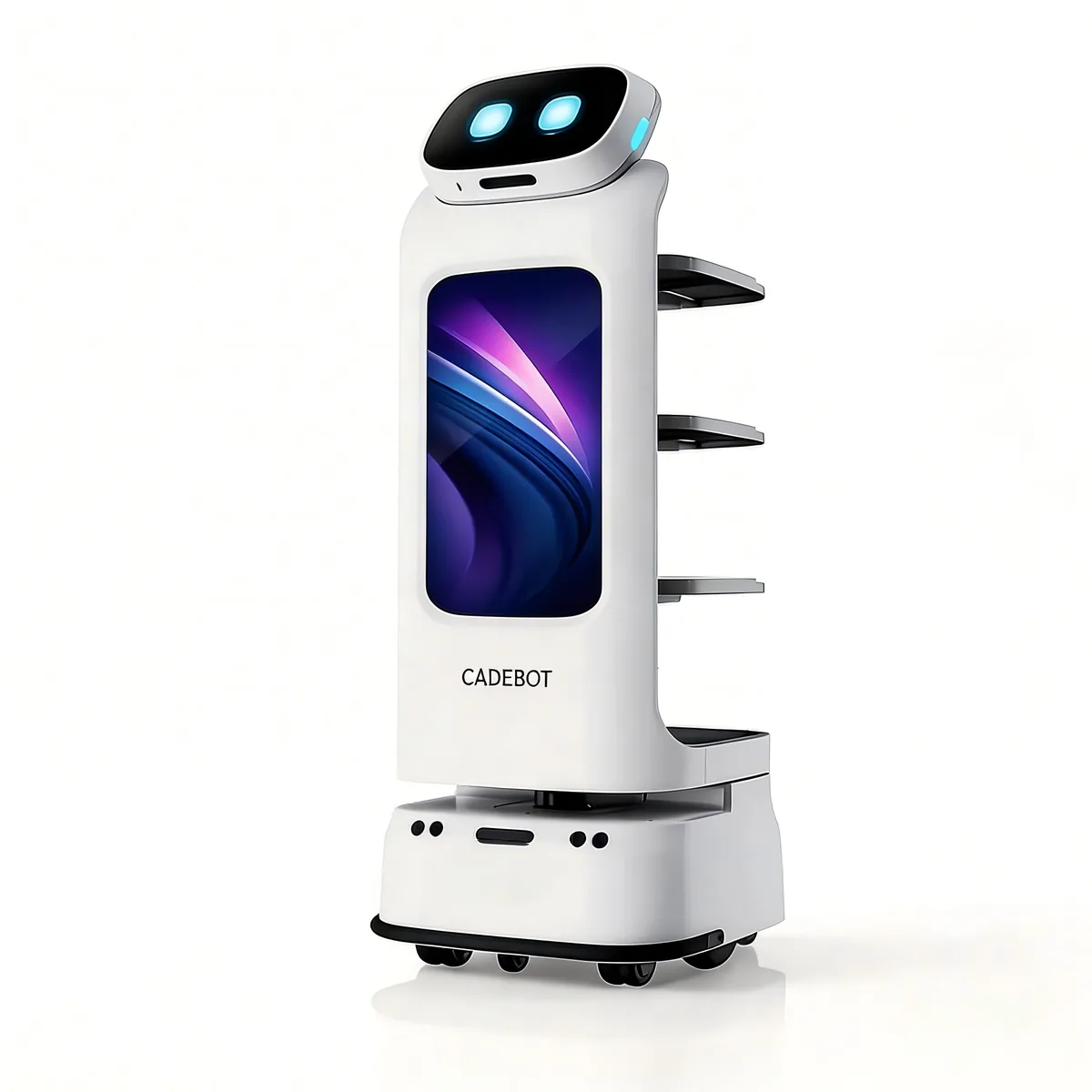
In Q3 2026, the operator deployed CADEBOT L100 autonomous delivery robots in the freezer zone for palletized goods movement and CLEINBOT CC201 outdoor units — hardened for sub-zero operation — for continuous floor maintenance. The CADEBOT units handle the horizontal transport of picked pallets from the freezer aisles to the staging area, a task that previously consumed 38% of each freezer worker's productive picking time. The CLEINBOT units maintain ice-free floor surfaces across the 112,000-square-foot freezer footprint, eliminating the nightly manual ice-scraping crew of six workers who cost the facility $340,000 annually in combined wages and workers' compensation claims (the slip-and-fall rate in the freezer zone was 3.7× the ambient-warehouse rate). At month 4, freezer-zone throughput per labor hour increased 31%, the slip-and-fall incident rate dropped 74%, and the facility reduced its freezer-zone headcount by 14 positions — all through natural attrition, with zero layoffs.

The Cold Chain Labor Crisis That Robots Solve Without Raising Wages
Cold storage labor economics have a structural problem that wage increases alone cannot solve. The U.S. Bureau of Labor Statistics reports that cold storage worker turnover runs 15-18 percentage points above ambient-warehouse turnover in the same geographic markets — not because cold storage operators pay less (they typically pay 18-25% more), but because the physical experience of working at -22°C for repeated cycles imposes a physiological ceiling on worker retention that no hourly wage premium can overcome. A 2025 study by the Global Cold Chain Alliance found that 67% of cold storage workers who leave within their first year cite "physical discomfort of the work environment" as the primary reason, not compensation.
Autonomous robots do not experience cold stress, do not require warm-up breaks, and do not file workers' compensation claims for slip-and-fall injuries on ice-covered floors. A CADEBOT L100 operating continuously in a -22°C freezer aisle delivers approximately 6.8 hours of productive transport work per 8-hour shift (accounting for battery swaps and charging), compared to 4.2 hours for a human worker in the same environment — a 62% productivity differential that compounds across three shifts per day.
This labor-productivity gap mirrors similar dynamics in other harsh-environment facilities. In manufacturing settings, autonomous platforms handle repetitive material movement that would otherwise expose workers to ergonomic injury risk, while construction sites use robots for tasks in environments with extreme temperatures and fall hazards. Cold chain represents the next frontier — an environment where the safety case for automation is arguably stronger than in any other vertical, given that the hazard (sub-zero ambient temperature) is uniform across the entire workspace and cannot be engineered away through process redesign.
Environmental Hardening: What Makes a Robot Cold-Chain-Ready
Not every autonomous platform can operate at -25°C. The key engineering considerations that distinguish cold-chain-capable robots from ambient-warehouse units fall into four categories:
Battery Performance at Sub-Zero Temperatures
Lithium-ion battery capacity degrades by approximately 20-30% at -20°C compared to room-temperature operation, depending on cell chemistry and discharge rate. Cold-chain-rated autonomous platforms address this through three strategies: (1) lithium iron phosphate (LiFePO4) cell chemistry, which retains 82-88% of rated capacity at -20°C versus 65-70% for standard NMC cells; (2) integrated battery heating systems that maintain cell temperature above -10°C during operation, drawing 3-5% of total battery capacity for thermal management; and (3) rapid-swap battery architectures that allow a depleted battery to be exchanged for a fully charged, pre-warmed unit in under 90 seconds, eliminating downtime for in-robot charging.
In practice, the CADEBOT L100's cold-chain configuration delivers 6.5-7 hours of continuous operation per battery cycle at -22°C with a payload of 100 kg, supported by a hot-swappable battery system that the facility's ambient-zone staff can manage without entering the freezer.
Sensor and Navigation System Performance
LiDAR and depth camera sensors face two challenges in cold environments: condensation on optical surfaces when transitioning between temperature zones, and reduced performance of time-of-flight sensors at extreme temperatures. Cold-chain deployments address these through heated sensor housings that maintain optical surfaces at 2-5°C above ambient, preventing condensation without consuming excessive power. The SLAM navigation systems that underpin autonomous movement in dynamic environments adapt seamlessly to freezer aisles, where the consistent racking geometry actually simplifies localization compared to the variable layouts of ambient warehouses.
Mechanical Component Lubrication
Standard bearing greases and joint lubricants thicken at -20°C, increasing motor current draw by 15-25% and accelerating wear on drivetrain components. Cold-chain robot configurations use synthetic low-temperature lubricants rated to -40°C, with sealed bearing assemblies that prevent ice crystal ingress — a failure mode that caused the early abandonment of several first-generation cold-chain automation attempts in the 2018-2020 period.
Floor Surface Adaptation
Freezer floors develop thin ice layers from condensation that freezes between defrost cycles, creating surfaces with a coefficient of friction 40-60% lower than ambient concrete. Cold-chain-rated navigation systems incorporate real-time friction estimation from wheel odometry data, dynamically adjusting acceleration and deceleration profiles to maintain traction on surfaces that would cause standard-configuration robots to lose positioning accuracy or slip entirely.

The Three-Robot Model for Cold Storage Facilities
Role 1: Palletized Goods Transport (CADEBOT L100)
Freezer-aisle picking follows a predictable pattern: a worker with a pallet jack moves down the aisle, picks cartons from rack locations onto a pallet, then transports the completed pallet to the staging area at the freezer perimeter. The transport leg — moving the loaded pallet 200-400 feet from the pick location to staging — consumes 35-40% of the picker's cycle time and exposes them to the lowest-temperature zone (the main travel aisle, where air circulation is highest) for the longest continuous duration.
A CADEBOT L100 deployed at the end of a freezer aisle receives completed pallets from the human picker, who remains in the warmer rack-adjacent zone, and autonomously transports them to staging. The picker begins assembling the next pallet while the robot is in transit, eliminating the transport waiting time that previously created idle gaps in the picking workflow. In the Midwest facility's deployment, this single change increased picks per labor hour from 48 to 63 — a 31% improvement — while reducing each worker's cumulative daily freezer exposure by approximately 42 minutes.
For operators running multi-site cold chain networks, the standardized CADEBOT platform allows a single robot fleet configuration to deploy across facilities with different layouts and throughput volumes, reducing the management overhead that typically makes heterogeneous automation deployments expensive to sustain.
Role 2: Continuous Ice-Free Floor Maintenance (CLEINBOT CC201)
Freezer floor ice accumulation is not a cosmetic problem — it is a safety, productivity, and regulatory compliance issue. OSHA's walking-working surfaces standard (29 CFR 1910.22) requires employers to maintain floors "in a clean, dry condition," and while the agency acknowledges that freezer environments present unique challenges, slip-and-fall incidents in cold storage facilities trigger OSHA recordable injury classifications at 2.5-4× the rate of ambient warehouses in the same NAICS code.
The CLEINBOT CC201, configured for cold-chain operation, combines three floor-maintenance functions in a single autonomous platform: (1) a heated squeegee system that melts thin ice layers and immediately vacuums the meltwater, preventing it from refreezing into thicker, more hazardous patches; (2) a dry-scrubbing head that removes the microscopic ice crystal residue that makes freezer floors appear clean while maintaining dangerously low friction coefficients; and (3) a continuous-mopping function that applies a thin film of food-grade de-icing solution to high-traffic travel aisles where pedestrian and equipment movement concentrates.
The Midwest facility's deployment replaced a manual ice-scraping process that required six workers to spend approximately 4 hours per night scraping freezer floors with handheld tools — a task with the facility's highest injury rate and lowest employee satisfaction score. The CLEINBOT units now maintain all freezer-zone floors on a continuous 90-minute cycle, with slip-and-fall incidents declining from an average of 2.1 per month to 0.3 per month across the first four months of operation.
For facilities already investing in autonomous cleaning across ambient-temperature zones, the commercial cleaning robot selection guide provides a framework for evaluating cold-chain-capable units alongside standard-temperature models, while the fleet management guide covers the software layer that coordinates cleaning schedules across robots operating in different temperature zones within the same facility.
Role 3: Security Patrol and Environmental Monitoring
Cold storage facilities contain high-value inventory — a single pallet of frozen seafood or pharmaceutical product can be worth $15,000-$80,000 — and their 24/7 operational schedule means the facility is never fully unoccupied, creating security vulnerabilities during shift transitions and off-peak hours when fewer staff are present. Autonomous security patrol robots equipped with thermal cameras and environmental sensors perform continuous perimeter and interior patrols, detecting unauthorized access, equipment anomalies (refrigeration unit failures, door seal leaks, temperature excursions), and safety hazards (spills, blocked emergency exits) that human security rounds — typically conducted every 2-4 hours — would miss in the interval between patrols.
The security dimension of cold chain automation connects to broader commercial facility security strategies, with the added requirement that patrol robots must function reliably in environments where standard security camera housings would fog and standard battery chemistries would fail.
Deployment Economics: The Cold Chain ROI Case
Cold storage operators evaluating autonomous robots should model ROI against three cost categories that behave differently in sub-zero environments than in ambient facilities:
Labor cost displacement. The wage premium for freezer-zone work — typically $3-6 per hour above ambient-warehouse rates — means the labor cost per productive hour (accounting for warm-up breaks) is 40-55% higher than the same worker classification in an ambient warehouse. A CADEBOT L100 operating 18 hours per day across two shifts displaces approximately 2.8 FTE-years of freezer-zone transport labor, but the cost of those 2.8 FTEs is equivalent to 4.1 FTE-years of ambient-warehouse labor. This differential accelerates cold-chain robot ROI relative to ambient-warehouse deployments by 12-18 months for the same capital investment.
Injury and compliance cost reduction. The combination of ice-covered floors, heavy pallet loads, and worker fatigue creates an injury cost profile that includes direct costs (workers' compensation claims, medical expenses) and indirect costs (OSHA inspections, temporary replacement workers, production disruption). The Midwest facility documented $340,000 in annual ice-scraping crew costs plus an estimated $180,000-$240,000 in annual slip-and-fall-related expenses (claims, investigations, overtime coverage) — a combined $520,000-$580,000 annual cost addressable through autonomous floor maintenance.
Throughput gains without capital expansion. When freezer-zone throughput per labor hour increases by 31%, the facility achieves the equivalent of a 31% expansion in picking capacity without adding a single square foot of freezer space — which at $180-$250 per square foot for cold storage construction costs, represents millions in avoided capital expenditure. This throughput dimension is the most important and most frequently overlooked ROI component in cold-chain robot business cases.
For the complete financial modeling framework, the service robot ROI guide provides cross-application cost models, while the RaaS and financing guide covers the lease and subscription structures that allow operators to deploy robots without upfront capital expenditure — particularly relevant for cold chain operators who may prefer OpEx models that align robot costs with the seasonal peaks and troughs of frozen food logistics.

Getting Started: The Cold-Chain Robot Pilot
Cold storage operators considering their first autonomous deployment should follow a 90-day pilot framework:
Month 1: Single-aisle CADEBOT deployment. Deploy one cold-chain-configured delivery robot in a single freezer aisle, measuring picks-per-labor-hour and worker freezer-exposure time against a control aisle using the existing manual process. This generates the facility-specific productivity data needed to model a full-scale deployment.
Month 2: Add CLEINBOT floor maintenance. Deploy one autonomous floor-maintenance unit in the highest-traffic freezer zone. Measure slip-and-fall incidents, floor friction coefficients (using a tribometer), and the reduction in manual ice-scraping hours. This validation period also confirms that the robot's de-icing solution is compatible with the facility's food safety protocols.
Month 3: Full-zone integration and ROI validation. Expand to a complete freezer zone with coordinated CADEBOT and CLEINBOT operations. Validate the combined ROI model against actual data from months 1-2, and prepare the business case for facility-wide deployment.
For organizations navigating the workforce transition — retraining freezer-zone workers for higher-value ambient-zone roles, communicating the "automation as retention tool" narrative that positions robots as the solution to the turnover crisis rather than the cause of job loss — the human-robot collaboration change management framework provides a structured implementation approach applicable to cold chain's unique workforce dynamics.