
AI Triage Before the RMA: Separating Fault From Abuse in the Field
At a glance: The expensive moment in a service contract is not the repair, it is the decision that opens a repair. Telemetry plus a structured triage script can classify most failures before a technician is dispatched — and the value is not in catching fraud, it is in separating three cases that need three completely different responses.
Roughly half the returns in a mature service robot fleet are not component failures at all. Some are configuration, some are consumable wear the operator was supposed to have replaced, and some are damage caused in service that the warranty does not cover. All three arrive as the same ticket: machine stopped, please send someone. The operator cannot tell them apart because the operator has no frame of reference, and the vendor cannot tell them apart remotely because the vendor's telemetry shows an error code and nothing else. This article is about the layer in between: the triage that happens before an RMA is raised, what evidence it needs, and how a vendor writes it into a contract without turning every fault into an argument.

The Three Cases Behind One Ticket
A service ticket says a machine stopped. Underneath, there are three categories, and they have nothing in common except the symptom.
Genuine premature failure. A component failed inside its rated life with the machine operated within specification. This is the vendor's cost, the return is legitimate, and the useful work is finding the pattern so the next batch does not fail the same way.
Configuration or consumable. The machine is behaving correctly given what it was told or what it was given. A brush worn past its wear line, a filter clogged because the site skips the weekly clean, a charge threshold set to a value that cannot complete a shift, a map that no longer matches the building after a refit. The machine did what it was configured to do. Sending a technician fixes it for two weeks.
In-service damage. Impact, water ingress from a wash-down the machine was not rated for, a foreign object in the brush deck, a battery abused by an out-of-spec charger. The repair is real and legitimate; who pays for it is the question.
These need three different responses: a warranty claim, an operator-side corrective action, and a chargeable repair. Treating all three as warranty returns is how a service contract becomes unprofitable, and treating all three as operator error is how an operator stops trusting the vendor.
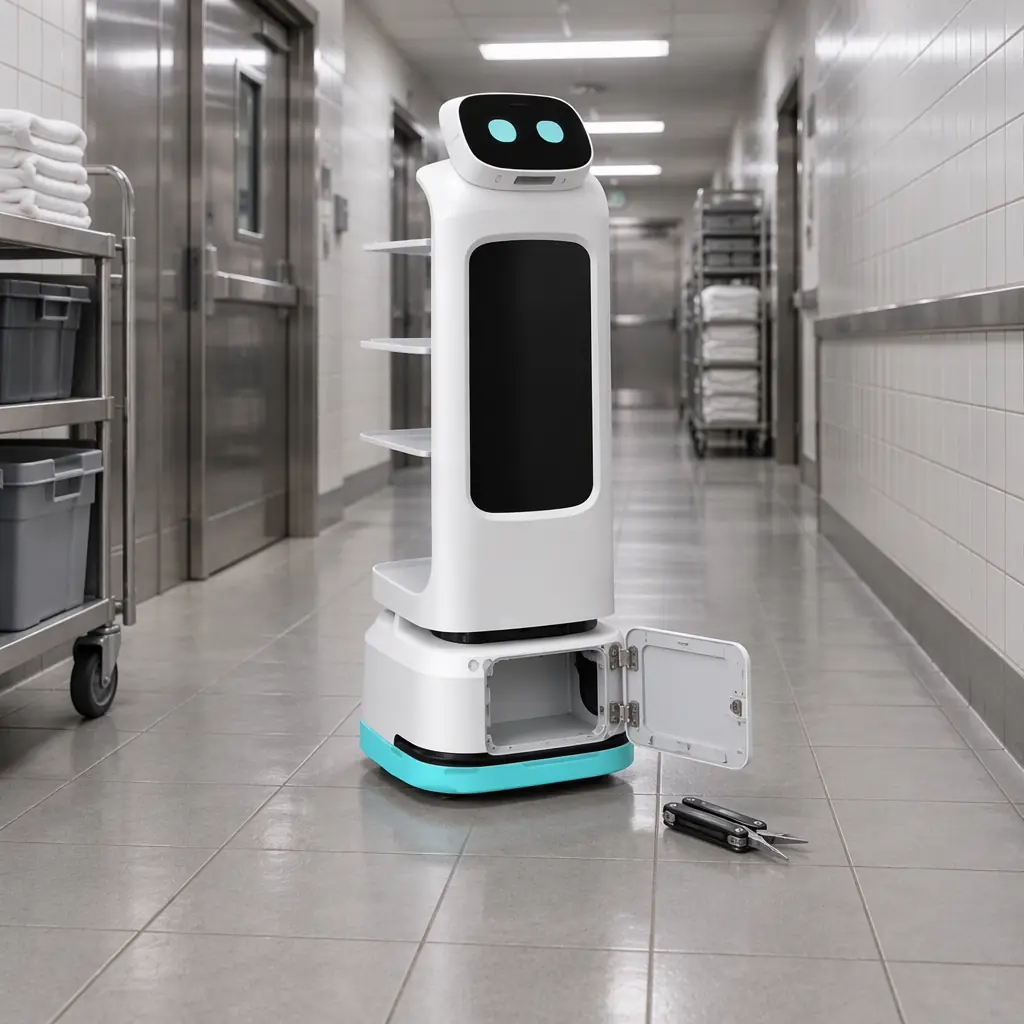
What Telemetry Can and Cannot Decide
Fleet telemetry is good at a specific job and bad at a much broader one, and knowing which is which prevents the whole triage design from going wrong.
Telemetry is strong on sequence. It can establish that the brush motor current rose steadily over 40 operating hours before the fault, or that the fault appeared eleven minutes after a wash-down event, or that the machine was commanded into a restricted zone and stopped as designed. Sequence is what separates a failure from a consequence.
Telemetry is strong on trend. Battery capacity fade, motor current at a fixed load, docking retries per week, and cleaning-path overlap percentage are all trend measures that move before a hard fault. A machine whose docking retries doubled over three weeks did not fail suddenly.
Telemetry cannot see the floor. It cannot tell you the operator removed the machine's guard, ran it over a threshold bar it was not rated for, or used a cleaning chemical that attacked the squeegee. The physical evidence is on the machine and only a person or a photograph gets it.
Telemetry cannot interpret intent. A machine that stopped in a corridor could have been commanded to stop by a person pressing the physical button, or stopped itself on an obstacle, or lost power. The log records the stop event; only the context distinguishes them.
| Triage question | Evidence source | Decisive when | What it cannot settle |
|---|---|---|---|
| Was the failure preceded by a trend? | Telemetry history, 30 to 90 days | A gradual rise in current or retries identifies wear, not impact | Whether the wear was accelerated by out-of-spec operation |
| What was the machine commanded to do? | Command log and job queue | A fault after a manual override points at configuration or operator action | The physical condition of the component |
| How many hours since the consumable was changed? | Consumable counter against rated life | Counter over the wear line moves the case to operator-side | Whether the counter matches actual installed parts |
| Was there an environmental event? | Wet-floor flag, ambient temperature, charger events | Wash-down or heat exposure immediately before the fault | Whether the ingress path was sealed as designed |
| What does the physical machine show? | Photographs against a required shot list | Impact marks, ingress staining, foreign objects, tamper evidence | Anything that needs dismantling to observe |
The table is deliberately asymmetric. Every row has something it cannot settle, and the triage process is only sound if the decision rule names which rows were available. A decision made on telemetry alone should be a provisional classification, not a final one.
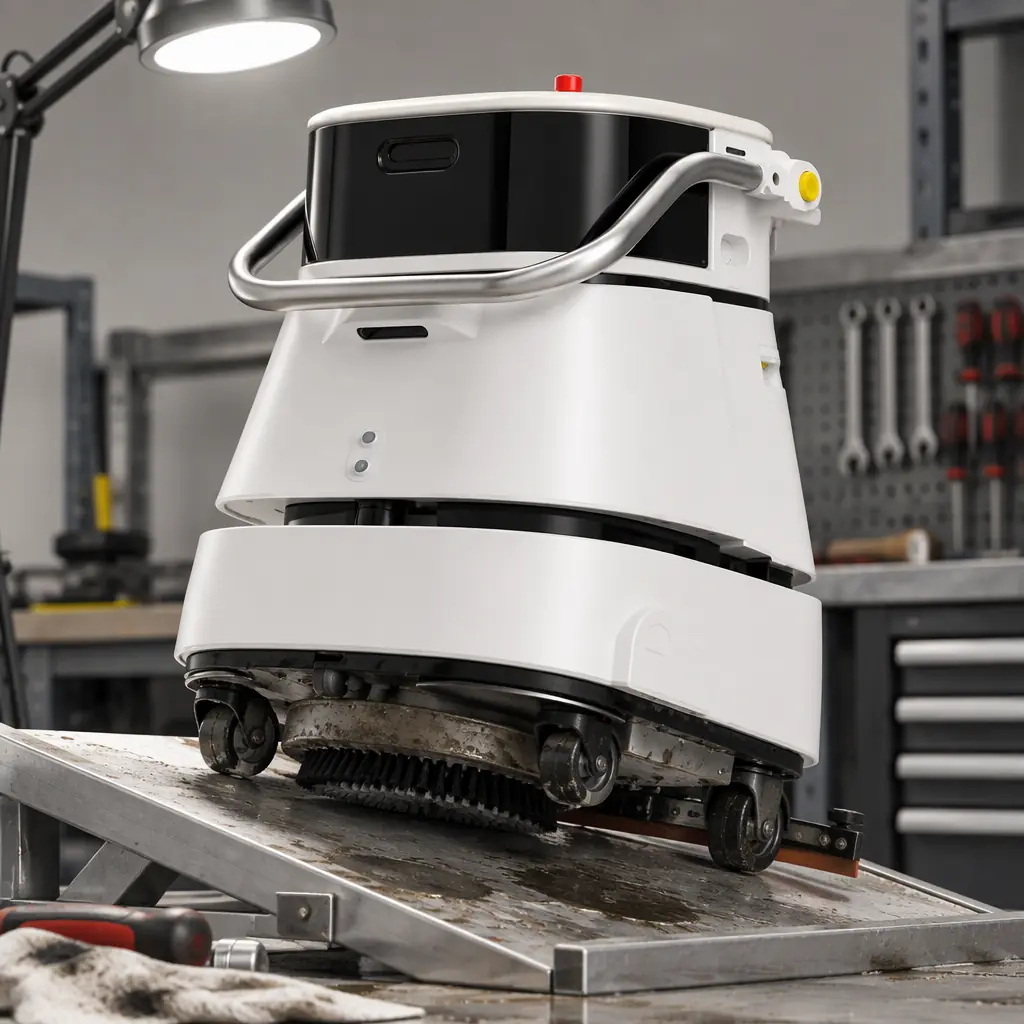
The Triage Script: Six Questions, Two Minutes
The script below is the operator-facing half of a triage process. It is deliberately short, because a long form produces invented answers. Each question has a fixed set of answers and each answer routes somewhere specific.
- What was the machine doing in the sixty seconds before it stopped? Routing normally, just started a cleaning pass, just docked or undocked, being handled manually, or unknown. "Unknown" is a real answer and routes to the physical-evidence path.
- Is there anything on the floor or on the machine that was not there yesterday? Water, debris, a fresh mark, a displaced guard, a smell. This question catches most in-service damage in one line.
- How many hours has the brush, squeegee or filter done since it was last changed? The operator has this or can read it from the app; a figure past the rated life closes the case.
- Has anything in the building changed in the last two weeks? Furniture moved, a floor stripped and resealed, a new mirror or glass wall, a lift taken out of service, a route re-taught. Most navigation faults at month six are building changes, not machine faults.
- Does the machine restart and stay running, or restart and stop again? A machine that runs after a restart is not a failed component, it is a latent condition. The distinction changes the urgency and usually the cost.
- Can someone photograph these four views? Front, the underside of the working head, both sides of the body at working height, and the charging contacts. The shot list is fixed so that photographs from different sites can be compared.
Run before an RMA is raised, the script classifies perhaps two thirds of tickets without a technician. Run after an RMA is raised, it is a formality that costs a site manager ten minutes and prevents nothing.
Writing Triage Into the Contract Without Starting a Fight
The commercial risk in pre-RMA triage is that it becomes a mechanism for the vendor to refuse claims. Operators know this and will resist a process that looks like one. Three clauses keep it workable.
Classify, do not deny. The triage output is a classification with its evidence attached, sent to the operator before any commercial position is taken. If the classification is operator-side, the response is a corrective action and a quote for the visit, not a rejected claim. The distinction matters: a rejected claim ends a conversation, a quote with evidence starts one.
Put the burden of proof on the named evidence. If the vendor classifies a fault as in-service damage, the contract should say which evidence class supports that finding, and what happens when that evidence is unavailable. A classification made without physical evidence should default to the warranty side. Vendors who write this in find that operators accept the process, because it protects them from the arbitrary case.
Time-bound the response. Triage that takes four days to produce a classification is worse than no triage, because the machine is down for those four days anyway. A classification within one working day of the six answers and four photographs is achievable and is the number to write.
The clauses that contain the response times, credit mechanics and escalation path for service failures are covered in uptime SLA contract terms. The intake process for a claim that survives triage is set out in the warranty claims and RMA process guide. And the telemetry design that makes any of this possible — what to log, at what resolution, retained for how long — is in telemetry and predictive maintenance.
The Numbers That Make It Worth Doing
The business case is not fraud prevention. It is dispatch avoidance and pattern detection, and both are measurable from the first quarter.
Technician dispatch rate. Count dispatches per hundred tickets before and after the script. A site with a mature script typically removes a substantial share of dispatches, and each removal is a site visit, a travel cost and a machine-day saved.
Repeat-ticket rate. The share of machines that raise a second ticket within 30 days of the first. This is the number that exposes configuration cases being treated as repairs: a fix that does not address the configuration produces a repeat within weeks.
Classification mix. The proportion of tickets in each of the three categories, reviewed quarterly. A mix that is 90% warranty is not a healthy fleet, it is a fleet whose triage is not running.
Time to classification. Hours from ticket to classification with evidence. This is the number that determines whether the process survives contact with an operations manager on a bad night.
None of these require new hardware. They require that the triage classification is recorded as a field on the ticket rather than left in an email, which is the difference between a process and an anecdote.
What AOMAN Provides and What It Does Not
AOMAN supplies the fleet-side interfaces to read command logs, consumable counters, charge events, retry counts and fault history, and the documented shot list and answer vocabulary that make triage decisions comparable across sites. Where an operator is designing a triage process for a mixed fleet, our service engineering team will review the decision rules before the script goes live.
What we do not do is adjudicate individual claims on your behalf or certify the physical condition of a machine we have not seen. The classification is a technical finding with evidence attached; the commercial decision on a chargeable repair is between the operator and their service provider, and we would rather it were made with the evidence on the table than without it.
The short version: separate the three cases before dispatch, use telemetry for sequence and trend and photographs for physical condition, keep the script to six questions, and write the classification as evidence attached to a ticket rather than as a verdict on a claim.

Get a Quote
Tell us about your space and workload, we reply within 24 hours.