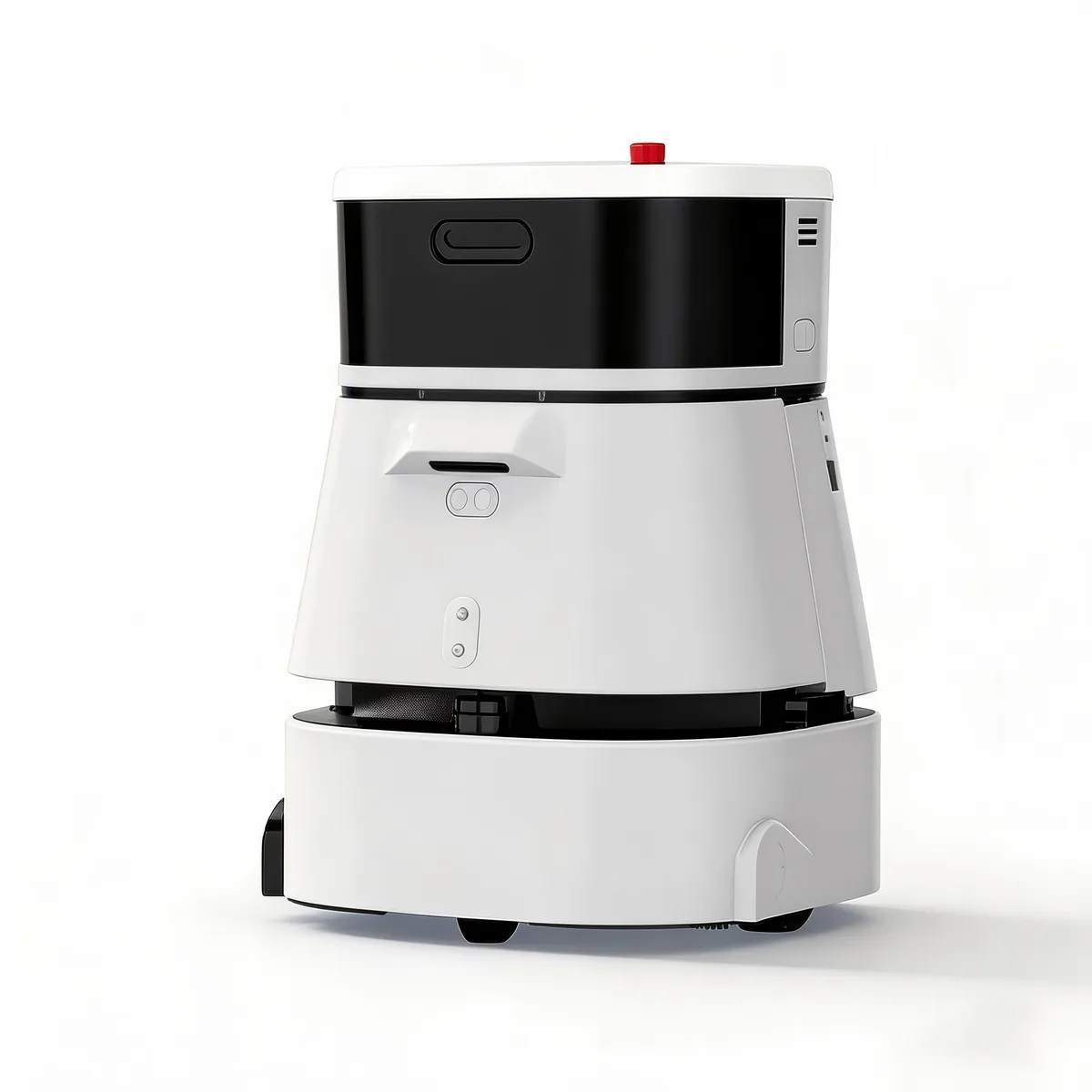
The operations manager of a 1,200-space hospital parking structure in a Midwestern U.S. city manages a facility that generates approximately $3.6 million in annual parking revenue but consumes $640,000 in operating costs — $380,000 of which is cleaning labor. The parking structure spans 6 levels (3 above ground, 3 below), with 340,000 sq ft of drivable surface. The cleaning requirement is continuous: tire dust accumulates on every surface within 72 hours after cleaning, road salt and sand are tracked in during winter months (requiring daily scrubbing November-March), and the below-ground levels have minimal natural ventilation — meaning diesel particulate from ambulances and delivery vehicles concentrates in the lower decks.
Human cleaning crews operating ride-on scrubbers can cover approximately 35,000 sq ft per 8-hour shift per operator. To clean the entire 340,000 sq ft facility weekly requires 10 operator-shifts ($3,800/week at $38/hour loaded cost for equipment operators). The result: $198,000 in annual cleaning labor for a facility that, within 48 hours of cleaning, already shows visible dirt accumulation. The residents parking on Level P3 don't know the deck was cleaned on Monday — they know it looks dirty on Wednesday.
This is not a labor-cost problem that can be solved with more labor. It is a frequency problem that can only be solved with robotics. An autonomous robot that cleans continuously — 8 hours per day, every day — achieves the frequency that episodic human cleaning cannot.

The GPS-Denied Navigation Challenge
Parking garages and underground facilities share a defining constraint: GPS signals do not penetrate reinforced concrete. This eliminates any robotic platform that relies on GPS for localization — which includes most outdoor autonomous vehicles and a subset of "outdoor-rated" cleaning robots that use GPS as their primary navigation sensor.
The solution is LIDAR-based SLAM (Simultaneous Localization and Mapping), the same technology used in warehouse AMRs and indoor logistics robots. The robot builds a 3D point-cloud map of the parking structure during initial deployment, then localizes itself within that map during operation by matching real-time LIDAR scans against the stored map. This approach works in complete darkness, through dust and diesel particulate, and across the repeating visual patterns of parking structures (identical concrete columns every 30 feet, identical level markings) that would confuse camera-based navigation systems.
The SLAM technology guide covers the technical underpinnings. For parking-facility deployment, the key requirement is that the robot's LIDAR has sufficient range (≥30 meters) to identify structural features (ramps, column grids, wall boundaries) and sufficient resolution to distinguish between levels that appear structurally identical.
Deployment Consideration — Ramp Navigation: Parking garage ramps present a combined challenge of grade (typically 6-8%, sometimes 12% for helical ramps in older structures), surface transition (grooved concrete for traction), and blind corners where ascending and descending vehicles share a narrow passage. The robot must maintain localization accuracy on a continuously changing incline — a scenario that causes IMU drift in consumer-grade platforms. Enterprise-grade robots with industrial IMUs (9-axis, ≤0.5° drift per hour) maintain localization through ramp transitions; consumer-grade platforms with 6-axis IMUs typically fail at grades above 5%.
Cleaning Parking Decks: The Tire-Dust Problem
The primary cleaning challenge in parking structures is not visible debris (trash, leaves, gravel) — it is tire dust. Every vehicle that enters a parking structure deposits approximately 0.03-0.05 grams of tire-wear particulate per visit, per parking industry studies. A 1,200-space structure with 2.5 vehicle turnovers per day deposits approximately 90-150 grams of tire dust daily — 33-55 kg annually. This particulate is respirable (PM2.5 and PM10 fractions), accumulates visibly as a dark gray film on concrete surfaces, and becomes a slip hazard when mixed with moisture (rain tracked in on vehicle tires, condensation on below-grade levels).
CLEINBOT CC201 outdoor autonomous scrubbers — rated for indoor/outdoor transition and equipped with industrial HEPA-filtered vacuum recovery — address the tire-dust problem through frequency rather than intensity. A human-operated ride-on scrubber cleans a parking deck thoroughly once per week. A CC201 deployed on a continuous 8-hour cycle cleans the same deck lightly every day — preventing the particulate accumulation that requires aggressive scrubbing to remove after a week of buildup. The result is a consistently clean surface rather than a weekly clean-to-dirty cycle.
A single CC201 covers approximately 60,000 sq ft per 8-hour operating day in parking-deck conditions (slower than its rated 80,000 sq ft on flat commercial floors, accounting for ramp transitions and obstacle avoidance around parked vehicles). For a 340,000 sq ft facility, two units operating daily maintain all surfaces at a consistent cleanliness level. The labor savings: pre-robot cleaning required 10 operator-shifts per week ($198,000/year). Post-robot, cleaning staff is reduced to 2 operator-shifts for specialized tasks (stairwell cleaning, elevator-landing detailing, drain clearing) at $39,600/year, plus annual robot cost of approximately $52,000 (2 units under RaaS), for net savings of $106,400/year.
Underground Logistics: The Loading-Dock-to-Storage Connection
Large commercial facilities — hospitals, convention centers, casino resorts, airport terminals — operate underground service corridors that connect loading docks to storage areas, kitchens, and operational zones. These corridors are typically 1.5-2.5 meters wide, poorly ventilated, and traversed continuously by staff pushing carts, dollies, and pallet jacks. The labor cost of moving materials through these corridors — food and beverage supplies at a casino resort, medical supplies and linens at a hospital, retail inventory at a shopping mall — is significant but invisible because it is absorbed into departmental operating budgets rather than tracked as a separate line item.
CADEBOT L100 delivery robots, deployed in underground logistics corridors, handle the routine material-transport tasks that currently consume 3-5 FTE of cart-pusher labor per shift. A casino resort's room-service kitchen, for example, receives 40-60 pallets of food supplies daily at its underground loading dock. Moving those supplies from dock to kitchen storage through 800 feet of service corridor currently requires 2 FTE per shift (3 shifts = 6 FTE daily). Two CADEBOT units, making continuous round trips between dock and kitchen with 22-lb payload capacity per trip, can handle 60-70% of this volume — freeing 4 FTE for higher-value kitchen tasks.
The economics mirror the cold chain logistics model and courier hub deployment pattern, where autonomous transport in constrained environments delivers labor savings by converting variable-cost human labor into fixed-cost technology. The underground facility adds the ventilation and air-quality dimension: robots operating in poorly ventilated service corridors must use sealed motors that do not emit combustion byproducts — electric drive is mandatory; internal-combustion utility vehicles (common in older underground facilities) are incompatible with occupied robot deployments.
Mixed-Use Commercial Parking: The Shopping Mall Basement
Mixed-use commercial buildings — shopping malls, office-retail complexes, transit-oriented developments — typically position parking underground or in attached structures. These parking facilities serve a dual function: vehicle storage and pedestrian access. The cleaning standard is higher than a standalone parking garage because shoppers and office tenants judge the entire property by the parking experience — a dirty parking deck with visible trash and oil stains signals a poorly managed building, suppressing retail foot traffic and office lease renewals.
The deployment model for mixed-use parking follows the same continuous-cleaning pattern as hospital parking, with one addition: the robot's operating schedule must avoid peak pedestrian hours. A shopping mall parking deck experiences pedestrian surge during store opening (9-10 AM), lunch (12-1:30 PM), and store closing (5-7 PM on weekdays, 6-9 PM on weekends). Cleaning robots should operate during off-peak hours (10 AM-12 PM, 1:30-5 PM, and overnight 9 PM-5 AM) to avoid pedestrian-robot interaction in confined parking-deck spaces. This scheduling capability depends on the fleet management platform, which must support time-zone-based and facility-hour-based operating schedules.
The financial model for a 650-space mixed-use parking structure: cleaning labor pre-robot is approximately $142,000/year (2.5 FTE). Post-robot with two CC201 units: labor reduced to 0.75 FTE ($42,600) plus robot cost of $52,000/year, net savings of $47,400/year. The non-financial benefit — consistent deck cleanliness improving the tenant and shopper experience — is significant but not directly captured in the operating budget. It shows up in tenant satisfaction surveys, lease-renewal negotiations, and the foot-traffic metrics that retail tenants use to calculate sales-per-square-foot.
Wi-Fi and Connectivity in Concrete Structures
Reinforced concrete is an effective RF shield. A Wi-Fi access point that provides -55 dBm signal strength in open air may deliver -78 dBm through a single 8-inch concrete floor slab — and -85 dBm or below through two slabs. Parking structures have multiple slabs (one per level), plus concrete columns, shear walls, and elevator cores that create multipath interference.
For autonomous robot deployment in parking structures, a dedicated Wi-Fi survey is mandatory before deployment. The survey must measure signal strength (dBm) at 15-foot grid intervals across every parking level, identify dead zones (≤ -75 dBm), and recommend access-point additions or mesh-node placements to fill coverage gaps. Budget $1,500-3,000 for the survey and $800-2,500 per additional access point if coverage gaps exist. This is the same connectivity planning detailed in the smart building integration guide and must be included in the RFP specification as a line item.
For underground facilities where Wi-Fi installation is impractical (historic structures, temporary facilities, or cost-prohibitive retrofits), some enterprise robots support offline operation with pre-loaded maps and post-mission data synchronization. This is not ideal — real-time fleet management and remote monitoring require connectivity — but it is viable for cleaning-only deployments where the robot operates on a fixed route and uploads data when it returns to a connected docking station.
Implementation Roadmap
Month 1: Wi-Fi site survey. Identify dead zones, add access points. Budget: $2,000-5,000.
Month 2: Site mapping. Walk robot through all operational levels (ramps, parking decks, service corridors). Build and validate SLAM map. Duration: 2-3 weeks for a 340,000 sq ft facility.
Month 3-4: Pilot deployment. Run 2 robots on a single level for 60 days. Measure: cleaning consistency (ATP surface testing), navigation success rate, battery endurance on ramp cycles, staff feedback. Go/no-go threshold: ≥95% navigation success, ≥85% cleaning consistency score vs. human baseline.
Month 5-6: Full deployment across all levels. Integrate fleet management with facility's work-order system. Train staff on robot monitoring, clearing, and basic troubleshooting. The multi-site deployment guide provides the scaled rollout framework if the deployment spans multiple parking structures.
The vendor evaluation framework should be applied before vendor selection, and the deployment should follow the pilot program methodology to validate operational assumptions before committing to full-scale deployment.