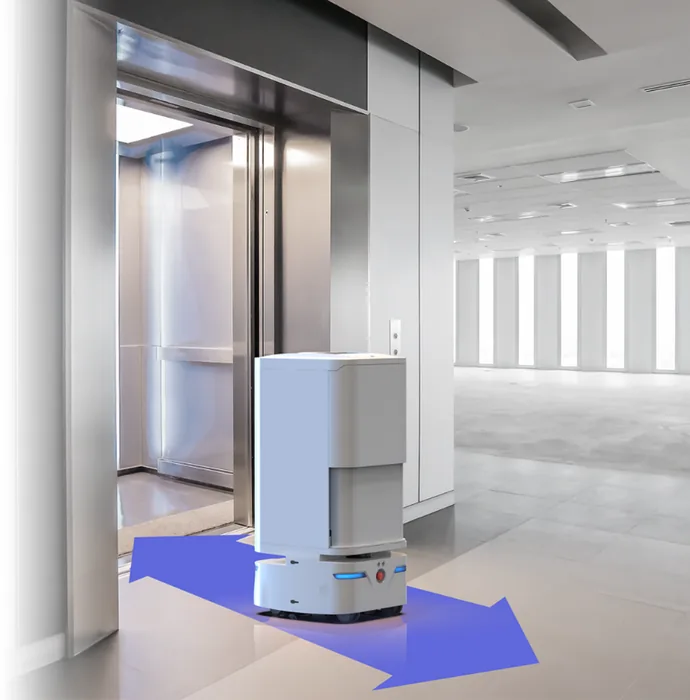
An eight-brand ghost kitchen in a Chicago warehouse district runs 400+ orders a day from 10 am to 1 am across 2,800 sq ft of shared kitchen. Its operator timed the handoff loop in February 2026 and found the weak point was not the fryers — it was the staging rack: couriers waited an average of 6 minutes 40 seconds at peak, the rack held 30+ bags in unmarked overlap at 7 pm, and the kitchen logged 14 wrong-pickup incidents and 9 cold-order complaints in a single month, most of them visible in the ratings within 48 hours.
Delivery-only kitchens are a different automation problem than dine-in restaurants, and the restaurant and food service guide documents the table-service pattern; this guide covers the ghost kitchen version, where there are no tables, the customer is a courier, and the two highest-value robot roles — order handoff staging and floor hygiene — map directly onto the two leaks the timing study found.
The Handoff Bottleneck: Where Orders Die
The staging rack is the industry's quiet tax. Every order that leaves the assembly line sits on a rack or shelf until a courier arrives, and every minute on the rack is a minute of cooling, a chance of wrong-pickup, and a negative-rating trigger. The Chicago kitchen's 6-minute-40-second average wait is typical — the delivery robot selection guide benchmark across delivery-only audits puts the average peak courier wait at 5–10 minutes, with 20% of orders sitting longer than 12 minutes.
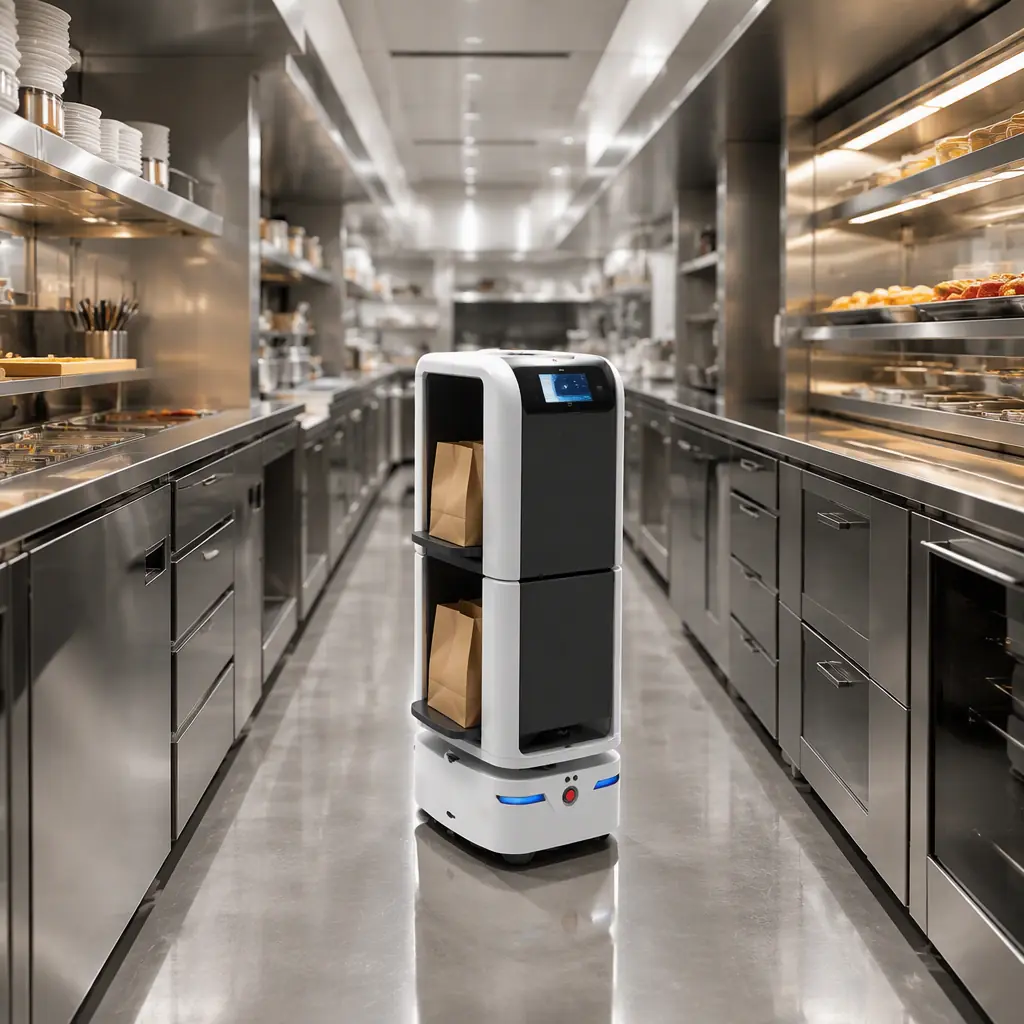
The fix is to replace the passive rack with an active staging loop: the robot carries the batch from the assembly line to a pickup zone the moment it is sealed, and the courier takes it from the robot's cabin instead of hunting through a rack. The AOMAN DOUBLE is the machine for the run: its 70L dual cabin (40L upper + 30L lower) carries two order batches per trip, its 420 mm width clears the narrow kitchen corridors, and its 0.9–1.5 m/s travel speed moves a batch from line to pickup in under a minute — a 6-minute courier wait becomes a 45-second one, and the rack shrinks from 30 bags to a handful.
Hot-Cold Batching: The Dual-Cabin Rule
Ghost kitchens sell temperature contrast — hot entrees, cold drinks and desserts — and the AOMAN DOUBLE dual-cabin layout is built for it: hot orders ride in the upper 40L cabin while cold drinks and desserts ride in the lower 30L cabin, so a two-part order arrives as one trip instead of two. Each cabin carries up to 15 kg, fingerprint authentication keeps the pickup zone access-controlled (only the courier for that order opens the cabin), and the optional UV disinfection module gives the kitchen a documented hygiene step between batches — a meaningful point for the health inspection file.
The hot-cold rule matters most at peak, when the assembly line is producing 30+ orders an hour: batching by cabin instead of by rack cuts the number of courier interactions in half, and it is the same principle the fleet management guide documents for scheduling — the robot cycles the line-to-pickup loop on a fixed cadence, and the kitchen dispatches by cabin slot rather than by shout.
Multi-Brand Assembly Lines: One Robot, Four Stations
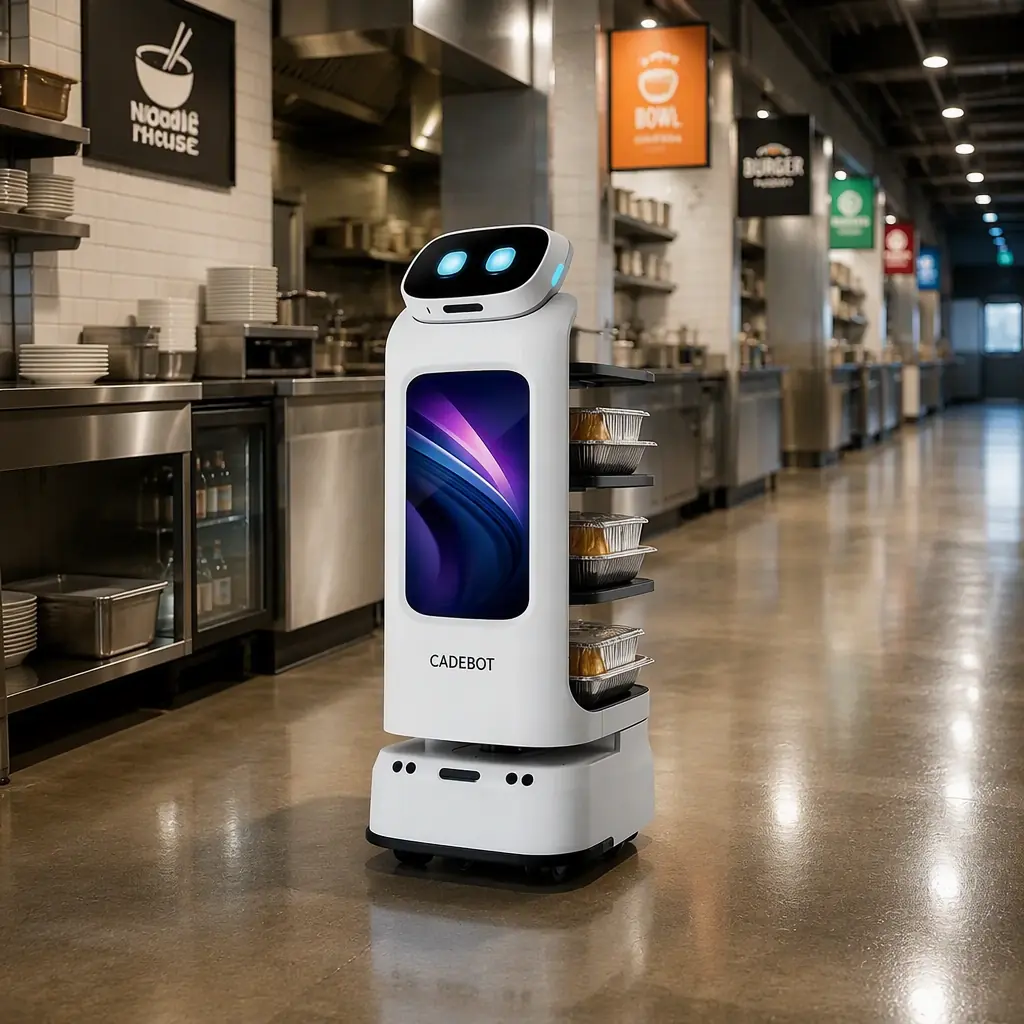
Shared kitchens run multiple brands on one line, and the CADEBOT L100 is the multi-station machine: four open trays at 15 kg each, height-adjustable over a 10 cm range, sized for brand-specific bag formats and drink carriers. Its LiDAR + RGB-D SLAM 3.0 navigation handles the tight shared corridor, and its 8–12 hour runtime covers a full brand-shift cycle. The operating pattern is a timed rotation: the L100 cycles four brand stations on a 90-second loop, picking up sealed batches from each line and dropping them at the pickup zone — the same pull-system logic the AMR vs AGV guide describes, where the robot becomes the dispatch clock instead of the staff running to four racks.
Floor Hygiene in a Food-Intensive Facility
Grease, sauce spills and food debris are the ghost kitchen's second leak: a 2,800 sq ft kitchen running 400 orders a day accumulates more floor soil per hour than most restaurants see in a day, and the clean-up window is always "after close" — which is when the debris has already been walked through the pickup zone and into courier shoes. The CLEINBOT C2 Pro holds the floor on a continuous, documented program: 20 kPa of suction lifts grease film and food debris without the water-first sequence that smears sauce, a 440 mm cleaning width at 500–800 m²/h covers the shared kitchen and pickup zone in under an hour, and its 2D LiDAR plus structured-light navigation maps the corridor layout that changes when a brand station moves. The commercial cleaning robot buyers guide covers the specification framework; the kitchen-specific design rule is to verify vacuum-first capability before piloting, because wet-scrub-first machines turn sauce spills into abrasive slurry.
Deployment Table for Delivery-Only Kitchens
| Kitchen format | Order volume | Delivery fleet | Floor-care fleet | Monthly cost (RaaS) | Peak courier wait |
|---|---|---|---|---|---|
| 2–4 brand kitchen | 100–250/day | 1 × AOMAN DOUBLE | 1 × C2 Pro | $1,700–2,600 | 6 min → under 1 min |
| 6–8 brand commissary | 250–500/day | 2 × AOMAN DOUBLE + 1 × CADEBOT L100 | 1–2 × C2 Pro | $3,500–5,200 | 6 min → under 1 min |
| 12+ brand hub | 500–900/day | 3–5 × delivery robots | 2 × C2 Pro | $6,000–9,500 | rack eliminated |
The RaaS financing guide covers the subscription structure that fits kitchen cash flow — most operators start with one delivery robot on the peak window and one floor-care robot on the nightly program, measure the courier wait delta in their own timing study, and add capacity in month two. The safety standards guide covers the kitchen safety case, and the change management playbook documents the crew dynamic: line staff adopt the handoff robot within days, because it is the first automation that stops them from being the staging rack.
A ghost kitchen's margin lives in order accuracy and ratings. The delivery robot kills the 6-minute courier wait and the wrong-pickup rack, and the floor-care robot holds the hygiene file that the health inspection and the ratings both read — both on a documented schedule. That is the automation pattern that fits a delivery-only P&L, and it starts with the same step every successful deployment starts with: a two-week timing study of where the orders sit and where the floor gets walked on.