An operations director at a 150-acre theme park managing 35,000 daily visitors confronts three problems that scale with crowd size: guest wayfinding requests spike 300% between 11 AM and 2 PM, food and merchandise delivery to VIP areas requires staff to navigate through dense crowds, and overnight cleaning must reset 500,000 square feet of public space before gates open at 8 AM. Each of these problems is a staffing challenge. Together, they are an automation opportunity that the entertainment industry is only beginning to exploit.
Entertainment venues represent a distinct deployment environment for service robots — one that combines the guest-facing demands of hospitality with the throughput logistics of warehouse operations, layered on top of crowd densities that would overwhelm standard autonomous navigation systems. This guide is written for entertainment operators — theme park GMs, museum directors, casino facility managers, and cruise line operations leads — evaluating whether and how to integrate service robots into their guest experience and operations strategy.
Why Entertainment Venues Are the Next Frontier for Service Robots
Three structural factors make entertainment venues uniquely suited to service robot deployment — and uniquely challenging:
The Labor Math Breaks at Peak Hours
A theme park needs 3x the staffing at 1 PM that it needs at 9 AM. A cruise ship needs full dining service from 6 PM to 9 PM and minimal coverage at 3 PM. Traditional staffing models force operators to overstaff for peaks and underutilize during troughs — or understaff peaks and degrade guest experience. Service robots close this gap: a CADEBOT L100 delivery unit operating 14 hours on a single charge covers food and merchandise delivery across the entire operating day, handling 80–120 deliveries without a single shift change. For the full evaluation framework on robot economics, see our service robot ROI methodology.
Guest Expectations Have Reset Post-2024
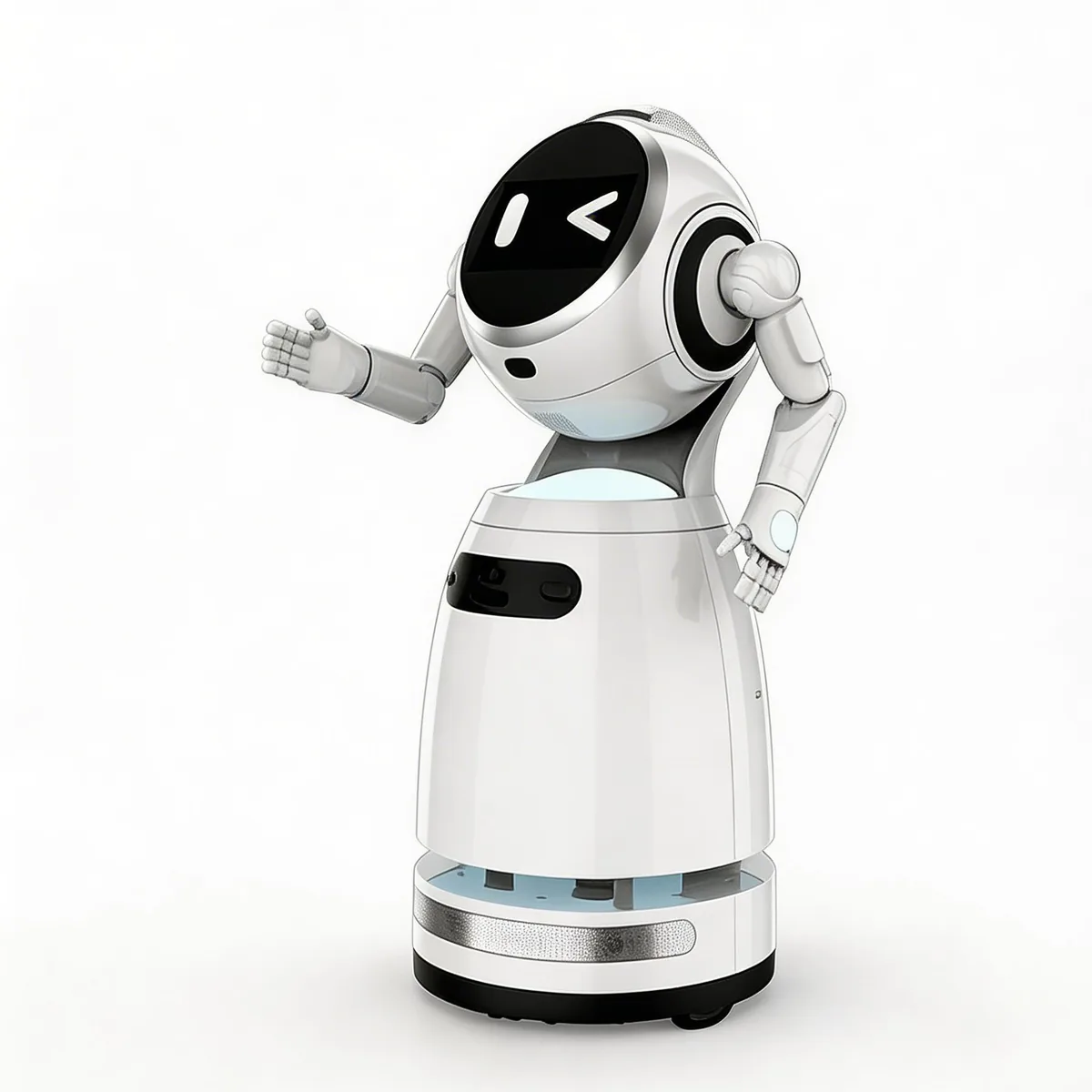
Post-pandemic, entertainment guests expect contactless service options, self-service wayfinding, and on-demand convenience — not just at airport check-in counters but in theme park lands, museum galleries, and casino floors. A humanoid reception robot stationed at a theme park entrance doesn't replace human greeters — it handles the top 20 most frequent questions (restroom locations, show times, ride wait times) so human staff can handle complex inquiries and VIP interactions. The model is augmentation, not replacement.
Crowded Dynamic Environments Are Now Technically Solvable
Until 2024, autonomous navigation in crowd-dense environments was the unsolved problem that kept robots out of entertainment venues. Standard SLAM systems trained on warehouse aisles and hospital corridors would freeze or reroute endlessly when confronted with 200 pedestrians per minute crossing a theme park plaza. The underlying navigation technology — multi-sensor SLAM with lidar, stereo camera, and ultrasonic fusion — has matured to handle dynamic obstacle densities that were unsolvable three years ago. Modern systems process 30+ simultaneous pedestrian trajectories and plot viable paths through moving crowds, not around them.
The Four Robot Roles That Transform Entertainment Operations
Not every entertainment venue needs every robot category. The deployment map depends on venue type, daily visitor volume, square footage, and existing staff structure. Here is the role-by-role breakdown:

1. Guest Engagement and Wayfinding: The Front-of-House Robot
The highest-visibility robot role in any entertainment venue. A humanoid service robot positioned at high-traffic nodes — park entrance, museum atrium, casino lobby, cruise ship atrium deck — handles the five most common guest interactions: directional queries ("where is Galaxy Zone?"), schedule information ("what time is the 4D show?"), facility location ("nearest restroom"), accessibility information, and promotional engagement.
The deployment model differs by venue type. Theme parks benefit from distributed wayfinding kiosks — 3–5 units stationed at intersection points across the park, each covering a 200-meter radius. Museums deploy 1–2 units at central atriums, programmed with multilingual exhibit descriptions and guided tour initiation. Casinos position units at lobby entrances for VIP escort initiation and gaming floor navigation. Cruise ships station units at atrium decks and gangway exits for port-day excursion information.
The key procurement distinction: entertainment-grade engagement robots need outdoor-rated enclosures (IP54 minimum for theme parks), daylight-readable screens (1,500+ nits for outdoor installations), and 8+ hour battery life to cover a full operating day without midday charging.
2. Autonomous Food and Merchandise Delivery: The Revenue Multiplier
Food and beverage delivery inside entertainment venues suffers from a structural bottleneck: the distance between kitchen and guest is filled with crowds. A server at a theme park restaurant walking an order 400 meters through dense foot traffic takes 12–18 minutes round-trip — which limits table turns and caps per-seat revenue. The same delivery handled by an autonomous robot reduces delivery time to 6–8 minutes while freeing the server to handle guest interaction at the table.
CADEBOT L100 units deployed across a 150-acre theme park handle 80–120 food and merchandise deliveries per unit per day. The revenue impact is measurable: faster table turns at quick-service restaurants, higher in-seat merchandise sales when guests can order from their phones and receive delivery at their location, and VIP cabana service that doesn't require dedicated runners. For the full delivery robot evaluation framework, see our delivery robot selection guide.
The outdoor operating requirement is critical. Entertainment delivery robots must handle 35°C heat, 90% humidity, sudden rain, and uneven paving — the same environmental spec that outdoor cleaning robots operate under. Indoor-only delivery robots designed for hotel corridors will fail within weeks on a theme park midway.
3. Large-Scale Venue Cleaning: The Overnight Reset
A 500,000-square-foot theme park generates more floor contamination in 14 operating hours than most commercial buildings generate in a week: spilled beverages, food debris, mud tracked from outdoor attractions, confetti from shows, and general foot-traffic grime. Overnight cleaning must reset the entire public-area floor surface — restaurants, queue lines, indoor attractions, restroom corridors — before reopening.
An automated cleaning fleet of 3–4 units operating on programmed overnight routes covers 8,000–12,000 m² per hour per unit, translating to full-venue coverage in a single 6-hour overnight window. The CLEINBOT M79 handles indoor hard surfaces; outdoor plazas and midways require the CLEINBOT CC201 with its all-terrain chassis and larger debris capacity. For the complete cleaning robot specification, see our commercial cleaning robot buyer's guide.
The entertainment-specific cleaning requirement that most procurement processes overlook: post-event deep cleaning. After a fireworks show deposits particulate across 80,000 m² of outdoor plaza, or after a concert leaves confetti and spilled beverages across a 2,000-seat amphitheater, the cleaning fleet needs event-triggered route overrides — not just scheduled nightly routes.
4. Back-of-House Logistics: The Invisible Efficiency Layer
Behind every theme park land, casino floor, and cruise ship deck runs a hidden logistics network: costume transport from laundry to dressing rooms, merchandise restocking from warehouse to retail outlets, food ingredient delivery from central kitchen to satellite restaurants, and linen movement between housekeeping and guest cabins. This is the least glamorous robot role — and often the highest-ROI deployment point.
Back-of-house delivery robots operating in staff-only corridors face simpler navigation challenges (no crowds, predictable routes) while delivering the same throughput as front-of-house units. A single CADEBOT unit running back-of-house logistics in a casino resort handles 60–80 deliveries per shift — costume racks, linen carts, restocking trolleys — replacing 1.5–2.0 FTE runners. The payback period is 6–10 months, compared to 12–18 months for guest-facing deployments that require more integration work.

The Entertainment-Specific Integration Requirements
Entertainment venues impose integration demands that standard commercial buildings do not:
Crowd-Dense Navigation Tuning
Standard robot navigation algorithms assume a static environment with <5 moving obstacles within sensor range. A theme park midway at 1 PM presents 50–100 moving obstacles within sensor range. The robot's navigation stack must be tuned for: (a) higher obstacle density thresholds, (b) predictive pedestrian trajectory modeling (anticipating where a walking guest will be in 2 seconds, not just where they are now), and (c) graceful degradation — slowing to walking speed and using audio cues rather than freezing entirely when crowd density exceeds safe-autonomy thresholds.
Weather-Hardened Outdoor Operation
Entertainment venues extend outdoors: theme park midways, outdoor amphitheaters, water park decks, cruise ship open decks, casino pool areas. Robots deployed in these zones need IP54 minimum enclosure ratings, operating temperature range of -10°C to 45°C, and navigation sensors that function in direct sunlight (which saturates standard lidar). The outdoor specification is not optional — it's the difference between a robot that works in the lobby and a robot that works across the entire venue. For the complete environmental spec framework, see coverage of all-terrain autonomous robots in our outdoor cleaning guide.
Show Control Integration
Entertainment venues run on show schedules: parade times, fireworks, character appearances, stage shows. These scheduled events cause sudden crowd surges that change in density by 5–10x within minutes. A robot fleet that doesn't know the show schedule will navigate into a parade route at 2:59 PM and freeze in a crowd at 3:01 PM. Fleet management integration with the venue's show control system — a simple API call that suspends robot movement on parade routes 5 minutes before and 10 minutes after each event — eliminates the single most common navigation failure mode in entertainment deployments.
Procurement Framework: 8 Questions Every Entertainment Operator Should Ask
Before issuing an RFP for venue-wide robot deployment, confirm the answers to these eight questions:
Has the vendor deployed robots in a venue with 20,000+ daily visitors? — Crowd-dense operation is a distinct engineering challenge. A vendor with 50 hospital deployments has not proven entertainment-venue capability.
What is the outdoor enclosure rating, and has the robot operated in direct sunlight, rain, and 35°C+ heat? — Require IP54 minimum. Ask for deployment references in outdoor entertainment environments specifically, not just "outdoor operation."
Does the fleet management platform support show-control integration? — The correct answer is "yes, via REST API, with configurable geo-fenced suspension zones and time-based scheduling." If the answer is "we can integrate with anything," ask for the name of the entertainment venue where they did it.
What pedestrian density can the navigation stack handle before degraded-mode operation? — Require a specific number: "≥50 simultaneous moving obstacles within sensor range at full autonomy, ≥100 with speed reduction." Vague answers mean the vendor hasn't tested it.
How does the robot communicate with guests during navigation? — Pedestrians in entertainment venues are not employees trained to work alongside robots. The robot needs audio cues ("passing on your left"), visible indicator lights, and predictable movement patterns that guests intuitively understand.
What is the total cost of ownership over 3 years for a mixed indoor-outdoor deployment of 5–8 units? — Require a single table: hardware lease, software licensing, outdoor environmental hardening surcharge, show-control integration fee, maintenance contract, and per-robot annual service.
What is the SLA for entertainment deployments with 7-day operation? — Theme parks and cruise ships operate 7 days a week. A 48-hour repair turnaround that works for office buildings is unacceptable. Require 4-hour remote response and next-day on-site service.
Can the vendor provide a reference call with an entertainment venue operator who has deployed at least 5 robots across 3+ robot roles? — Three-role deployment (engagement + delivery + cleaning) is the test of fleet orchestration capability. Single-role deployments don't prove the platform.
The Deployment Timeline: From Site Survey to Show Day
A realistic deployment timeline for a theme park or large entertainment venue with 6–10 robots across 3 roles:
- Weeks 1–3: Venue mapping — each robot is walked through its operating area to build SLAM maps. Outdoor mapping requires daylight and nighttime runs to account for lighting variation. Show-control integration scoping runs in parallel.
- Weeks 4–5: Navigation tuning for crowd-dense zones. Robots are deployed during off-peak hours and progressively introduced to higher crowd densities. Pedestrian interaction behavior is calibrated — audio cue volume, speed profiles, avoidance patterns.
- Weeks 6–7: Supervised autonomous operation during live operating hours with a human monitor on standby. Show-control integration tested against actual parade and event schedules. Alert thresholds tuned to venue-specific patterns.
- Week 8: Go-live with full autonomous operation across all robot roles. First-week hypercare with vendor engineer on-site during peak hours.
- Months 2–3: Route optimization based on actual crowd flow data. Delivery route refinement based on order heatmaps. Cleaning schedule adjustment based on post-event contamination patterns.
- Month 6: Full ROI review — compare actual guest satisfaction scores, delivery throughput, cleaning coverage, and labor cost reduction against pre-deployment baseline.
The Entertainment ROI Equation
For a mid-scale theme park with 15,000 daily visitors across 120 acres, here is a representative deployment configuration:
| Robot Role | Units | Monthly Cost (per unit) | Annual Cost |
|---|---|---|---|
| Guest Engagement (CRUZR) | 3 | $2,200–3,500 | $79,200–126,000 |
| Food/Merch Delivery (CADEBOT L100) | 3 | $2,800–4,200 | $100,800–151,200 |
| Venue Cleaning (CLEINBOT M79 + CC201) | 2 + 1 | $3,500–5,500 | $126,000–198,000 |
| Back-of-House Logistics (CADEBOT) | 1 | $2,800–4,200 | $33,600–50,400 |
| Fleet Management Platform | — | $1,500–3,000 | $18,000–36,000 |
| Total Annual Robot Cost | 10 units | — | $357,600–561,600 |
Against this, staffing offsets:
| Role | FTE Reduced/Replaced | Annual Cost Offset |
|---|---|---|
| Guest information / wayfinding staff | 1.5–2.5 FTE | $67,500–150,000 |
| Food runner / delivery staff | 2.0–3.0 FTE | $70,000–135,000 |
| Overnight cleaning crew | 3.0–5.0 FTE | $105,000–250,000 |
| Back-of-house logistics runners | 1.0–2.0 FTE | $35,000–90,000 |
| Total Annual Labor Offset | — | $277,500–625,000 |
The net range spans from a net cost of $80,100 (conservative leasing, modest labor offset) to a net savings of $267,400 (competitive leasing, maximum labor reduction). Most mid-scale venues land in the middle: roughly cost-neutral in Year 1, meaningfully net-positive by Year 2 as route optimization, staff reallocation, and guest satisfaction improvements compound.
The case strengthens for venues operating 365 days per year (casinos, cruise ships) where the robot utilization rate is higher, and weakens for seasonal venues (water parks, holiday attractions) where 4–6 months of downtime drags on the amortization math.
Is Your Venue Ready?
The readiness framework applies differently to different venue types:
| Venue Type | Ready Signal | Caution Signal |
|---|---|---|
| Theme Park (≥100 acres, ≥10K daily) | Multiple F&B outlets, existing guest app | Single-entrance park, <5K daily visitors |
| Museum / Gallery (≥80K sq ft) | 3+ exhibit floors, multilingual audience | Single-floor museum, local-only visitors |
| Casino Resort (≥200K sq ft) | Hotel + F&B + entertainment complex | Gaming-only facility, no ancillary services |
| Cruise Ship (≥2,000 pax) | 7+ day itineraries, multi-venue ship | Short-cruise ferry, single-deck vessel |
Venues that check their respective ready signals are deployment-ready. Venues hitting caution signals can still deploy — but should start with a single robot role (typically back-of-house logistics for theme parks, guest engagement for museums) and expand once the integration infrastructure and staff confidence are established.
Evaluating service robots for your entertainment venue? Contact our solutions team to schedule a venue assessment, a reference call with an entertainment operator running multi-robot deployments, and a customized ROI projection based on your visitor volume, square footage, and current labor costs.