
The sticker price of a service robot is not what you budget. For an overseas buyer importing from China, the number that matters is total landed cost — the price after freight, duty, VAT, customs brokerage, and compliance work are added on top. That gap is often 25–40% of the unit price, and it is where most procurement mistakes are made. Here is exactly how to calculate and control it, whether you are importing a delivery robot, an outdoor sweeper, or a reception robot.
Why Total Landed Cost Beats Sticker Price
Two facilities can import the same robot from the same factory and pay meaningfully different amounts. The difference is not the machine — it is the freight mode, the duty classification, and whether the consignee holds the right certificates. Landed cost is the honest number: it is what your accounts team will actually debit. The vendor evaluation framework should be scored on landed cost, not FOB price, because a nominally cheaper unit can become more expensive once freight and duty are factored in.
HS Codes & Customs Classification for Service Robots
Customs classification drives duty. Service robots — autonomous floor scrubbers, sweepers, and delivery platforms — typically fall under HS code 8479.50 (industrial robots), but the exact classification depends on whether the HTS authority classifies the unit as a "robot" (8479.50) or as a "floor-cleaning machine" (8508 for vacuumized, 8479.89 for other). This distinction matters: cleaning-focused units sometimes fall under a different heading with a different duty rate.
| Unit type | Likely HS/HTS heading | Notes |
|---|---|---|
| Autonomous delivery robot | 8479.50 | Industrial robot heading |
| Indoor scrubber (e.g. CLEINBOT M79) | 8479.50 or 8508 | Depends on vacuumization |
| Outdoor sweeper (e.g. CC201) | 8479.50 | Non-vacuum, self-propelled |
| Humanoid reception robot (e.g. CRUZR) | 8479.50 | Robotic, with IP display |
Do not guess. Get a binding tariff ruling from your customs authority before you order in bulk, and ask the vendor for the exact subheading they ship under. A classification error at scale is a customs audit and a surprise duty bill.
Regulatory Compliance & Certifications for Import
Compliance is a gate, not a checkbox. Before a robot clears customs in most jurisdictions, it must carry the relevant conformity marks:
- EU / EEA — CE marking under the Machinery Directive (2006/42/EC), EMC (2014/30/EU), and, for wireless robots, the RED (2014/53/EU). A CE Declaration of Conformity (DoC) is the document you need.
- UK — UKCA marking, increasingly aligned to CE for machinery.
- US — FCC Part 15 for intentional radiators (the radio/Wi-Fi module) and often UL 61010 for safety; many commercial buyers ask for a UL-listed unit.
- Japan / Korea / Australia — local marks (VCCI/PSE, KC, RCM) mirror CE/FCC.
The safety standards compliance guide details the full list of directives and what each verifies. When you request a quote, ask the vendor explicitly which marks the unit carries and whether the DoC is issued to the exporter — the cert must match the consignee to be usable on import.
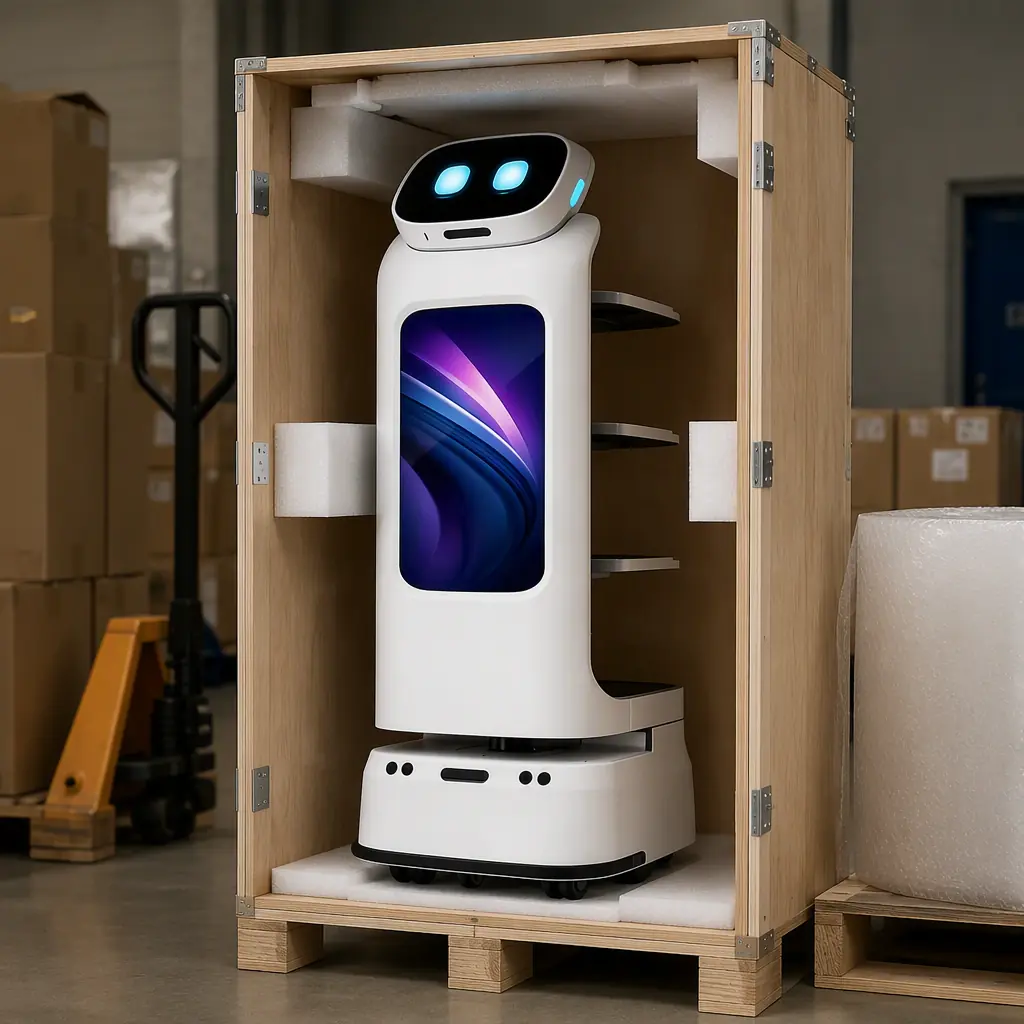
Freight & Logistics: Sea vs Air vs Rail
Freight mode trades cost against cash-flow time. For robots, the decision is usually sea vs air since rail is limited to the Eurasian land corridor.
- Sea (FCL/LCL) — cheapest on a cost-per-unit basis. A 20-ft container can hold roughly 40–60 compact delivery robots. Transit from Shenzhen to Rotterdam or Los Angeles runs 25–35 days.
- Air — fastest (3–7 days) but typically 3–5× the cost per kg. Suitable for a pilot unit or an urgent replacement when you need a robot this quarter, not next.
- Rail (China–Europe) — an intermediate option at 15–18 days, often cheaper than air and faster than sea, but only viable for EU-bound freight.
For a first-order pilot, air freight is worth the premium — see the pilot program guide on why a single test unit is better flown than shipped. For a scaled fleet, sea freight plus a local parts cache is the cost-correct play.
Total Landed Cost: A Worked Example
Enough theory — here is a real example. A buyer imports a single ship of 20 delivery robots from China to Europe. The figures below are representative and should be replaced with your quote, but the structure is the template.
| Cost component | Per-unit (USD) | Share of landed cost |
|---|---|---|
| FOB unit price (CADEBOT L100) | 6,800 | 76% |
| Sea freight (LCL, allocated) | 620 | 7% |
| Insurance (0.5% of CIF) | 34 | 0.4% |
| Duty (est. 3–5% on HS 8479.50) | 300 | 3% |
| VAT (20% EU, reclaimable) | 1,551 | 17% |
| Customs brokerage + handling | 180 | 2% |
| Landed cost per unit | ~9,485 | 100% |
Note that VAT is a large line but is usually reclaimable for a registered importer, so the true burden is lower than the headline. The non-reclaimable number (duty + freight + brokerage) is roughly 12–13% in this example. If you are comparing vendors, ask each to produce a landed-cost table with the same freight mode and duty basis.
Documentation Checklist
Clearance fails on paperwork more often than on tariff classification. Assemble these ten documents before the vessel arrives:
- Commercial invoice (matching the customs value)
- Packing list (weights, dimensions, packages)
- Bill of lading (sea) or air waybill
- Certificate of origin (COO) — matters for trade agreements
- CE / UKCA Declaration of Conformity
- Test reports (EMC, radio, safety)
- Insurance certificate
- Freight invoice
- Power of attorney for the customs broker
- Import licence or registration (where required, e.g. certain radio equipment)
A missing DoC or a value mismatch between the invoice and the packing list is the single most common cause of customs holds.
Duty & VAT by Region
Rates differ sharply by region, and trade agreements change them. Treat the table below as a planning aid, not a ruling — always confirm with a forwarder.
| Region | Duty (HS 8479.50, indicative) | VAT/GST | Key programme |
|---|---|---|---|
| EU | 0–3% | 17–27% | EU single market, CE required |
| US | 0–4.5% | Sales tax (state) | FCC + UL common |
| UK | 0–3% | 20% | UKCA |
| Middle East (GCC) | 0–5% | 5% (UAE) | Various |
| SEA (ASEAN) | 0–8% | GST varies | ACFTA possible |
Many manufacturing-origin goods qualify for preferential duty under agreements like ACFTA (ASEAN–China) or the EU's GSP if the product meets the origin rules. Ask the vendor for a COO that supports the agreement — a small administrative step that can cut duty to zero.
Working With a Freight Forwarder & Customs Broker
A good forwarder is worth their fee many times over. Look for one that:
- Handles DDP (delivered duty paid) or DAP terms, so the seller quotes you a landed price and you avoid clearance surprises.
- Has a broker relationship in your destination country and can pull your HS classification for you.
- Offers tracked, door-to-door quotes for a pilot unit.
For an expanded deployment, negotiate freight on a multi-site basis and coordinate delivery dates with your on-site acceptance testing schedule so the equipment is on the ground when the FAT/SAT window opens.
The Bottom Line
The robot that looks cheapest on the price sheet is not the cheapest once you land it. Model the full landed cost — freight mode, duty classification, VAT treatment, brokerage and compliance — before you commit, and score vendors on that number. Start with a flown pilot unit to de-risk, then scale on sea freight with a local parts stash. See the solutions page to map the right robot and doc set to your import programme.