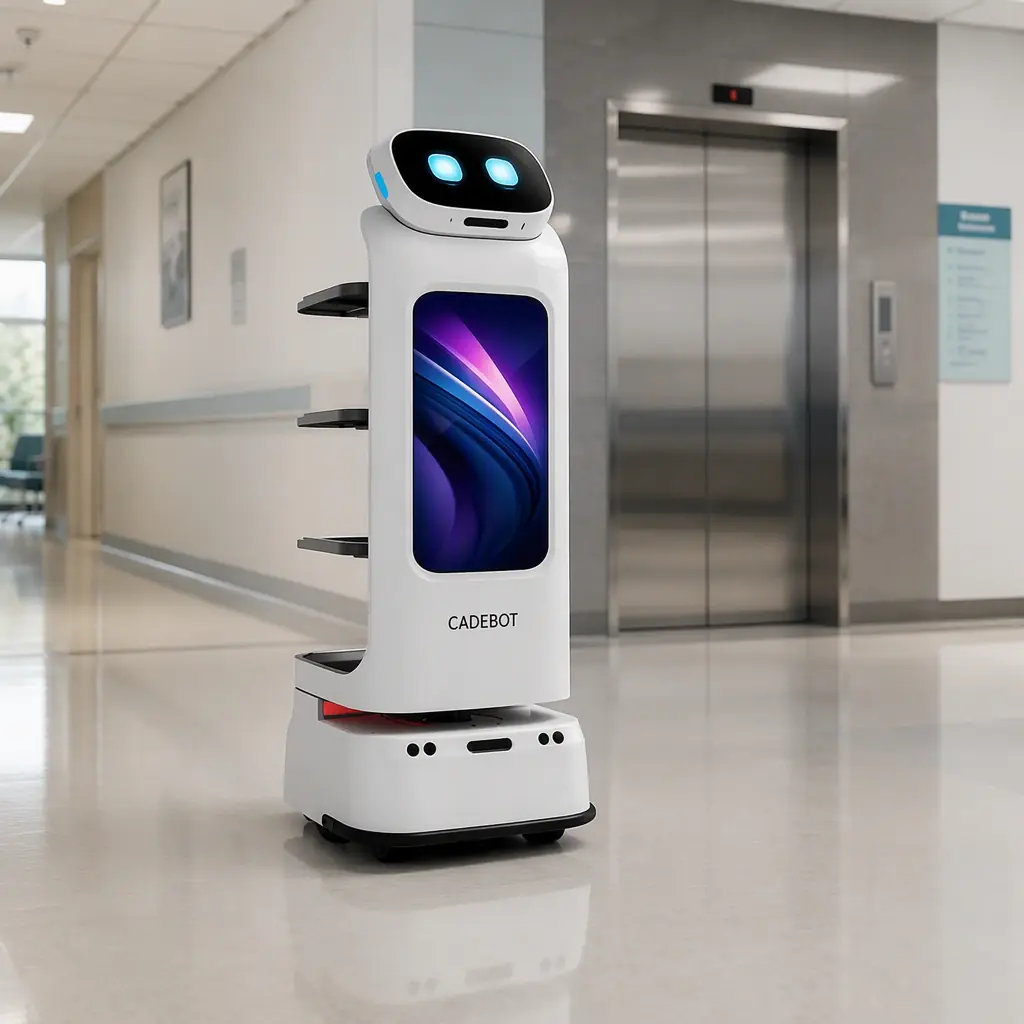
A 900-bed hospital in Guangzhou was considering a pneumatic tube system for its pharmacy, lab and kitchen deliveries. The system quote was over $400,000 for the central carrier network, plus annual maintenance. Then they tested two CADEBOT L100 delivery robots on the existing internal logistics route. The answer was not that the robots always win — it is that the two technologies solve different problems, and most facilities get this choice wrong by assuming the most expensive rail-based system is automatically the best. Choosing internal logistics automation is a routing problem, not a status problem.
The four options have very different cost and flexibility profiles. A conveyor is fixed, high-volume, and expensive to change. A pneumatic tube is the same but smaller. Manual carts are cheap and flexible but consume labor. A delivery robot is the middle of the spectrum: mobile, route-flexible, moderate throughput, and it replaces walking labor rather than marginalizing it. This guide gives you the comparison matrix and the decision rule.
The Four Internal Logistics Options Compared
Every facility moves things internally — samples, meds, meals, parts, documents, stock. The question is what moves them. Here is the honest comparison:
| Option | Capital cost | Route flexibility | Throughput | Labor impact | Best fit |
|---|---|---|---|---|---|
| Conveyor belt | Very high ($250k–$1M+) | None — fixed path | Very high, continuous | Replaces some labor | Fixed, high-volume, same-destination flows |
| Pneumatic tube | High ($150k–$500k+) | None | Medium, batched | Limited | Point-to-point small-item transport (hospitals) |
| Manual carts/carts | Low ($200–$2k each) | Full | Limited by labor | Heavy labor | Low volume, opportunistic, flexible |
| Delivery robot | Moderate ($20k–$60k each) | Full — re-route via software | Medium, on-demand | Replaces walking labor | Multi-destination, changing routes, hubs and spokes |
The key insight is the volume × route-flexibility trade. If your flow is high-volume and the destination never changes, a fixed system wins on throughput. If your flow is moderate and the destinations change daily — which is most facilities — a mobile robot wins because you can reprogram the route at zero capital cost.
Throughput Reality: Why Robots Don't Compete With Conveyors on Volume
A conveyor belt moves hundreds of items per hour continuously. No delivery robot matches that raw throughput, and the honest engineers will tell you so. The AMR vs AGV guide covers the difference between mobile robots and fixed guides in detail.
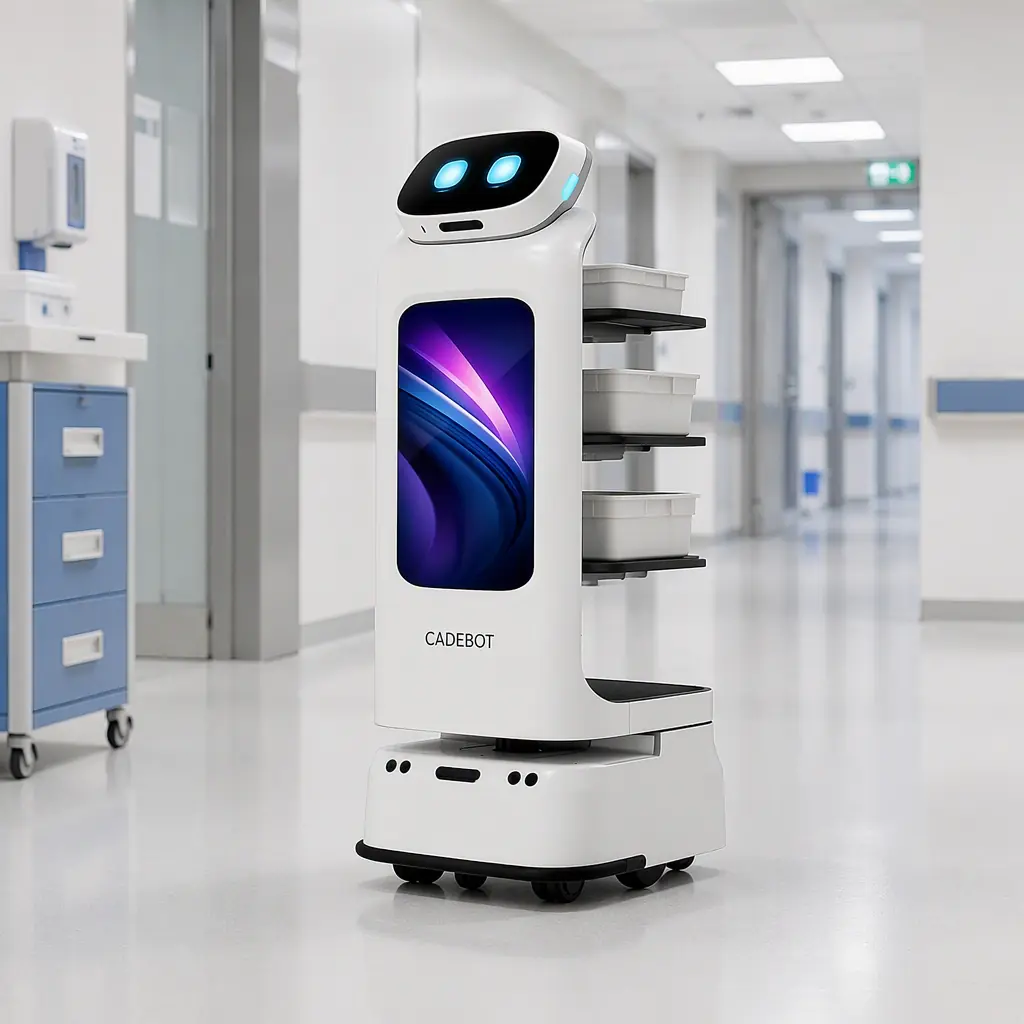
Reality check on a CADEBOT L100: it carries up to 40 kg across four tray layers on a 400 mm platform, moving at roughly 0.9–1.2 m/s. At a realistic 1.0–1.5 m/s (the AOMAN DOUBLE is spec'd at 0.9–1.5 m/s), a single robot moving between two floors might complete 12–18 one-way trips an hour depending on elevator wait and loading time. That is perhaps 25–50 kg of goods per hour, per robot.
The point: if you need to move 200 kg/hour continuously, you need a conveyor, not a robot. If you need to move 40 kg of samples to 12 different destinations across 6 floors, with routes that change every shift, a robot is dramatically more appropriate — because a conveyor can only service one fixed route and a pneumatic tube connects a fixed set of stations.
Where Delivery Robots Win: Route Flexibility and Multi-Destination
The strongest case for a delivery robot is when the network of destinations keeps changing. Consider a hospital: the pharmacy ships to the ICU, the OR, the ward, the lab and the ER — and the priority order changes hourly. A pneumatic tube serves fixed stations; if a new ward opens or a station moves, you re-plumb the system. A robot just receives a new route.
The hospital delivery logistics guide documents this exact pattern — the robot becomes a shared resource that can be reassigned when demand shifts. The same logic applies to a warehouse or logistics hub, where pick-and-pack routes change with every order wave.
The flexibility-multiplier: a mobile robot's route is software. Reprogramming it costs nothing. Re-routing a conveyor costs new hardware, new installation, often new civil works, and weeks of downtime. For any facility whose internal flows change quarterly or monthly — which is most of them — that flexibility alone is frequently the deciding factor.
Elevators, Doors, and the Building-Shared Infrastructure Question
This is where delivery robots differ most from a pneumatic tube or conveyor: a robot must share the building's elevators, doorways and corridors with people. The elevator integration guide explains the standards and the access-control requirements — your robot must request elevator service, and the elevator controller must grant it.
A useful operating constraint to model upfront:
- A robot needs elevator wait time added to each trip; peak-hour elevator contention can halve trips/hour.
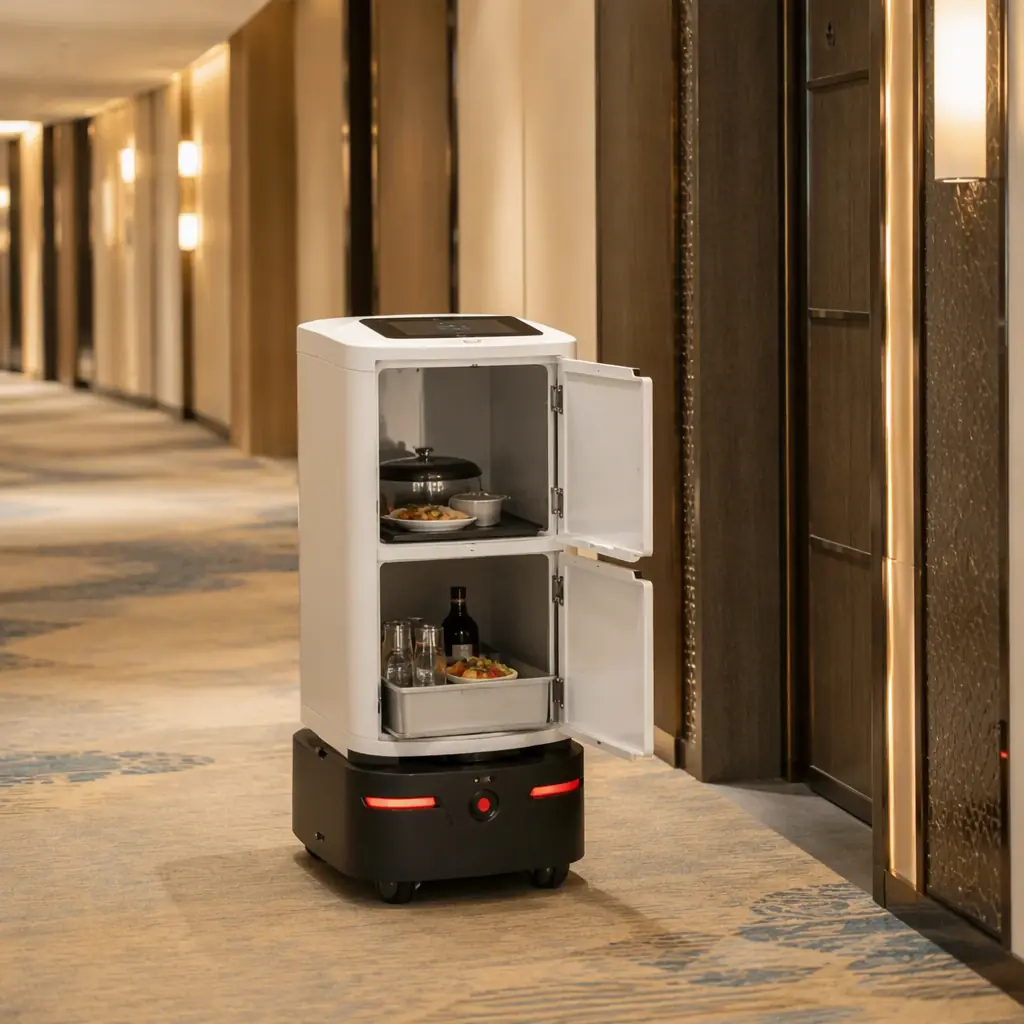
- A robot needs minimum passing width. The AOMAN DOUBLE has a 420 mm width and 55 cm minimum passing width, ascending a 13° slope and crossing a 25 mm hurdle, so it fits most existing corridors and even into an elevator without turning. But a 900 mm-wide cart or a fixed conveyor does not share the elevator at all — so in a building with constrained elevator capacity, a robot adds contention that a conveyor avoids.
- A robot needs consistent floor conditions for docking and navigation. Rough floors, loose mats, or heavy carpet can degrade navigation.
If your elevator is the bottleneck — a 4-stop building with a single car and heavy resident traffic — the elevator wait may dominate your cycle time, and a conveyor that bypasses elevators may be justified. Model this before you choose.
Cost per Trip: The Number That Decides It
Neither capital cost nor raw throughput alone answers the procurement question. The decisive metric is cost per completed trip. Here is a worked comparison for a mid-size facility making roughly 80 internal deliveries a day:
| Option | Annualized cost | Trips/day | Cost per trip (approx.) |
|---|---|---|---|
| Conveyor | $300,000 (capex amortized + maintenance) | 400 | $3.75 |
| Pneumatic tube | $160,000 | ~120 | $5.50 |
| Manual cart (2 staff) | $70,000 (loaded labor) | 80 | $3.70 |
| Two delivery robots | $56,000 (lease + power + service) | 80–120 | $2.10–$3.20 |
The robot edges out on cost per trip at the moderate volume the facility actually needs — because it carries no ongoing labor cost and its capital is relatively low. Manual carts look cheap per trip, but only because that per-trip cost is mostly labor that the ROI math has to account for hour by hour.
The rule: cost per trip is the denominator, and it rewards whichever option most closely matches your actual volume. Buy the capacity you need, not the capacity you can imagine flexing.
When to Still Choose a Conveyor or Pneumatic Tube
There are four cases where a fixed transport system genuinely beats a robot, and it is worth being direct about them:
- Extreme fixed volume. Continuous, same-destination, same-direction flow above ~200 kg/hour — a conveyor's throughput is unmatched.
- No elevator, no corridor access. A tube or chute may be the only thing that fits a tight vertical shaft.
- High-security or temperature-controlled continuous flow. Certain pharma or food lines require uninterrupted, enclosed transport that a shared robot cannot provide.
- You have zero floor space for a roaming robot and the delivery route is fully enclosed.
For every other case — and that is the majority of hospitals, hotels, offices, kitchens and warehouses — a delivery robot is the more cost-effective and more flexible choice.
Making the Call: A Simple Decision Rule
Step through this checklist and it will route you to the right answer in under five minutes:
- What is your peak throughput? Above ~200 kg/hour continuous, consider a conveyor. Below that, a robot can keep up.
- How many destinations? More than five, and they change regularly → robot. Two to three fixed stations → a tube or chute could work.
- Are elevators the bottleneck? If yes, weigh the wait time against a robot's routing flexibility.
- Does the flow need to be enclosed and continuous? If yes, a fixed transport system. If not, a robot.
- What is the loaded labor cost of your current manual cart system? If it is above $4,000/month per function, the robot case strengthens quickly.
For a hospital, the internal logistics automation decision tends to land on robots for anything that roams. For a courier or express hub, the delivery robot pattern is similar. For a kitchen or ghost kitchen, robots handle the last few meters that a conveyor cannot reach.
The Bottom Line
Internal transport is a portfolio decision, not a single-technology one. Most facilities do not have the continuous, fixed-volume flow that justifies a conveyor or pneumatic tube — they have moderate, changing, multi-destination flows that are a perfect match for an autonomous delivery robot that can also navigate elevators and corridors alongside staff.
Run the cost-per-trip math with your own throughput, elevator constraints, and loaded labor. The answer will almost always be a hybrid: keep the high-volume spine fixed where you have one, and put delivery robots on the roaming, high-variety routes where a fixed system cannot follow. To see the full delivery line and the dual-cabin configuration for heavy loads, take a look at the AOMAN DOUBLE alongside the CADEBOT, or explore the solutions page for a deployment-ready view.