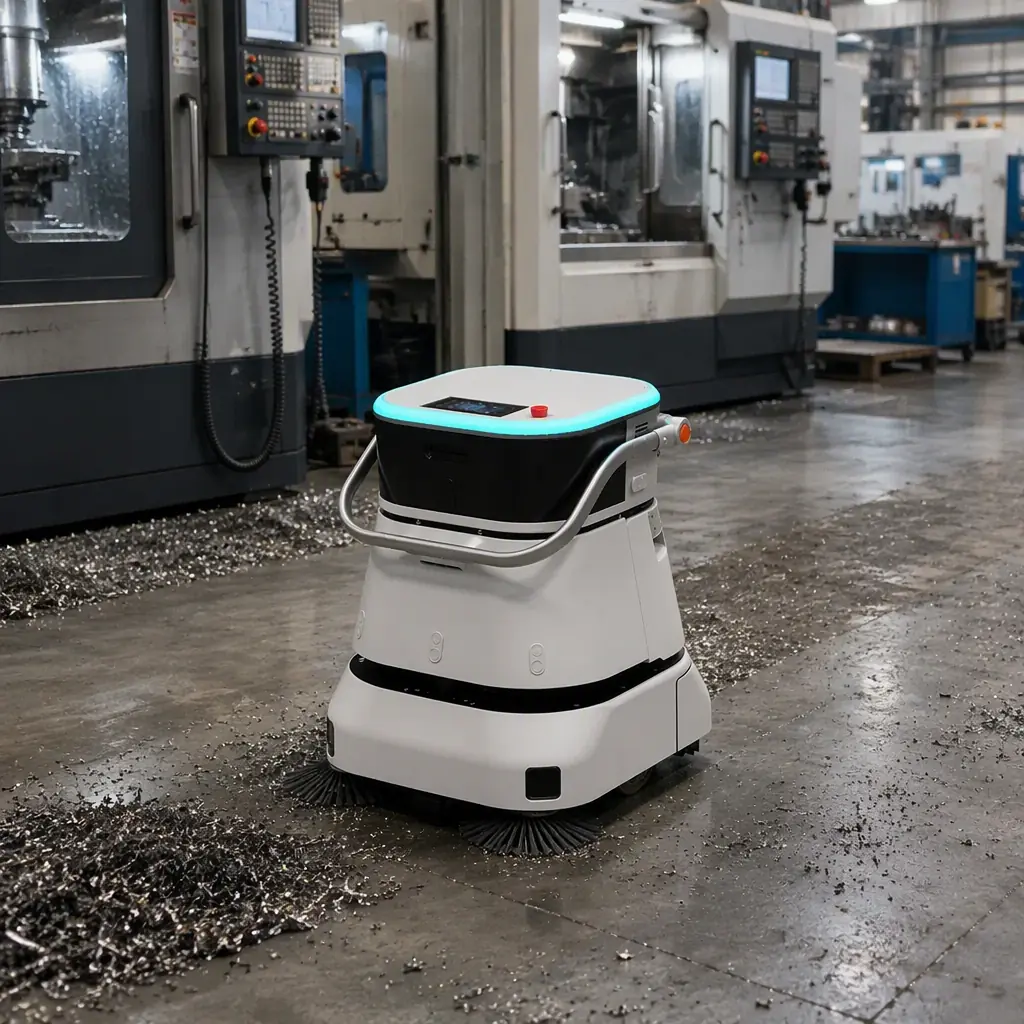
A 60-person metal fabrication shop in northwest Ohio runs 14 CNC machining cells, three welding bays and a 45,000 sq ft production floor. The shop's owner ran a stopwatch audit over two weeks in early 2026 and found the crew made 87 tool-crib trips per day — an average of 1.9 km walked per machinist per shift, or roughly 26 minutes of a $32/hour machinist's time spent walking instead of cutting metal. Annualized across the crew, the crib tax came to 2,150 hours. The audit's second finding was the floor: grinding cells produced an estimated 40 kg of swarf and metal fines per week, the shop logged two slip incidents in the trailing year, and one customer rejected a $38,000 machined component lot after finding embedded metal debris — traced to swarf tracked across the floor on a work boot.
Fabrication shops rarely think of themselves as automation candidates. The manufacturing service robot guide documents the pattern in larger plants; this guide covers the job-shop version, where the budget is tighter, the floor is messier and the two highest-value robot roles — crib-to-cell delivery and swarf-control floor care — map directly onto the two leaks the stopwatch audit found.
The Tool Crib Tax: Walk Time Is Machining Time
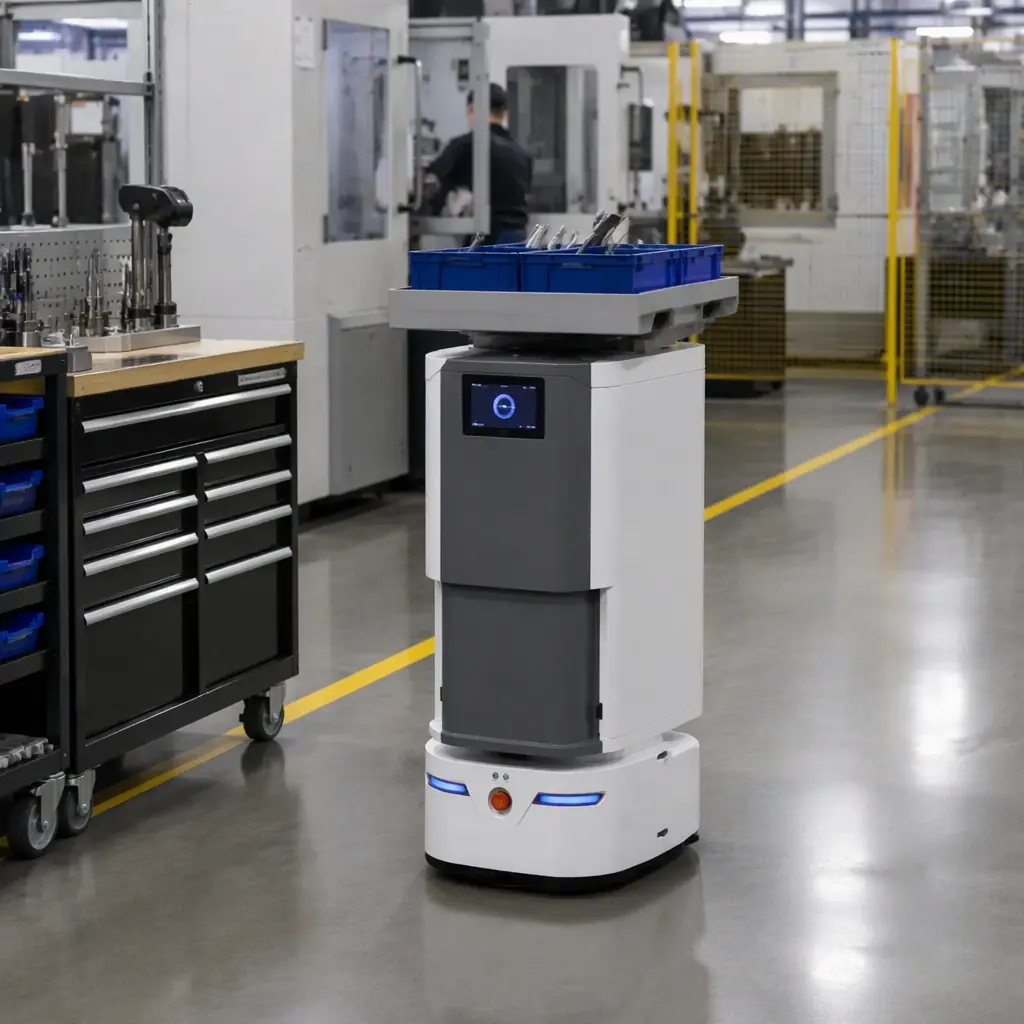
The tool crib in a fabrication shop is a gravity well for skilled time: inserts, drills, end mills, fixtures, calipers, welding consumables and fasteners all live there, and every cell operator visits it multiple times per shift. The Ohio shop's 87 daily trips are typical — a delivery robot selection guide benchmark across light-manufacturing audits puts the average at 60–110 crib trips per day for a 40–80 person shop — and the trips are worst at shift start, when every cell needs tooling at once and the crib becomes a queue.
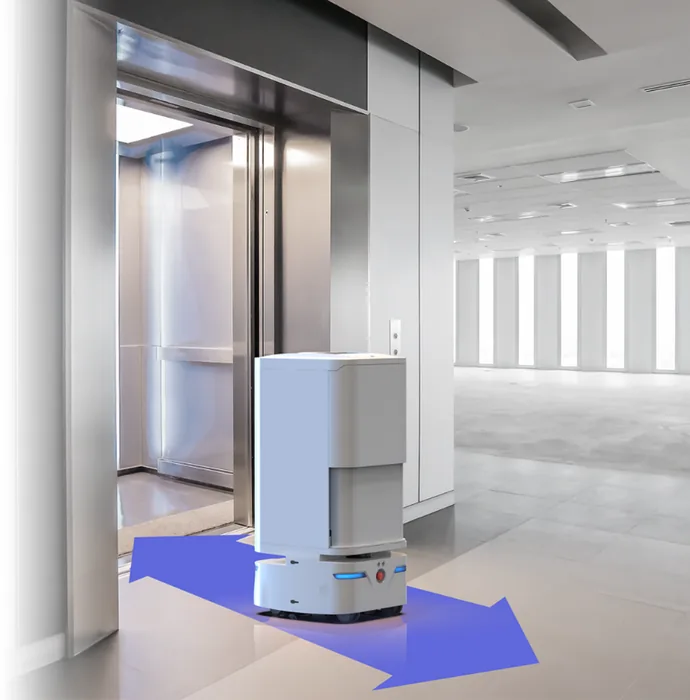
The AOMAN DOUBLE 70L delivery robot takes the crib-to-cell run: its 70L dual cabin (40L upper + 30L lower) carries insert boxes, drill sets and hardware kits from the crib to the cell, its 420 mm width clears the aisle between machines and workbenches, and its fingerprint-authenticated cabins keep calibrated tooling access-controlled — a genuine advantage in shops where tooling walks off the floor. The CADEBOT L100 covers the lighter kitting flow with four open tray shelves sized for insert trays and consumable totes. The AMR vs AGV guide explains why self-navigation matters in a shop: fabrication floors reorganize constantly — a new cell, a moved saw, a stock rack rearranged — and an AMR re-maps the changed layout in under an hour, where a guided vehicle needs re-laid tape and re-programmed waypoints.
The walk-time economics are the same ones quantified in the pharmacy guide: one delivery robot at $1,300–1,800 per month under a RaaS subscription returns roughly 90 minutes of machinist time per shift — about 375 hours per year at $32+/hour, which is $12,000+ of cutting time returned to the floor per robot.
Swarf Control: Floor Safety Is Part Quality, Part Liability
Swarf — the metal shavings, grinding dust and fines that accumulate around every cutting and grinding operation — is a fabrication shop's most persistent hazard. It is a slip hazard on the floor, a contamination source for finished parts (the Ohio shop's rejected $38,000 lot), and a fire-safety issue when aluminum or magnesium fines accumulate. The industry rule of thumb is that swarf should be collected at the source, but the floor between cells still accumulates it, and the clean-up window is always "after the shift" — which is when the debris has already been walked across the entire floor.
The compact floor-cleaning robot holds the swarf problem on a continuous, documented program. The CLEINBOT C2 Pro integrates scrubbing, vacuuming, mopping and sweeping in a single 503×503 mm platform, with 20 kPa maximum suction that lifts dry fines without the water-first sequence that smears grinding dust, and a 440 mm cleaning width at 500–800 m²/h that covers a 45,000 sq ft shop in about 2.5 hours — runnable between shifts and in low-traffic periods at ≤65 dB. Its 2D LiDAR plus structured-light navigation maps the shop's changing floor layout in real time, which matters in a fabrication environment where stock racks and work-in-progress move weekly. The commercial cleaning robot buyers guide covers the specification framework; the shop-specific design rule is to verify vacuum-first capability before piloting, because wet-scrub-first machines turn dry swarf into abrasive slurry.
Kit-to-Cell Logistics: The Tool Crib as a Dispatch Center
The highest-leverage workflow change in a fabrication shop is not the delivery itself — it is reorganizing the crib around kitting. Instead of each operator walking to the crib for individual items, the crib becomes a dispatch center: the kit for each job (inserts, tooling, fixtures, consumables, inspection tools) is assembled once at the crib and delivered to the cell on a schedule. This is the same pattern the vendor evaluation framework documents for larger plants, and it converts the delivery robot from a taxi into a pull-system enabler — the change management playbook covers the crew dynamic: machinists defend the robot within a week, because it is the first automation that gives them back their time at the spindle.
Deployment Math for a Fabrication Shop
| Shop size | Delivery fleet | Floor-care fleet | Monthly cost (RaaS) | Skilled hours returned |
|---|---|---|---|---|
| 15,000–30,000 sq ft | 1 × AOMAN DOUBLE | 1 × C2 Pro | $2,300–3,400 | 350–500/year |
| 30,000–80,000 sq ft | 2 × AOMAN DOUBLE + 1 × CADEBOT L100 | 1–2 × C2 Pro | $4,500–7,000 | 800–1,300/year |
| 80,000–200,000 sq ft | 3–5 delivery robots | 2–3 × C2 Pro / M79 | $8,000–14,000 | 1,800–3,200/year |
The budget planning framework walks through the full cost comparison, and the RaaS financing guide covers the subscription structure that fits shop cash flow — most fabrication shops start with one delivery robot and one floor-care robot, document the walk-time savings in their own stopwatch audit, and add capacity in year two. The safety standards guide covers the shop-floor safety case, and the multi-site deployment guide documents the pattern for shops with multiple facilities.
A fabrication shop's margin lives in spindle time and rework avoidance. The delivery robot returns the 2,150 hours the stopwatch audit found walking to the crib, and the floor-care robot holds the swarf problem that caused the slip incidents and the rejected lot — both on a documented schedule that becomes part of the shop's quality file. That is the automation pattern that fits a job shop's budget, and it starts with the same step every successful deployment starts with: a two-week audit of where the walking and the debris actually are.