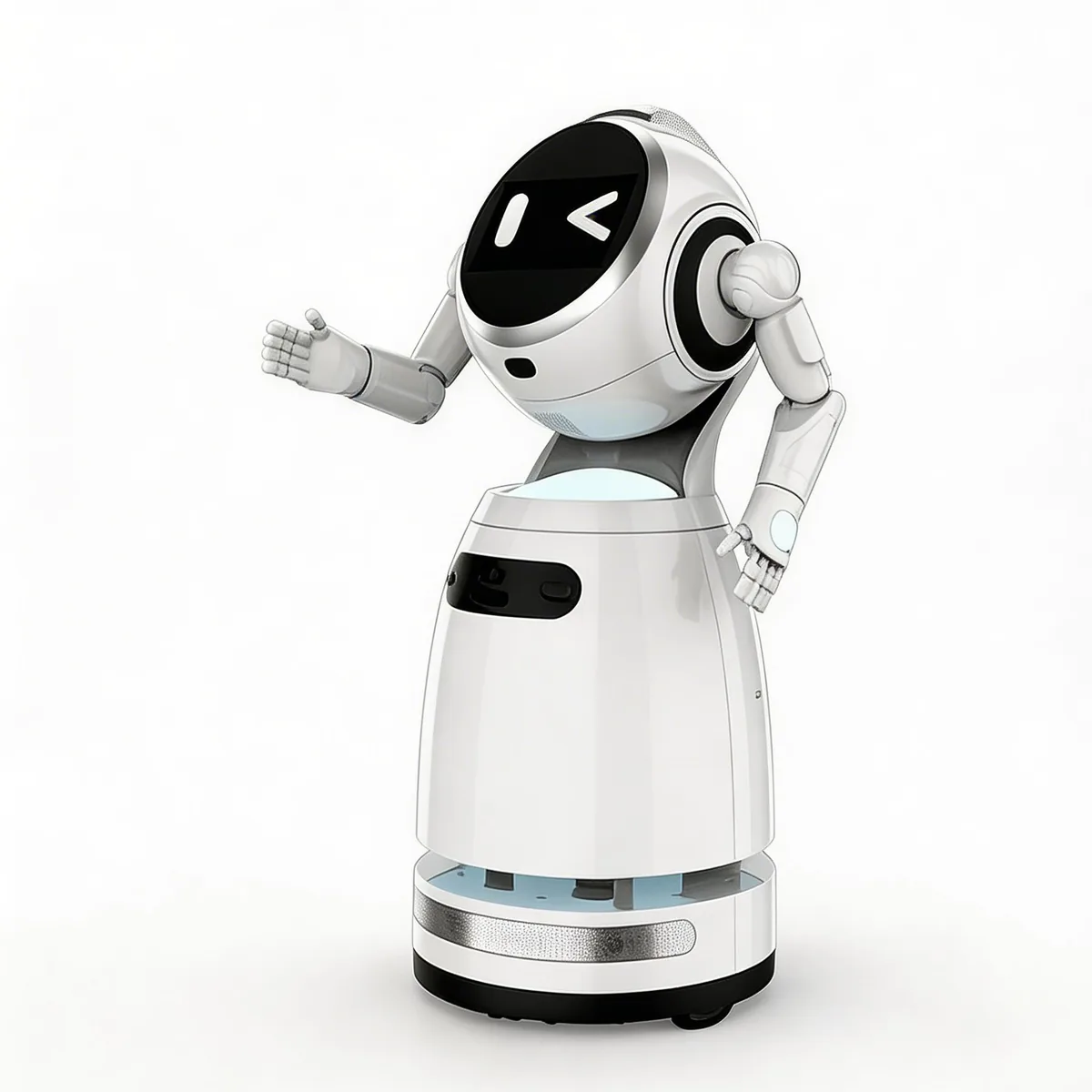
Libraries are undergoing a transformation that goes deeper than digitization. The modern library is simultaneously a study space, community hub, digital media lab, event venue, and information resource center. Patron expectations have expanded — visitors want the same intuitive, tech-enabled experience they get from the best retail and hospitality environments. Meanwhile, library staff are stretched across an ever-widening set of responsibilities.
Service robots are emerging as a practical answer to this challenge. Not replacing librarians — amplifying them. Handling the repetitive, directional, and logistical tasks so human staff can focus on what humans do best: reader advisory, research support, community programming, and collection curation.
Here's what library directors, campus facility planners, and municipal procurement teams need to know about deploying service robots in libraries in 2026.

Why Libraries? The Automation Case for Knowledge Spaces
Public and academic libraries share a specific set of operational characteristics that make them unusually well-suited to service robot deployment:
High visitor volume with repetitive queries. A mid-size public library branch serves 500–1,200 visitors daily. Front-desk staff field an average of 120 directional questions per shift — "Where's the children's section?", "Where's the restroom?", "What time does the computer lab close?" These are high-volume, low-complexity interactions that consume staff capacity without requiring professional expertise.
Complex physical layouts. University libraries span 50,000–300,000 square feet across multiple floors with specialized zones: reference, periodicals, special collections, study carrels, group study rooms, media labs, archives. First-time visitors spend an average of 6 minutes just orienting themselves. Staff spend another 5–8 minutes per directional query.
Collection management at scale. A university research library holds 500,000–5 million volumes. Shelf-reading — verifying that every book is in its correct LC (Library of Congress) call number position — is a continuous, labor-intensive task. A single mis-shelved book can be effectively "lost" for months until a manual shelf-read catches it.
Programming and event demands. Libraries host 300–1,200 events per year: story times, author readings, workshops, maker space sessions, exam-period extended hours. Each event requires wayfinding, crowd management, and information delivery — tasks that don't require a librarian's expertise but do consume their time.
Three Library Robot Deployment Models
1. Patron Guidance and Wayfinding
The highest-impact, fastest-ROI deployment for most libraries. A reception robot stationed at the library entrance greets visitors and provides interactive wayfinding.
How it works: The robot, positioned near the main entrance, uses voice interaction and a touchscreen to answer directional queries. A visitor asks "Where are the study rooms?" — the robot displays a floor map with the route highlighted and offers to escort them. For physical escort, the robot navigates autonomously to the destination, using SLAM-based mapping of the library's floor plan.
Voice and multilingual capability. Modern reception robots like the CRUZR support natural language interaction in 20+ languages. In a university library serving an international student body, this is transformative — a first-year international student who might hesitate to approach a busy reference desk can comfortably interact with a robot in their native language.
Measured impact (Singapore National Library, branch deployment):
| Metric | Before Robot | After Robot | Change |
|---|---|---|---|
| Directional queries handled by front desk | 580/day | 210/day | −64% |
| Average visitor orientation time | 5.8 min | 2.1 min | −64% |
| Front desk staff reclaimed time | — | 4.2 hours/day | — |
| Visitor satisfaction (directional help) | 3.8/5 | 4.6/5 | +21% |
Staff time reclaimed from directional work was redirected to reader advisory, collection development, and community programming — the high-value work that libraries exist to provide.
2. Collection Management: Shelf-Reading and Inventory
The most technically sophisticated library robot application. Shelf-reading robots autonomously navigate library stacks, scan RFID-tagged books on shelves, and identify items that are mis-shelved, missing, or out of sequence.
The shelf-reading problem. A library with 1 million volumes requires approximately 12,000 staff hours annually for complete shelf-reading — and even then, coverage is usually partial (high-use sections only). Between shelf-reads, an estimated 3–5% of volumes are mis-shelved at any given time. That's 30,000–50,000 "lost" books in a million-volume collection — books the catalog says are available but patrons can't find.
How RFID shelf-reading robots work. The robot traverses aisles with an RFID antenna array that reads tags at shelf level. Each tag has a unique ID linked to the item's call number in the ILS (Integrated Library System). The robot compares actual tag positions against expected call number order at up to 30,000 items per hour — roughly 10 times faster than human shelf-reading and with higher accuracy (99.2% vs. 92% for human readers after 2 hours, when fatigue degrades accuracy).
Data beyond inventory. Shelf-reading robots don't just find misplaced books — they generate collection usage data that transforms collection management:
- Which call number ranges have above-average browsing activity (based on displacement patterns)?
- Which sections have items that haven't moved in 12+ months (candidates for off-site storage)?
- Which shelves are over-capacity (items above the normal density threshold, suggesting weeding needed)?
University of Technology Sydney deployment (2024–2025):
| Metric | Pre-Deployment | Post-Deployment (6 months) |
|---|---|---|
| Full collection shelf-read cycle | 14 months | 8 days |
| Mis-shelved items found per cycle | 6,200 | 18,400 (first comprehensive scan) |
| "Claimed returned / not on shelf" resolution time | 11 days avg | 2.3 days avg |
| Staff hours redirected from shelf-reading | — | 2,800 hours/year |

3. Event Support and Community Engagement
Libraries host an extraordinary variety of programs: children's story time, teen coding clubs, adult literacy classes, author talks, citizenship preparation workshops, job search assistance, maker space orientations.
Reception and guidance robots serve as event ambassadors — positioned outside the event space, they display event information, answer FAQs, and direct late arrivals. For children's programming, the robot becomes part of the experience — telling stories, leading simple activities, and creating the kind of tech-enabled excitement that draws families to the library.
Library programming data (US public libraries, 2025):
- Average programs per library per year: 420
- Average attendance per program: 28 visitors
- Staff hours per program (planning + execution + cleanup): 5.2 hours
- Robot-assisted programs: staff hours reduced 38% (robot handles wayfinding, FAQs, attendance tracking)
Technology Integration: What Your ILS and Network Need
Library robots aren't standalone devices — they integrate with library systems:
ILS/LMS integration. The robot queries the Integrated Library System via API to answer "Where is this book?" queries in real-time. A patron asks for "The Great Gatsby" — the robot queries the ILS, confirms the item's location (call number, floor, shelf range), and provides navigation instructions or escort.
Library Wi-Fi requirements. Library robots require persistent Wi-Fi connectivity for ILS queries, cloud-based voice processing, and remote monitoring. Libraries with older Wi-Fi infrastructure (802.11n or earlier) may need an access point upgrade in the robot's operating area — budget $500–2,000 per floor for Wi-Fi 6 APs if needed.
Integration with room booking systems. For libraries with reservable study rooms, the robot can display real-time room availability, guide patrons to their booked room, and even trigger check-in upon arrival — reducing the "no-show and squatting" problem that plagues study room booking systems.
Privacy considerations. Library patron privacy is sacrosanct. Robots in libraries should:
- Process voice queries locally or via encrypted cloud with no query storage
- Never record or store patron conversations
- Not use facial recognition
- Log directional queries anonymously (count, not identity)
- Display clear signage indicating data handling practices
These are the same privacy standards applied to library computer terminals and digital services — extended to a new interaction modality.

Procurement Roadmap: From Assessment to Deployment
Phase 1: Needs Assessment (Weeks 1–2)
- Map visitor query types and volumes (2-week front desk log)
- Identify top 10 directional queries — these are your robot's primary use cases
- Audit current staffing: how many hours per week go to directional, logistical, and repetitive tasks?
- Survey staff attitudes toward automation (address concerns early)
Phase 2: Pilot Design (Weeks 3–4)
- Select a single deployment model (guidance robot at entrance is the lowest-risk starting point)
- Define success metrics: visitor query volume handled, staff time reclaimed, visitor satisfaction scores
- Map the robot's operating area and identify Wi-Fi dead zones
- Set up ILS API access for real-time catalog queries
Phase 3: 30-Day Pilot (Weeks 5–8)
- Deploy 1–2 robots with clear staff training and visitor communication
- Collect daily metrics: interactions handled, queries resolved, escalation rate
- Survey visitors at Day 15 and Day 30
- Review with staff: what's working, what needs adjustment
Phase 4: Scale Decision (Week 9)
- Analyze pilot data against success metrics
- If positive: plan fleet expansion (additional locations, additional robot types)
- If mixed: identify the friction points and address before scaling
- If negative: understand why — was it the robot, the workflow, the use case, or the implementation?
Budgeting benchmark: A single reception/guidance robot deployed in a library typically costs $750–1,200/month on a RaaS lease, including maintenance and software updates. Shelf-reading robots are $1,500–2,500/month due to the specialized RFID hardware. Compare against the cost of staff hours reclaimed: a librarian earning $60,000/year costs approximately $38/hour fully loaded. A robot that reclaims 15 hours of staff time per week pays for itself in 3–4 months.
For procurement teams new to service robotics, our RaaS financing guide compares lease, subscription, and purchase models with education-sector budget cycles in mind. Use our 12-point vendor evaluation framework to assess providers across technical, integration, and support dimensions. Library deployments benefit from the structured approach in our 30-60-90 day pilot program roadmap — start with one guidance robot in one branch before scaling.
For institutions considering robots across multiple campus functions, our multi-site deployment strategy guide covers the operational considerations of fleet management across distributed library branches. See also our higher education campus automation overview for complementary use cases in student services, facilities management, and campus safety.
The Library of 2030
The convergence of service robots, AI-powered discovery tools, and smart building infrastructure is reshaping what a library can be. Imagine walking into your local library in 2030: you're greeted by a robot that recognizes you're a first-time visitor (opt-in, privacy-preserving), asks what brings you in, and guides you to the relevant section. Need a study room? The robot checks availability, books it, and escorts you to the door. Meanwhile, shelf-reading robots have just finished their nightly scan — every one of the library's 1.2 million items is confirmed in correct position, and the morning report flags 47 items that need staff attention.
None of this replaces librarians. It liberates them — from directional queries, from shelf-reading drudgery, from repetitive event logistics. The librarian of 2030 spends their day doing what they trained for: reader advisory, research consultation, collection curation, community programming. The robots handle the rest.
For library directors planning 2026 budgets, service robots offer a practical path to higher patron satisfaction, better collection management, and more impactful staff work — without increasing headcount. The technology is deployed and documented in libraries worldwide. The question is whether your library wants to lead or follow.
Interested in library robot deployment? Our education and cultural institution solutions team provides consultation on use case selection, pilot design, and ILS integration for academic and public libraries of all sizes.
