Healthcare facilities worldwide are facing a staffing squeeze. The WHO estimates a shortfall of 10 million health workers by 2030. While robots won't replace nurses, they are proving uniquely capable of absorbing the non-clinical tasks that consume up to 40% of nursing time.
In 2026, healthcare robotics has moved from pilot programs to enterprise-wide deployments. Here are five applications delivering measurable results today.
Autonomous Medication and Specimen Transport
The most widely adopted healthcare robot application is autonomous transport. Every day, a 500-bed hospital generates approximately 2,500 internal transport requests — medications from pharmacy to ward, lab samples from ward to lab, meal trays, linens, and supplies.
The deployment model
Delivery robots like the CADEBOT L100 navigate hospital corridors autonomously, using lidar and depth cameras to avoid obstacles, operate elevators, and reach designated drop-off points. They carry up to 40 kg across multiple secure compartments with PIN-code access control.
Measured impact
- Nursing time reclaimed: A 2025 study at Shenzhen University Hospital found that robot transport eliminated an average of 73 minutes of walking time per nurse per shift
- Medication error reduction: Secure, compartmentalized delivery with digital chain-of-custody reduces wrong-ward errors by 62%
- Turnaround time: Lab sample transport time dropped from 35 minutes (pneumatic tube + manual handling) to 12 minutes (direct robot delivery)
Clinical-Grade Autonomous Disinfection
Hospital-acquired infections (HAIs) affect 7% of patients in developed countries and 15% in developing countries. Manual cleaning is inconsistent — a 2024 audit found that only 34% of high-touch surfaces in ICU rooms were cleaned to protocol.
How cleaning robots work
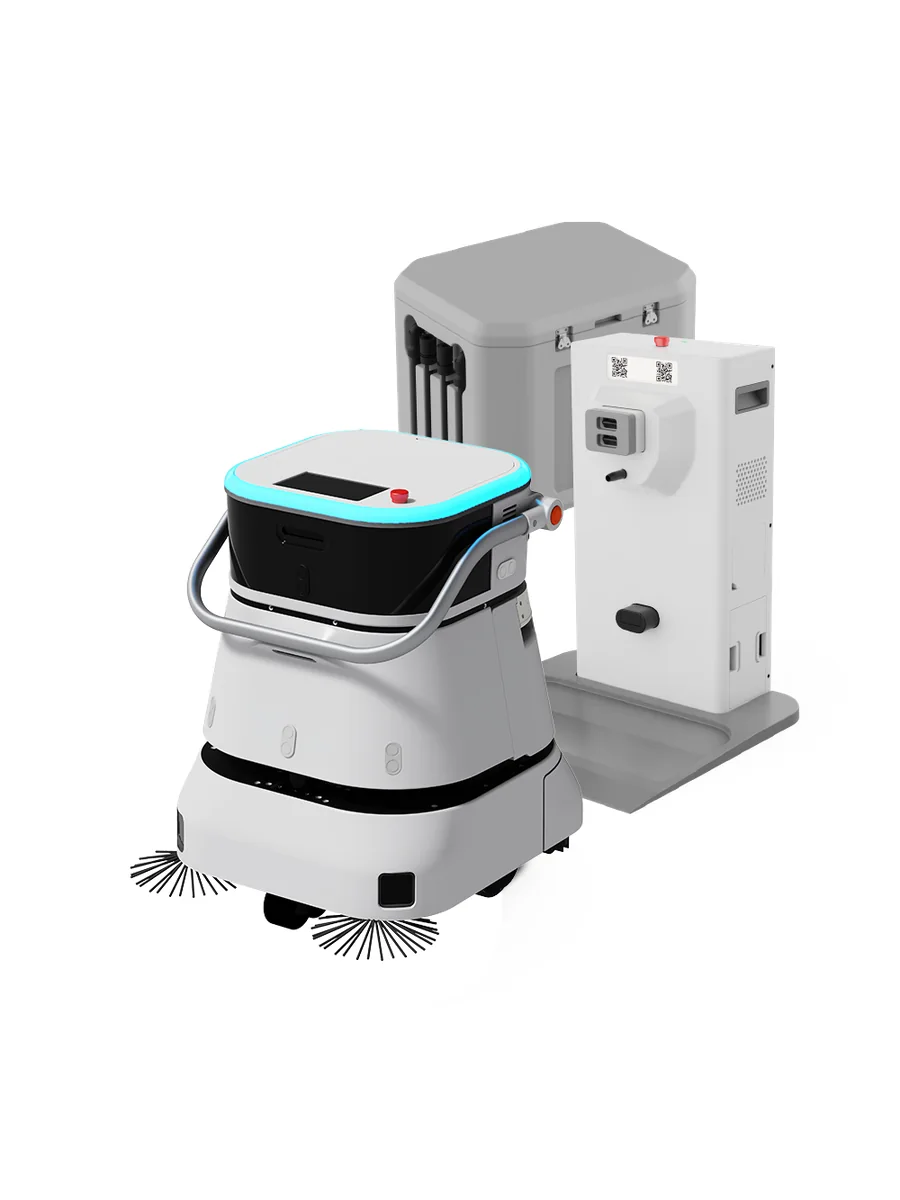
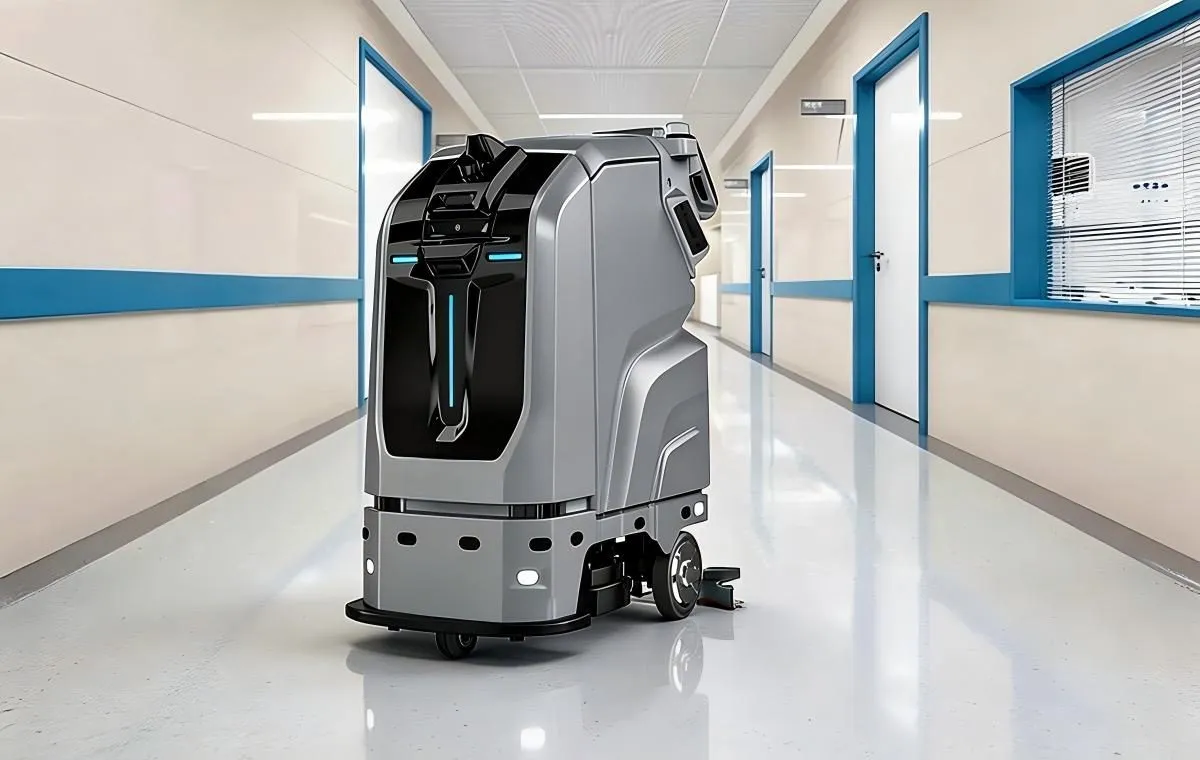
Robots like the CLEINBOT C2 Pro and CLEINBOT M79 combine autonomous navigation with multi-mode disinfection:
- Coverage: 2,000–3,000 m² per shift for open areas (corridors, waiting rooms)
- Methods: Microfiber scrubbing + optional UV-C sterilization + HEPA filtration
- Verification: ATP surface testing confirms disinfection levels post-cleaning
- Scheduling: Programmed to clean overnight or between procedures, with auto-return to docking station for water exchange and charging
The compliance advantage
The key differentiator from manual cleaning is verifiable consistency. Cleaning robots log every square meter cleaned with timestamps, water temperature, and chemical concentration data — creating an audit trail for infection control compliance that manual processes cannot match.
Patient Guidance and Wayfinding
Large hospital campuses are notoriously difficult to navigate. An estimated 30% of first-time visitors and outpatients ask for directions at least once — each interaction consuming 2–3 minutes of staff time.
Humanoid service robots like CRUZR are deployed in hospital lobbies and outpatient wings to:
- Escort patients to specific departments and consultation rooms
- Provide multi-language wayfinding for international patients
- Answer common pre-appointment questions (fasting requirements, document checklist)
- Display wait times and queue status for outpatient clinics
One 800-bed hospital in Guangzhou reported that CRUZR handled 280–350 wayfinding interactions daily, equivalent to 1.2 FTE of volunteer coordination time.
Secure Waste and Linen Logistics
Hospitals generate 0.5 kg of hazardous waste per bed per day, plus regulated medical waste requiring chain-of-custody tracking. Autonomous robots handle:
- Soiled linen transport: Sealed compartment robots move soiled linen from wards to collection points without cross-contamination risk
- Regulated medical waste: PIN-secured compartments with digital handover records
- Sterile supply delivery: OR-ready instrument trays delivered just-in-time from sterile processing
What to Evaluate Before Deploying
Infrastructure readiness
- Elevator integration: Robots need VDV (vertical delivery vehicle) communication to call and ride elevators autonomously. Most modern elevator systems support this via BACnet or Modbus protocols
- Door access: Automatic doors with motion sensors work best; retrofitting manual doors with actuators adds deployment cost
- Wi-Fi and 5G: Seamless connectivity across all operational zones is non-negotiable. Conduct a site survey before deployment
Infection control compliance
- Robots deployed in clinical zones should have smooth, sealed surfaces compatible with hospital-grade disinfectants
- HEPA-filtered models (H13 or higher) are recommended for operating room corridors and ICU zones
- ISO 13482 certification covers personal care robot safety requirements
Staff adoption
The most successful healthcare robot deployments designate a "robot coordinator" per shift — a staff member who handles battery swaps, cleaning, and troubleshooting. Facilities that invest 4–8 hours in staff training see 3× higher utilization rates in the first month.
The Bottom Line
Healthcare service robots are no longer a futuristic concept. They are delivering measurable ROI — not by replacing clinical staff, but by absorbing the logistics, cleaning, and wayfinding tasks that pull clinicians away from patient care.
For hospital administrators evaluating automation, the recommended approach matches hospitality: start with one application (transport or disinfection), measure impact over 90 days, then expand. AOMAN FUTURE provides on-site pilots and feasibility assessments for healthcare facilities considering robotic deployment.
Contact us to schedule a healthcare automation consultation.